Intercom
 Shopify
 Stripe
 Slack
Slack Notion
 Google Workspace
 Confluence

Gupshup AI: The Complete Guide (2026)


Gupshup builds AI agents for sales, marketing, and support conversations across WhatsApp, Instagram, SMS, and RCS, and unlike most vendors in this guide series, it publishes its actual per-message rate on a public page. This guide covers what the platform does, exactly what it costs, the real customer results available, and how it compares to Infobip.

We build AI agents for customer service ourselves, for teams running an existing help desk, so treat this as an outside look at a neighboring category.
What is Gupshup?
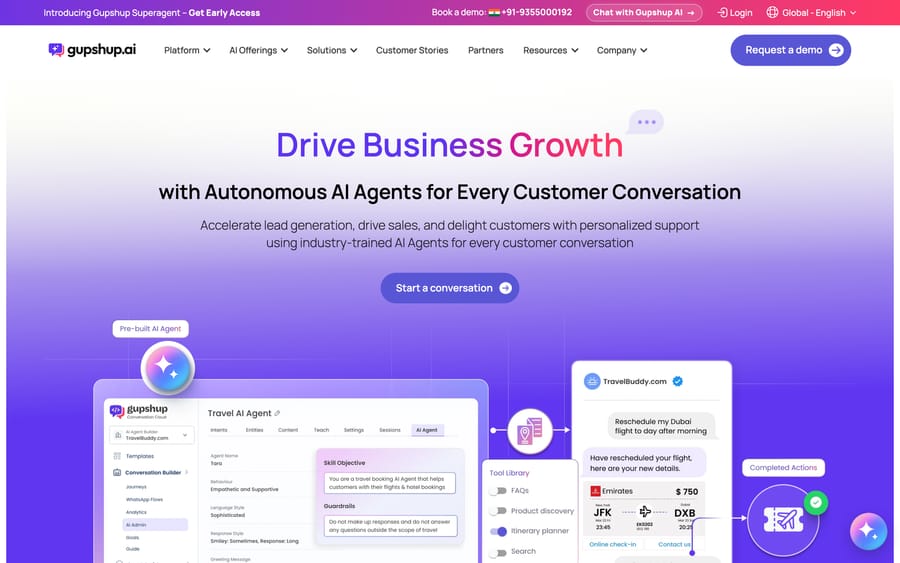
Gupshup is a conversational AI platform for marketing, commerce, and support automation, built on top of a messaging infrastructure business that's been operating since 2014 (its own site also describes "20+ years operations in the communications space," so treat the exact founding year as approximate). Beerud Sheth is named as co-founder and CEO. The company says it serves 50,000-plus businesses across 130-plus countries, handling 120 billion conversations annually through a roughly 900-person team across 12 offices, and it raised more than $60 million in a July 2025 round backed by Fidelity, Accel, Helion Venture Partners, and Tiger Global, among others.
Named customers span a genuinely large range of recognizable brands: Netflix, HSBC, Unilever, Disney, Flipkart, Standard Chartered, Axis Bank, OYO, and Rajasthan Royals all appear on its site.
How Gupshup's AI works
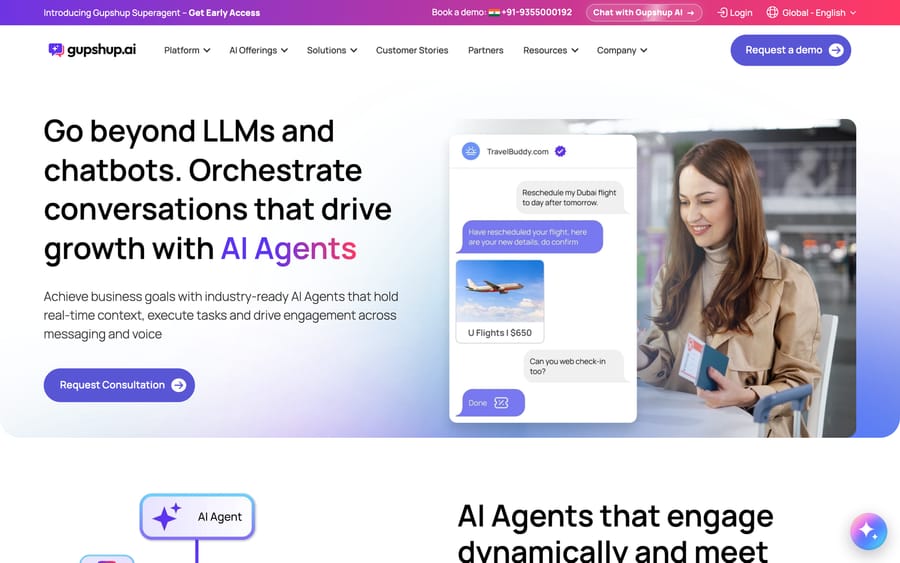
Gupshup's AI Agent Builder lets a business configure an agent's behavior, response style, and guardrails directly, an example on its own site shows a travel-booking agent named "Tara" with an explicit guardrail: "Do not make up responses and do not answer any questions outside the scope of travel." Agents connect to a Tool Library (itinerary planning, product discovery, FAQs) that determines what actions they can actually take beyond replying, and the underlying model is Gupshup's own proprietary ACE LLM, though the platform can route to other models too. A separate AI Co-Pilot product assists human agents with suggested responses and conversation summarization, and escalation to a human is built in for anything the agent can't resolve.
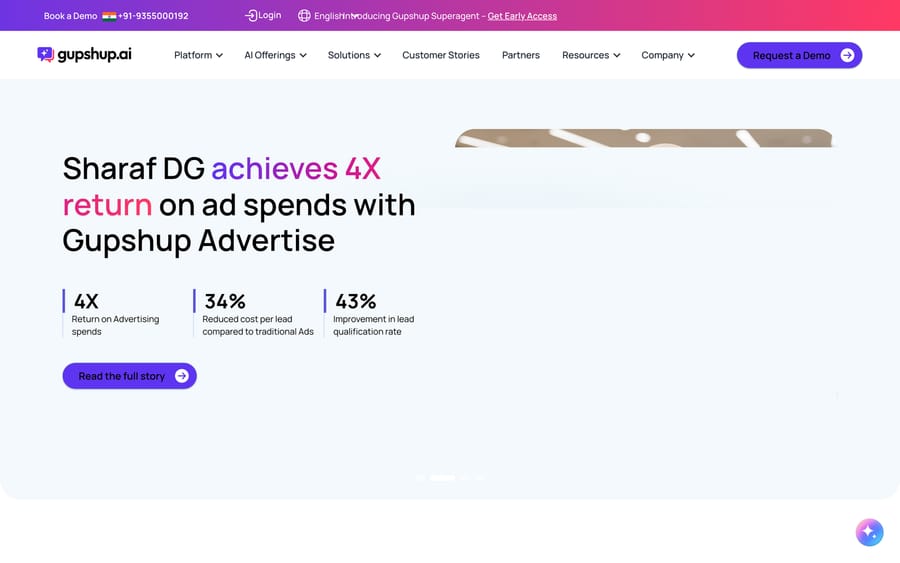
The clearest published result is Tonik Bank: the case study reports $20 million in expected cost savings over three years, 95% AI accuracy, and 4.3 times higher customer care productivity. Sharaf DG reports a 4x return on ad spend, a 34% reduction in cost per lead, and a 43% improvement in lead qualification rate using Gupshup's advertising product specifically, separate from its support AI agents.
Key features
- AI Agent Builder with configurable skill objectives, guardrails, and a tool library for real actions, not just replies.
- ACE LLM, Gupshup's proprietary model, with the option to route to other models.
- AI Co-Pilot for human agents: suggested responses and conversation summarization.
- Omnichannel messaging: WhatsApp, Instagram, SMS, and RCS from one platform.
- Automated, event-triggered campaigns for marketing and lifecycle use cases, separate from the support-facing agents.
Gupshup pricing
Gupshup publishes its self-serve WhatsApp API pricing directly, which is unusual for a vendor this large.
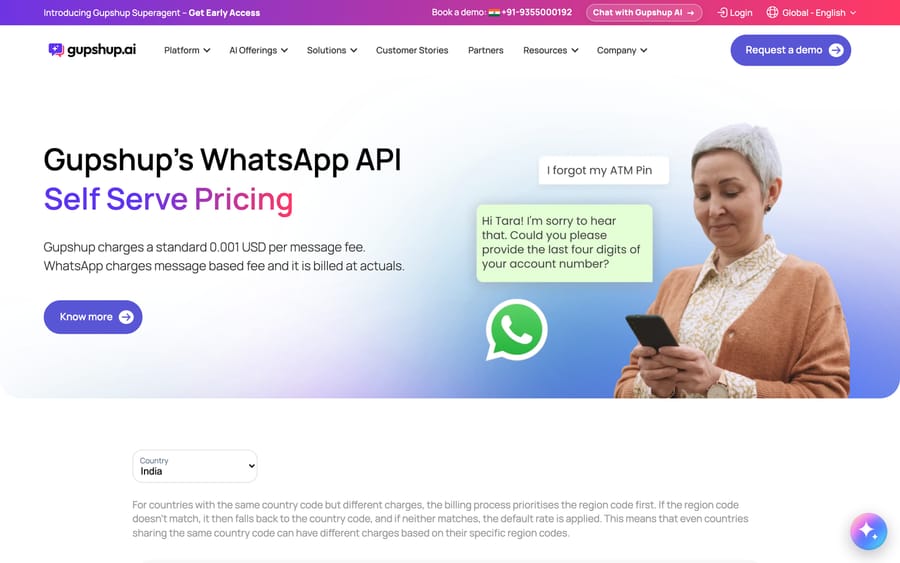
The platform fee is flat and simple: $0.001 per message for both template (outgoing) and session messages, whether incoming or outgoing, media above 64KB is free of Gupshup's own fee, and voice calls run $0.0001 per second. On top of that, WhatsApp itself charges a separate, per-category fee ("billed at actuals"), which the page notes varies by country and by message type (marketing, utility, authentication, service), and Meta's own per-message pricing changes flow through directly. Enterprise features and volume pricing exist beyond the self-serve plan but require contacting sales.
The incentive behind separating the two fees
Splitting "Gupshup's fee" from "WhatsApp's fee" on the same page is worth naming directly: it lets Gupshup keep its own margin visible and flat ($0.001, unchanged regardless of message category) while WhatsApp's fee, the part Gupshup doesn't control and can't discount, moves independently based on Meta's own pricing changes. That's more honest than bundling both into one blended per-message rate that quietly absorbs whatever Meta changes next, but it also means your real cost per conversation depends on a fee Gupshup doesn't set and can't promise won't move.
Real customer evidence, since third-party reviews were out of reach
We tried G2 for a rating and it blocked the request, and Vendr has no listing for Gupshup at all. This session's WebSearch budget was exhausted before a cached fallback could be tried. What's verifiable instead: Britannia's Prabakaran K, Head - Digital Center of Excellence, is quoted directly: "With WhatsApp, we brought Choco Stars to life in a way that felt truly personal." Carl ZEISS's Suresh Gandhi, Lead, Digital Marketing, is quoted on the challenge of fragmented consumer preferences that led them to Gupshup. These are vendor-published case studies, not independent reviews, and we're labeling them as such.
Pros and cons
Pros
- A genuinely published, flat per-message platform fee, rare for a vendor operating at Gupshup's scale.
- Real named enterprise customers (Netflix, HSBC, Unilever, Disney) rather than only SMB logos.
- A specific, configurable agent architecture (skill objectives, guardrails, tool library) shown transparently on the marketing site itself.
- Honest separation of Gupshup's own fee from WhatsApp's pass-through fee, instead of one blended number.
Cons
- No accessible third-party review data (G2 blocked, no Vendr listing) at the time of this research.
- Founding and history details on Gupshup's own site are slightly inconsistent ("since 2014" versus "20+ years"), and we couldn't independently resolve which is precise.
- The WhatsApp pass-through fee varies by country and category and isn't fully in Gupshup's control, so total cost per message isn't fully predictable from Gupshup's page alone.
- Enterprise-tier AI agent pricing (beyond self-serve WhatsApp API) isn't published and requires a sales conversation.
Who Gupshup is best for
Gupshup fits businesses that already run high-volume WhatsApp, Instagram, or SMS messaging for sales and marketing and want to add AI agents for support or lead qualification on the same platform, particularly if transparent, flat per-message pricing on the core API matters to the evaluation. Its enterprise customer roster suggests it scales to large, multi-market brands as well as smaller self-serve users.
It's the wrong fit if you need a fully predictable, single all-in-one rate, since WhatsApp's own pass-through fee still varies by market. It's also the wrong tool if your actual bottleneck is a support team's ticket backlog inside a help desk. That's a help-desk automation problem, priced and built differently.
Gupshup AI vs alternatives
| Gupshup | Infobip | Macha | |
|---|---|---|---|
| Model | AI agents plus omnichannel messaging (WhatsApp, Instagram, SMS, RCS) | CPaaS platform with messaging AI across SMS, WhatsApp, Viber, email, voice | AI agent layer on your existing help desk |
| Best for | Businesses wanting flat, published per-message platform fees | Enterprises wanting one platform across many programmable channels | Support teams on Zendesk, Freshdesk, Front, or Gorgias |
| Pricing | Published: $0.001/message platform fee, plus WhatsApp's pass-through fee | Not published; interactive calculator behind sign-up or demo | From $299/mo for 750 tickets (~$0.40/ticket), published |
| Reviews | Not accessible at time of research | See our Kore.ai guide for a related conversational AI comparison | N/A (new category on G2) |
| Self-serve trial | Yes, self-serve WhatsApp API plan | Yes, "Try for free" | $50 of free usage, no credit card |
| Setup | Self-serve for WhatsApp API; enterprise deployment for full AI agents | Self-serve or enterprise deployment with Infobip's team | Built, tested and monitored by the Macha team |
| Replaces your help desk? | Not applicable; not a help desk product | Not applicable; not a help desk product | No, it deliberately augments it |
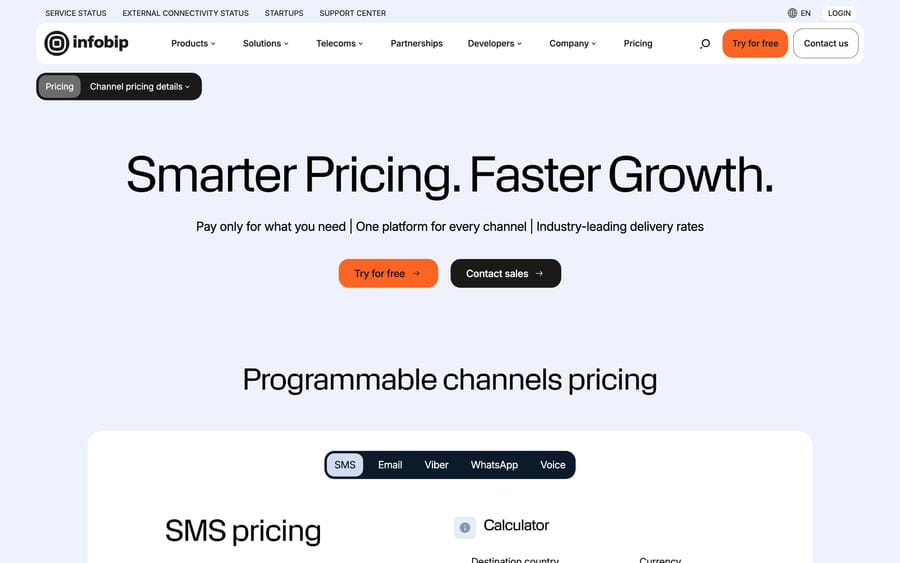
Infobip is the closer comparison on scope: both are messaging-first platforms that layered AI agents on top of an existing CPaaS business, and both cover WhatsApp alongside several other channels. The pricing approach differs: Gupshup states its $0.001 platform fee directly in text on the page, while Infobip's detailed rates sit behind an interactive calculator you have to work through channel by channel. If you want the number in five seconds rather than five clicks, that's the practical difference.
Neither company solves a support team's ticket backlog, which is a separate problem. If your bottleneck is email and chat tickets, Macha runs as an agent layer on top of the help desk you already use, with one published rate per ticket.
How we researched this
We pulled product and pricing claims directly from gupshup.ai (home, /pricing, /resources/case-studies, /ai-agents, and /about-us), fetched 2026-09-17; the .io domain redirects here. G2's Gupshup page returned a 403 on direct fetch, and Vendr's marketplace has no Gupshup listing (404); this session's WebSearch budget was used up before a cached-search fallback could be tried, so this guide relies on Gupshup's own named case studies for customer evidence rather than an independent rating. Infobip's pricing page was fetched directly.
FAQ
What is Gupshup AI? An AI agent platform for sales, marketing, and support conversations across WhatsApp, Instagram, SMS, and RCS, built by Gupshup, a messaging infrastructure company operating since roughly 2014.
How much does Gupshup cost? Its self-serve WhatsApp API charges a flat $0.001 per message as Gupshup's own fee, plus a separate WhatsApp pass-through fee that varies by country and message category. Enterprise AI agent pricing beyond that isn't published.
Is Gupshup good, based on reviews? We couldn't access G2 for a rating during this research, and Vendr has no listing for Gupshup. What's verifiable is Gupshup's own case studies, including Tonik Bank reporting $20 million in expected savings over three years.
Does Gupshup offer a free trial? Yes, for the self-serve WhatsApp API plan. Full enterprise AI agent deployments go through a sales conversation.
What model powers Gupshup's AI agents? Gupshup's own proprietary ACE LLM, with the option to route to other models depending on the use case.
What are good alternatives to Gupshup? Infobip is the closer comparison, also a messaging-first CPaaS platform with AI agents layered on top, though its detailed pricing sits behind an interactive calculator rather than stated directly. Neither is a fit for a support team's ticket backlog, which is a help-desk automation problem instead.
Who are Gupshup's named customers? Netflix, HSBC, Unilever, Disney, Flipkart, Standard Chartered, Axis Bank, OYO, and Rajasthan Royals appear on its site, with Tonik Bank, Sharaf DG, Britannia, and Carl ZEISS providing detailed case studies.
If your actual bottleneck is a support team's ticket queue rather than sales and marketing messaging, see how Macha's pricing works or start a trial.
Sources: Gupshup, Gupshup pricing, Gupshup - Customer Stories, Gupshup - AI Agents, Gupshup - About Us, Infobip pricing, G2 - Gupshup reviews (blocks automated fetches).
Resolve tickets automatically with AI agents
Macha's AI agents work on top of the help desk you already use — no code.