Intercom
 Shopify
 Stripe
 Slack
Slack Notion
 Google Workspace
 Confluence

Letterbook Explained: What It Automates and Where It Stops (2026)


Letterbook is a small, YC-backed AI-native help desk that positions itself as a direct replacement for Zendesk, Freshdesk, Help Scout, and Intercom, built by a two-person team. This guide covers exactly what it automates, how setup actually works, its real published pricing, where it stops without a human, and who it suits, based on the vendor's own site.

We build AI agents for customer service ourselves, and Letterbook isn't a platform we compete with directly in the way this guide will explain. One correction up front: the domain most searches turn up for "letterbook" is letterbook.com, which we checked and is an unrelated open-source project, not this company. The real site is letterbook.ai, and everything below comes from there.
What Letterbook does
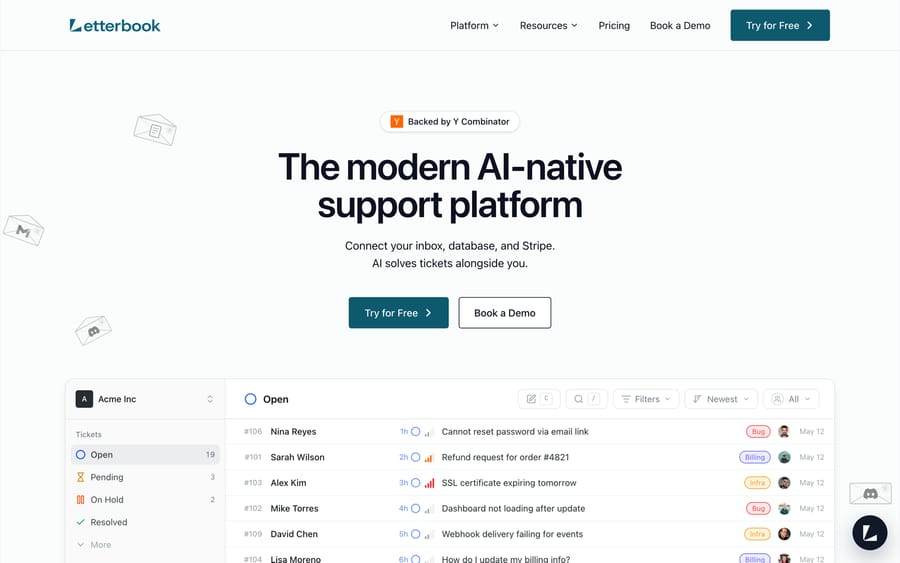
Letterbook's own pitch is direct: "Connect your inbox, database, and Stripe. AI solves tickets alongside you." The AI agent pulls in context from a connected database and payment system, then drafts or resolves tickets a human reviews, cutting out the manual order or subscription lookup an agent would otherwise do in a separate tab. Per Y Combinator's own company page, Letterbook was founded by Dawson Chen and Ethan Hou (Letterbook's own site doesn't name its founders directly), who previously built an AI personal assistant called Martin that reportedly reached 100,000 users, a hedged, third-party-reported figure rather than one Letterbook itself states.
The product covers ticket intake from email, API-created tickets, Discord, and web forms, auto-triage and labeling, a hosted customer help center, and analytics on ticket volume and resolution. It's aimed squarely at fast-growing startups, per Y Combinator's own description, with several companies in the YC network reportedly replacing Intercom, Zendesk, Zoho Desk, Help Scout, or Freshdesk with it.
How to set up Letterbook
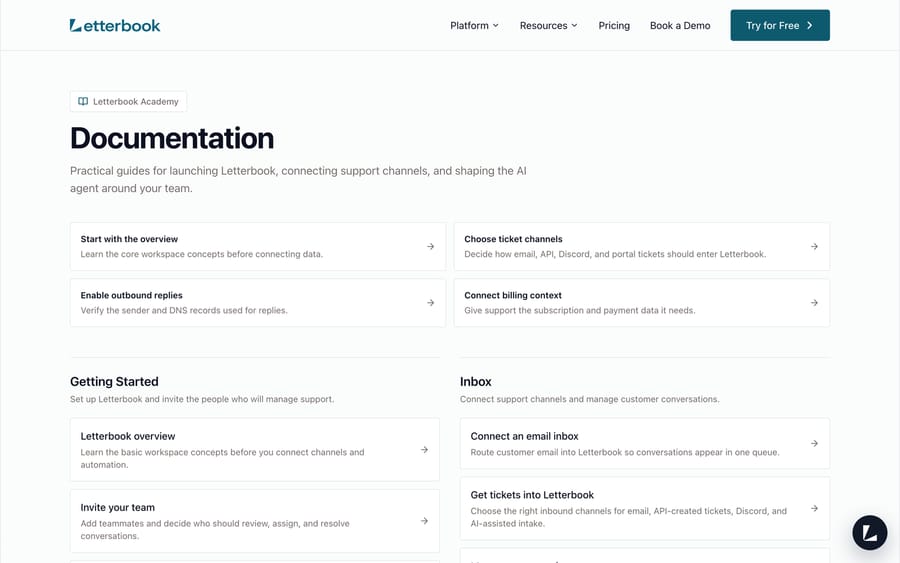
Letterbook's own site claims a specific setup sequence: connecting support channels takes about 5 minutes, integrating a database and payment system takes about 10 minutes, and reviewing and solving the first ticket is the final step, for a stated 15 minutes to launch. That's fast next to a legacy help desk's implementation timeline, and it's a believable claim for the connection step specifically, since OAuth-style integrations to email, Discord, and Stripe are genuinely quick to wire up.
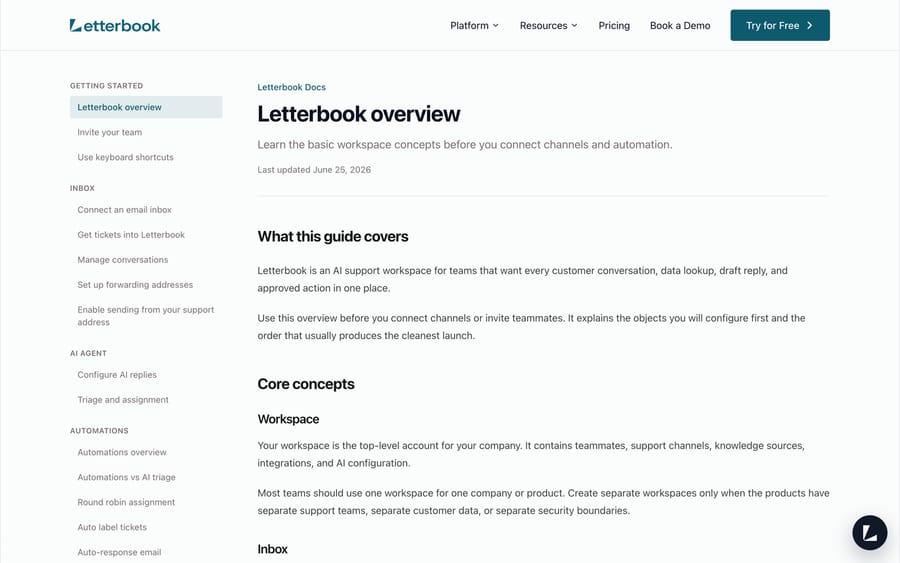
Per Letterbook's own documentation, the practical setup order is: understand the core workspace concepts first, invite the team, connect an email inbox and any other ticket channels, then configure AI replies and triage rules, and separately connect billing context so the AI can act on subscription and payment data. The 15-minute framing covers the mechanical connection steps; writing AI reply guardrails a team actually trusts with live customers, the same tuning period every AI agent needs, happens after that initial connection.
What Letterbook costs
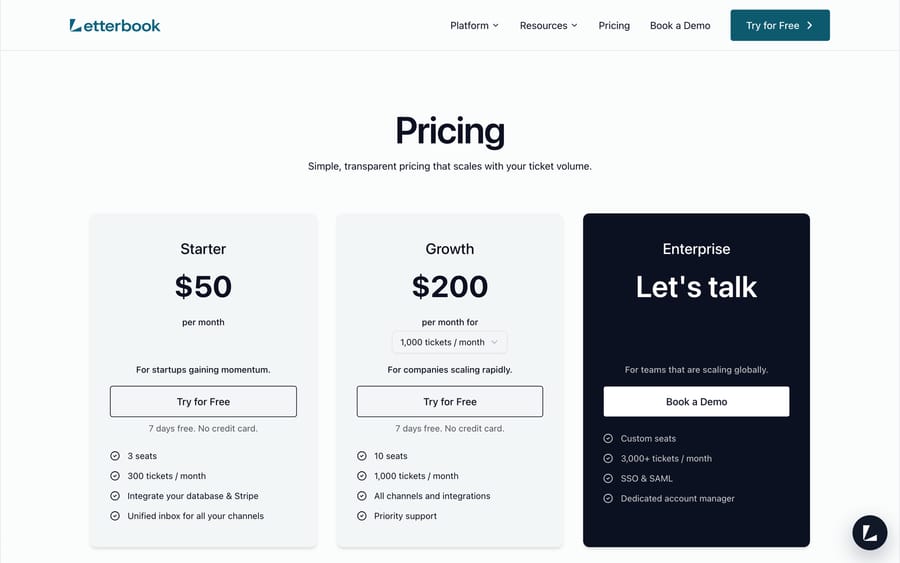
Letterbook publishes real pricing on its own site:
| Plan | Price/month | Seats | Tickets/month | Notable inclusions |
|---|---|---|---|---|
| Starter | $50 | 3 | 300 | Database & Stripe integration, unified inbox |
| Growth | $200 | 10 | 1,000 | All channels and integrations, priority support |
| Enterprise | Custom | Custom | 3,000+ | SSO & SAML, dedicated account manager |
Both Starter and Growth carry a 7-day free trial with no credit card required. On a per-ticket basis, Starter works out to roughly $0.17 a ticket at its 300-ticket cap and Growth to $0.20 a ticket at 1,000, both assuming a team stays at or under the included volume; Letterbook's own page doesn't state an overage rate for tickets beyond the cap; a team running consistently over its tier's limit should expect that conversation to come up before it's automatic.
Where Letterbook stops
Letterbook's AI drafts and prepares resolutions that a human reviews and sends, per its own positioning and a customer quote on its site, rather than resolving every ticket with zero human involvement. That's a meaningfully different claim than full autonomy, and it matches what a 2-person team building a young product would reasonably ship: assisted resolution first, broader autonomy as trust in the AI's judgment builds.
The product is also scoped to the channels and integrations it explicitly supports (email, API, Discord, web forms, plus a connected database and Stripe). A team running support through channels Letterbook doesn't list, a native mobile app's in-app chat, for instance, would need to route that volume elsewhere or wait for coverage. And because Letterbook is a young, small company (two founders per third-party reporting), a buyer should weigh that against the multi-year support-desk incumbents on its own comparison list: less operating history, but also a team that, per public feedback on Product Hunt, is actively iterating on rough edges like onboarding clarity and AI-escalation confidence thresholds.
What actual users say
Letterbook has no G2 or Capterra listing with a usable review count as of this check (2026-09-15), which is itself informative: this is a very new, very small vendor that hasn't yet reached the review volume most of this series can draw on. The available public evidence is thinner but real. On Product Hunt, where Letterbook reached #3 Product of the Day, one detailed review from a builder using it for another product, Isaac Tolley, calls it "a great platform for customer support," while a second commenter, Arun Tamang, gave concrete UX feedback: the signup flow asks for organization details before showing the product's value, and he suggested demonstrating a resolved ticket first to back up the "15 minutes to first resolved ticket" claim.
On Letterbook's own site, Edrei Chua, co-founder of Stellar Sleep, is quoted saying the AI support agent "saves us so much time" and calling Letterbook "by far the most intuitive." That's a named, attributable customer quote, though it comes from the vendor's own page instead of an independent review platform, worth weighing accordingly.
How we researched this: we worked from letterbook.ai's homepage, pricing page, and documentation (all fetched directly, 2026-09-15), plus Y Combinator's own company page for founder names and prior-company history, and Product Hunt for the only independent review evidence we could find. We could not find a G2 or Capterra listing, an independent funding figure specific to Letterbook, or any analyst coverage, all of which is consistent with a very early-stage company rather than a red flag on its own.
Who Letterbook suits
Letterbook fits teams that are small, fast-moving startups, especially ones already in or adjacent to the YC network, that want ticket volume low enough (under a few hundred to a thousand a month) to fit its Starter or Growth tiers, and that are comfortable being an early customer of a two-person company still actively shipping fixes based on user feedback. A team that already has a database and Stripe as its core backend gets the clearest value from Letterbook's specific integration angle.
Flat per-tier pricing with a hard ticket cap, rather than metering every ticket individually, optimizes for predictable revenue on Letterbook's side and predictable cost on the buyer's: a team knows its bill in advance as long as it stays under the cap, and Letterbook doesn't have to build usage-based billing infrastructure this early. The trade-off lands on whichever side blows past the cap first.
It's a weaker fit for a team that needs the operating history, compliance certifications, or large-scale reference customers a longer-established help desk can show, or one running support volume well above Letterbook's published tiers where the Enterprise conversation becomes mandatory rather than optional.
Where an AI agent layer fits on top
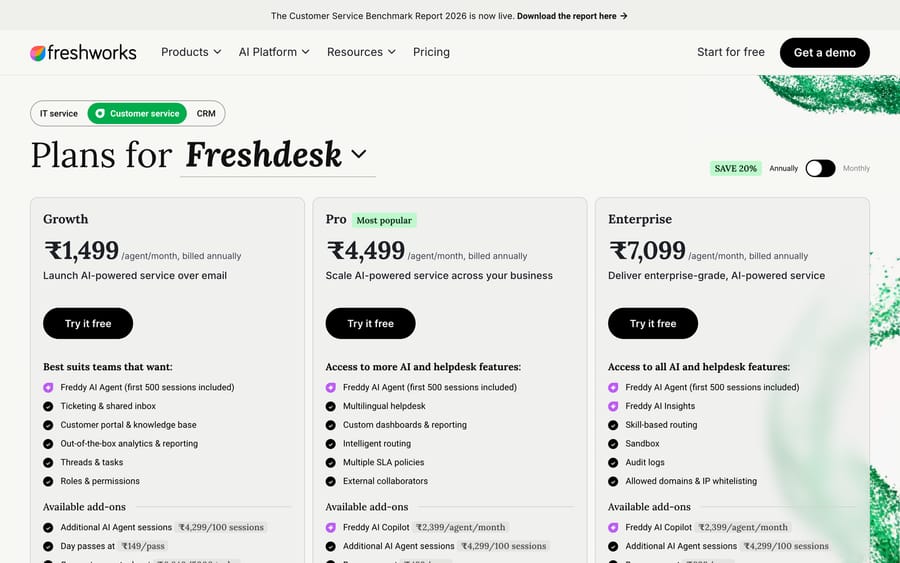
Letterbook and Macha solve different problems: Letterbook replaces the help desk itself with an AI-native one, while Macha is an AI agent layer that runs on top of a help desk a team already uses (Zendesk, Freshdesk, Gorgias, or Front) rather than swapping it out. A team happy with its current help desk but wanting AI agents inside it is Macha's fit; a team open to replacing the help desk entirely, and small enough to be comfortable with a very young vendor, is Letterbook's. Help Scout and Freshdesk sit in between: established help desks with their own bundled AI, a useful comparison point for what a more mature version of Letterbook's pitch looks like once a vendor has years of pricing and feature history behind it.
For a team that wants to keep its existing help desk and add an agent layer instead of migrating, see Macha's pricing or start a $50 free trial directly.
FAQ
What is Letterbook? Letterbook is an AI-native customer support platform (letterbook.ai), a YC S23 company founded by Dawson Chen and Ethan Hou, positioned as a direct replacement for Zendesk, Freshdesk, Help Scout, and Intercom.
Is letterbook.com the same company? No. letterbook.com is an unrelated open-source federated microblogging project. The AI help desk covered here is at letterbook.ai.
How much does Letterbook cost? Starter is $50/month for 3 seats and 300 tickets. Growth is $200/month for 10 seats and 1,000 tickets. Enterprise is custom-priced for 3,000+ tickets with SSO/SAML and a dedicated account manager. Starter and Growth both include a 7-day free trial with no credit card.
Does Letterbook have reviews on G2 or Capterra? No listing with a usable review count exists on either platform as of this writing. The available public evidence is a Product Hunt review and a named customer testimonial (Stellar Sleep's co-founder) on Letterbook's own site.
How long does Letterbook take to set up? Letterbook's own site claims about 15 minutes: 5 minutes to connect support channels, 10 minutes to integrate a database and Stripe, then reviewing the first ticket. Writing AI reply rules a team trusts fully takes longer than the mechanical connection steps.
Does Letterbook's AI fully automate tickets, or does a human review them? Per its own positioning and a customer quote on its site, the AI prepares resolutions that a human reviews and sends; it isn't resolving everything with zero human involvement.
What channels does Letterbook support? Email, API-created tickets, Discord, and web forms, plus integration with a connected database (MongoDB, Supabase, PostgreSQL) and Stripe.
Is Macha an alternative to Letterbook? Not directly. Letterbook replaces the help desk itself; Macha is an AI agent layer that runs on top of a help desk a team keeps using (Zendesk, Freshdesk, Gorgias, or Front). A team open to migrating its whole support stack to an AI-native platform fits Letterbook; a team keeping its current help desk and adding agents fits Macha.
Sources: Letterbook homepage, Letterbook pricing, Letterbook documentation, Letterbook on Y Combinator, Letterbook on Product Hunt.
Automate your support workflows
Macha's agents run multi-step workflows across the tools you already connect.