Intercom
 Shopify
 Stripe
 Slack
Slack Notion
 Google Workspace
 Confluence

Minded AI: The Complete Guide (2026)


Minded is an AI agent that finds and completes business tasks across finance, sales, marketing, HR, operations, and customer support after watching someone do the task once. This guide covers what Minded actually does, how its pay-per-finished-task pricing works, the company's own account of its earlier, more support-focused product, and how it compares to Lindy and to a help-desk-native AI agent like Macha.

What is Minded?
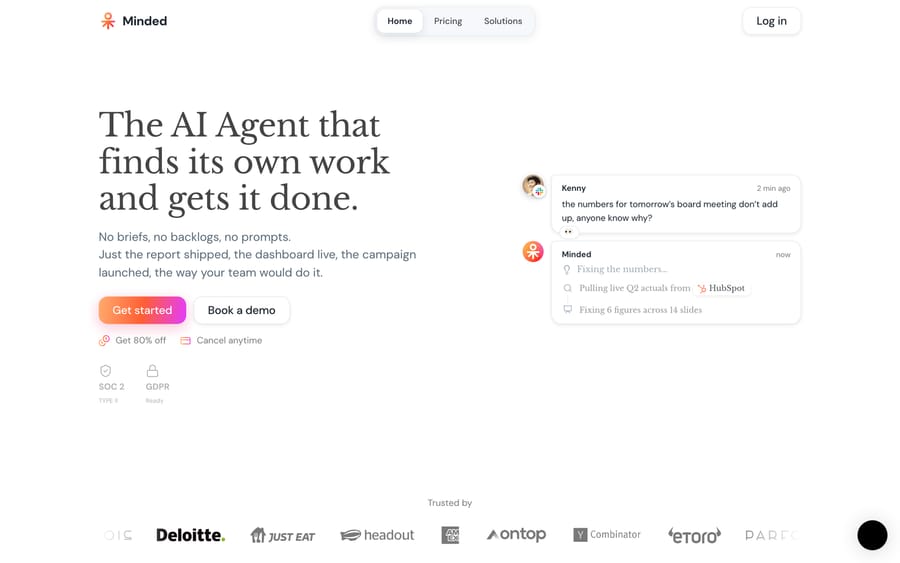
Minded was founded in 2023 by Ohad Navon and Nadav Zamir, went through Y Combinator's Summer 2023 batch, and is based in Tel Aviv with a small team of around 2 people as of YC's own listing. Y Combinator describes Minded as a "Cursor for AI Agents," and its own site pitches a specific idea: instead of writing a detailed prompt or brief, you show Minded a task once, and it turns that demonstration into a repeatable skill it can run on its own going forward.
Y Combinator's page also notes something Minded's own marketing doesn't lead with: the founders previously built a product called Octo, focused specifically on customer support automation, which reportedly let support teams "replace 70% of their support team" by resolving tickets through AI agents that take actions via APIs and read a knowledge base. Minded's current pitch is broader than Octo's: finance month-end closes, sales CRM updates, marketing campaign reports, HR candidate screening, operations approval routing, and customer support responses are all listed as areas Minded automates today, so the company has moved from a support-specific tool toward a general business-task agent.
Minded lists customers including Deloitte, JustEat, eToro, Payoneer, Headout, Amex (as a partner or customer, per the logo placement), Ontop, and Parfois on its own site, and claims more than 1.2 million tasks automated monthly, with results equivalent to "6 to 180 hires freed" depending on the organization. Those are Minded's own figures, unaudited by anyone outside the company.
How Minded's AI works
The mechanism starts with demonstration instead of instruction. A user performs a task (Minded's own examples show sequences taking as little as a few seconds), and the platform records the steps, converts them into a repeatable "skill," and can then execute similar tasks going forward without a human walking through it again.
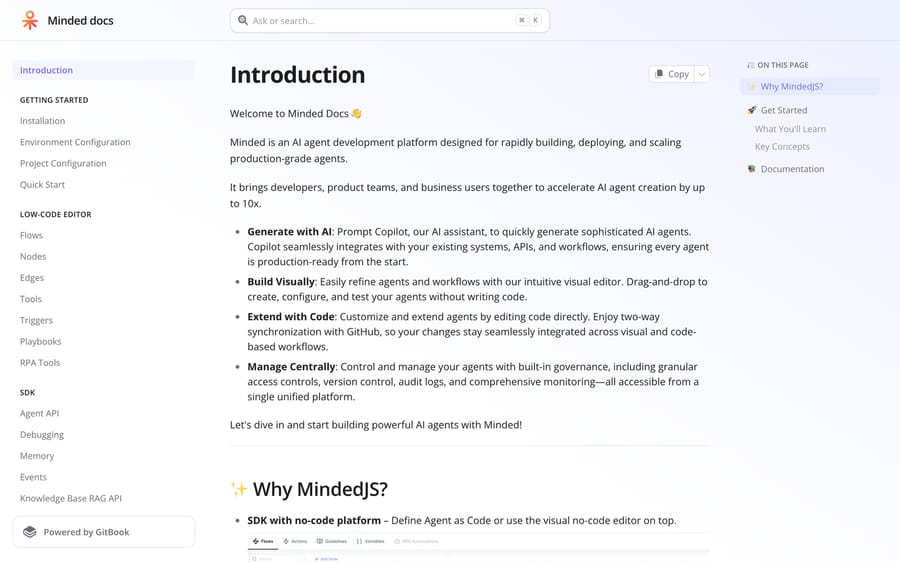
Underneath that no-code layer sits a real developer platform. Minded's documentation describes "MindedJS," an SDK for building, deploying, and scaling what it calls "production-grade agents," structured around flows (directed graphs), nodes (processing units), edges (routing logic), typed tools for LLM function calls, and a memory layer for state. A "Prompt Copilot" generates an initial agent from a plain-English description, a visual editor lets you refine it without code, and two-way GitHub sync lets a developer drop into actual code when the visual layer isn't enough.
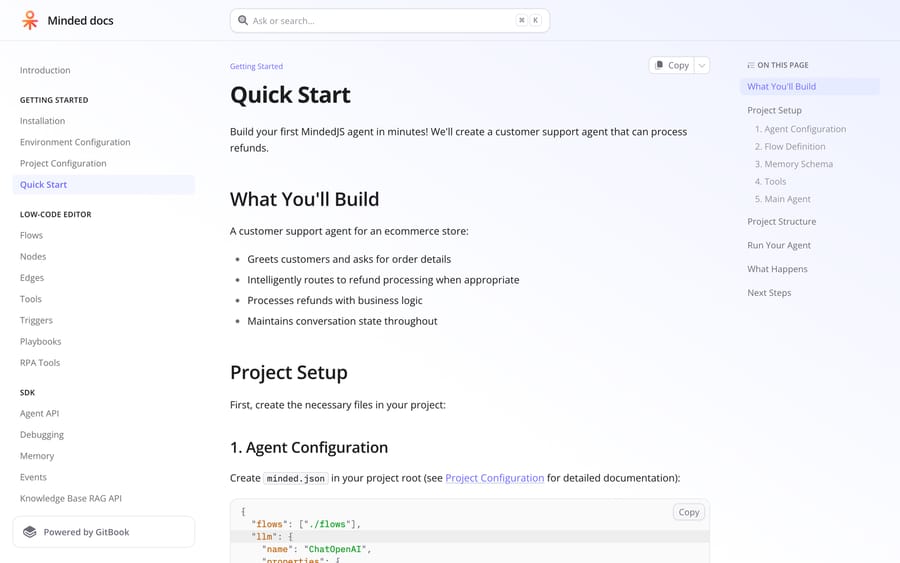
The documentation's own Quick Start tutorial is a useful, concrete detail: it walks a new developer through building "a customer support agent for an ecommerce store" that greets customers, routes to refund processing when appropriate, and processes the refund with business logic. That's a direct echo of the founders' earlier Octo product, built into the platform's own onboarding example even though Minded's current homepage sells a much broader pitch.
Key features
- Learn-by-demonstration workflow capture, turning a one-time walkthrough into a repeatable skill.
- MindedJS SDK, with flows, nodes, edges, tools, and memory as the underlying building blocks.
- Prompt Copilot for generating an initial agent from a plain-English description.
- Visual, drag-and-drop editor alongside direct code editing with two-way GitHub sync.
- 3,000+ tool integrations, including Gmail, Slack, Salesforce, NetSuite, Stripe, and Jira.
- Deployment surfaces: Chrome, email, Microsoft Teams, and Slack.
- A
/humanoption on the Business plan: vetted human experts on demand for tasks the AI can't finish alone. - SOC 2 Type II and GDPR compliance.
Minded pricing
Minded's pricing model is genuinely distinctive in this category: you pay for finished tasks, not seats, and the company markets that as "you pay when it's done."
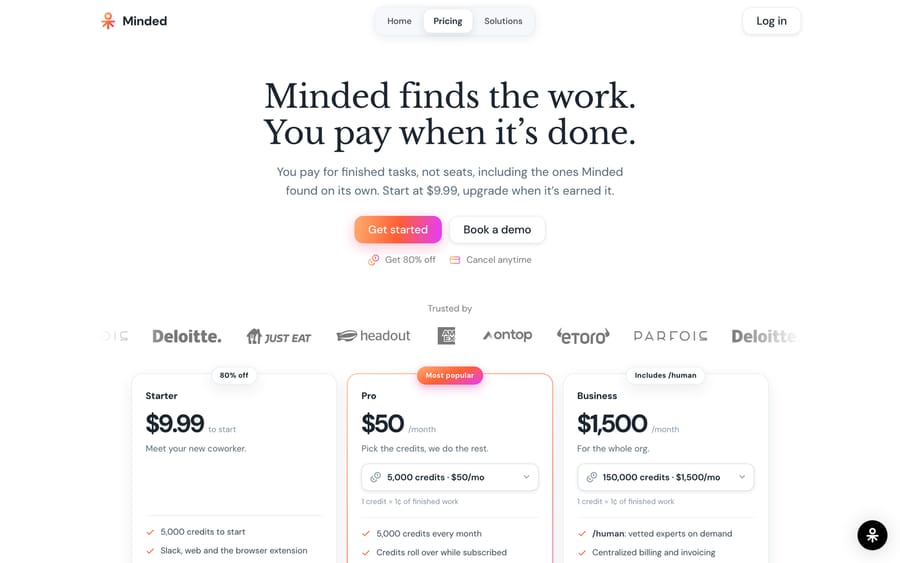
| Plan | Price | What's included |
|---|---|---|
| Starter | $9.99 to start | 5,000 credits to start; Slack, web, and browser extension; all integrations |
| Pro | $50/month (most popular) | 5,000 credits/month, rolling over while subscribed; tiers scale from $20/mo (2,000 credits) up to $2,000/mo (200,000 credits) |
| Business | $1,500/month | 150,000 credits; /human vetted experts on demand; centralized billing; shared workspaces and team roles; priority support; tiers scale up to $10,000/mo (1,000,000 credits) |
One credit equals one cent of finished work, so a $50 Pro plan buys roughly $50 worth of completed tasks a month, not $50 of compute time regardless of outcome. That's the incentive worth naming directly: Minded's pricing ties its own revenue to work actually finishing, rather than to time spent running, which is a meaningfully different bet than a per-seat SaaS price that gets paid whether the tool gets used or not.
Pros and cons
Pros
- Pay-per-finished-task pricing aligns what you pay with what actually got done, instead of a flat seat fee.
- Real, verifiable enterprise and mid-market customer logos (Deloitte, JustEat, eToro, Amex, Parfois) shown directly on Minded's own site.
- A genuine developer platform underneath the no-code layer (MindedJS, GitHub sync, typed tools), so a team isn't boxed into visual-only editing as it scales.
- 3,000+ integrations cover a very wide range of the tools a business already runs.
- The founders have direct prior experience building a customer-support-specific AI product (Octo), which shows up concretely in the platform's own onboarding example.
Cons
- A very small team (about 2 people per YC's own listing) for a platform with this broad a feature surface and this many integrations, worth factoring into any evaluation of long-term support capacity.
- No G2, Capterra, or TrustRadius listing we could confirm for this specific company, so there's no independent review data to check against the vendor's own claims.
- Broad, cross-department positioning (finance, sales, marketing, HR, operations, support all at once) makes it harder to evaluate for a team that only cares about one specific use case, like customer support.
- Credit-based pricing requires estimating task volume in advance, which takes more modeling than a flat per-seat number.
- Public company-data sources return conflicting funding information for "Minded," some of which clearly describes an unrelated company; verify any funding claim directly with Minded instead of trusting a generic company-database search.
Who Minded is best for
This fits teams at a small or mid-size company that want one AI agent handling a genuinely wide range of internal task types, learns by demonstration instead of detailed prompting, and is comfortable with a young, very small vendor in exchange for pricing tied to completed work instead of seats. The /human option on the Business plan is a real differentiator for teams that want an AI-first workflow with a fallback to real people for the tasks the AI can't close.
It's a weaker fit if your only interest is customer support specifically. Minded's current positioning spans far more departments than support alone, and a narrower, support-specific tool (including the founders' own earlier product category) is likely to be simpler to evaluate and configure for that one job.
Minded AI vs alternatives
| Minded | Lindy | Macha | |
|---|---|---|---|
| Model | Self-directed AI agent across finance, sales, HR, ops, and support | AI teammate connected to a company's tools, general workplace automation | AI agent layer on your existing help desk |
| Best for | Small/mid-size teams wanting one agent across many internal task types | Teams wanting an AI teammate across Slack, email, and everyday tools | Teams on Zendesk, Freshdesk, Gorgias or Front automating ticket replies |
| Pricing | Published: $9.99 to start, $50-$2,000/mo (Pro), $1,500-$10,000/mo (Business) | Published tiers with a 7-day free trial | From $299/month for 750 tickets (~$0.40/ticket), published |
| Self-serve trial | Starter tier at $9.99, no separate free trial listed | Yes, 7-day free trial | $50 of free usage, no credit card |
| Setup | Learn-by-demonstration, or build with the MindedJS SDK | Connects to existing tools; built for non-technical setup | Built, tested and monitored by the Macha team |
| Replaces your help desk? | No, it's a general task agent | No, it's a general task agent | No, runs on top of the help desk you already use |
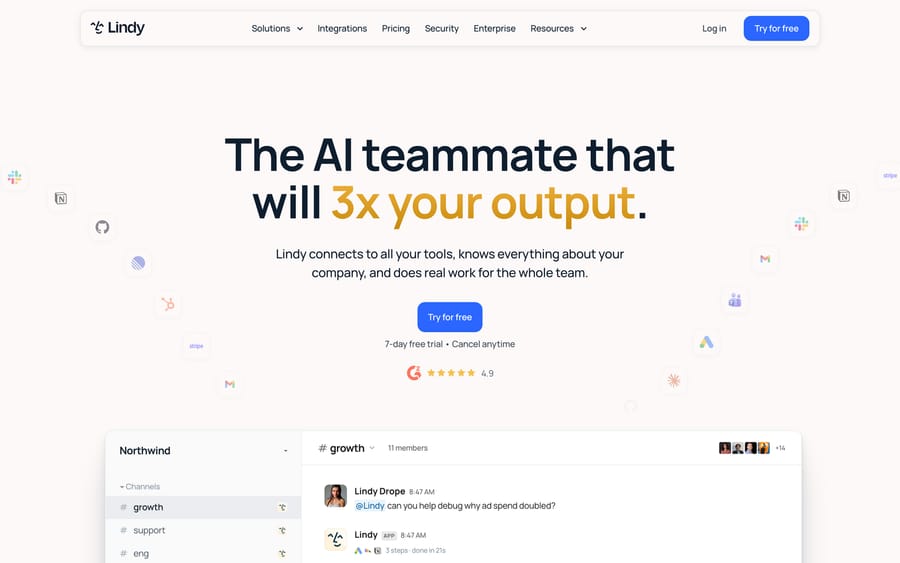
Lindy is the closer comparison: both are general-purpose AI agent platforms that connect to a company's existing tools and automate work across departments, going well beyond one job like customer support alone. Lindy's homepage shows a public 4.9 G2 rating; we could not confirm an equivalent independent rating for Minded, which is a real gap in the evidence between the two.
Macha is a different category and shouldn't be confused with either. Minded and Lindy are general task agents that happen to include customer support as one of several use cases. Macha does one thing: it runs as an AI agent layer inside a help desk like Zendesk, Freshdesk, Gorgias, Front, HubSpot or Intercom, reading tickets and drafting or sending replies. If you specifically need customer support automated well, a tool built only for that job, the way Minded's founders' earlier Octo product was, is often a more direct fit than a broader agent platform that treats support as one of six things it does. For another take on plain-English agent building, see our Chatbase guide.
How we researched this
We checked Minded's own homepage, pricing page, and documentation site (docs.minded.com) directly, plus Y Combinator's own company listing for founding details, team size, and the founders' prior product history. A third-party funding aggregator returned data that doesn't reconcile with YC's own listing and is very likely describing a different company with the same name; we've flagged that rather than reported it as fact. No independent review platform listing could be confirmed for this company as of 2026-09-18.
If customer support specifically is your actual problem, Macha is built only for that: see pricing or start a trial with $50 of free usage and no credit card required.
FAQ
What is Minded AI? Minded is an AI agent platform that learns tasks by watching a person demonstrate them once, then repeats similar tasks autonomously across departments including finance, sales, marketing, HR, operations, and customer support.
How much does Minded cost? Minded publishes pricing based on finished tasks, not seats: Starter at $9.99 to start (5,000 credits), Pro from $20-$2,000/month depending on credit tier, and Business from $1,500-$10,000/month with a /human option for expert help. One credit equals one cent of finished work.
Who founded Minded, and when? Ohad Navon and Nadav Zamir founded Minded in 2023. The company went through Y Combinator's Summer 2023 batch and is based in Tel Aviv.
Is Minded related to a company called Octo? According to Y Combinator's own company page, Minded's founders previously built a customer-support-specific product called Octo before starting Minded, which now covers a much broader set of business functions.
How much funding has Minded raised? We could not confirm reliable, independently verifiable funding data specific to this company. A generic company-database search returns a $33.5M, multi-round history that doesn't match Y Combinator's own small-team listing and is very likely describing a different, unrelated company that shares the name Minded.
What does Minded integrate with? Minded lists more than 3,000 tool integrations, including Gmail, Slack, Salesforce, NetSuite, Stripe, and Jira, and deploys inside Chrome, email, Microsoft Teams, and Slack.
Does Minded have good reviews? We could not confirm a G2, Capterra, or TrustRadius listing for this specific company as of 2026-09-18. The customer logos shown on Minded's own site (Deloitte, JustEat, eToro, Amex, Parfois) are real and verifiable, but we found no independent review-platform rating to cite.
What are the best Minded AI alternatives? Lindy is a direct comparison as a general-purpose AI teammate connecting to existing business tools. For customer support specifically, a narrower, help-desk-native tool like Macha is a more direct fit than a broad, multi-department agent platform.
Is Minded good for a team that only needs customer support automation? It can work, but Minded's current positioning spans many departments rather than being scoped to support alone. A team with a support-only need may find a dedicated support AI agent simpler to evaluate and configure.
Sources: Minded homepage, Minded pricing, Minded documentation, Minded on Y Combinator, Lindy homepage.
Resolve tickets automatically with AI agents
Macha's AI agents work on top of the help desk you already use — no code.