Intercom
 Shopify
 Stripe
 Slack
Slack Notion
 Google Workspace
 Confluence

Ravenna AI: The Complete Guide (2026)


Ravenna is a Slack-native service desk that turns employee messages into tickets and lets AI agents resolve routine IT, HR, and operations requests without anyone leaving the channel they're already in. This guide covers what it actually does, its funding and pricing, and how it compares to Moveworks and Aisera if a Slack-first internal support tool is what you're evaluating.

We build AI agents for customer service ourselves, so we checked what Ravenna's own comparison pages claim against what its product pages and docs actually show. Worth saying upfront: Ravenna is young. It's a real, funded, shipping product, and it's also a company with almost no public review history yet, which we're not going to paper over with vague enthusiasm.
What is Ravenna?
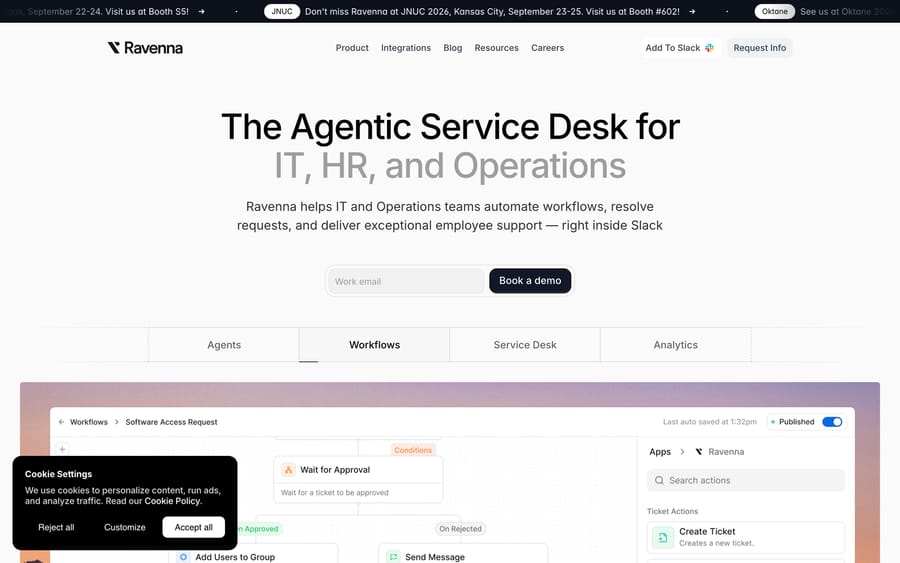
Ravenna calls itself "The Agentic Service Desk for IT, HR, and Operations," built entirely around Slack instead of a separate portal employees have to remember to visit. The product has four parts: Agents (AI coworkers that answer common questions and route requests), Workflows (a visual canvas for automating things like onboarding, offboarding, and hardware issues), a Service Desk (chat-native ticketing), and Analytics (dashboards tracking service desk performance).
The company was seeded with $15 million in April 2025, in a round led by Madrona Venture Group with Khosla Ventures and Founder's Co-op also participating. It was founded by Taylor Halliday and Kevin Coleman and is based in Seattle. That funding profile (a well-known enterprise VC leading a fresh seed round) signals real institutional confidence, but it also means Ravenna has had roughly a year and a half to build a track record as of this writing, which shows up clearly in how thin its public review base still is.
How Ravenna's AI works
Per Ravenna's own documentation, the mechanism is built around a message becoming a ticket directly inside a Slack thread: "the channel you connect receives the form you build, the form triggers the workflow you publish, and the agent you deploy answers from the knowledge you import." That's a meaningfully different architecture than a bot bolted onto Slack as a notification layer. The whole resolution happens in the thread, start to finish.
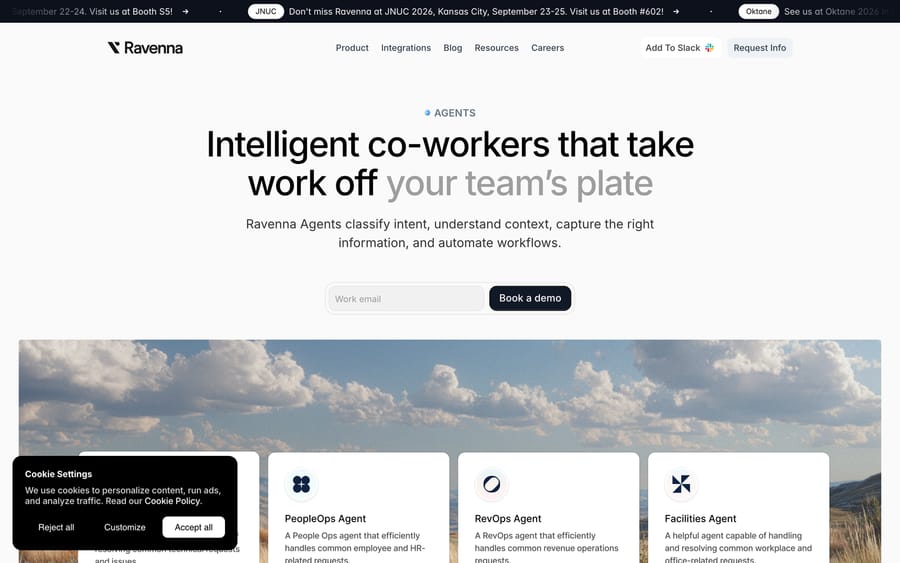
The Agents component classifies intent, captures the information a workflow needs, and either answers directly from a connected knowledge base or escalates to a human when it can't. Ravenna's docs describe agents that can "generate knowledge from Slack threads" automatically, so past resolved conversations become future answers without someone manually writing a knowledge base article. Agents also carry configurable traits (tone, response length, formality) and use what the vendor calls "agentic memory" to track multi-turn conversations, so a follow-up message doesn't get treated as a fresh, context-free request.
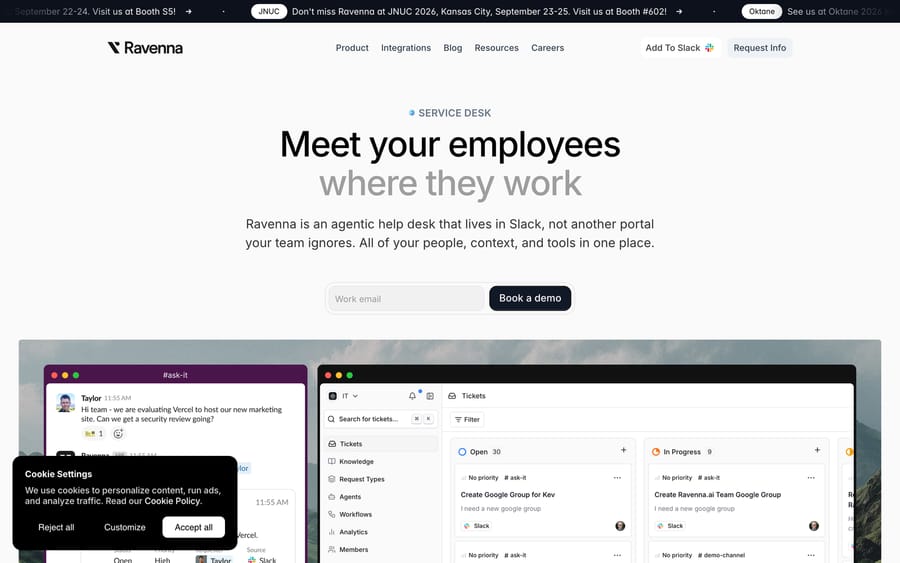
The Service Desk layer is what makes this different from a Slack bot with a ticketing add-on bolted on: the underlying ticket view (shown above) is a full kanban-style board with priority, status, and requester fields, visible to the team without ever leaving Slack.
Key features
- Slack-native agents: classify intent, capture required information, and answer from a connected knowledge base or escalate.
- Visual workflow builder: automate onboarding, offboarding, hardware requests, and software access approvals without writing code.
- Service Desk: a full ticket board (open, in progress, priority, requester) that lives alongside the Slack thread it came from.
- Analytics: dashboards on service desk performance, tied to business outcomes.
- Knowledge generation from threads: agents can turn resolved Slack conversations into reusable knowledge automatically.
- SOC 2, HIPAA, and GDPR compliance, positioned toward enterprise buyers despite the seed-stage company size.
Ravenna pricing
Ravenna doesn't publish pricing. Per a third-party pricing aggregator (Software Advice's SoftwareFinder listing, checked 2026-09-18), it uses custom per-agent monthly pricing, quoted based on team size, and there's no self-serve signup or published tier to point to. That's typical for a young enterprise seller still calibrating deal sizes instead of running a fixed price list, but it means a buyer has to go through a sales call to get any number at all, even a rough one. The incentive is straightforward: a no-published-price seller can charge each new logo whatever that logo will bear, which is normal at this stage but worth knowing before the call.
Pros and cons
Pros:
- Genuinely Slack-native architecture: the ticket lives in the thread, without a link out to a separate portal, which is the single biggest adoption barrier most internal service desks fight.
- Backed by a real institutional seed round ($15M, led by Madrona) instead of bootstrapped or pre-seed funding, which suggests runway to keep building.
- Positions itself honestly against larger platforms on its own comparison pages: its Aisera comparison acknowledges "Aisera is a serious platform" instead of trashing the competitor outright.
- Automatic knowledge generation from resolved threads is a real, documented mechanism, backed by its own docs, and not just a marketing claim.
Cons:
- No published pricing at all, and no free trial or self-serve tier, so an early evaluation requires a sales conversation before you know if it's even in budget range.
- Public review evidence is extremely thin: we found exactly one verified review (5 stars, from a single reviewer in September 2026) via a third-party aggregator, and it explicitly flags the platform as "early-stage" and "awaiting maturation for larger teams." G2 blocked automated access, so we can't point to a broader independent rating.
- No named enterprise customers or case studies appear on Ravenna's public site as of this check, which is a real gap for a company at this funding level and marketing spend (conference sponsorships at JNUC and Oktane 2026 are visible on its homepage banner).
- Slack-only today. Ravenna's own copy notes Teams support is "coming soon," so a Microsoft-Teams-first company can't use it yet.
Who Ravenna is best for
Ravenna fits teams at a mid-market or growth-stage company that already lives in Slack and wants IT, HR, and ops requests handled inside that same workspace instead of a portal employees ignore. Its own positioning against Aisera is candid about this: Ravenna targets "Slack-first companies" prioritizing speed, while a platform like Aisera or Moveworks suits "large organizations with ServiceNow or Workday" needing breadth across many departments and systems. A company evaluating Ravenna today should treat it as an early bet on a well-funded, fast-moving young vendor, not a proven, widely-referenced platform yet.
Ravenna vs alternatives
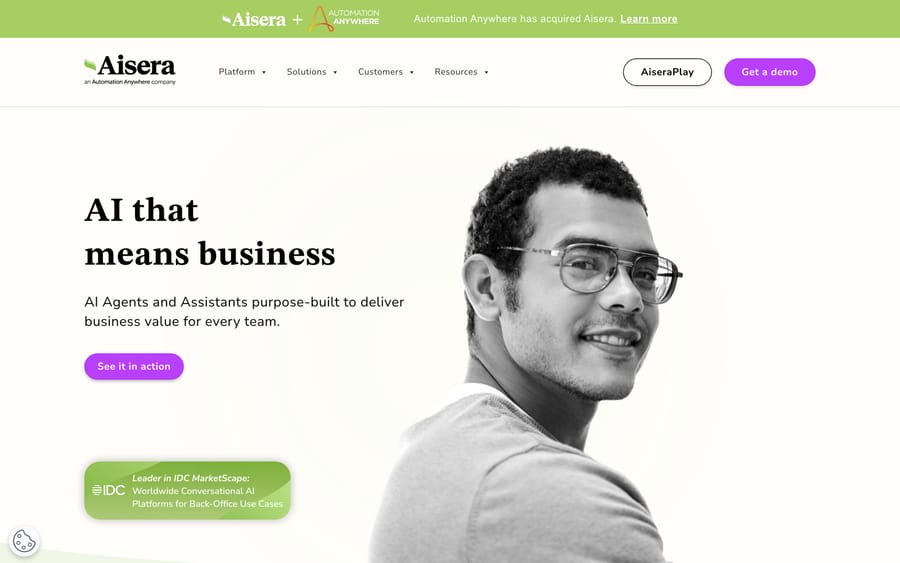
Moveworks, now part of ServiceNow, and Aisera, now part of Automation Anywhere, are the two platforms Ravenna itself names as points of comparison. Both are older, more established, and built for larger, multi-department deployments. Macha is a different category entirely: an AI agent layer for customer-facing support tickets, not an internal Slack-based service desk.
| Ravenna | Aisera | Macha | |
|---|---|---|---|
| Model | Slack-native agentic service desk for IT, HR, Ops | AI agents/assistants across IT, HR, finance, legal, facilities, and customer service | AI agent layer on your existing customer-facing help desk |
| Best for | Slack-first mid-market and growth companies | Large enterprises with ServiceNow or Workday needing breadth | Support teams on Zendesk, Freshdesk, Gorgias or Front |
| Pricing | Not published; custom per-agent quote | Not published; enterprise sales only | From $299/mo for 750 tickets (~$0.40/ticket), published |
| Setup | Vendor-led; Ravenna claims agents resolve requests within the first week | Multi-step "discovery, configuration, integration, and tuning" program | Built, tested and monitored by the Macha team |
| Trial | None; demo only | None; demo only | $50 free usage |
Macha fits a different team entirely: one whose bottleneck is customer-facing tickets, not internal Slack requests. If that's the actual problem, Macha's AI agent layer and its published pricing are worth comparing directly, since neither Ravenna nor Aisera addresses external customer support at all.
How we researched this
This guide is based on Ravenna's own homepage, product pages, and documentation (all fetched 2026-09-18), Madrona's own investment announcement for funding and founder details, and a single third-party review aggregator for user sentiment, since G2 blocked automated access and no broader review base could be located. We're stating plainly that Ravenna's public review and customer-reference record is thin. For a company seeded 18 months ago, that's the normal state of evidence. We'd rather say so plainly than manufacture confidence the record doesn't support yet.
FAQ
What is Ravenna AI used for? Ravenna automates internal IT, HR, and operations support requests inside Slack, turning employee messages into tickets that AI agents can resolve directly in the thread, without a separate portal.
How much does Ravenna cost? Ravenna doesn't publish pricing. It uses a custom, per-agent monthly quote based on team size, requested through a sales conversation.
Who founded Ravenna and when was it funded? Ravenna was founded by Taylor Halliday and Kevin Coleman. It raised a $15 million Seed round in April 2025, led by Madrona Venture Group with Khosla Ventures and Founder's Co-op also participating.
Is Ravenna only for Slack? As of this writing, yes. Ravenna's own materials describe Microsoft Teams support as coming soon but not yet available.
What are the best Ravenna alternatives? Moveworks (now part of ServiceNow) and Aisera (now part of Automation Anywhere) are the two platforms Ravenna itself names as comparisons, both built for larger, multi-department enterprises. If the actual problem is customer-facing support rather than internal IT/HR requests, an AI agent layer like Macha is a better fit than any of these three.
Is there a free trial for Ravenna? No public self-serve trial. Ravenna sells through a demo and a custom quote.
How mature is Ravenna as a company? Very early. It's a seed-stage company (funded April 2025) with, as of this check, no published customer case studies and a single public review. That doesn't mean the product doesn't work; it means the public evidence base is still small.
Does Ravenna replace ServiceNow? Ravenna positions itself as a lighter-weight alternative for Slack-first companies, not a like-for-like ServiceNow replacement for large, multi-system enterprises; its own comparison pages acknowledge that larger platforms like Aisera suit organizations already standardized on ServiceNow or Workday.
Whichever internal service desk you're evaluating, weigh the review evidence honestly against the funding and marketing spend; a well-funded seed company can still be a one-review product. And if the tickets piling up are customer-facing rather than internal, see how Macha's agents work on your existing help desk.
Sources:
- https://ravenna.ai
- https://ravenna.ai/product/agents
- https://ravenna.ai/product/help-desk
- https://ravenna.ai/alternatives/aisera
- https://docs.ravenna.ai/getting-started/introduction
- https://www.madrona.com/ravenna-ai-native-service-management/
- https://softwarefinder.com/customer-service-software/ravenna
- https://aisera.com
- https://www.moveworks.com
Resolve tickets automatically with AI agents
Macha's AI agents work on top of the help desk you already use — no code.