Intercom
 Shopify
 Stripe
 Slack
Slack Notion
 Google Workspace
 Confluence

Sendbird AI Agent: The Complete Guide (2026)


Sendbird AI Agent is now called delight.ai. Sendbird, the chat-API company, rebranded its AI agent product into a standalone-branded platform, and delight.ai's own homepage says so directly: "A Sendbird product," "built on Sendbird's enterprise-grade infrastructure." This guide covers what the product actually does under its new name, what it costs (and where the pricing goes dark), what real customers and reviewers report, and where it fits next to Macha.

Macha builds AI agents for customer service that run inside a help desk a team already uses, so we read a platform like delight.ai from that angle: what survived the rebrand as a real product, and what it costs to actually run.
What is Sendbird AI Agent (now delight.ai)?
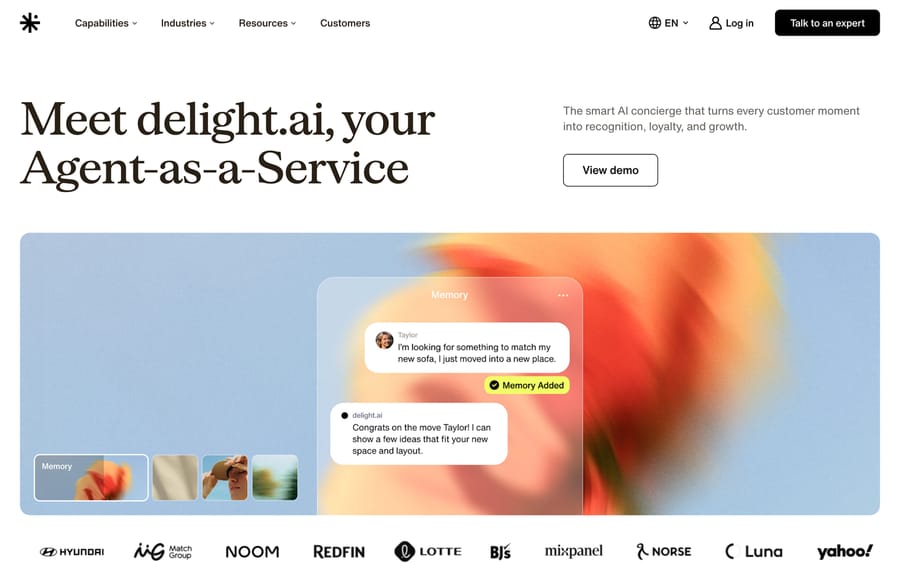
Sendbird was founded in 2013 by John S. Kim, Brandon Jeon and Harry Kim, and built its reputation as a chat and messaging API powering in-app conversations for apps and platforms. It's raised over $220 million from investors including SoftBank Vision Fund, Tiger Global and ICONIQ, reaching a $1 billion-plus valuation after a $100 million raise in April 2021. Sendbird's own documentation still describes "Sendbird AI Agent" as a current product ("a modern, flexible solution for automating conversations"), but the company now markets that same capability under a separate brand: delight.ai, an "Agent-as-a-Service" platform, with delight.ai's own site stating plainly it's built on Sendbird's infrastructure.
Named delight.ai customers, shown directly on its site, include Hinge, Hyundai, Match Group, Noom, Redfin, Lotte, BJ's, Mixpanel and Yahoo, spanning dating, automotive, retail and wellness. That's a genuinely broad enterprise customer base for a product still working through a rebrand.
How the AI works
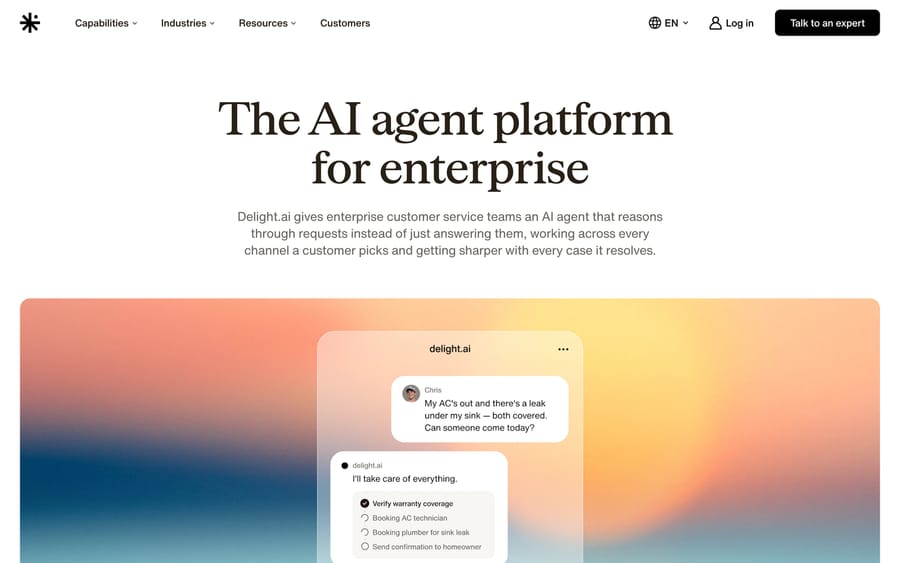
delight.ai's positioning is that it "reasons through requests instead of just answering them," working across whatever channel a customer picks and improving with every resolved case. The product screenshot above shows the mechanism concretely: a customer reports an AC outage and a sink leak, and the agent works a checklist (verify warranty coverage, book an AC technician, book a plumber, send a confirmation) rather than returning a single canned reply.
Key architectural pieces:
- Trust OS: governance layer with spend limits, approval gates, escalation rules and full decision logging, aimed at giving enterprises audit control over what an autonomous agent is allowed to do.
- Agent Memory Platform: the agent gets sharper from resolved cases over time rather than staying static.
- Omnichannel delivery: SMS, email, WhatsApp, in-app chat, voice and social messaging from one agent definition.
- Integrations: Salesforce, Freshworks, and third-party knowledge bases, plus Sendbird's own chat infrastructure underneath.
Key features
- Agent builder: no-code interface for configuration, testing and evaluation.
- Trust OS governance: spend limits, approval gates, escalation rules, decision logging for compliance-conscious enterprises.
- Agent Memory Platform: continuous learning from resolved cases rather than a static knowledge base.
- Compliance certifications: GDPR, SOC 2 Type II, HIPAA, ISO 27001.
- Omnichannel reach: SMS, email, WhatsApp, in-app chat, voice, social messaging.
- Underlying infrastructure: Sendbird's chat API, described as powering 7 billion conversations a month across 300 million-plus monthly active users.
Sendbird / delight.ai pricing
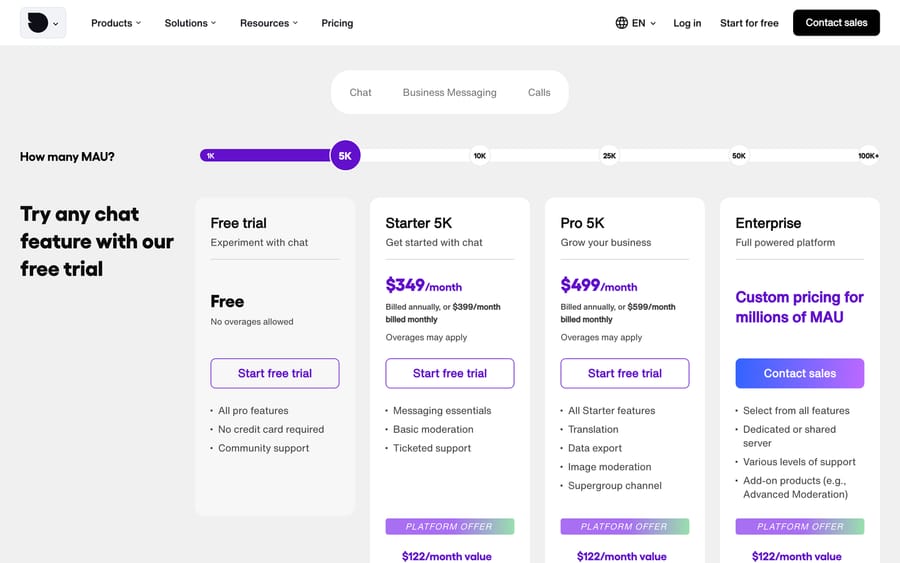
Sendbird's underlying Chat API has real, published pricing: a free trial (up to 1,000 MAU), Starter at $349/month annual ($399 monthly) for 5,000 MAU, Pro at $499/month annual ($599 monthly), and custom Enterprise pricing for millions of MAU, with overages beyond each tier's MAU limit.
delight.ai (the AI agent product) has no published price anywhere we could find. We checked delight.ai's site directly (pricing is "custom, available upon request") and a third-party review independently confirms the same gap, describing Sendbird's AI pricing as billed "per conversation" with no public rate card, no tier structure, and no defined operational unit for what counts as one conversation. That's a real gap for a buyer trying to budget: the chat infrastructure underneath is transparently priced, but the AI layer on top is not. Leaving the newer, higher-margin AI product behind a sales call while keeping the older commodity chat API on a public price list is a normal incentive: it lets a rep price the AI seat to whatever the account can bear instead of a number a competitor can undercut in public.
Real-user reviews: what buyers say
We checked two sources on 2026-09-17. Capterra rates "Sendbird" 4.2/5 from 31 reviews — this covers the base chat platform, not delight.ai or AI Agent specifically, since no separate AI Agent listing exists on Capterra. G2 returned a 403 to direct automated access.
"The customer service team has been very responsive with any inquiries." (Software Engineer, 2+ years)
"SendBird makes it really easy to build out complex chat features with minimal overhead!" (Software Engineer, Sports)
"What kind of a company takes your money and refuses to rebate unused service." (CEO, Broadcast Media)
The recurring complaint theme, and the one worth flagging loudest: cost. A third-party review cites G2 tags like "Expensive," "Cost" and "Cost Limitations" appearing 34 times combined, the single largest complaint cluster on that platform. Capterra reviewers separately mention thin documentation and refused refunds for unused service. None of this is specific to the AI Agent/delight.ai product line, since it predates the rebrand, but it's the clearest signal available about what it's like to be a paying Sendbird customer.
Pros and cons
Pros
- Built on genuinely large-scale, proven infrastructure (7 billion conversations/month, 300M+ MAU).
- Trust OS governance (spend limits, approval gates, decision logging) is a real differentiator for compliance-conscious enterprises.
- Broad, named enterprise customer base (Hyundai, Match Group, Noom, Redfin) across multiple industries.
- Omnichannel reach across SMS, email, WhatsApp, chat, voice and social in one agent definition.
Cons
- No published AI pricing anywhere; the underlying Chat API is transparent, but the AI agent layer is quote-only.
- Cost is the single largest recurring complaint theme on independent review sites, even before AI Agent pricing is added.
- The rebrand to delight.ai adds real navigation confusion for anyone searching "Sendbird AI Agent" and landing on old documentation.
- No independent review data (G2, Capterra) specific to delight.ai or AI Agent exists yet; all available reviews predate the rebrand.
Who Sendbird AI Agent (delight.ai) is best for
delight.ai fits teams at an enterprise already running (or comfortable adopting) Sendbird's chat infrastructure, that need strict governance over an autonomous AI agent (spend limits, approval gates, audit logs) and want one agent definition working across SMS, WhatsApp, voice and chat rather than separate tools per channel.
It's a harder sell for a team that wants a transparent, self-serve price before talking to sales, or a smaller team without the enterprise procurement process a "custom pricing" product implies. The base Sendbird platform's cost complaints are also worth weighing before adding an AI layer priced the same opaque way.
Sendbird AI Agent vs alternatives
| delight.ai (Sendbird) | eesel AI | Macha | |
|---|---|---|---|
| Model | Agent-as-a-Service built on Sendbird's chat infrastructure | AI agents inside existing help desks | AI agent layer on your existing help desk |
| Best for | Enterprises already on Sendbird, needing strict AI governance | Teams wanting a public price and fast, self-serve setup | Teams on Zendesk, Freshdesk, Gorgias or Front |
| Pricing | Opaque; Chat API published, AI Agent quote-only | Published price on the pricing page, per ticket | From $299/month for 750 tickets (about $0.40 per ticket), published |
| Reviews | 4.2/5 (Capterra, 31, base platform only) | Independent reviews on its own pricing/setup story | See our pricing and product pages |
| Replaces your help desk? | No, sits alongside CRM/support stack | No, plugs into Zendesk, Freshdesk, Gorgias | No, deliberately augments it |
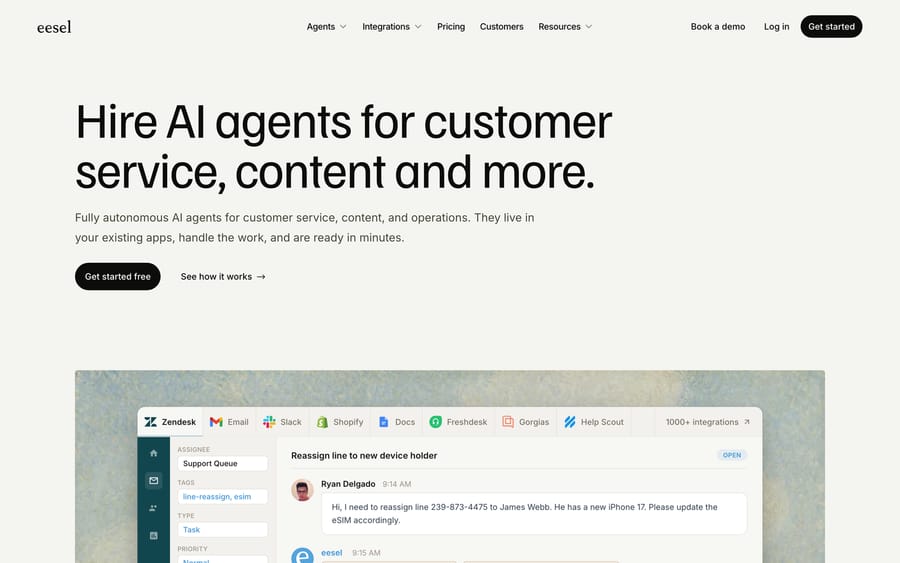
eesel AI is the most direct comparison for the specific complaint that shows up in delight.ai's own third-party reviews: it publishes a price on its pricing page and defines its billing unit clearly, which is exactly the gap reviewers flag against Sendbird's opaque per-conversation model.
Macha is closer to eesel's shape than delight.ai's: an AI agent layer with published pricing that works inside the help desk a team already runs. See Macha on your help desk or pricing, and our Kore.ai guide for another enterprise conversational AI platform worth comparing against delight.ai's governance-first approach.
How we researched this: Sendbird's own documentation and delight.ai's own site (homepage and product page) were fetched and screenshotted directly on 2026-09-17; delight.ai's homepage explicitly confirms it's "A Sendbird product." Company history came from Sendbird's Y Combinator page and its own About page. Sendbird's Chat API pricing page was fetched and screenshotted directly; no equivalent page exists for delight.ai/AI Agent. Review data came from Capterra (fetched directly, 31 reviews, base platform) since G2 returned a 403; a third-party review (eesel AI, a competitor) was used only to corroborate the rebrand and the pricing-opacity complaint pattern, both of which matched what we found independently.
FAQ
Is Sendbird AI Agent still called that? No, not in its current marketing. Sendbird rebranded its AI agent product as delight.ai, an "Agent-as-a-Service" platform that delight.ai's own site describes as "A Sendbird product" built on Sendbird's infrastructure. Sendbird's documentation still uses the "AI Agent" name internally.
How much does Sendbird AI Agent / delight.ai cost? There's no published price. Sendbird's underlying Chat API is transparently priced (Starter $349-399/mo, Pro $499-599/mo, custom Enterprise), but delight.ai itself is quote-only, billed "per conversation" with no public definition of that unit.
What do Sendbird's reviews say? Capterra rates Sendbird 4.2/5 from 31 reviews, covering the base chat platform rather than delight.ai specifically. The most common complaint across review sites is cost, with "Expensive" and related tags appearing 34 times on G2 per a third-party review.
What is Trust OS? Trust OS is delight.ai's governance layer: spend limits, approval gates, escalation rules and full decision logging, designed to give enterprises audit control over an autonomous AI agent's actions.
Who uses delight.ai? Named customers on delight.ai's own site include Hinge, Hyundai, Match Group, Noom, Redfin, Lotte, BJ's, Mixpanel and Yahoo.
Is delight.ai good for a small support team? Probably not the first choice. It's positioned for enterprise governance needs and has no published, self-serve pricing, which suits a larger buyer with a procurement process better than a small team wanting to start today.
What are the best Sendbird AI Agent alternatives? eesel AI is a direct comparison worth checking specifically because it addresses the pricing-transparency gap reviewers flag against Sendbird. For teams wanting AI agents inside an existing help desk with published pricing, Macha is a more direct fit.
Does delight.ai integrate with Zendesk or Salesforce? It lists Salesforce and Freshworks as integrations on its own site. It doesn't list Zendesk as a named integration, unlike some help-desk-native competitors.
Looking for an AI agent with published pricing that works inside the help desk you already use? Start a Macha trial at dashboard.getmacha.com/signup or see pricing: $50 of free usage (about 125 tickets), no credit card, no time limit.
Sources: Sendbird AI Agent documentation, delight.ai homepage, delight.ai AI Agent product page, Sendbird Chat API pricing, Sendbird on Y Combinator, About Sendbird. Capterra ("Sendbird," capterra.com) checked 2026-09-17, 31 reviews.
Resolve tickets automatically with AI agents
Macha's AI agents work on top of the help desk you already use — no code.