Intercom
 Shopify
 Stripe
 Slack
Slack Notion
 Google Workspace
 Confluence

SoundHound AI: The Complete Guide (2026)


SoundHound AI is a publicly traded (NASDAQ: SOUN) voice AI company that has spent the past three years acquiring its way into a full enterprise conversational AI stack, most recently completing an acquisition of LivePerson. Its current flagship platform is OASYS, the Orchestrated Agent System. This guide covers what OASYS actually does, the company's acquisition history, real (unpublished) pricing, and where it fits next to a lighter, help-desk-native alternative.

We build AI agents for customer service ourselves, so we read SoundHound the way a buyer researching a fast-moving, acquisition-heavy public company would: what's confirmed, what changed most recently, and what a deal actually costs.
A brand note worth flagging up front
Search demand for "SoundHound AI" is genuinely split across several names: SoundHound the public company, Houndify (its older developer voice-platform brand), and OASYS (its current agent product). This guide covers the current corporate entity and its OASYS platform specifically, since that's what SoundHound itself now leads with on its own homepage.
What is SoundHound AI?
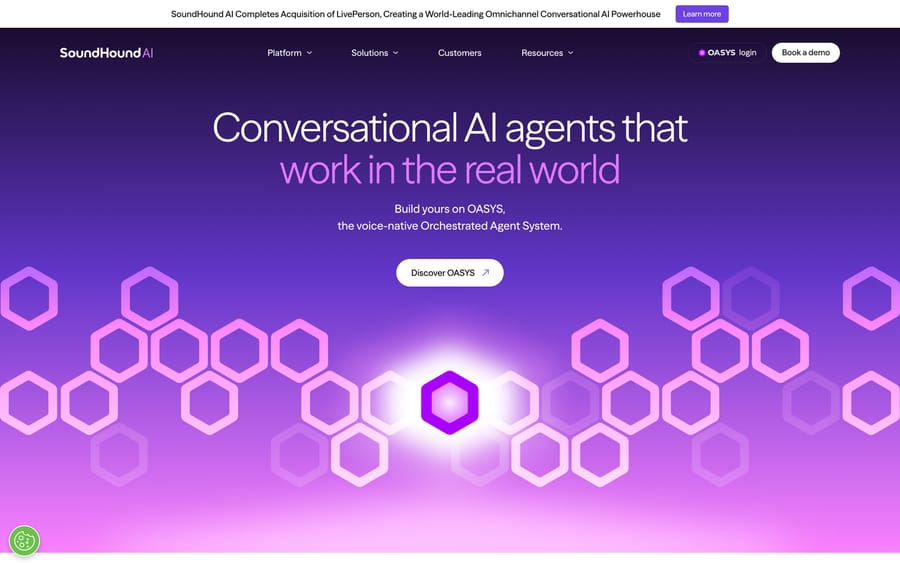
SoundHound was founded in 2005 as Melodis Corp by Keyvan Mohajer, James Hom, and Majid Emami, rebranding to SoundHound in 2010 after its Midomi music-recognition app took off. The company went public via a SPAC merger with Archimedes Tech SPAC Partners on April 28, 2022, at a $2.1 billion valuation, and now trades on NASDAQ as SOUN. Its own newsroom reports Q2 revenue of $61.9 million, up 45% year over year, alongside a raised full-year outlook. That's the company's own figure; we did not independently audit it.
The company has grown largely through acquisition over the past three years: SYNQ3 Restaurant Solutions (December 2023, $25 million), Allset (June 2024), Amelia AI (August 2024, $85 million, a well-known enterprise conversational AI vendor in its own right), Interactions LLC (September 2025, $60 million), and, most recently, LivePerson, confirmed directly on SoundHound's own homepage banner as completed. That's a genuinely aggressive consolidation strategy: a buyer evaluating "SoundHound AI" today is really evaluating the combined output of at least five formerly independent companies now merged into one platform.
Named customers span automotive, restaurants, retail, healthcare, and hospitality: GoDaddy, Chipotle, Five Guys (92% AI phone order completion, per SoundHound's own case study), Stellantis, Lucid Motors, Resorts World Las Vegas (59% of guest volume automated), and Jersey Mike's.
How SoundHound AI works
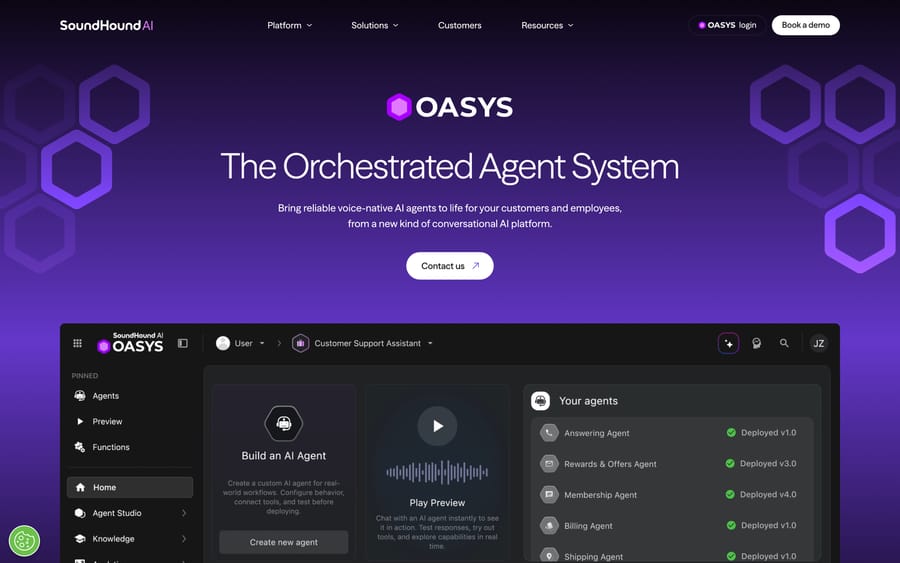
OASYS (Orchestrated Agent System) is SoundHound's current platform, built around voice-native AI agents that operate across both digital and physical touchpoints, a drive-thru speaker, a phone line, an in-vehicle assistant, and a web chat widget, from one unified system. The dashboard shown above illustrates the actual mechanism: instead of one monolithic bot, a business deploys multiple named, independently versioned agents (an Answering Agent, a Rewards & Offers Agent, a Billing Agent), each handling a specific task and each individually testable in a "Play Preview" mode before deployment.
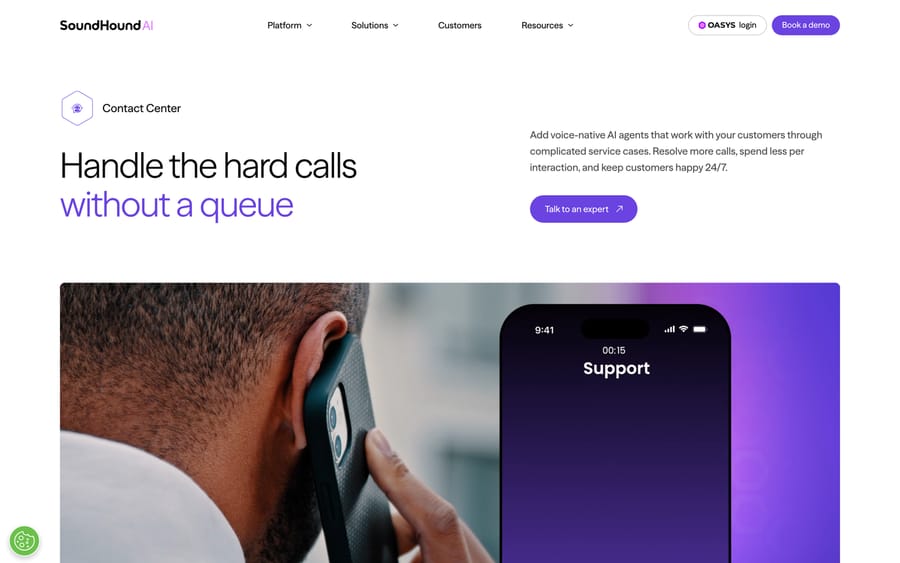
The platform includes enterprise guardrails specifically: rule-based actions, optional human-assisted resolution for cases outside an agent's confidence, and a proprietary PII-detection LLM, alongside ISO 27001 and SOC 2 Type II certification. SoundHound frames its differentiator as working reliably "in the real world," a direct reference to noisy, real-world voice conditions: a drive-thru speaker with traffic noise, a phone call with background chatter, instead of the clean, scripted demo environment competitors are sometimes benchmarked in.
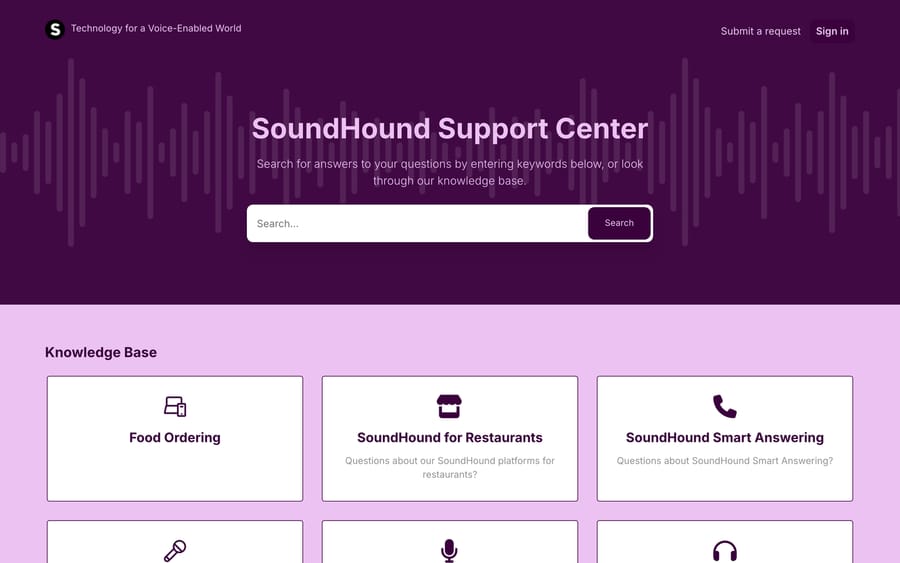
SoundHound's own public support center corroborates the acquisition-driven product spread directly: its knowledge base is organized by product line (Food Ordering, SoundHound for Restaurants, SoundHound Smart Answering, and more), rather than one unified help section, a visible trace of the same multi-product consolidation discussed above.
Key features
- OASYS: the core orchestration platform for building, deploying, and versioning multiple named AI agents.
- Voice-native processing tuned for noisy, real-world physical environments (drive-thru, in-vehicle, phone).
- Omnichannel deployment, now expanded through the LivePerson acquisition to cover a broader digital messaging footprint.
- Human-assisted resolution: a built-in escalation path when an agent's confidence is low, instead of a hard failure.
- Enterprise guardrails: rule-based action constraints, a proprietary PII-detection LLM, ISO 27001 and SOC 2 Type II certification.
- Agent Studio and testing tools: individual agents can be previewed and tested before deployment, each independently versioned.
SoundHound AI pricing
SoundHound doesn't publish pricing anywhere in its site navigation; there's no pricing page, and the only calls to action are "Book a demo," "Talk to an expert," or "Contact us." As a public company, SoundHound's overall financials are disclosed (the $61.9 million Q2 revenue figure above), but that's company-wide revenue. It isn't a per-customer rate card, and it spans a mix of enterprise contact-center deals, automotive OEM licensing, and restaurant/retail deployments priced very differently from each other. Budget for a sales conversation and a scoping call instead of a self-serve signup.
Keeping pricing off the site is a natural incentive for a company that just absorbed five acquisitions into one platform: a published rate card would need to account for wildly different deal shapes (a restaurant chain's per-location drive-thru rollout versus an automotive OEM's per-vehicle licensing versus a contact center's per-seat contract) that a sales team can price individually but a single number can't represent honestly.
Pros and cons
Pros
- A publicly traded company (NASDAQ: SOUN) with disclosed, auditable financials and a fast-growing revenue base.
- Genuine acquisition-driven breadth: Amelia's enterprise conversational AI, Interactions' contact-center technology, and LivePerson's omnichannel messaging are now combined under one roof.
- Specific, named efficiency claims (92% AI phone order completion at Five Guys, 59% guest automation at Resorts World Las Vegas) backed by public case studies.
- Real enterprise guardrails (PII detection, human-assisted resolution, ISO/SOC 2 certification) built into the core platform.
Cons
- No published pricing anywhere; every deal requires a sales conversation.
- Rapid, ongoing acquisition activity (five deals in under two years) means the platform a buyer evaluates today may look meaningfully different in twelve months as integrations complete.
- Brand fragmentation (SoundHound, Houndify, OASYS, plus newly absorbed Amelia, Interactions, and LivePerson branding) makes research genuinely harder than for a single-product vendor.
- We could not obtain independent, attributed customer reviews for this guide: G2 blocked automated access and a Capterra listing we tried returned a 404.
What actual users say
We were not able to independently verify user sentiment for this guide. G2's review page returned a blocked response to our direct fetch, and a Capterra product URL we tried resolved to a 404 rather than SoundHound's actual listing. This session's search budget was exhausted before an alternative source could be checked. Rather than substitute an unverified number, we're disclosing the gap directly: check G2 and Capterra yourselves for current ratings before a purchase decision, keeping in mind that reviews may still be split across the Amelia, Interactions, and legacy SoundHound/Houndify product names during this integration period.
How we researched this: we checked SoundHound's homepage, OASYS platform page, contact center use-case page, and about page directly on 2026-09-17. Founding and acquisition history came from a WebFetch of the company's Wikipedia entry, cross-checked against SoundHound's own leadership bios; the LivePerson acquisition specifically is confirmed on SoundHound's own homepage banner as of this research date. Independent review platforms were not accessible during this research session.
Who SoundHound AI is best for
SoundHound AI fits teams at large, physical-world-facing enterprises, restaurants, automotive OEMs, hospitality, and contact centers with real voice volume, that want a single vendor now covering voice, chat, and omnichannel messaging after its recent acquisitions, and that have a procurement process suited to a public company's enterprise sales cycle. The Five Guys and Resorts World Las Vegas case studies are a good proxy for the ideal buyer: high call volume, a physical or drive-thru component, and a clear efficiency metric to hit.
It's a weaker fit for a team that wants a single, stable, well-documented product rather than a platform still absorbing multiple recent acquisitions, or a smaller team without the procurement capacity for an enterprise, demo-gated sales process.
SoundHound AI vs alternatives
| SoundHound AI (OASYS) | Kore.ai | Macha | |
|---|---|---|---|
| Model | Voice-native agent orchestration platform, expanding via acquisition into omnichannel | Enterprise agentic AI platform for CX and EX | AI agent layer on your existing help desk |
| Best for | Large, physical-world enterprises with real voice/call volume | Enterprise contact centers wanting a dedicated agent platform | Teams on Zendesk, Freshdesk, Gorgias, or Front |
| Pricing | Not published; sales-led enterprise deal | Not independently verified here; see the Kore.ai guide | From $299/mo for 750 tickets (~$0.40/ticket), published |
| Setup | Enterprise sales cycle, demo-gated | Sales-led, enterprise onboarding | Built, tested, and monitored by the Macha team |
| Trial | Demo-gated | Demo-gated | $50 free usage |
| Replaces your help desk? | Can, depending on deployment (contact center + omnichannel) | No, layers onto existing CX/EX systems | No, deliberately augments it |
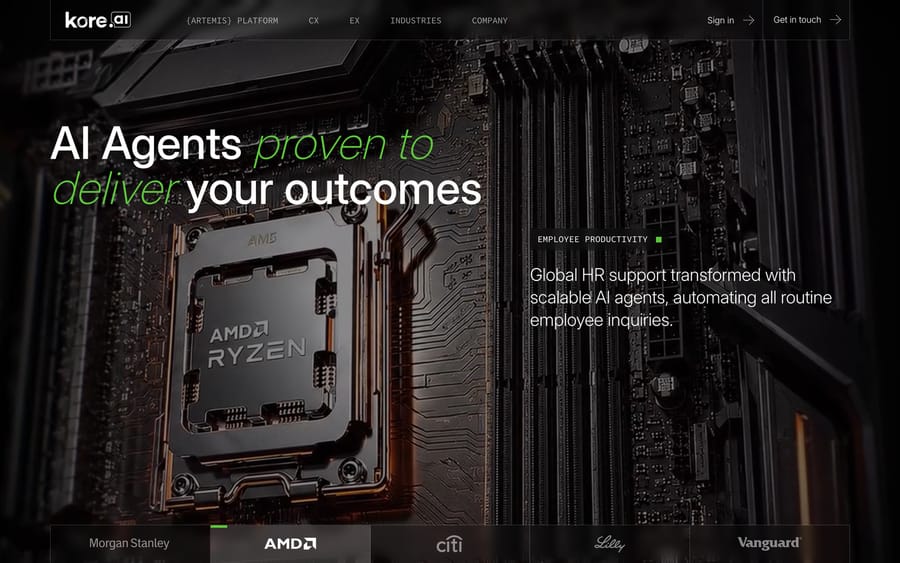
SoundHound AI and Kore.ai both sell enterprise conversational AI through sales-led processes, but SoundHound's specific edge is voice performance in noisy, physical-world settings, drive-thrus, in-vehicle systems, phone lines, built from two decades of audio processing work, while Kore.ai's platform is channel-agnostic from the start.
Macha sits at a different layer entirely: instead of a voice-native platform expanding into omnichannel messaging, it's an AI agent layer that runs on top of a help desk a team already uses (Zendesk, Freshdesk, Gorgias, or Front). A restaurant chain or automotive OEM with real drive-thru or call-center voice volume fits SoundHound; a team whose queue is mostly email and chat tickets inside an existing help desk fits Macha. See Macha's pricing or start with $50 of free usage against real tickets.
FAQ
What is SoundHound AI? SoundHound AI is a publicly traded (NASDAQ: SOUN) voice AI company, founded in 2005, whose current platform, OASYS, orchestrates multiple named AI agents across voice and omnichannel touchpoints for enterprises.
What is OASYS? OASYS (Orchestrated Agent System) is SoundHound's current agent-building and deployment platform, letting a business build, test, version, and deploy multiple distinct AI agents (billing, rewards, answering, and so on) from one dashboard.
What companies has SoundHound AI acquired? SYNQ3 Restaurant Solutions (Dec 2023), Allset (June 2024), Amelia AI (Aug 2024, $85M), Interactions LLC (Sept 2025, $60M), and most recently LivePerson, confirmed completed on SoundHound's own homepage.
How much does SoundHound AI cost? SoundHound doesn't publish pricing. Every engagement goes through a demo request and sales conversation, consistent with a public enterprise vendor selling into contact centers, restaurants, and automotive OEMs.
What do real users say about SoundHound AI? We could not obtain independent review data for this guide: G2 blocked our direct access and a Capterra listing we tried returned a 404. Check G2 and Capterra directly, keeping in mind reviews may be split across SoundHound, Amelia, and Interactions product names during this integration period.
Is Macha an alternative to SoundHound AI? Not directly. SoundHound AI is a voice-native platform expanding into omnichannel enterprise messaging; Macha is an AI agent layer that runs on top of a help desk a team already uses (Zendesk, Freshdesk, Gorgias, or Front). A business with real voice or drive-thru call volume fits SoundHound; a team whose queue is mostly email and chat fits Macha.
Sources: SoundHound AI, SoundHound OASYS, SoundHound Contact Center, SoundHound about, Wikipedia's SoundHound AI entry (for founding and acquisition dates). G2's review page blocked our direct fetch; a guessed Capterra listing 404'd.
Resolve tickets automatically with AI agents
Macha's AI agents work on top of the help desk you already use — no code.