Intercom
 Shopify
 Stripe
 Slack
Slack Notion
 Google Workspace
 Confluence

SupportLogic: The Complete Guide (2026)


SupportLogic sells AI agents that read the sentiment, urgency, and risk hiding inside support tickets, chats, and calls, then flag which ones are about to escalate before a customer does it for you. This guide covers what its 16 "ambient AI agents" actually do, what it costs starting at a real published floor, and how it compares to Level AI if you're evaluating support intelligence platforms.

We build AI agents for customer service ourselves, and we checked SupportLogic's own case studies against what it actually ships. One thing stood out immediately: SupportLogic's core pitch is detection and prediction. It tells a team a case is about to blow up. It doesn't answer the ticket.
What is SupportLogic?
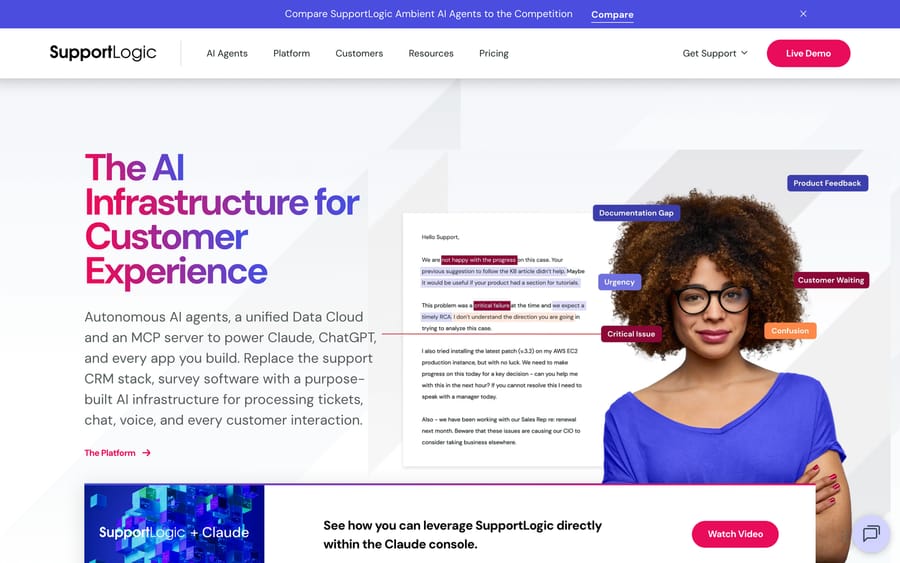
SupportLogic calls its product "AI Infrastructure for Customer Experience," built around 16 specialized "Ambient AI Agents" that each address one function: sentiment, escalation prediction, routing, coaching, voice, account health, and summarization among them. The pitch is explicitly against the CRM model of doing this work: "Support CRMs were built for tickets. The next decade belongs to agents," is the company's own framing, and it positions its architecture as "CRM-less," sitting alongside Salesforce or Zendesk instead of replacing the ticketing system itself.
The company reports roughly 67 customers globally per third-party firmographic data, concentrated in enterprise technology and software companies: CrowdStrike, Databricks, Fivetran, NICE, Elastic, and Rubrik are named on its site. That's a small, concentrated customer base for a company operating at this pricing level, and it signals a product built for a specific kind of enterprise support org, not a broad market play.
How SupportLogic's AI works
The architecture starts with three foundation layers: a Context Agent, a Signal Extraction Agent, and a Data Extraction Agent, which feed the 16 specialized agents built on top. Per SupportLogic's own platform page, the Signal Extraction layer can "automatically extract 40 different customer signals and hundreds of domain-specific keywords" from tickets, chats, and call transcripts as they come in, live, instead of in a nightly batch job. Those signals (urgency, confusion, a documentation gap, a critical issue) get tagged directly onto the interaction, which is what the homepage screenshot above shows in practice: a customer email is annotated in real time with the emotional and risk signals SupportLogic's models pulled out of the raw text.
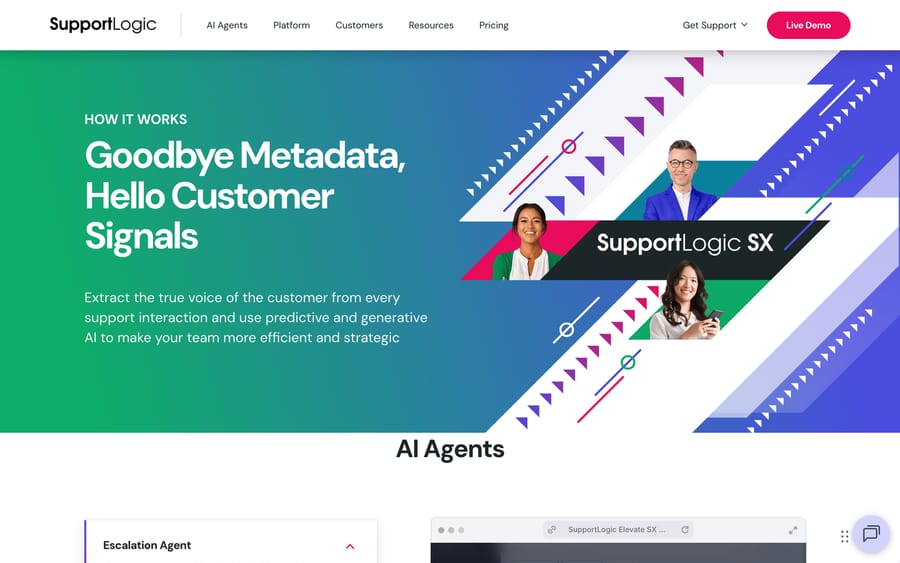
The Escalation Agent uses those signals to generate "real-time insights and automated QA, CSAT, and CES predictions," which is the mechanism behind the vendor's headline claim: catching an escalation before it happens, before a customer has already asked for a manager. SupportLogic also ships an MCP Server, meaning the same signal data can feed directly into Claude, ChatGPT, or Gemini as grounded context, and a Data Cloud component that pushes the same predictive signals into a Snowflake-native warehouse for a team that wants to query them alongside other business data.
Key features
- 16 Ambient AI Agents covering sentiment, escalation, routing, coaching, voice, account health, and summarization.
- 40+ signal extraction, pulling structured emotional and risk signals out of unstructured ticket, chat, and call text as it arrives.
- MCP Server, exposing SupportLogic's signal data as grounded context for Claude, ChatGPT, and other AI assistants.
- Data Cloud, a Snowflake-native layer for querying SupportLogic's predictions alongside a company's own data warehouse.
- CRM widgets, embedding directly into Salesforce and Zendesk so agents don't need a separate tool.
- REST API for programmatic access to signals and predictions.
SupportLogic pricing
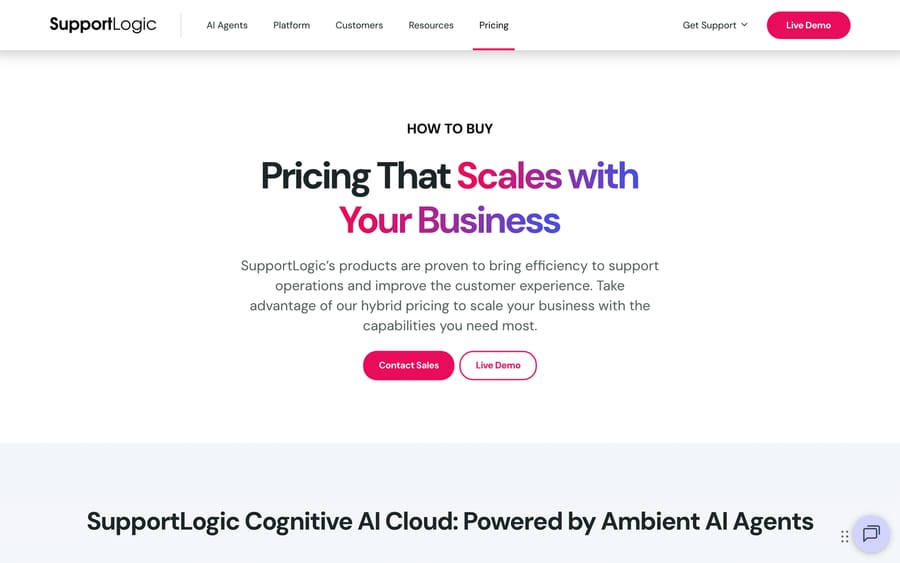
SupportLogic publishes a real floor, which is more than several vendors in this category do: pricing starts at $4,000 a month, on a pre-paid annual contract. Beyond that number, the model is a hybrid of usage-based and seat-based charges.
The usage component is credit-based: a starting allocation of 2.5 million credits scaling up to 100 million, tied to the volume of tickets, transcripts, and chat sessions the platform processes. Seat-based licensing applies separately to three specific product bundles: Assign (intelligent case routing), an automated-QA bundle, and Resolve SX (agent-facing tools), with volume discounts available up to 50%. Beyond the $4,000 floor, exact per-bundle and per-credit pricing requires a sales conversation and an Enterprise Licensing Agreement for larger accounts.
The incentive worth naming: a credit-metered, seat-plus-usage model means SupportLogic's revenue scales with how much data a team pushes through it, not with how many escalations it actually prevents. That's a different alignment than an outcome-based vendor, and it's worth asking directly how the credit consumption scales as ticket volume grows, since that's the number that determines whether the $4,000 floor holds or climbs fast.
Pros and cons
Pros:
- Publishes an actual pricing floor ($4,000/month) instead of a pure "contact sales" wall, which most enterprise support-intelligence vendors don't do.
- Customer-reported results are concrete: Coveo's Chief Customer Officer is quoted directly reporting a 50% MTTR reduction within three months of using Intelligent Case Assignment, and a separate SupportLogic case-study headline claims a 30% drop in escalations for Qlik within six months (that one is the vendor's own headline, not a quote from a named Qlik person).
- The CRM-less architecture means it layers onto Salesforce or Zendesk rather than asking agents to learn a new primary tool.
- MCP Server support is a genuinely forward-looking integration choice, letting a team's existing Claude or ChatGPT workflows pull SupportLogic's signal data directly.
Cons:
- The $4,000/month floor, paid annually upfront, prices out small support teams entirely; this is built for enterprise accounts with real escalation volume to manage.
- Full pricing for the three product bundles (Assign, the automated-QA bundle, Resolve SX) isn't public, so a buyer can't build an accurate estimate without a sales call.
- We could not verify an independent third-party review rating. G2 and TrustRadius blocked automated access, PeerSpot and Software Advice returned no usable review page, and SupportLogic's own Salesforce AppExchange listing shows "No Ratings." That's an unusually thin public review record for a vendor at this price point and customer roster.
- SupportLogic detects and predicts; it doesn't resolve tickets itself. A team still needs a separate automation or agent layer to act on what SupportLogic flags.
Who SupportLogic is best for
SupportLogic suits enterprise support teams that already have meaningful ticket volume and a real escalation problem: teams like Databricks or Certinia, tracking CSAT and SLA misses across a large account base, where catching a case before it escalates has measurable dollar value. It's a weaker fit for a small or mid-sized support team, both because of the $4,000 floor and because the product's job is surfacing risk. A team without a downstream process for acting on SupportLogic's flags (a coaching workflow, an escalation desk, an account health review) won't get much value from knowing a ticket is at risk.
SupportLogic vs alternatives
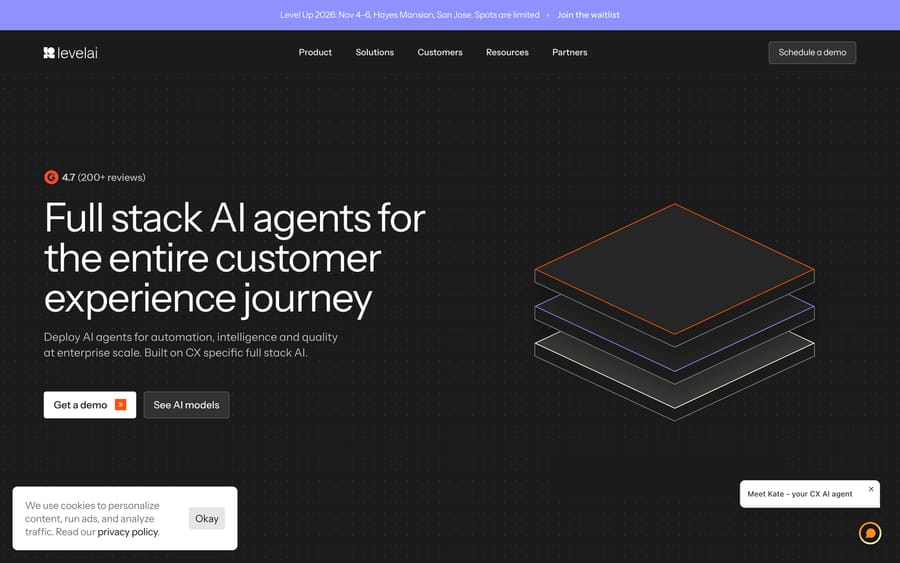
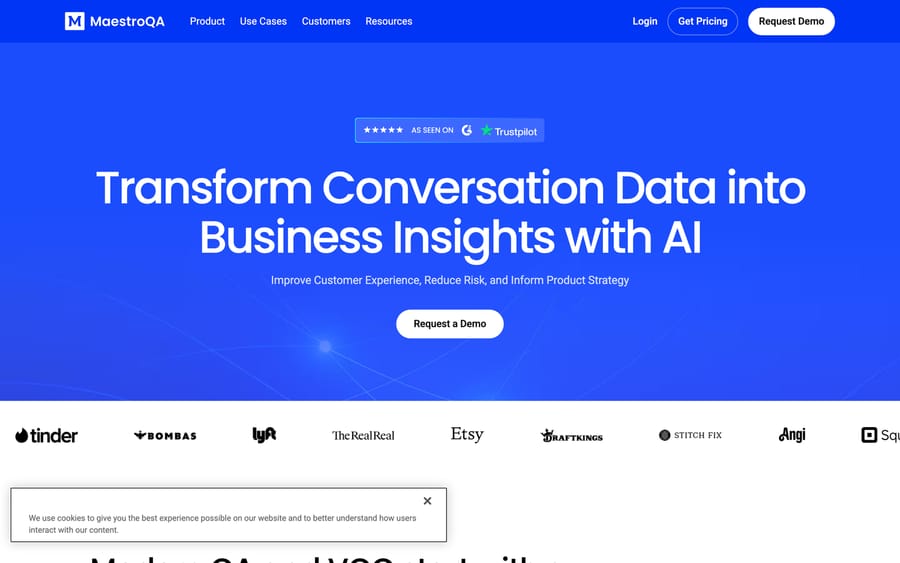
Level AI is the most direct comparison: both companies sell AI infrastructure that sits on top of a support team's existing tools to extract signal from conversations, on top of the help desk instead of inside it. MaestroQA is a second reasonable comparison specifically for the QA and coaching angle, since it targets the same "turn conversation data into quality insight" problem with a lighter-weight product. Macha is a different category: an AI agent layer that acts on tickets directly, instead of a signal-extraction layer that flags them for a human to act on.
| SupportLogic | Level AI | Macha | |
|---|---|---|---|
| Model | Ambient AI agents extracting sentiment/escalation signal from support data | Full-stack AI agents across the CX journey, layered on existing tools | AI agent layer that resolves tickets on your existing help desk |
| Best for | Enterprise support orgs tracking escalation, CSAT and SLA risk at scale | Enterprise CX teams wanting broader automation plus quality/coaching | Support teams on Zendesk, Freshdesk, Gorgias or Front |
| Pricing | Published floor: from $4,000/mo, hybrid usage + seats | Not published on its pricing page; reports 4.7/200+ reviews on its own G2 badge | From $299/mo for 750 tickets (~$0.40/ticket), published |
| Setup | Vendor-led enterprise onboarding | Vendor-led enterprise onboarding | Built, tested and monitored by the Macha team |
| Trial | Demo only | Demo only | $50 free usage |
If the actual gap is that tickets pile up faster than agents can answer them, SupportLogic's flags won't close that gap on their own; something still has to write the reply. Macha fits teams stuck on that exact problem: Macha's AI agent layer does the answering directly, with published pricing instead of a sales-call floor.
How we researched this
This guide is based on SupportLogic's own homepage, pricing page, platform page, and customer case studies (all fetched 2026-09-18), plus Level AI's own homepage for its self-reported G2 badge. We could not locate SupportLogic's founding year or funding history: its /about and /news pages, as we found them on 2026-09-18, carried only product news, and G2, TrustRadius, Crunchbase, PeerSpot, and the Salesforce AppExchange all either blocked automated access or showed no rating data on that same check. We're stating that gap directly rather than filling it with an unverified guess.
FAQ
What is SupportLogic used for? SupportLogic extracts sentiment, urgency, and escalation-risk signals from support tickets, chats, and calls, then predicts which cases are likely to escalate so a team can intervene before a customer complains further.
How much does SupportLogic cost? Pricing starts at $4,000 a month on a pre-paid annual contract, combining usage-based credits (2.5 million to 100 million) with seat-based licensing across its Assign, automated-QA, and Resolve SX bundles. Full bundle pricing requires a sales conversation.
Does SupportLogic replace my CRM or help desk? No. It's built as a "CRM-less" intelligence layer that sits alongside Salesforce, Zendesk, or another ticketing system, extracting signal from the data already flowing through it rather than replacing the system of record.
Who founded SupportLogic and when? We could not verify a public founding date or funding history for SupportLogic. Its own site and major funding databases did not surface this information as of 2026-09-18.
What are the best SupportLogic alternatives? Level AI is the closest direct competitor, selling full-stack AI agents across the CX journey with a published G2 rating on its own site. MaestroQA is a narrower alternative focused specifically on QA and coaching. If the actual need is resolving tickets rather than flagging them, an AI agent layer like Macha does that job directly.
Is there a free trial for SupportLogic? No public self-serve trial. SupportLogic sells through a live demo and a sales-led quote process.
Does SupportLogic resolve customer tickets automatically? Not directly. It detects, tags, and predicts risk in a conversation; a human agent or a separate automation layer still has to act on what it surfaces.
What data sources does SupportLogic connect to? Tickets, chat transcripts, and voice/call data feed its signal extraction, and it integrates with existing CRM and ticketing systems like Salesforce and Zendesk via embedded widgets and a REST API.
Whichever support-intelligence platform you're comparing, ask what happens after the signal fires: SupportLogic tells you a case is at risk, but somebody or something still has to act on it. If that "somebody" is an overloaded queue of tickets, see how Macha's agents work on your existing help desk.
Sources:
- https://www.supportlogic.com
- https://www.supportlogic.com/pricing
- https://www.supportlogic.com/platform
- https://www.supportlogic.com/customers
- https://www.6sense.com/tech/customer-experience-management/supportlogic-market-share
- https://appexchange.salesforce.com/appxListingDetail?listingId=a0N4V00000Gsq6yUAB
- https://thelevel.ai
- https://www.maestroqa.com
Resolve tickets automatically with AI agents
Macha's AI agents work on top of the help desk you already use — no code.