Intercom
 Shopify
 Stripe
 Slack
Slack Notion
 Google Workspace
 Confluence

Teneo AI: The Complete Guide (2026)


Teneo AI is an enterprise voice AI platform built around a strict claim: "no direct LLM output ever touches a customer interaction." This guide covers what that controlled-response architecture actually does, verified results at Medtronic and Swisscom that held up against a direct check of the underlying case studies, what Teneo costs since it doesn't publish pricing, and how it compares to Kore.ai and Macha for teams evaluating enterprise voice AI against a lighter, help-desk-native option.

Teneo's pitch runs directly against the generate-anything approach most conversational AI vendors now lead with. Its homepage banner reads "AI that doesn't guess. Ever," a specific, checkable design claim rather than a vague safety promise.
What is Teneo AI?
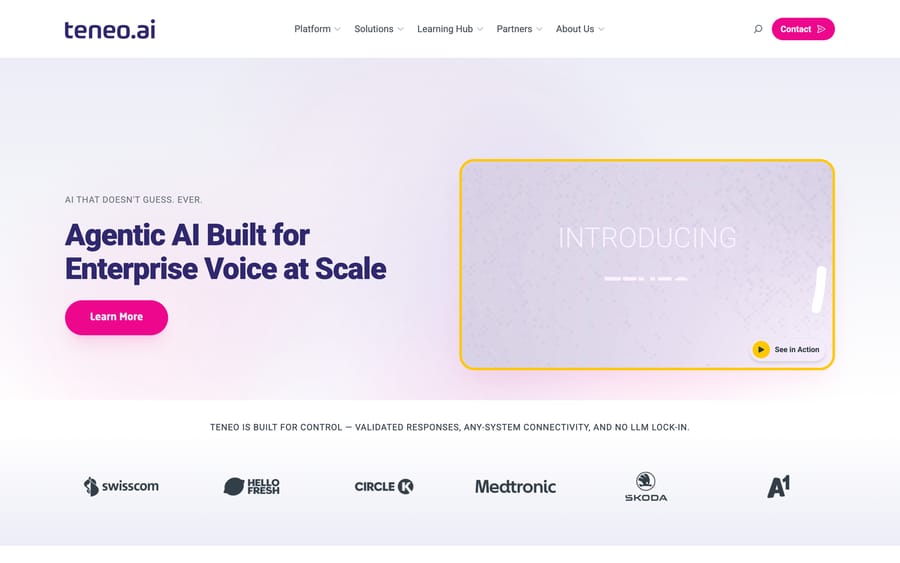
Teneo AI is an enterprise conversational AI platform focused on contact-center voice automation, built for organizations running Genesys Cloud, Amazon Connect, and similar CCaaS platforms. Its architecture keeps generative AI at arm's length from the customer: "only controlled responses reach your customers," with the platform describing itself as "LLM-independent by design," letting a customer choose how much generative AI to use, and which model, without getting locked into one provider. Teneo is a rebrand rather than a recent startup: the company was founded in Stockholm in 2001 as Artificial Solutions and traded on Nasdaq First North under the ticker ASAI before rebranding as Teneo.ai in August 2024.
The platform reports 17,000-plus AI agents in production, 99% intent accuracy, support for 86-plus languages, and named enterprise customers including Telefónica Germany, Swisscom, Medtronic, HelloFresh, Circle K, Škoda, and A1.
Verified results: Medtronic and Swisscom hold up
This category has produced more than one vendor whose homepage statistics don't match its own case studies once you check. Teneo is a useful contrast: we fetched the individual case studies behind three of its headline claims, and all three matched.
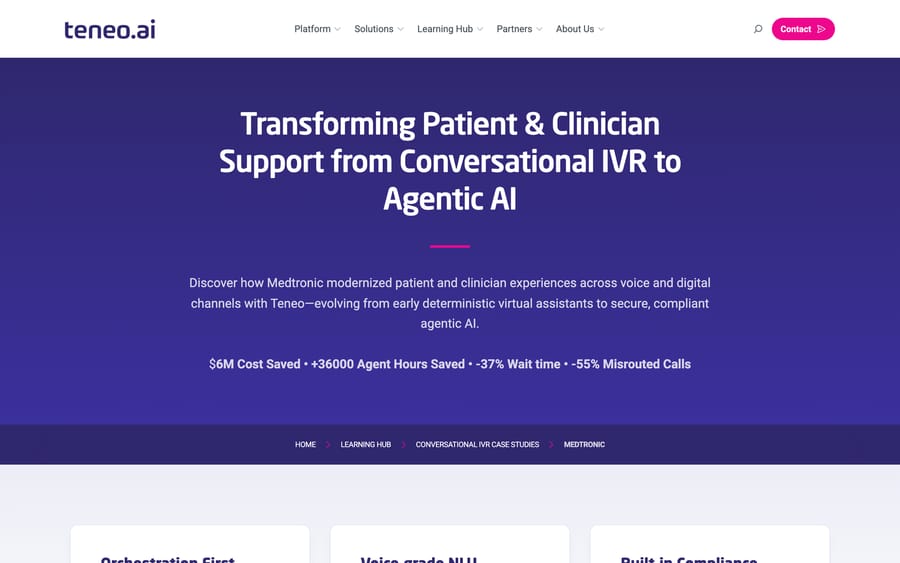
Medtronic's case study confirms the homepage's $6 million saved and 36,000 agent hours freed exactly, and adds detail beyond the homepage figure: cost per contact fell from $25.96 to under $12 in its Cardiovascular Group business unit, wait times dropped 37%, misrouted calls fell 55%, and field reps got back 4-5 hours a week. Telefónica's case study confirms "almost one million voice-based requests per month," matching the homepage's "900,000+ monthly calls" closely, plus 200,000 monthly SMS and WhatsApp requests. Swisscom's case study confirms "9 million calls per year," matching the homepage's figure exactly, alongside an 18-point Net Promoter Score increase.
We could not locate the specific case study behind the homepage's separate claim of "$32.4M monthly savings for one customer," a figure large enough that it's worth asking Teneo directly which customer and what methodology produced it before treating it as comparable to the three verified numbers above.
How Teneo's AI works
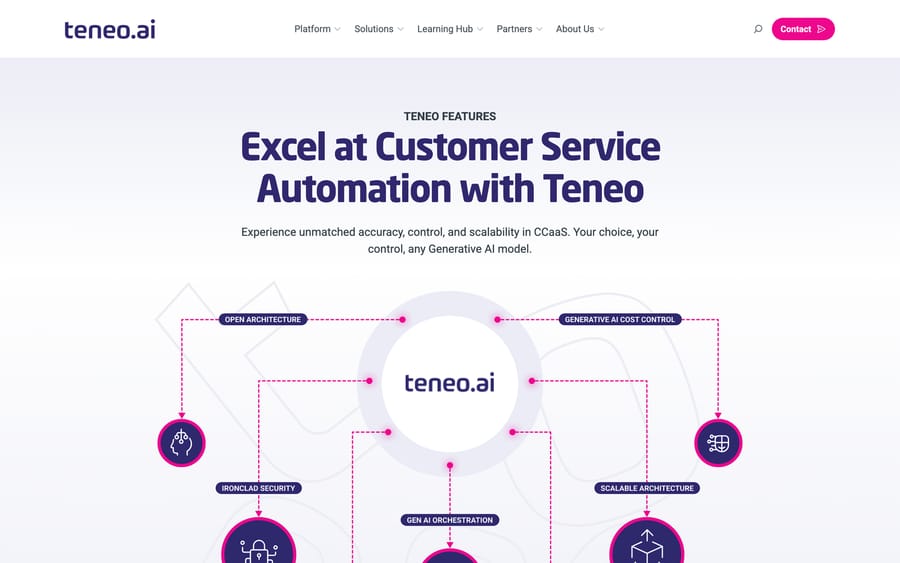
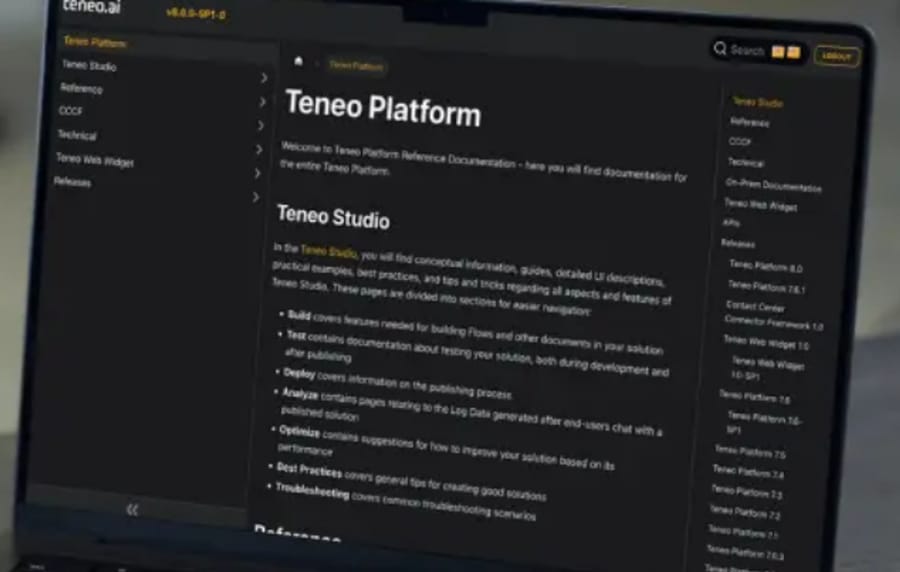
Teneo's core design choice is response validation before delivery, rather than raw model output reaching a caller directly. That's paired with omnichannel consistency across voice, chat, apps, and email, any-system integration via API, support for Model Context Protocol and Agent-to-Agent protocols (recent standards for how AI agents interoperate), and a low-code agent builder with public API access for engineering teams that want to build on top of the platform rather than only configure it through a UI.
Key features
- Validated-response architecture: generative AI output is checked before it reaches a customer, aimed at eliminating hallucinated answers on high-volume voice traffic.
- LLM-independent design: choose which model (or models) power the platform, without a hard dependency on one vendor.
- Omnichannel: voice, chat, apps, and email from one platform.
- Low-code agent builder with public API access for deeper customization.
- MCP and Agent-to-Agent protocol support, positioning Teneo to interoperate with other agent systems as those standards mature.
Teneo AI pricing
Teneo AI does not publish pricing; the pricing URL returns a 404, and every path leads to a "Contact" form. We have no reliable published number or third-party estimate to cite.
Given the scale of its verified customer deployments, Medtronic alone reports an estimated $9-10 million in cumulative savings in one business unit, it's reasonable to assume Teneo's enterprise contracts run into six or seven figures annually for a large voice deployment, but treat that as a directional assumption, not a quote. Budget for an enterprise sales and integration cycle typical of contact-center-scale voice AI.
The incentive worth naming: a custom, quote-per-deal model lets Teneo price each enterprise account against the specific savings it expects to deliver, which is easier to justify internally when the number is $6 million than when it's a flat rate card. Ask for the same kind of before/after modeling Medtronic's case study shows, applied to your own call volume, before agreeing to a number.
What actual users say
Teneo's G2 reviews page returned a 403 to direct access. FeaturedCustomers.com gave an accessible rating instead: 4.7 out of 5.0, based on 3,545 reference ratings, with 29 testimonials and 27 case studies listed on the profile, checked 2026-09-17.
The individual testimonial and case-study text on that page sits behind a "locked content" wall that requires a FeaturedCustomers account to read, so we could not independently verify specific reviewer quotes beyond the aggregate score itself. Treat the 4.7/5.0 figure as a real, checkable data point, and ask Teneo directly for a customer reference call rather than relying on a quote you can't read in full.
Pros and cons
Pros
- Verified case-study results: three of three homepage customer statistics we checked (Medtronic, Telefónica, Swisscom) matched their individual case studies closely.
- A specific, checkable architecture claim (validated responses, no raw LLM output reaching customers) rather than a vague safety promise.
- LLM-independent design avoids locking a large voice deployment to one model provider.
- 4.7/5.0 on FeaturedCustomers, based on 3,545 reference ratings, a genuinely large sample for this category.
Cons
- No published pricing, and no reliable third-party estimate exists.
- One prominent homepage statistic ($32.4M in monthly savings) has no case study we could locate to verify it, unlike the platform's other headline numbers.
- No accessible G2 review page at the time of writing.
- Built for large-scale voice deployments on Genesys Cloud or Amazon Connect; a small team without that CCaaS infrastructure gets less benefit from the platform's core positioning.
Who Teneo AI is best for
Teneo fits teams at a large enterprise running high call volume through Genesys Cloud or Amazon Connect, where a validated, no-hallucination response is a hard requirement, healthcare (Medtronic), telecom (Telefónica, Swisscom, A1), and similarly regulated or high-stakes industries. The verified case studies all describe multi-year, multi-million-dollar deployments at meaningful scale.
It's the wrong choice for a team that wants to see a price before a sales call, or one that doesn't run a CCaaS platform Teneo is built to integrate with. A 15-person support team on a single help desk gets little from a platform built and priced around enterprise voice infrastructure.
Teneo AI vs alternatives
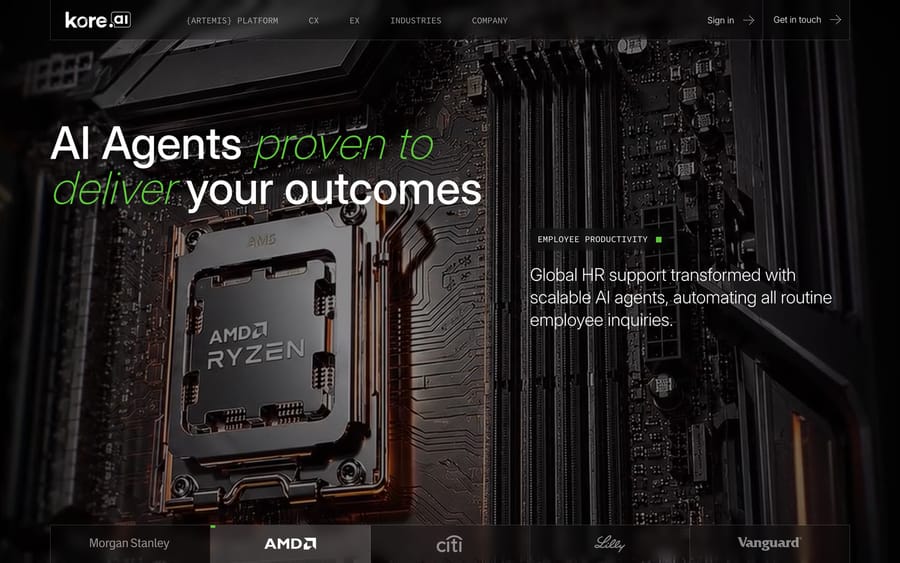
The closest comparison is Kore.ai, another enterprise conversational AI platform serving similarly large, regulated organizations. Kore.ai also publishes no pricing page, consistent with enterprise, sales-led software in this category.
| Teneo AI | Kore.ai | Macha | |
|---|---|---|---|
| Model | Enterprise voice AI with validated-response architecture | Broad enterprise conversational AI across industries | AI agent layer on your existing help desk |
| Best for | Large contact centers on Genesys Cloud or Amazon Connect | Enterprise contact centers across many verticals | Teams on Zendesk, Freshdesk, Gorgias, or Front |
| Pricing | Unpublished, sales-led | Unpublished, sales-led | From $299/mo for 750 tickets (~$0.40/ticket), published |
| Verified customer results | Medtronic, Telefónica, and Swisscom case studies matched homepage claims | Not independently verified for this guide | N/A (newer platform) |
| Self-serve trial | No | No | $50 free usage |
| Replaces your help desk? | No, voice-first for contact centers | No, layers onto an existing CCaaS/CRM stack | No, sits on top of Zendesk, Freshdesk, Gorgias, or Front |
Both Teneo and Kore.ai compete for the same large enterprise voice buyer. For our detailed take on Kore.ai specifically, see our guide to Kore.ai. Neither vendor reaches a support team's ticket queue inside a help desk; that's where Macha fits instead, published per-ticket pricing and a self-serve trial as an AI agent layer inside Zendesk, Freshdesk, Gorgias, or Front. For more on how enterprise voice AI compares to ticket-based agents, see our guide to AI agents for customer service.
How we researched this
We fetched Teneo.ai's homepage, features page, Teneo 8 launch page, and its Medtronic, Telefónica, and Swisscom case studies directly on 2026-09-17, using its sitemap to find real case-study URLs, specifically to check the homepage's headline customer statistics against each underlying case study. All three matched closely. We could not locate a case study for the separate "$32.4M monthly savings" claim. G2 returned a 403; FeaturedCustomers.com gave an accessible aggregate rating (4.7/5.0 based on 3,545 reference ratings), though the individual testimonial and case-study text on that page is locked behind an account wall, so we're not citing specific reviewer quotes from it. Kore.ai's homepage (captured previously for its own guide) is reused here for the comparison.
FAQ
What is Teneo AI? Teneo AI is an enterprise conversational AI platform for contact-center voice automation, built around a validated-response architecture that keeps raw generative AI output from reaching customers directly, integrating with Genesys Cloud and Amazon Connect.
How much does Teneo AI cost? Teneo doesn't publish pricing. There's no reliable third-party estimate; budget for an enterprise sales and integration cycle typical of contact-center-scale voice AI.
Are Teneo AI's customer results verified? The three we checked directly, Medtronic, Telefónica, and Swisscom, matched their homepage figures closely. A separate "$32.4M monthly savings" claim has no case study we could locate to verify it.
Is there a free trial? No self-serve trial is published. Every path on the site leads to a "Contact" form.
What do real users say about Teneo AI? FeaturedCustomers.com shows a 4.7/5.0 rating based on 3,545 reference ratings, checked 2026-09-17, across 29 testimonials and 27 case studies. The individual quote text on that page is locked behind an account wall, so treat the aggregate score as the verifiable data point and ask Teneo for a direct customer reference.
Was Teneo AI previously called something else? Yes. Teneo.ai was founded in Stockholm in 2001 as Artificial Solutions, traded publicly on Nasdaq First North under the ticker ASAI, and rebranded as Teneo.ai in August 2024.
What are good alternatives to Teneo AI? Kore.ai is the closest comparison: another enterprise conversational AI platform with unpublished, sales-led pricing serving similar large organizations. For a team running a single help desk instead of enterprise voice infrastructure, a lighter, help-desk-native AI agent is a better fit than either vendor.
Does Teneo AI replace a help desk? No. It's built for voice-first contact-center automation on top of platforms like Genesys Cloud and Amazon Connect. It isn't a general-purpose ticket queue for a single support inbox.
Ready to automate the ticket queue with published, per-ticket pricing instead of a sales-led enterprise contract? See how Macha's pricing works or start a trial on top of the help desk you already run.
Sources: Teneo.ai, Teneo features, Teneo 8 launch, Medtronic case study, Telefónica case study, Swisscom case study, FeaturedCustomers: Teneo AI reviews, Kore.ai.
Resolve tickets automatically with AI agents
Macha's AI agents work on top of the help desk you already use — no code.