Intercom
 Shopify
 Stripe
 Slack
Slack Notion
 Google Workspace
 Confluence

Workativ: The Complete Guide (2026)


Workativ is an AI agent platform that HR and IT teams deploy into Slack and Microsoft Teams to handle employee requests: password resets, PTO questions, onboarding, access provisioning, and more, without an employee ever opening a separate portal. This guide covers what Workativ actually does, real published pricing, an honest look at a named customer result, and how it compares to Moveworks and to a help-desk-native AI agent like Macha.

What is Workativ?
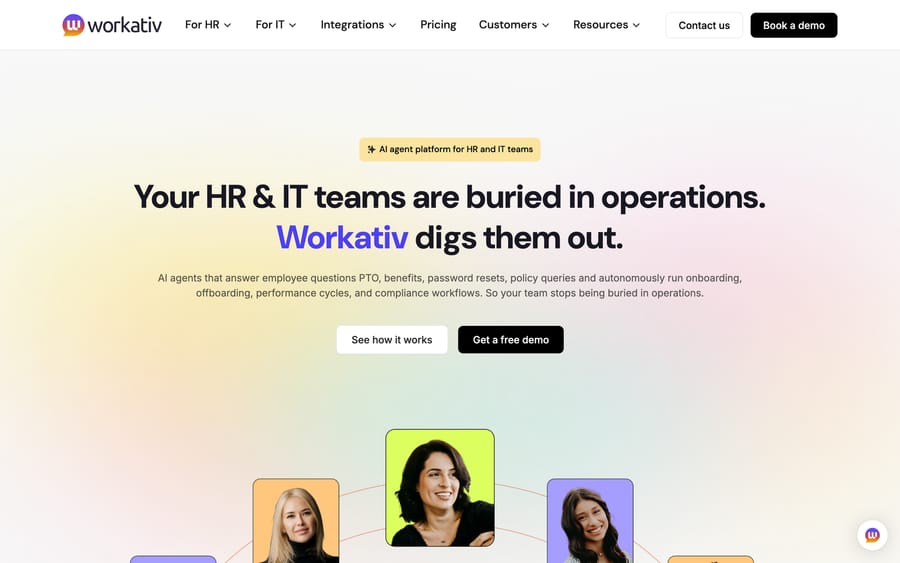
Workativ was founded in 2019 by CEO Imran Q. and is headquartered in Newark, Delaware. Unlike most vendors in this series, Workativ appears to be bootstrapped: Tracxn lists it as unfunded, with no venture rounds on record, which is unusual for a company selling into HR and IT departments at enterprises the size of Kraft Heinz and Lagardère.
The product sits inside the messaging tools employees already use. Workativ's AI agents live directly in a Slack or Teams channel and handle the request there, so nobody gets sent off to a separate HR or IT portal: answering a benefits question, resetting a password, or walking a new hire through onboarding steps from offer acceptance to a 90-day check-in.
How Workativ's AI works
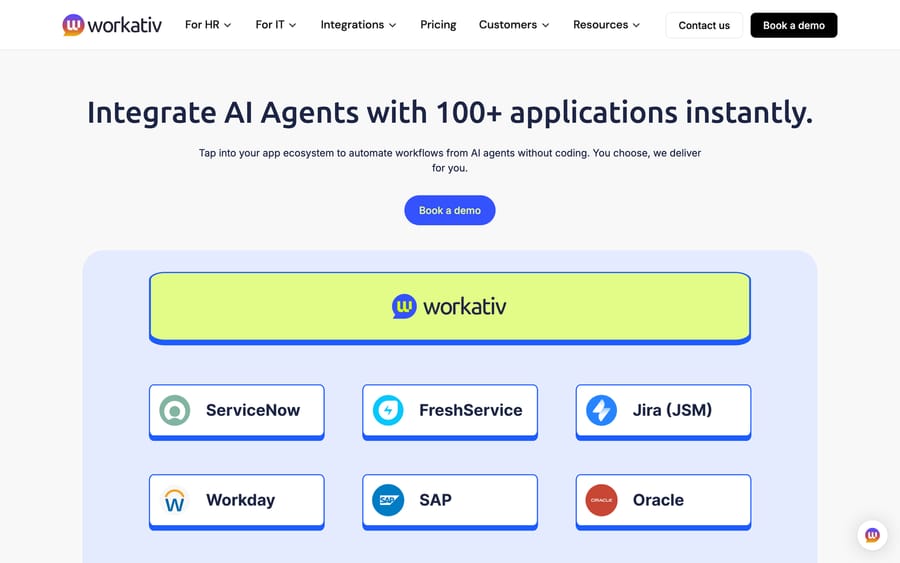
The mechanism is a bidirectional integration layer connecting AI agents to more than 100 HR, IT, and productivity systems: Workday, ADP, UKG, ServiceNow, Jira, Okta, and Azure AD among them. "Bidirectional" is the operative word. The agent doesn't just answer a question by reading data; it can also write back to the source system, so approving a PTO request or provisioning software access actually happens in Workday or ServiceNow, not just in the chat window.
For HR, that covers PTO and benefits questions, full onboarding sequences (offer through day-90 check-ins), offboarding (access revocation, equipment return, compliance sign-off), and performance-review cycles. For IT, it covers password resets, account unlocks, access requests, and what Workativ calls L0-L1 ticket resolution, the routine, repetitive tier of support tickets that doesn't need a human's judgment call. Workativ's own claim is that 65% to 80% of employee queries get resolved automatically, with anything more complex escalating to a human.
A real customer result
Workativ's GoTo case study is worth reading in full because it's specific. GoTo replaced its previous tool (BOLD360) with Workativ across 5,000 employees and more than 50 connected applications, deployed inside Slack for both IT and HR, and reports 84% of employee requests auto-resolved by the AI. Susan Treadway, GoTo's Vice President of HR Operations, is quoted directly: "Our AI Bot Orion has become a critical enabler of employee self-service. The quality of responses is fast, comprehensive, and highly reliable, allowing employees to find accurate answers without needing to escalate to HR or IT."
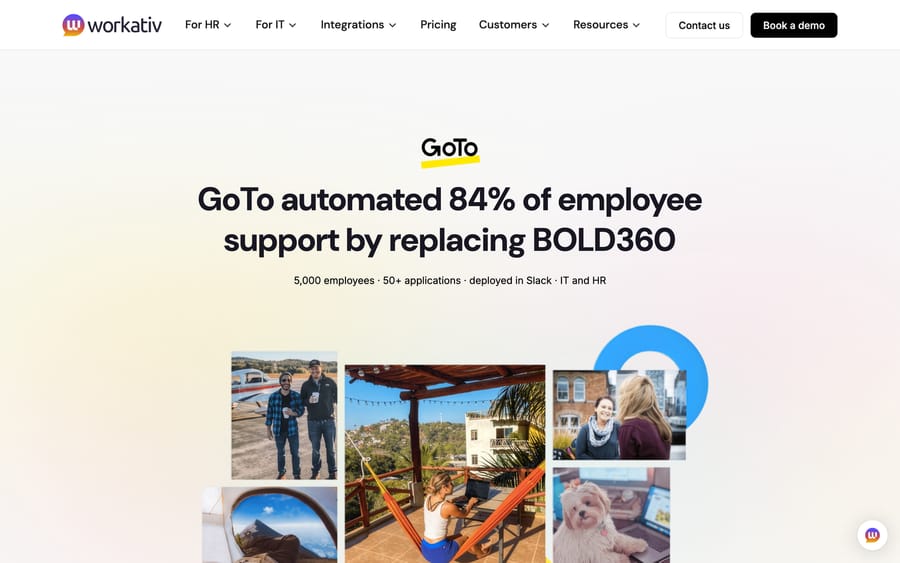
That's a genuinely attributed, named quote with a specific figure behind it, which is rarer in this category than it should be.
Key features
- AI agents deployed directly in Slack and Microsoft Teams, so employees never leave the tool they already work in.
- Bidirectional integrations with 100+ systems: Workday, ADP, UKG, ServiceNow, Jira, Okta, and Azure AD among them.
- End-to-end HR workflows: onboarding, offboarding, 30/60/90 check-ins, performance cycles, benefits enrollment, compliance tracking.
- IT ticket automation: password resets, account unlocks, access requests, and L0-L1 support.
- Session-based, not per-user, pricing, so adding more employees to the Slack workspace doesn't raise the bill on its own.
- Compliance certifications: SOC 2 Type II, ISO 27001, GDPR, and HIPAA.
- A stated deployment timeline of days, without requiring outside implementation consultants.
Workativ pricing
Workativ publishes real numbers, which puts it in the same small group as eGain in this series of guides.
| Plan | Price | What's included |
|---|---|---|
| Starter | $99/month | 50 AI chat sessions (per Workativ's homepage and corroborated by GetApp) |
| Business | $349/month (or 15% less billed yearly) | 500 AI chat sessions, train on up to 10 million characters, 2 AI agents, 5 actions, 3 admins/live agents, 60 days of data retention |
| Enterprise | Custom | Everything in Business, plus more sessions, custom app integrations, higher training limits, more live agents, and training on images and advanced documents |
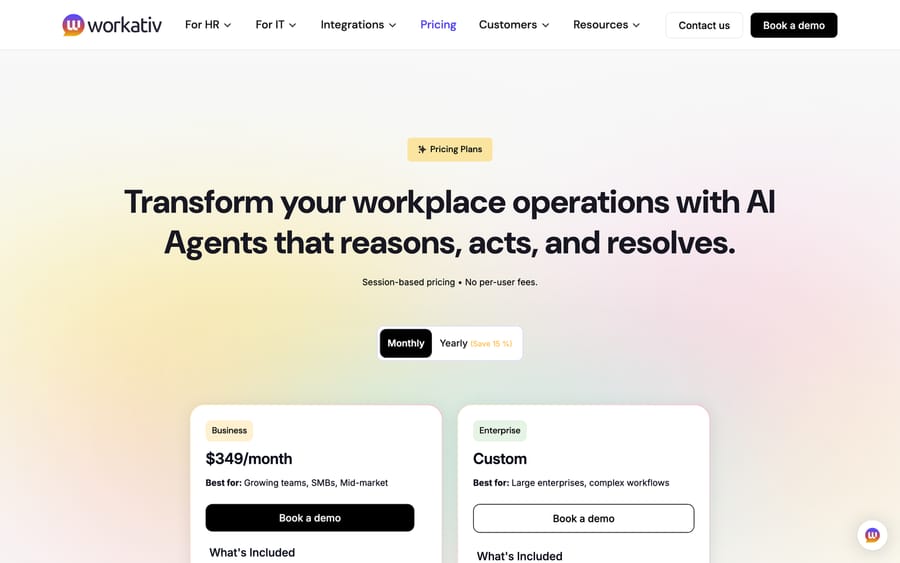
The pricing model itself sets an incentive worth naming: it's based on sessions and actions rather than per employee seat, so Workativ earns more as usage grows regardless of headcount, and a company with a small team running high volumes of automated actions could pay more than a much larger company that automates lightly. That's the opposite shape from most enterprise HR software, which usually bills per employee whether they use the tool or not.
Pros and cons
Pros
- Actually publishes pricing, with real per-tier numbers rather than "contact sales" at every level.
- Deploys inside Slack and Teams directly, so there's no separate portal for employees to learn.
- Bidirectional integrations mean the AI can act on a request instead of just describing how to submit one elsewhere.
- The GoTo case study is a genuinely strong, specifically attributed result: 84% automation, named executive quote, real scale (5,000 employees).
- Bootstrapped and apparently profitable enough to operate without VC funding, which is a different risk profile than most of the venture-backed vendors in this series.
Cons
- Review coverage is thin. GetApp Australia shows only 4 reviews, and G2 blocked our direct access, so there's a limited independent sample to weigh against the vendor's own case studies.
- Session-based pricing takes some modeling to predict; a team with unpredictable spikes in requests could see costs move around more than a flat per-seat price would.
- The Business plan's 500-session cap and 2-agent limit will genuinely constrain a mid-size company fast, pushing many real deployments toward the custom Enterprise tier anyway.
- Reviewers on GetApp specifically flagged limited third-party channel integrations beyond Slack and Teams, and occasional UI sizing issues with the bot window.
Who Workativ is best for
This fits teams led by an HR or IT leader at a company already living in Slack or Microsoft Teams who wants employee self-service handled inside that same tool, with real write-back into systems like Workday, ServiceNow, or Okta, going beyond a chatbot that just answers questions and stops there. The published pricing and days-not-months deployment claim also suit a team that wants to move without a long procurement cycle.
It's a weaker fit for a company whose employee support already runs through a dedicated portal or ticketing system employees are used to, where moving that workflow into a chat app would be a change management project, with no guarantee of a clear improvement, or for a team whose request volume is unpredictable enough that session-based pricing is hard to forecast confidently.
Workativ vs alternatives
| Workativ | Moveworks (ServiceNow) | Macha | |
|---|---|---|---|
| Model | AI agents for HR/IT deployed in Slack and Teams | Enterprise AI assistant across business applications, now part of ServiceNow | AI agent layer on your existing help desk |
| Best for | HR/IT teams wanting employee self-service inside Slack or Teams | Large enterprises wanting a single AI layer across many internal systems | Customer support teams on Zendesk, Freshdesk, Gorgias or Front |
| Pricing | Published: $99-$349/month, custom above | Not published; enterprise quote via ServiceNow | From $299/month for 750 tickets (~$0.40/ticket), published |
| Self-serve trial | Free trial available (per GetApp) | No | $50 of free usage, no credit card |
| Setup | Days, per Workativ's own claim, no consultants required | Enterprise implementation, typically multi-quarter | Built, tested and monitored by the Macha team |
| Who it serves | Employees (internal HR/IT support) | Employees (internal support across many systems) | Customers (external support tickets) |
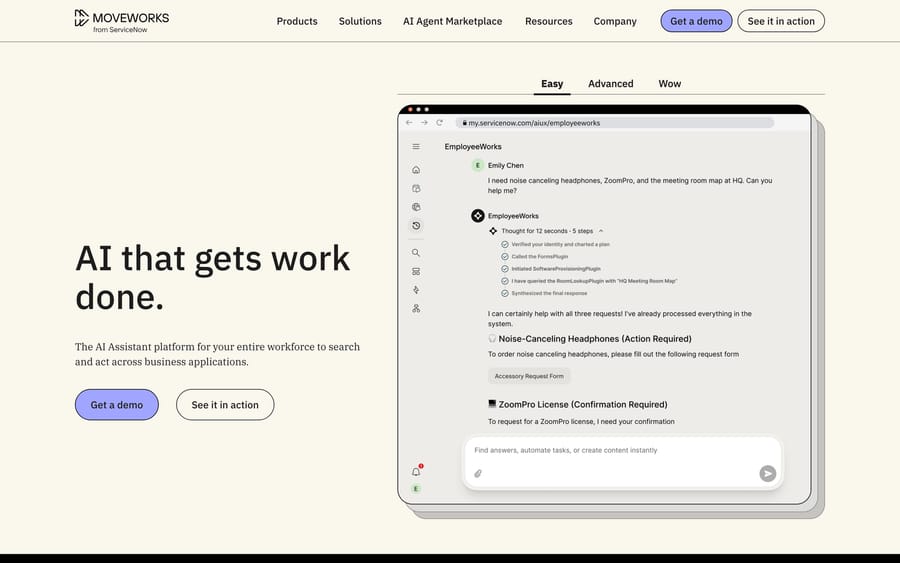
Moveworks is the more direct comparison in scale and ambition: both automate employee requests across many backend systems from inside a chat interface, though Moveworks (acquired by ServiceNow and now marketed as "Moveworks from ServiceNow") targets a broader swath of enterprise applications and a much larger deal size than Workativ's published, mid-market-accessible pricing.
Macha solves a different problem entirely and shouldn't be confused with either. Workativ and Moveworks both automate internal, employee-facing requests. Macha is built for external customer support, running as an AI agent layer inside a help desk like Zendesk, Freshdesk, Gorgias, Front, HubSpot or Intercom, drafting or sending replies to actual customers. If your gap is employees pinging IT and HR in Slack, Workativ is in the right category. If your gap is customer tickets piling up in a help desk, that's what Macha is built to handle.
How we researched this
We checked Workativ's own homepage, pricing page, integrations page, and its GoTo customer-success page directly. Company founding details and funding status came from Tracxn, since Crunchbase blocked direct access. GetApp Australia's listing supplied real, attributed customer reviews since G2 blocked our access. The GoTo case study's named quote and specific figures are Workativ's own published customer story, not independently audited, and we've presented them as such.
If your gap is customer-facing tickets rather than internal HR or IT requests, see how Macha's pricing works, or start a trial with $50 of free usage and no credit card required.
FAQ
What is Workativ? Workativ is an AI agent platform for HR and IT teams that deploys inside Slack and Microsoft Teams, handling employee requests like password resets, PTO questions, onboarding, and access provisioning.
How much does Workativ cost? Workativ publishes pricing: Starter at $99/month (50 sessions), Business at $349/month (500 sessions, 2 AI agents), and custom Enterprise pricing above that, billed on sessions instead of per employee seat.
Does Workativ offer a free trial? Yes, per third-party listings like GetApp, though the exact trial terms should be confirmed directly with Workativ.
Who founded Workativ? Imran Q. founded Workativ in 2019 as CEO. The company is based in Newark, Delaware, and appears to be bootstrapped, with no funding rounds on record per Tracxn.
What does Workativ integrate with? More than 100 systems, including Workday, ADP, UKG, ServiceNow, Jira, Okta, Azure AD, Slack, and Microsoft Teams, with bidirectional read/write access.
What results has Workativ's customers reported? GoTo, a named customer, reports 84% of employee support requests auto-resolved across 5,000 employees and 50+ connected applications, per a quote attributed to Susan Treadway, GoTo's Vice President of HR Operations.
What are the best Workativ alternatives? Moveworks (now part of ServiceNow) is a direct comparison for enterprise-scale employee AI assistants. For customer-facing support automation rather than internal HR/IT requests, Macha is a different category built for help-desk ticket automation.
Does Workativ have good reviews? GetApp Australia shows 4.5 out of 5 stars from 4 reviews, with reviewers praising out-of-the-box functionality and flagging limited third-party channel integrations as a drawback. We could not access G2 directly to check its rating.
Is Workativ a help desk replacement? No. Workativ automates internal employee support inside Slack and Teams. It isn't built for external, customer-facing support tickets, which is the category Macha and traditional help desks serve.
How long does Workativ take to deploy? Workativ's own claim is deployment in days rather than months, without requiring outside implementation consultants, though actual timelines will depend on how many systems you're integrating.
Sources: Workativ homepage, Workativ pricing, Workativ integrations, Workativ: GoTo case study, Moveworks homepage.
Resolve tickets automatically with AI agents
Macha's AI agents work on top of the help desk you already use — no code.