Intercom
 Shopify
 Stripe
 Slack
Slack Notion
 Google Workspace
 Confluence

Zendesk QA: The Complete Guide (2026)


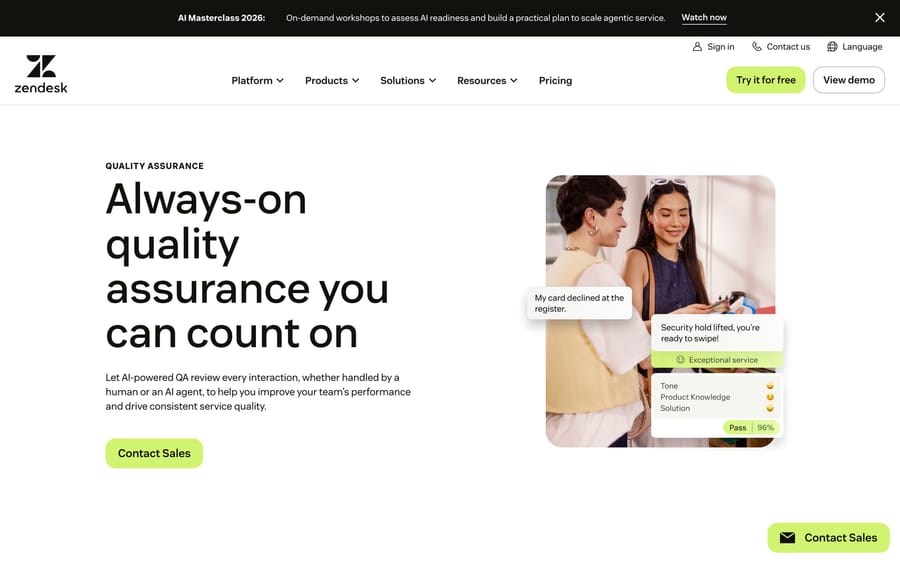
Zendesk QA is Zendesk's own AI-powered quality assurance add-on: it reviews customer service conversations, including ones an AI agent handled, and scores them against the standards a team sets. This guide covers what it does, its history as the independent startup Klaus before Zendesk acquired it, real pricing evidence, honest pros and cons, and where a separate AI agent layer like Macha fits alongside it rather than instead of it.

One framing matters before anything else: Zendesk QA doesn't replace Zendesk, and it doesn't replace Macha either. It's a feature that runs inside a Zendesk account you're already paying for, reviewing conversations that happened there. Keep that distinction in mind through the rest of this guide.
What is Zendesk QA, and where did it come from?
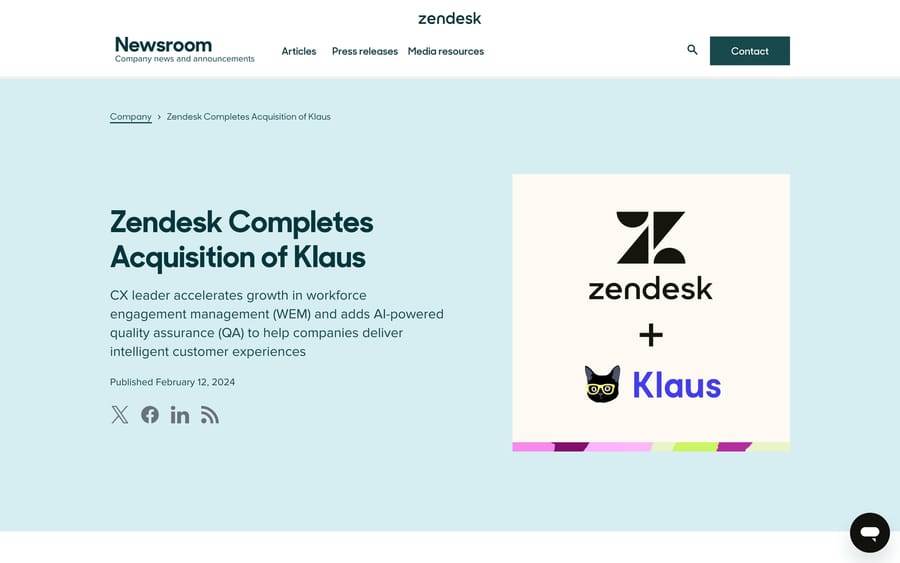
Zendesk QA started life as Klaus, an independent quality management startup founded in Estonia in 2019 by Kair Käsper and Martin Kõiva. Klaus raised about $19.3 million from investors including Creandum and Acton Capital before Zendesk announced it would acquire the company, closing the deal on February 12, 2024. Zendesk's own newsroom post described Klaus as "the industry leading AI-powered quality management platform," specifically calling out its ability to assess 100% of customer interactions, compared to the 1-in-20 sample most manual QA processes manage.
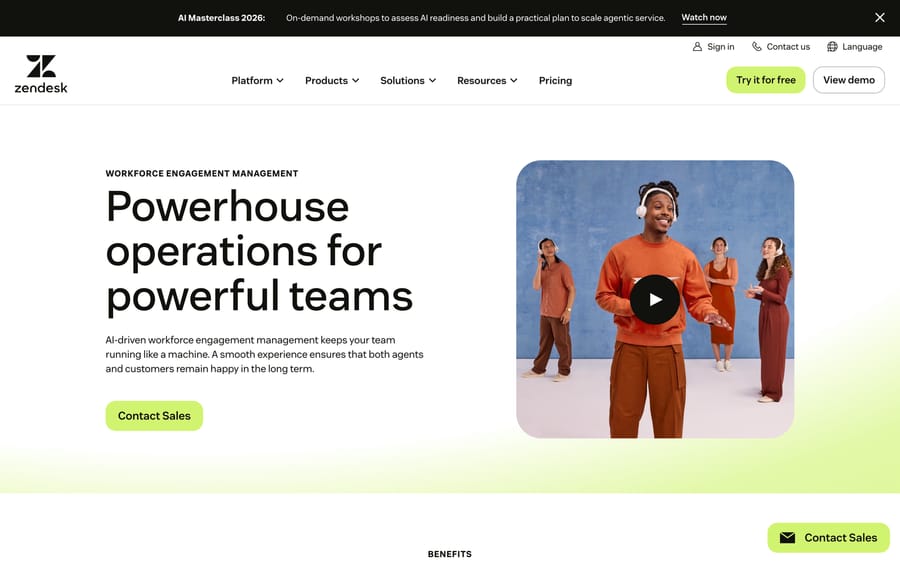
Zendesk folded Klaus into its Workforce Engagement Management (WEM) portfolio, alongside its existing Tymeshift workforce-management product, and renamed it Zendesk QA. The Klaus brand and standalone product no longer exist separately; if you see a review or forum post mentioning Klaus, it's talking about the same product this guide covers.
How Zendesk QA's AI works
The core mechanism is automated scoring instead of manual sampling. A traditional QA process has a team lead spot-check a handful of tickets a week, because reading every conversation by hand doesn't scale. Zendesk QA's AutoQA scores every interaction, on every channel, against categories a team defines: things like empathy, tone, or whether the agent actually solved the problem, either using Zendesk's pre-built categories or a custom prompt a team writes itself, with no model training required.
Three named capabilities sit underneath that:
- AutoQA scores conversations against structured categories or free-text prompts.
- Spotlight automatically flags specific risk moments: a customer showing churn signals, an escalation, a knowledge gap the agent clearly didn't have, a conversation that's looping without resolution, or dead air on a call.
- AI Agent QA applies the identical scoring standard to tickets an AI agent handled, so a team can hold a bot to the same bar as a human agent, instead of grading it separately or skipping it entirely.
That last point is the one worth naming directly: Zendesk QA doesn't just check human agents. It's built to audit the AI agents running inside the same Zendesk account, which matters if your team is also running Zendesk's own AI features or a third-party AI agent layer and wants one consistent quality bar across both.
Key features
- 100% interaction coverage across every channel, including voice, instead of a manual sample.
- AutoQA with pre-built scoring categories or custom prompts.
- Spotlight for automatic risk-moment detection: churn signals, escalations, knowledge gaps, conversation loops, dead air.
- AI Agent QA, scoring bot-handled tickets against the same standard as human agents.
- 1:1 coaching workflows built from the scoring data, so a team lead can turn a low score into a specific coaching session instead of a vague note.
- SOC 2 Type 2, GDPR, and HIPAA-enabled data handling, relevant if you're evaluating this for a regulated support operation.
Zendesk QA pricing
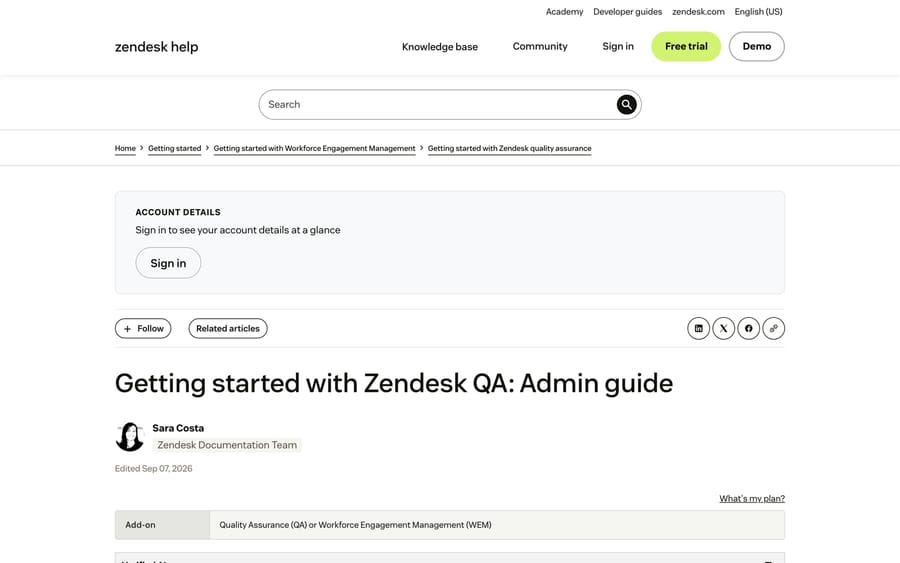
Zendesk doesn't publish a standalone QA price on its own pricing page; the page simply links out to "full pricing and packaging" without a number, and its own admin documentation confirms QA is billed as a separate add-on, not something bundled into a base Suite plan.
Third-party pricing research (helpcrunch.com's Zendesk breakdown) puts Zendesk QA at roughly $35 per agent per month standalone, or as part of a $50-per-agent-per-month Workforce Engagement bundle that combines QA with Zendesk WFM (workforce management), saving about $10 per agent over buying them separately. We're flagging that figure as a third-party estimate; we couldn't find it stated directly on zendesk.com as Zendesk's own published rate.
That opacity has a straightforward incentive behind it: an add-on priced per agent, on top of whatever Suite plan you're already paying for, gets negotiated per deal, and a published number would cap what Zendesk's sales team can ask a larger account to pay. Confirm the actual rate for your seat count and plan tier directly with Zendesk before budgeting.
Pros and cons
Pros
- Scores 100% of interactions instead of a small manual sample, which is a genuine step up from typical QA processes.
- Built by Klaus, a team with years of dedicated QA-product experience before the acquisition, so it doesn't feel like a QA feature bolted onto a help desk as an afterthought.
- AI Agent QA holds bots and humans to the identical standard, useful if you're running any AI agent inside Zendesk.
- Real customer reviews are strongly positive: 4.9 out of 5 on Capterra from 24 reviews as of this writing.
- Native integration means no separate login, export, or sync step; it reads tickets already in your Zendesk account.
Cons
- Only reviews conversations that live inside Zendesk. If your team also runs a second channel or help desk, Zendesk QA can't see it.
- No published standalone price; expect a sales conversation to get an exact number for your account.
- It's an add-on cost layered on top of your existing Suite plan, so total spend needs to include both.
- A young review base (24 on Capterra) is thin for a product this widely deployed, so weight the rating accordingly.
Real-user evidence
We checked Capterra's listing for Zendesk QA (still filed under its former name, Klaus) on 2026-09-18, and it shows 4.9 out of 5 stars from 24 reviews. Real, attributed reviews include Jose Gerardo R., a Customer Service Manager in logistics, who said the platform helps with "maintaining consistency," which he called important for his team; Deniz K., a Senior Manager of Customer Support in insurance, who called it "a valuable tool for us to make sure that we operate in high quality" and specifically praised its integrations with Intercom and Aircall; and David M., an Escalations Specialist in consumer services, who called it "great for quality check purposes" and pointed to the browser extension's usefulness for auditing tickets directly. We couldn't get past G2's access block to check that platform's rating separately.
Who Zendesk QA is best for
This fits teams already on Zendesk who want to move beyond spot-checking a handful of tickets a week and score every conversation, including ones an AI agent handled, against a consistent standard. It's a natural fit if you're already paying for Zendesk Suite and want quality data to drive coaching, instead of a subjective sense that "agents seem fine."
It's the wrong choice if you're shopping for a general AI agent that drafts and sends replies, since that's not what this product does at all: Zendesk QA reviews conversations after the fact, it doesn't have them. It's also a weak fit if your support operation spans a second help desk or channel Zendesk QA can't see, since its coverage stops at the edge of your Zendesk account.
Zendesk QA vs alternatives
| Zendesk QA | MaestroQA | Macha | |
|---|---|---|---|
| Model | AI-powered QA add-on native to Zendesk | AI conversation-quality platform across multiple help desks | AI agent layer that drafts and sends replies on your help desk |
| Best for | Zendesk-only teams wanting native, 100% QA coverage | Teams on multiple platforms wanting one QA layer across all of them | Teams wanting AI to handle the ticket, not just review it afterward |
| Pricing | ~$35/agent/mo standalone (third-party estimate); Zendesk doesn't publish a figure | Not published; sales quote | From $299/month for 750 tickets (~$0.40/ticket), published |
| Self-serve trial | No; sold as a Zendesk add-on through sales or admin center | No | $50 of free usage, no credit card |
| Setup | Native to an existing Zendesk account | Requires connecting each help desk or channel separately | Built, tested and monitored by the Macha team |
| What it does to a ticket | Reviews and scores it after the conversation ends | Reviews and scores it after the conversation ends | Reads the ticket and can draft or send the reply itself |
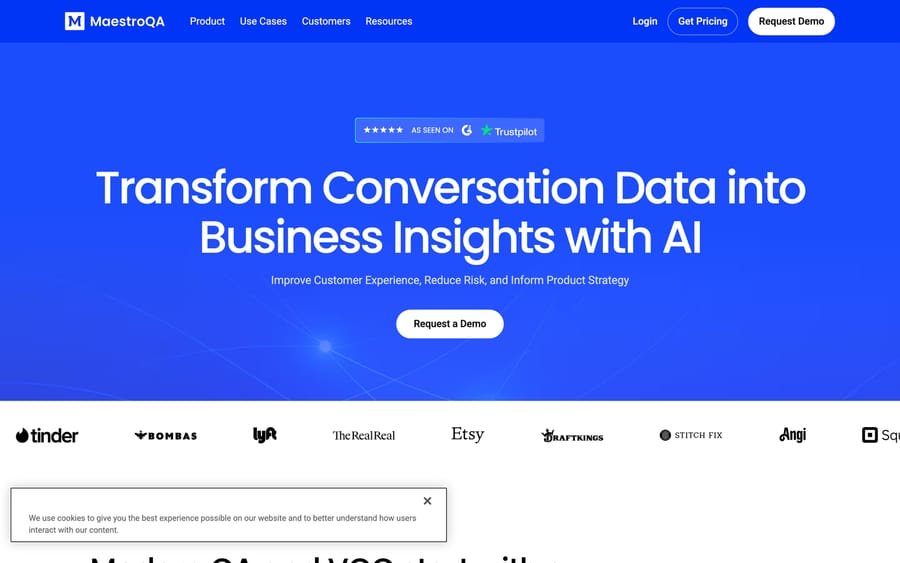
MaestroQA is the more direct comparison to Zendesk QA: both score conversations for quality, and MaestroQA's pitch is doing that across whatever combination of help desks and channels a company runs, so a team isn't locked to one platform. If your support operation genuinely spans Zendesk plus something else, that's a real reason to look at MaestroQA instead of, or alongside, Zendesk's native option.
Macha isn't a competitor to either. Zendesk QA and MaestroQA both look backward at a conversation that already happened and grade it. Macha looks forward: it reads an incoming ticket and drafts or sends the reply, running as an AI agent layer inside Zendesk itself. A team can run both at once without any overlap: Macha handles the reply, and Zendesk QA (or its AI Agent QA feature specifically) scores that reply against the same standard as a human agent's. If you're comparing QA tools to decide how to grade agent performance, see our Level AI guide for a broader AI-driven quality and coaching platform. If your actual goal is fewer tickets needing a human reply at all, that's a different problem, and it's the one Macha is built to solve.
How we researched this
We pulled Zendesk's own QA product page, its newsroom announcement of the Klaus acquisition (with the exact close date confirmed by screenshot), and its support-center admin guide, which confirms QA is billed as a separate add-on. TechCrunch's original 2024 coverage supplied Klaus's founding year, founders, and funding history. Zendesk doesn't publish a standalone QA price, so the $35/agent/month figure we cite comes from a third-party pricing breakdown (helpcrunch.com), flagged as an estimate rather than confirmed. Capterra supplied real, attributed customer reviews; G2 blocked automated access.
If your team needs AI to handle the reply itself rather than grade it after the fact, see how Macha's pricing works, or start a trial with $50 of free usage and no credit card required.
FAQ
What is Zendesk QA? Zendesk QA is Zendesk's AI-powered quality assurance add-on. It automatically reviews and scores customer service conversations, including ones handled by AI agents, against categories a team defines.
Is Zendesk QA the same as Klaus? Yes. Klaus was an independent Estonian QA startup that Zendesk acquired, with the deal closing February 12, 2024. Zendesk renamed the product Zendesk QA and folded it into its Workforce Engagement Management portfolio.
How much does Zendesk QA cost? Zendesk doesn't publish a standalone price. Third-party research puts it at roughly $35 per agent per month on its own, or bundled with Zendesk WFM into a Workforce Engagement bundle for around $50 per agent per month. Confirm the actual rate for your account with Zendesk directly.
Does Zendesk QA review AI agent conversations? Yes, through its AI Agent QA feature, which scores AI-handled tickets against the same standard used for human agents.
Is Zendesk QA an alternative to Zendesk itself? No. It's an add-on that runs inside an existing Zendesk account, reviewing conversations that already happened there. It doesn't replace or compete with the help desk.
Is Zendesk QA a Macha alternative? No. Zendesk QA reviews and scores conversations after they happen. Macha is an AI agent layer that reads incoming tickets and drafts or sends replies. The two solve different problems and can run together on the same Zendesk account without overlapping.
What are the best Zendesk QA alternatives? MaestroQA is a direct comparison for teams that want AI-driven conversation quality scoring across multiple help desks rather than one native to Zendesk alone.
Does Zendesk QA have good reviews? Yes. Capterra shows 4.9 out of 5 stars from 24 reviews as of 2026-09-18, with reviewers specifically praising consistency, ease of use, and integrations with tools like Intercom and Aircall.
Do I need Zendesk QA if I already have an AI agent handling tickets? It can still be useful. AI Agent QA specifically scores AI-handled conversations against the same bar as human ones, which is a separate question from whether the AI agent is drafting good replies in the first place.
Sources: Zendesk QA product page, Zendesk newsroom: Zendesk Completes Acquisition of Klaus, Zendesk QA admin guide, TechCrunch: AI-powered Estonian QA startup Klaus acquired by Zendesk, helpcrunch.com: Zendesk pricing breakdown, MaestroQA homepage.
Add AI agents to your Zendesk
Macha reads the ticket, drafts the reply and takes the action, inside the Zendesk you already run.