Intercom
 Shopify
 Stripe
 Slack
Slack Notion
 Google Workspace
 Confluence

Zendesk vs. ServiceNow (2026): CX Platform vs. Enterprise ITSM


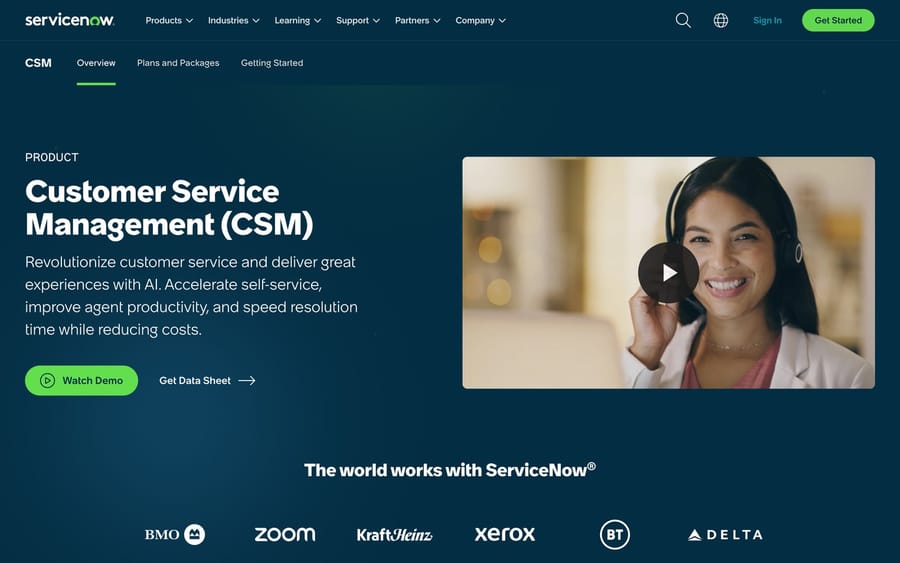
If you're comparing Zendesk and ServiceNow head-to-head, the most useful thing to know first is that they aren't really the same kind of product. Zendesk is a customer-support and CX platform built around conversations, tickets, and resolution speed. ServiceNow is an enterprise ITSM and workflow platform — its Customer Service Management (CSM) module is the piece that overlaps with Zendesk, but that's one app sitting on a much larger governance and process engine. As one neutral comparison put it: Zendesk optimizes support conversations; ServiceNow orchestrates enterprise processes.

So this isn't "which is better" — it's "which fits your buyer." This guide gives you honest pricing (including ServiceNow's quote-only ranges), the CSM-vs-ITSM distinction nobody explains, and a clear "when to run both" framework.
The 30-second verdict
| If you are… | Pick |
|---|---|
| A customer-support / CX team (SMB → enterprise) | Zendesk |
| A team that wants to be live in days–weeks, self-serve | Zendesk |
| A large enterprise that needs ITSM (incident/problem/change + CMDB) | ServiceNow |
| Running IT, HR, security and customer service on one platform | ServiceNow |
| Wanting customer service tightly coupled to back-office/IT workflows | ServiceNow (CSM) |
| Both a CX team and a heavy ITSM org | Often both (see below) |
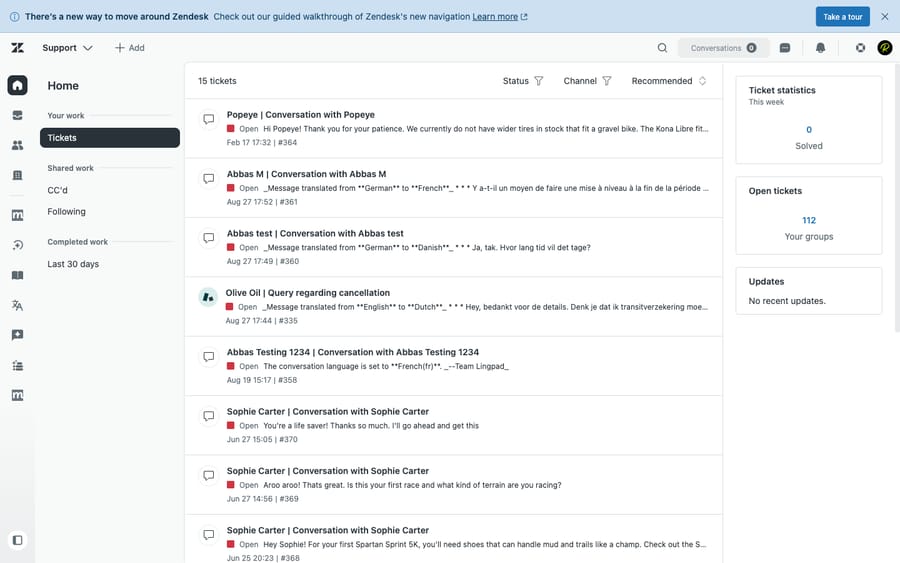
How we compared: Zendesk pricing is verified against its official page; ServiceNow is quote-only, so its figures are labeled third-party estimates. Features are checked against the products (we ran Zendesk hands-on in a live test account — the screenshot below is from it; ServiceNow's UI is login-walled and quote-only, so we can't show it), and the user sentiment below comes from real G2, Capterra, and Gartner Peer Insights reviews (ServiceNow CSM's third-party review base is small and some quotes skew older — flagged). Macha is our own product — we flag that wherever it comes up.
Pricing: public vs. quote-only
This is where the two diverge hardest. Zendesk publishes its prices; ServiceNow does not.
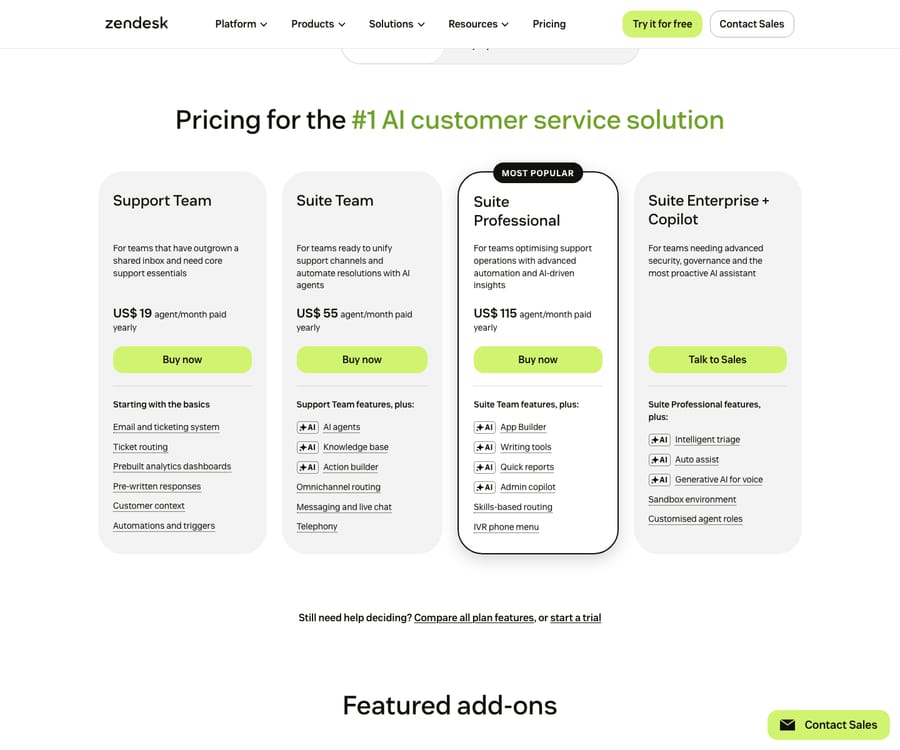
Zendesk Suite (per agent/month, billed annually):
| Plan | Price |
|---|---|
| Support Team (ticketing only) | $19 |
| Suite Team | $55 |
| Suite Professional ("most popular") | $115 |
| Suite Enterprise + Copilot | contact sales |
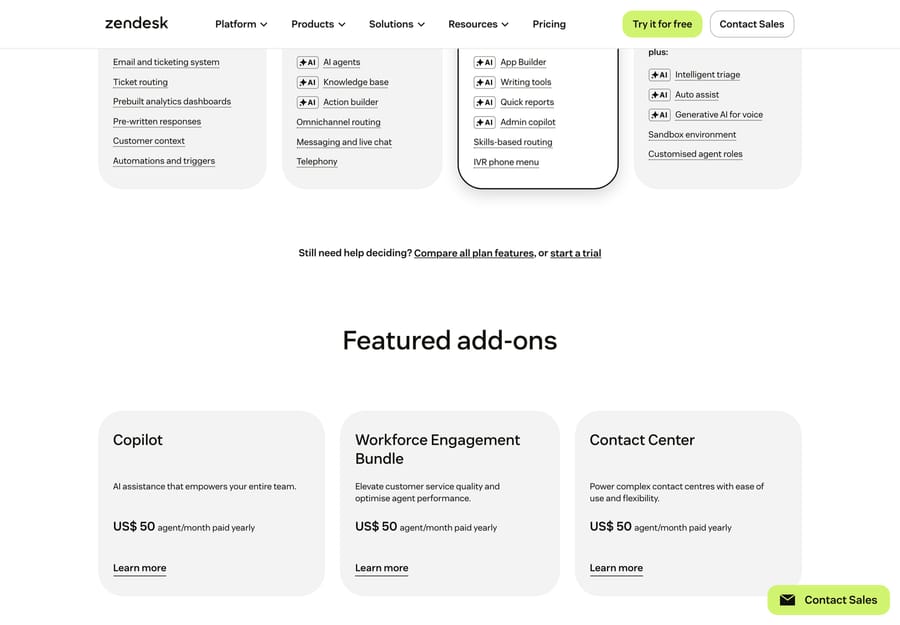
Plus a Copilot/Advanced-AI add-on at $50/agent/mo. Source: Zendesk pricing, verified June 2026.
Beyond the per-seat plans, Zendesk’s AI and CX capabilities are sold as separate add-ons — each priced per agent on top of your base plan:
ServiceNow: there is no public price. Every deal is a custom, usually multi-year annual contract negotiated with sales, priced per fulfiller (the people who resolve work), plus platform fees and substantial implementation costs. The figures below are estimates aggregated from third-party licensing guides and reviews — not quotes — and real cost varies widely by modules, fulfiller count, term, AI usage, and negotiation:
| Item (ServiceNow) | Estimated range | Source (estimate) |
|---|---|---|
| CSM fulfiller (the Zendesk-comparable license) | ~$80–180 / user / mo | redresscompliance, eesel licensing guides |
| Now Assist AI add-on | +25–60% on top of base license | eesel |
| Typical annual floor (total contract) | ~$50,000+/yr | getvoip |
| Implementation | often ≈ the license cost itself (partner-led) | industry analyses |
Print this caveat with any ServiceNow number: ServiceNow does not publish pricing. The ranges above are third-party estimates and may be outdated or off for your situation — get a quote. Customer self-service via the portal does not consume fulfiller licenses (the same end-user model Zendesk uses).
The honest takeaway on cost: Zendesk is lower and predictable, and you can self-serve. ServiceNow is a significant, quote-only enterprise investment where licenses are only part of the bill — budget for implementation partners and ongoing platform administration too.
CSM vs. ITSM — the licensing nuance nobody explains
ServiceNow sells CSM (Customer Service Management) and ITSM (IT Service Management) as different SKUs. If you're comparing to Zendesk, CSM is the right comparison — it's the customer-facing module. Roles are tiered: requesters (free, submit requests), business stakeholders (lower-cost, approve/view), and fulfillers/ITIL users (the expensive primary cost driver). The autonomous-AI and advanced capabilities sit in higher product tiers. Most "Zendesk vs ServiceNow" articles skip this entirely and just say "custom pricing" — but knowing you're buying CSM fulfiller seats (not ITSM) is the difference between a usable estimate and a guess.
Feature-by-feature: who wins what
| Capability | Winner | Why |
|---|---|---|
| Customer-support ticketing & agent workspace | Zendesk | Purpose-built, intuitive, minimal training; ServiceNow CSM is heavier and more technical |
| ITSM (incident/problem/change/CMDB) | ServiceNow (decisive) | Full ITIL depth + configuration management; Zendesk has ITIL-flavored ticketing but no real CMDB/change governance |
| Omnichannel customer support | Zendesk | Superior native email/chat/messaging/social/voice; ServiceNow often needs connectors |
| Workflow automation & platform/app engine | ServiceNow | Flow Designer + App Engine build cross-department apps and enforce process org-wide |
| Native AI | Split | Zendesk AI/Copilot = practical, ready-to-use support AI; ServiceNow Now Assist = broader cross-workflow AI but gated behind config, tiers, and a 25–60% uplift |
| Self-service / knowledge | Tie | Zendesk easier for customer help centers; ServiceNow stronger for internal/employee portals |
| Reporting / analytics | ServiceNow for cross-domain; Zendesk for CX dashboards | ServiceNow is deeper with effort; Zendesk is faster out of the box |
| Integrations | Tie | Zendesk marketplace is CX-rich; ServiceNow Store is enterprise-system rich (ERP, infra, security) |
| Time-to-value / implementation | Zendesk (big gap) | Days–weeks, often self-serve, vs ServiceNow's months and near-mandatory implementation partners |
| Total cost of ownership | Zendesk for support use cases | Lower, predictable; ServiceNow TCO = licenses + platform fees + partner implementation + admin |
The pattern: **Zendesk is the better dedicated customer-support tool; ServiceNow is the better enterprise workflow platform that also does customer service.**
Strengths & weaknesses, honestly
Zendesk — strengths: fast deployment; intuitive UX and high agent adoption; best-in-class omnichannel CX; transparent pricing; strong ready-to-use support AI; large CX app marketplace. Zendesk — weaknesses: not an enterprise workflow/ITSM platform; no real CMDB or deep change governance; add-on costs creep; not built for complex cross-department process orchestration.
ServiceNow — strengths: unmatched ITSM/ITIL depth; one platform spanning IT, HR, security, and CSM; powerful Flow Designer/App Engine; enterprise governance and compliance; scales to the largest, most complex orgs; advanced autonomous workflow agents. ServiceNow — weaknesses: opaque, quote-only pricing and very high TCO; long, partner-dependent implementations; steep learning curve; CSM's omnichannel is weaker than dedicated CX tools; Now Assist's value depends on data living in-platform and the right licensing tier.
What real users say
A caveat first: ServiceNow CSM has a small third-party review base (~150 on Capterra) and many of its reviews skew older, so treat its scores as directional rather than settled. Ratings as of mid-2026 (approximate — review sites rate-limit scraping):
| G2 | Capterra | |
|---|---|---|
| Zendesk | 4.3 / 5 (~6,700 reviews) | 4.4 / 5 (~4,080) |
| ServiceNow CSM | 4.4 / 5 (~420 reviews) | 4.4 / 5 (~150) |
- ServiceNow — praised for deep workflow and a single platform: "Workflow management is the best feature… the company can smoothly manage projects" (Mahipal Singh B., Software Engineer, Capterra, 2022). The recurring complaints are cost, a steep learning curve, and performance: "Performance is truly an issue as page refresh can be lengthy from time to time" (Senior IT Analyst, Capterra, 2019).
- Zendesk — praised for breadth and fast time-to-value, dinged for tier-gated pricing and its own support: "Strong value for money considering the wide range of features" (Ifra S., Capterra, Dec 2025) vs. "Their support is some of the worst I've ever experienced" (Katie Y., Capterra, Mar 2025).
The sentiment matches the framing: ServiceNow's depth is real but comes with cost and complexity; Zendesk is faster and friendlier for customer support specifically.
Who each is genuinely for
- Zendesk → customer-support and CX teams from SMB through enterprise that want a dedicated, fast-to-deploy support solution — high ticket volume, true omnichannel, customer help centers, and value without enterprise-platform complexity. The buyer is usually a support/CX leader.
- ServiceNow → large, complex enterprises that need ITSM plus cross-department workflow orchestration — IT operations, internal/employee service (HR, facilities), governance- and compliance-heavy organizations, and companies that want customer service (CSM) running on the same platform as IT and internal workflows. The buyer is usually IT or enterprise architecture, not a support manager.
When to run both (the option nobody mentions)
In a lot of mid-to-large enterprises, the right answer isn't one or the other — it's ServiceNow for ITSM and internal workflows, plus Zendesk for external customer support. Each stays in its lane (ServiceNow's depth for IT; Zendesk's speed and CX polish for customers), and the two integrate so a customer ticket can spawn an IT incident behind the scenes. You'd consolidate onto ServiceNow CSM instead when the customer-service process must be tightly coupled to CMDB and back-office workflows and you've already standardized on ServiceNow. You'd stay Zendesk-only when speed-to-value, agent experience, and omnichannel CX matter more than platform unification.
The AI question — and the knowledge-fragmentation gap
Both vendors are investing heavily in AI — Zendesk AI/Copilot for support deflection, ServiceNow Now Assist for cross-workflow automation — but for a team that already owns these tools, both share two limits: their best AI is priced as an expensive upsell (Zendesk's $50/agent + per-resolution billing; ServiceNow's 25–60% uplift), and it's locked to each vendor's own data and platform. That's especially awkward if you run both: your customer knowledge lives in Zendesk, your IT and internal knowledge in ServiceNow, and neither AI sees across the divide.
This is where an independent AI agent layer can help — one that sits on top of your help desk(s), unifies knowledge across sources, and drives autonomous resolution priced per action rather than per vendor-defined outcome. A layer like Macha is helpdesk-agnostic by design, so it can add autonomous AI on top of Zendesk without a platform migration (and connect knowledge from multiple sources rather than being confined to one). It's not a replacement for either platform — it's the AI layer you add on top. The honest caveat: a layer is another vendor and integration to maintain, it only resolves as well as the knowledge you connect to it, and per-action pricing still costs money at scale — it's additive, not free. (More on native AI vs. an AI layer.)
Frequently asked questions
Is ServiceNow a Zendesk competitor? Only through its CSM module. ServiceNow is primarily an enterprise ITSM/workflow platform; Zendesk is a dedicated customer-support platform. They overlap at customer-service case management but serve different buyers.
How much does ServiceNow cost vs. Zendesk? Zendesk is public: $19–$115/agent/mo plus a $50/agent AI add-on (Enterprise is quote-only). ServiceNow publishes no prices — third-party estimates put CSM around $80–180/user/mo with a ~$50k+/yr floor and implementation costs that often rival the license. Treat ServiceNow figures as estimates and get a quote.
Which is easier to implement? Zendesk, by a wide margin — days to weeks, often self-serve. ServiceNow typically takes months and an implementation partner.
Should I choose ServiceNow CSM or Zendesk for customer service? ServiceNow CSM if customer service must be tightly coupled to your IT/CMDB and back-office workflows and you're already on ServiceNow. Zendesk if speed-to-value, agent experience, and omnichannel CX matter most.
Can I get better AI without committing to either platform's AI? Yes — an AI agent layer like Macha adds autonomous AI on top of your existing help desk, unifies knowledge across sources, and prices per action instead of per resolution.
The bottom line
Choose Zendesk if your need is customer support: it's faster to deploy, easier to run, stronger on omnichannel CX, and far cheaper and more transparent. Choose ServiceNow if you need enterprise ITSM and cross-department workflow orchestration, and you have the budget and admin resources for it. And if you're a large org with both needs, running ServiceNow for ITSM and Zendesk for CX is a perfectly sensible — and common — answer. Whichever way you go, treat the AI decision separately: an AI layer on top can add autonomous resolution without locking you into one platform's roadmap or pricing. (If you're weighing customer-support tools more broadly, see our best Zendesk alternatives shortlist.)
Run Zendesk (or both) and want unified, autonomous AI on top? See how Macha layers AI agents over your existing help desk. 7-day free trial, no credit card required. Start Trial.
Add AI agents to your Zendesk
Macha reads the ticket, drafts the reply and takes the action, inside the Zendesk you already run.