Shopify
 Stripe
 Slack
Slack Notion
 Google Workspace
 Confluence

Zowie: The Complete Guide (2026)


Zowie is an AI agent platform for enterprise customer service, built around a Decision Engine that keeps business rules out of the language model's hands. Its own website shows no prices, but its AWS Marketplace listing does: $34,500 for a 12-month contract covering 25,000 automated conversations, or about $1.38 each. This guide covers what Zowie does, how its agents are built and monitored, what it costs, what real users say, who it fits, and how it compares with Decagon, Intercom Fin and Macha. If you searched "zowie" looking for gaming mice, that's BenQ's ZOWIE brand, a different company entirely.

Zowie was founded in 2019 by Maja Schaefer, its CEO, and Maciej Ciołek. It started life as an ecommerce chatbot: when it announced a $14M Series A led by Tiger Global in May 2022, it described itself as built for ecommerce teams and said brands typically automated 70% of inquiries. That round, with Gradient Ventures, 10xFounders, Inovo and Jack Altman also participating, took total funding to $20M. We found no later round reported.
Four years on, the pitch has moved upmarket. The homepage now calls Zowie "AI you can hand your customer to", lists banking, fintech, insurance, telecom, debt collection, healthcare and logistics next to retail, and claims 100 million conversations a year. People researching Zowie in 2026 are usually CX leaders at mid-size and large brands comparing it with the other enterprise AI agents covered in our guide to AI agents for customer service.
What is Zowie?
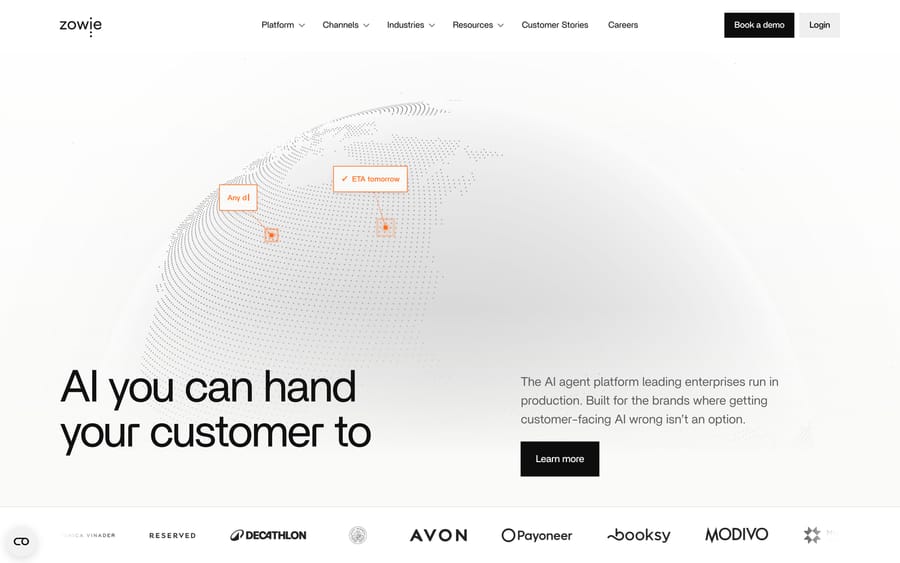
How we researched this. On September 15, 2026 we read Zowie's homepage, platform, Agent Studio, Supervisor, Inbox, customer stories and product updates pages plus its docs, captured every screenshot below from those pages, and pulled the contract price and the 4.7 rating from Zowie's AWS Marketplace listing the same day. Zowie has no free trial and no self-serve signup, so we have not used the product: everything about how it behaves comes from its own documentation and from reviewers. G2, TrustRadius and Gartner Peer Insights all refuse automated fetches, so the review excerpts below are quoted from aggregators that republish them, named in each case.
Zowie sells a platform with four layers: a builder for agents, a runtime that routes conversations to them, a quality suite that scores what they did, and an optional human inbox for the conversations they hand off. The logo strip on its homepage shows Monica Vinader, Reserved, Decathlon, Avon, Payoneer, Booksy and Modivo. Its customer stories page adds InPost, AirHelp, MuchBetter, Monos, Total Wine, MediaMarkt, Missouri Star Quilt Company and Aviva.
The retail roots still show. The retail and commerce page lists connectors for Shopify, Magento, BigCommerce, WooCommerce and Adobe Commerce, plus Klaviyo, Recharge and ShipStation, and pitches product recommendations and cart recovery alongside order tracking and returns. The newer regulated-industry pages lean on compliance instead: the homepage lists GDPR, SOC 2, HIPAA, the EU AI Act and DORA.
How Zowie's AI works
The central idea on Zowie's site is a split between talking and deciding. In the homepage's words, "A separate engine runs your rules. The language model talks to your customer."
Take a return. A customer writes "I want to return the boots I bought last week." A pure LLM agent reads the policy, reasons about whether the return window has passed, and decides. If the model misreads a date or a customer argues persuasively, the agent can approve a return the policy doesn't allow. In Zowie's design, the model identifies the intent and collects the details (order number, item, reason), then hands them to the Decision Engine, which runs the return policy as a defined sequence of steps with fixed conditions. The model then phrases the outcome. The Agent Studio page puts it as "Flows compile before they run - so the steps that can't go wrong don't depend on what the model decides in the moment."
Zowie's docs describe the same architecture from the inside: an intent recognition system routes messages to process automations, the Decision Engine "executes configurable workflows through a series of parameterized building blocks", and a Reasoning Engine uses retrieval-augmented generation over the knowledge base for open questions.
Deterministic flows are predictable and auditable, which is what a bank or an insurer needs before letting software touch a claim or an identity check. They also have to be built and maintained. Every process you want enforced exactly is a flow someone designs, tests and updates when the policy changes. Teams that want an agent to handle a messy long tail of questions with judgment get less out of this design than teams with a short list of high-stakes processes that must never go wrong.
Zowie is model-agnostic on paper. The homepage lists Anthropic, OpenAI, Google, Meta and Mistral as language model providers, and ElevenLabs, Cartesia, Deepgram and Azure Speech for voice.
Key features
Agent Studio: Flows, Playbooks and Knowledge
Agent Studio is where agents get built, and it offers three ways to define behavior. Flows are the deterministic processes described above, "multi-step conversations where every branch, condition, and action is defined up front." Playbooks are the looser option, where teams "define goals and guardrails in plain language" and let the model use judgment. Knowledge connects documentation so the agent can answer questions directly. Around those sit personas, intents, guidelines, segmentation and language settings.
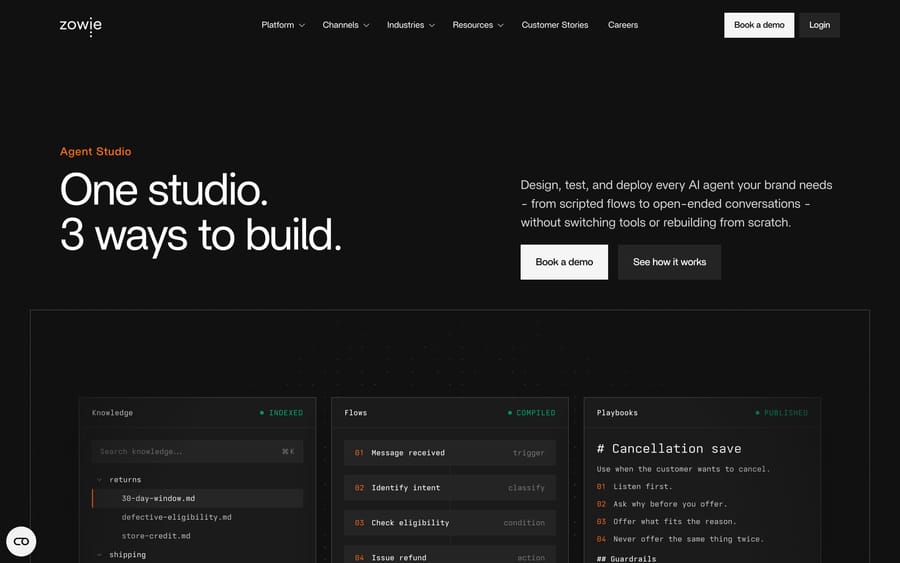
The three panels on that page are the three build modes side by side: indexed Knowledge on the left (files like 30-day-window.md and store-credit.md), a compiled Flow in the middle stepping from "Message received" to "Identify intent" to "Check eligibility" to "Issue refund," and a published Playbook on the right written as plain instructions ("Listen first. Ask why before you offer. Never offer the same thing twice.").
Zowie says CX managers work visually while developers wire in APIs, so expect a mix of no-code building and engineering time for integrations. Recent product updates point at a maturing builder: version control across agent versions (July 21, 2026), collaborative flow editing that prevents overwrites (June 2, 2026), and Zowie Doctor, which flags configuration problems before customers hit them (July 23, 2026).
Orchestrator
The Orchestrator is the runtime. Zowie says it "reads intent, assigns the right agent, adapts the response to the channel, and logs every decision," and quotes a 120ms average assignment time and 91% first-try resolution. Both are vendor figures with no stated methodology. The routing model matters if you plan several specialist agents (returns, billing, identity verification) instead of one generalist.
Supervisor, Tester and Traces
The quality suite is where Zowie differs most from lighter tools. Supervisor "evaluates every interaction across AI agents, human agents, and third-party systems," scoring conversations on criteria you write in plain language. Its demo dashboard scores resolution, tone matching, policy adherence, empathy and clarity, and flags integration failures, sentiment shifts and policy deviations such as a skipped identity check. Tester covers pre-launch checks and Traces covers debugging, which Zowie frames as "Test before launch. Monitor in production. Debug when something breaks."
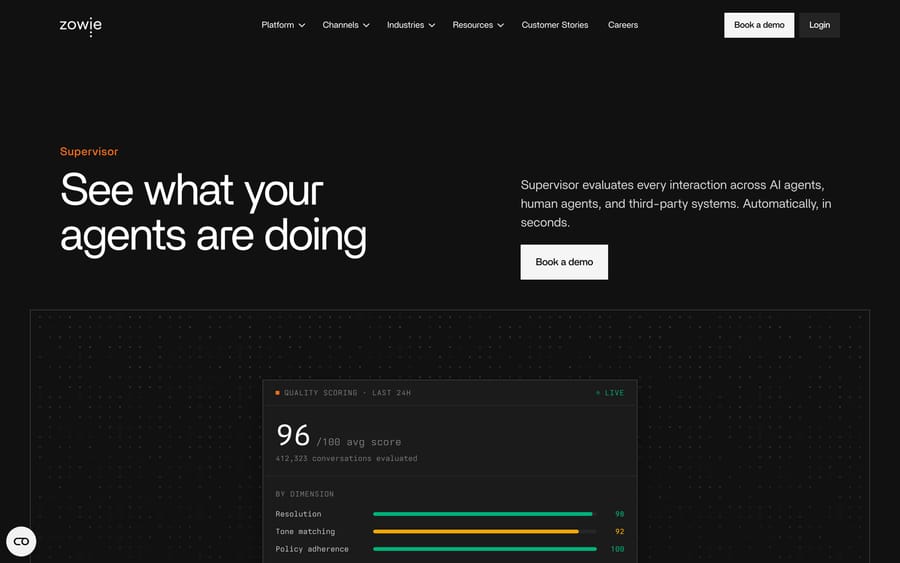
Scoring human agents in the same place as AI agents is a real feature for large contact centers, where QA teams otherwise sample a few percent of conversations by hand.
Channels, including voice
Zowie lists chat, email, voice and a channel it calls Hello, and says it plugs into contact center setups. Voice looks like an active area: updates from May to July 2026 added a staging phone number, error fallbacks, speech and listening controls, and configurable "insertions" for what the agent says while it processes a request. The docs also mention Facebook, Instagram and WhatsApp connectors.
Inbox, and the help desk question
Zowie Inbox is "The helpdesk built into Zowie." When an AI agent hands off, a human picks up the same conversation with its context. Zowie also says it integrates with Zendesk, Salesforce, Freshdesk and Genesys, so you can keep your existing help desk.
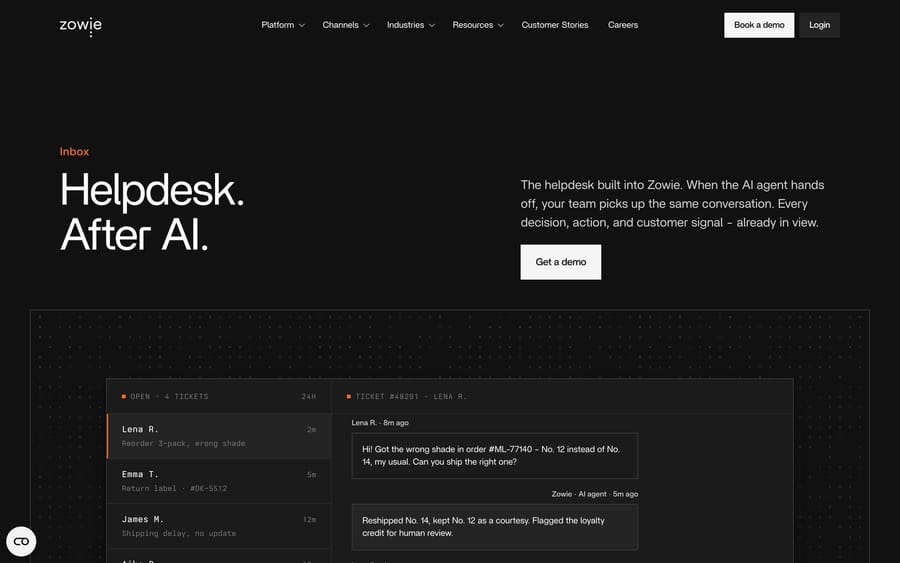
The page is candid about where Zowie would like you to end up: "Do you like your current helpdesk? We doubt it. Try Inbox." and, for teams not ready, "Keep yours (for now)." That's a sensible business model for Zowie. A vendor that owns both the AI and the human inbox owns the whole support seat, and switching away gets harder. For a buyer it's a decision to make on purpose, because adopting Inbox means migrating agents, macros and reporting off a help desk your team already knows.
What a Zowie rollout involves
Zowie doesn't publish an implementation guide, so this is assembled from its product pages and changelog. A rollout has four pieces of work. First, connecting systems: the commerce platform or core system that holds orders, accounts or policies, plus the help desk or Zowie Inbox for handoff. Second, building the agents: a persona and intents, knowledge sources for open questions, and a flow for each process that has to run exactly. Third, testing: Tester for pre-launch checks, and for voice a staging phone number so calls can be tried before the live line switches over. Fourth, monitoring: Supervisor criteria written for your own policies, which only mean something once someone has decided what "policy adherence" looks like for a refund.
Building the agents is what takes the time. A retailer with returns, exchanges, order tracking and loyalty questions might need four or five flows, each with its own branches for edge cases like partial shipments or items bought on sale. An insurer's claim intake is longer again. That's work for your CX operations team as much as for Zowie, and it recurs every time a policy changes, which is why the version control and Zowie Doctor releases in July 2026 matter to anyone running this in production.
Zowie pricing
Zowie's own site shows no prices: getzowie.com/pricing returned a 404 when we checked on September 15, 2026, and every call to action is "Book a demo". Its AWS Marketplace listing is a different matter. Marketplace sellers have to publish a contract price, and Zowie's is there in a table.
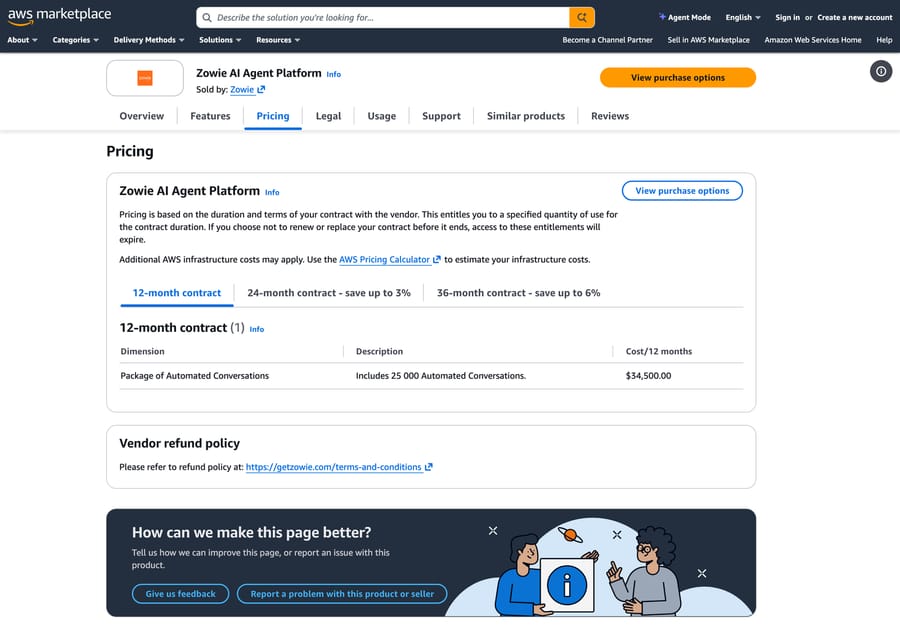
| Contract | What it includes | Price |
|---|---|---|
| 12 months | 25,000 automated conversations | $34,500 |
| 24 months | Same package, "save up to 3%" | Discount stated, total not listed |
| 36 months | Same package, "save up to 6%" | Discount stated, total not listed |
That works out at $1.38 per automated conversation, and it's a floor rather than a quote. The listing sells one package; a brand doing 100 million conversations a year is not buying 25,000 of them off a marketplace page, and AWS notes separately that "additional AWS infrastructure costs may apply." Implementation, extra channels such as voice, and the Inbox module are all things a real contract would price on top. What the listing does settle is the shape: an annual commitment for a block of automated conversations, discounted for longer terms, with the conversation as the billing unit.
Third-party figures circulate too, and they now look weaker than the marketplace number:
| Source | What it says | How much weight to give it |
|---|---|---|
| Rep AI comparison page | Billed per automated resolution, "$0.25 to $0.50 per resolution" | Competitor-written, no source given, and an order of magnitude below the AWS rate |
| Gorgias comparison page | "Per user seat" model, entry price "Hidden" | Competitor-written; contradicts both the AWS listing and Rep AI |
| PricingNow | Monthly tiers of $499, $999 and $2,499 by conversation volume | No source cited; we couldn't match these tiers to anything Zowie publishes |
What 3,000 automated conversations a month costs
Take a team with 5,000 conversations a month where the AI fully resolves 60%, or 3,000 a month, 36,000 a year. Against the AWS rate of $1.38, that's about $4,140 a month, or roughly $49,700 a year, which is just above the published 25,000-conversation package. For comparison, Intercom publishes Fin at $0.99 per outcome with a 50-outcome monthly minimum, which is $2,970 on the same 3,000. Rep AI's claimed $0.25 to $0.50 would be $750 to $1,500 a month, and nothing on Zowie's own listing supports it.
Billing per automated conversation has an incentive worth naming before you sign. The vendor earns more as its AI handles more conversations, so the contract's definition of "automated" is where the money sits. Ask whether a conversation the agent opens and then hands to a human counts, whether a customer who goes quiet counts, and whether the same customer coming back two days later with the same problem is billed twice. Ask too what happens when you exceed the package mid-term, because a contract bought as a block of conversations has to answer that somewhere.
What Zowie's customers say
Zowie's own customer stories page is the source of the numbers you'll see quoted everywhere: 70% ticket automation and $600,000 in annual savings at Booksy, 70% automation in seven days at MuchBetter, 75% cost reduction at Monos, 25% fewer phone calls at InPost, a 76% chat resolution rate at Missouri Star Quilt Company, and response times down to 36 seconds at AVON. All of them are vendor-reported, none carries a methodology, and each belongs to a specific brand: check the attribution before you repeat one, because the 70% and 75% figures get swapped around in secondhand write-ups.
Independent ratings are harder to reach. G2, TrustRadius and Gartner Peer Insights all return 403 to automated fetches, and the Capterra, GetApp and Shopify App Store listings for Zowie carry zero reviews between them. Two sources we could read agree on the score:
| Source | Rating | Ratings counted | Checked |
|---|---|---|---|
| AWS Marketplace listing | 4.7 | 73 | Read directly, September 15, 2026 |
| G2, as reported by eesel AI | 4.7 | 73 | Secondhand; G2 blocks our fetcher |
| G2 excerpts republished by Findstack | 4.7 | 62 | Secondhand, and a smaller sample than the other two |
The attributed excerpts run positive on speed to value. Mateusz Z., a founder at a mid-market company, credits "Incredibly fast implementation and ROI in days compared to other tools that take months to implement." Natalia G., also a mid-market founder, reports that "In just 6 months, we were able to automate almost 80% of our traffic & deflect 40% of inquiries." Emma P., a head of support at a small business, says "Zowie is an integral part of why our customer success team can keep up with the scaling rate of our company."
The complaints cluster in three places. Post-sale support is the sharpest: eesel AI quotes a G2 reviewer on roughly $2,100 a month saying "The service is non-existent," and describes support responses taking hours or days. Findstack's summary lists a workflow builder that gets awkward for advanced scenarios and analytics that are hard to get out of the dashboard. Multilingual accuracy comes up third. For a platform sold on deterministic control to regulated buyers, slow support on a broken flow is the failure mode to ask about in the reference call.
Pros and cons
Pros
- The Decision Engine keeps refunds, claims and identity checks inside defined rules, which is the right design for regulated processes.
- Supervisor scores every conversation, AI and human, against criteria you write.
- Wide channel coverage, including voice under active development.
- Deep ecommerce connectors from its retail years, alongside Salesforce, Zendesk, Freshdesk and Genesys.
- Named, checkable customers across retail, fintech, travel and logistics.
Cons
- No price on its own site and no free trial, so the only public number is an AWS package aimed at a volume most buyers will exceed.
- At the AWS rate of $1.38 a conversation, the cost grows with exactly the thing you're trying to automate more of.
- Deterministic flows have to be designed and maintained, so the setup burden grows with every process.
- The platform is broad, and a team that mainly needs ticket automation inside one help desk will pay for modules it won't use.
- Inbox messaging pushes toward replacing your help desk, a migration some teams won't want.
- Post-sale support is the recurring complaint in reviews, including one G2 reviewer quoted by eesel AI calling it "non-existent".
- Customer results (70% automation at Booksy and MuchBetter, 75% cost reduction at Monos, 25% fewer calls at InPost) are vendor-reported without methodology.
Who Zowie is best for
Zowie suits teams at mid-size and large brands with high conversation volume across several channels, and a handful of processes that must run exactly to policy: refunds and exchanges in retail, claims and identity checks in insurance and banking, payment arrangements in debt collection. It also suits contact centers that want one QA layer over AI and human agents, and buyers whose compliance teams need DORA, HIPAA or EU AI Act paperwork before anything goes live.
It's the wrong fit if you want to try the product before a sales call, if your team is small enough that a demo cycle costs more than the problem, or if your support already runs well inside Zendesk, Freshdesk, Gorgias or Front and you mainly want AI working those tickets. In that last case Zowie's own Inbox, Orchestrator and voice stack are capacity you'd be paying for and not using.
Zowie vs alternatives
The closest comparisons are Decagon, another enterprise AI agent sold through demos, and Intercom Fin, which publishes its price. Macha sits in a different spot: agents that work inside the help desk you already run.
| Zowie | Decagon | Intercom Fin | Macha | |
|---|---|---|---|---|
| Model | Enterprise AI agent platform with its own inbox | Enterprise AI agent platform | AI agent native to Intercom, also sold standalone | AI agent layer on your existing help desk |
| How rules are enforced | Decision Engine runs deterministic flows | Agent operating procedures | Workflows and procedures inside Intercom | Plain-English instructions, tools and confirmation steps per agent |
| Channels | Chat, email, voice, social, contact center | Chat, email, voice | Chat, email, voice and more | Channels your help desk already handles |
| Pricing | $34,500/year for 25,000 automated conversations (~$1.38 each) on AWS Marketplace; nothing on its own site | Not published; demo required | $0.99 per outcome, published | From $299/mo for 750 tickets (~$0.40/ticket), published |
| Setup | Implementation project with Zowie | Implementation project with Decagon | Self-serve inside Intercom | Built, tested and monitored by the Macha team |
| Trial | None listed | None listed | Free trial on Intercom plans | $50 free usage |
| Replaces your help desk? | Optional; Inbox is pitched as one | No | Part of Intercom's help desk | No |
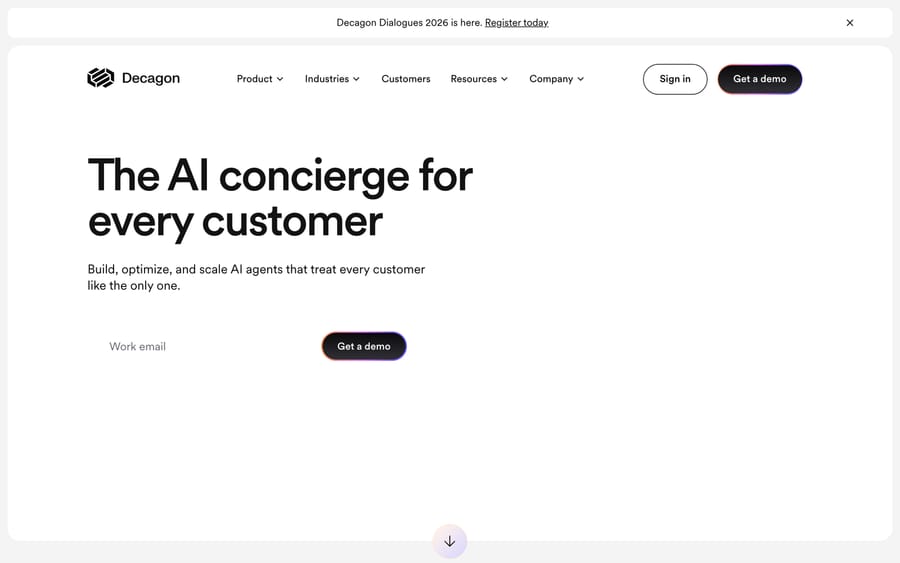
Decagon is the closest match to Zowie's sales motion: an enterprise AI agent with no price and no trial, where a work email and a demo call are the only entry. Our Decagon guide covers its build model and customers (Chime, Duolingo, Oura, Rippling, per its homepage) in the same depth. The honest watch-out is the same as Zowie's: you can't evaluate it without a procurement cycle.
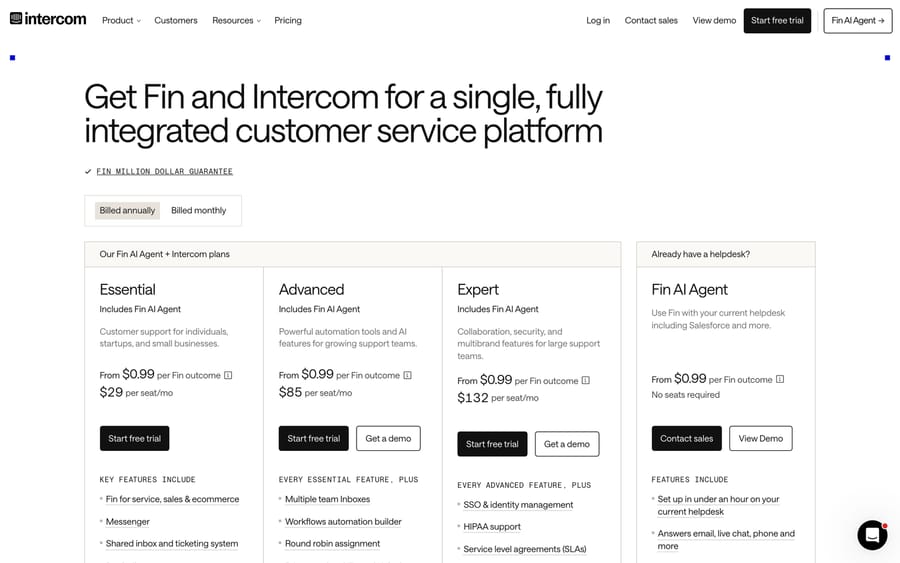
Intercom Fin is the published-price option, at $0.99 per resolved outcome with a 50-outcome monthly minimum, and it runs on your existing help desk as well as inside Intercom's. Our Fin guide goes through what counts as an outcome, which is the number that decides the bill. The watch-out is that per-outcome billing makes a busy month an expensive one, and the definition of "resolved" belongs to the vendor.
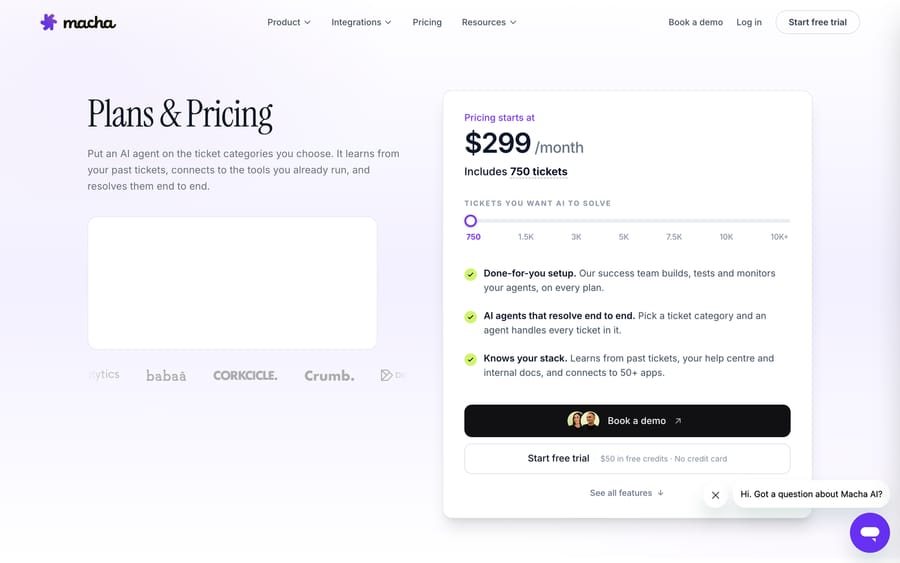
Where Macha fits
Macha fits teams already running Zendesk, Freshdesk, Gorgias or Front who want AI agents acting inside the ticket instead of a new platform and inbox around it. Agents read the ticket, pull order or account data from connected tools such as Shopify and Stripe, draft or send the reply, tag and route, and pause for confirmation on customer-facing actions you choose to gate. The help desk stays the system of record, so there's no migration. See how that works on Macha on your help desk.
The pricing mechanism is different. Macha charges per ticket, where a ticket is one thread with one person, and it's one charge however many replies it takes and whichever model runs it. That makes the bill predictable from your ticket volume, with no argument over what counted as resolved. The trade-off runs the other way too: a ticket an agent works and then hands to a human still counts. At 5,000 tickets a month the published price is $1,999, against roughly $4,140 for 3,000 automated conversations at Zowie's AWS rate, and the Macha team builds, tests and monitors the agents on every plan. The full table is on the pricing page.
If you need deterministic claim handling across voice and a regulated contact center, Zowie is built for that and Macha isn't trying to be. If your tickets already land in Zendesk, Freshdesk, Gorgias or Front and you want more of them resolved this quarter, the trial is $50 of free usage with no card: start one here and run it against real tickets.
FAQ
What is Zowie? Zowie is an AI agent platform for enterprise customer service. It combines an agent builder (Agent Studio), a Decision Engine that runs business rules deterministically, an Orchestrator that routes conversations, a quality suite (Supervisor, Tester, Traces) and an optional human inbox.
Is Zowie the same as BenQ ZOWIE? No. BenQ's ZOWIE is a gaming monitor and mouse brand. Zowie at getzowie.com is an unrelated customer service AI company founded in 2019.
How much does Zowie cost? Its AWS Marketplace listing prices a 12-month contract at $34,500 for 25,000 automated conversations, about $1.38 each, with 24-month and 36-month terms saving up to 3% and 6%. Zowie's own site publishes nothing, so anything above that package is a negotiated contract based on volume, channels and modules.
Does Zowie have a free trial? None that we could find. Capterra listed no free trial when we checked, the AWS listing sells an annual contract rather than a trial, and the website offers demos only.
What do Zowie reviews say? The AWS Marketplace listing shows 4.7 from 73 ratings, and eesel AI reports the same 4.7 from 73 on G2. Reviewers praise implementation speed and automation rates; the recurring complaint is post-sale support, along with a workflow builder that gets awkward for advanced cases.
Does Zowie replace Zendesk or Salesforce? It doesn't have to. Zowie integrates with Zendesk, Salesforce, Freshdesk and Genesys for handoff. It also sells Zowie Inbox as its own help desk and openly encourages teams to switch to it.
What is the Zowie Decision Engine? It's the component that runs business processes, such as refunds or identity checks, as predefined flows with fixed conditions. The language model handles conversation, and the engine makes the decision, so outcomes don't depend on how the model interprets a policy in the moment.
What are the best Zowie alternatives? For enterprise AI agents sold through demos, Decagon and Sierra are the usual comparisons. Intercom Fin is the published-price option. For AI agents that work inside Zendesk, Freshdesk, Gorgias or Front without a new platform, Macha is an alternative.
Who uses Zowie? Customers named on Zowie's site include Decathlon, InPost, Avon, Payoneer, Booksy, AirHelp, Monos, MuchBetter, Total Wine, MediaMarkt and Aviva.
Sources: Zowie homepage, Zowie platform, Agent Studio, Supervisor, Zowie Inbox, Retail and commerce, Customer stories, Product updates, Zowie docs, Zowie Series A announcement, Rep AI vs Zowie, Gorgias vs Zowie, PricingNow, Zowie on AWS Marketplace, eesel AI on Zowie alternatives, Findstack Zowie reviews, Intercom pricing, Fin pricing, Decagon.
Resolve tickets automatically with AI agents
Macha's AI agents work on top of the help desk you already use — no code.