Intercom
 Shopify
 Stripe
 Slack
Slack Notion
 Google Workspace
 Confluence

Avaamo: The Complete Guide (2026)


Avaamo is an enterprise AI contact center platform built around voice-first agents that automate, assist, and analyze customer, patient, and employee interactions. This guide covers what it actually does, its real (unpublished) pricing, honest reviews, and where it fits next to a lighter, help-desk-native alternative.

We build AI agents for customer service ourselves, so we read Avaamo the way an enterprise buyer would: what's actually confirmed, what a deal costs when no price list exists, and what's said about the product once the sales conversation is over.
What is Avaamo?
Avaamo was founded in 2014 by Ram Menon and Sriram Chakravarthy, and is based in Los Altos, California. The company has raised $30.5 million in total funding, including a $14.2 million Series A led by Intel Capital, which reportedly still holds roughly 11% ownership. Data aggregators report Avaamo processes over 2 billion interactions annually through around 7,000 deployed AI agents, with a headcount of roughly 107 employees, figures that are press- and data-aggregator-reported. We found no independent audit of them.
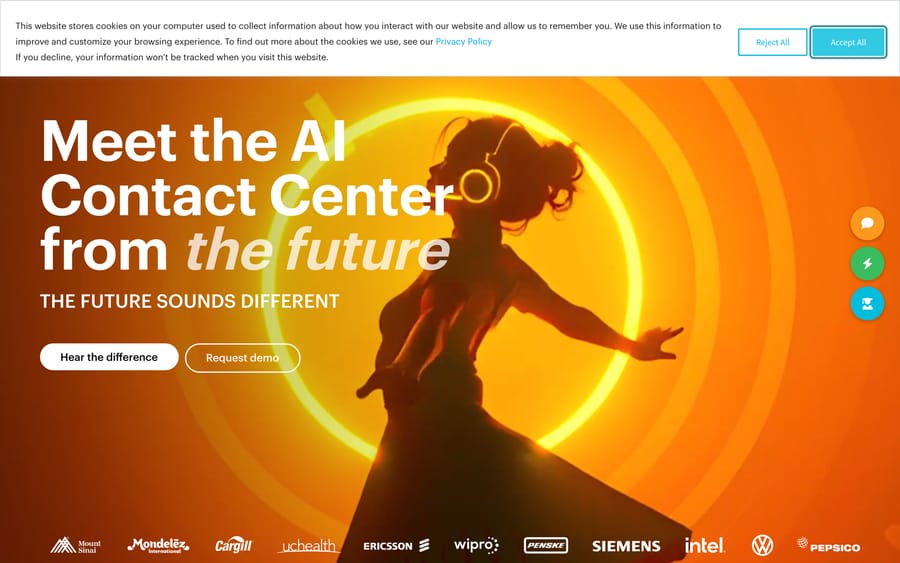
Avaamo's own homepage names Volkswagen (parts ordering), UCHealth (patient access), Franklin Templeton (query automation), Penske (reservations), and Wipro (impacting 200,000 employees) as customers, with logo placements for Mount Sinai, Mondelez, Cargill, Ericsson, Siemens, Intel, and PepsiCo reinforcing a genuinely large-enterprise customer base across healthcare, manufacturing, and financial services.
How Avaamo's AI works
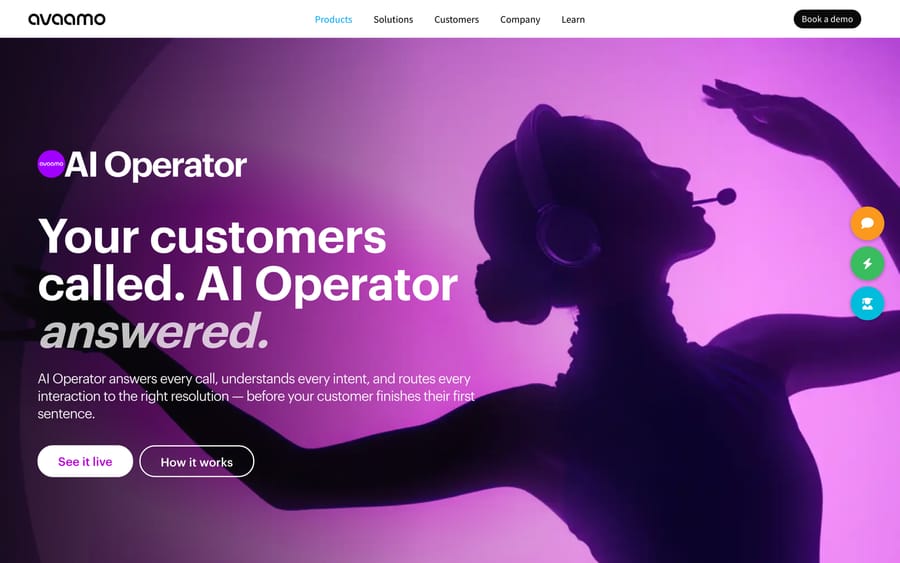
Avaamo organizes its platform around three functions. Automate covers AI Operator, which replaces a traditional IVR by authenticating callers with natural language instead of touch-tone menus and resolving requests (scheduling, refills, payments) end to end without a human. Augment covers Agent Assist, real-time coaching surfaced to a human rep during a complex call, plus AutoQA, which scores 100% of calls against quality criteria rather than the small sampled percentage a human QA team can typically review. Analyze turns call data into natural-language-queryable insights.
Avaamo also markets a separate "Orchestrator" layer, described as patented technology that dynamically coordinates multiple agents to handle a single complex request, without a human pre-building the specific handoff logic for every possible combination of agents. That's a meaningfully different claim from a simple router that matches a request to one agent: the pitch is that a request touching scheduling, insurance, and a clinical question in one conversation gets split and coordinated across the relevant specialist agents automatically, instead of routed to whichever single agent happens to match the first sentence.
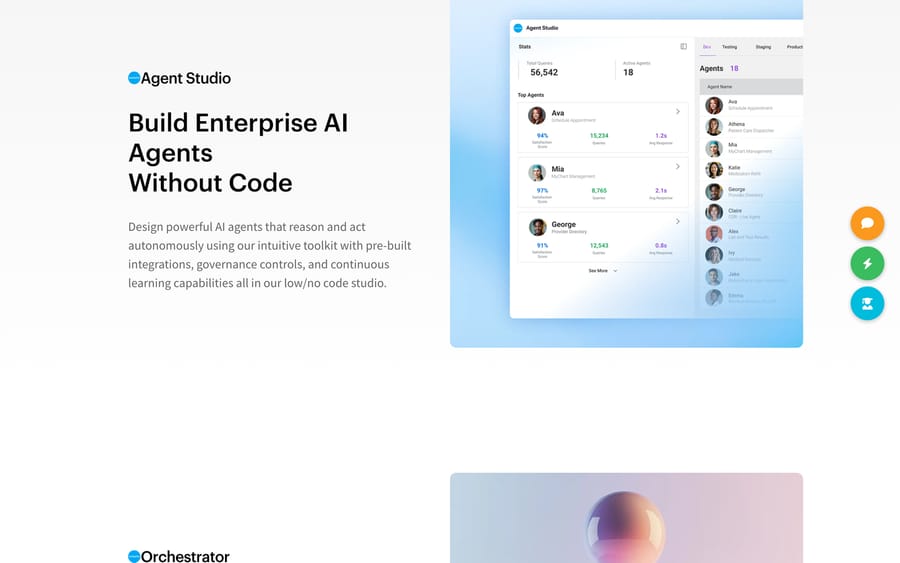
The healthcare-specific mechanism worth noting is direct integration with Epic and Cerner, the two dominant EHR systems, which lets an Avaamo agent take real actions (scheduling, chart lookups) rather than just answering questions. Agent Studio, Avaamo's no-code builder, shows named individual agents (the screenshot above shows "Ava," "Mia," and "George" each handling a distinct task like appointment scheduling or medication refills) tracked with their own satisfaction score, query volume, and average response time, treating each automated task as its own measurable unit instead of one undifferentiated bot.
Key features
- AI Operator: IVR replacement that authenticates and resolves calls end-to-end using natural language.
- Agent Assist: real-time coaching for human agents during live, complex calls.
- AutoQA: automated quality scoring across 100% of calls, not a sampled subset.
- Agent Studio: a no-code builder for deploying and monitoring individual named agents with their own performance metrics.
- Epic and Cerner integration for healthcare-specific scheduling and record actions.
- Multi-industry deployment across healthcare, workplace/HR, and customer support.
Avaamo pricing
Avaamo does not publish pricing anywhere in its site navigation (Products, Solutions, Customers, Company, Learn); every deal goes through a "Book a demo" sales conversation. We checked for an AWS, Azure, or Google Cloud Marketplace listing before writing this (none found), consistent with a fully sales-led enterprise motion.
What we found instead comes from Capterra's own review data: one reviewer, a Director of IT, called the platform "somewhat expensive, but felt it was worth the value," while another, a Software Development Manager, described it flatly as "very expensive." Neither gives a number, but the consistent theme across both is that Avaamo prices at the high end of the category, which lines up with a customer base built from Fortune 500 names like Volkswagen and Siemens instead of mid-market buyers.
Keeping pricing off the site is a normal incentive at this end of the market: a sales-led enterprise deal lets Avaamo price to the specific value a Volkswagen or a Siemens gets from millions of automated interactions, rather than anchoring every prospect to one published number that a smaller buyer could point back at during negotiation. That's not unique to Avaamo, most vendors selling into Fortune 500 accounts do the same, but it does mean a buyer should treat any third-party estimate, including the sentiment in the reviews above, as a starting point for a negotiation rather than a number to budget against directly.
Pros and cons
Pros
- Genuine large-enterprise customer base spanning healthcare, manufacturing, and financial services.
- AutoQA scoring 100% of calls is a real capability gap versus manual sampled QA.
- Direct Epic and Cerner integration for healthcare deployments that need real scheduling actions, not just chat.
- Agent Studio tracks individual named agents with their own metrics, useful for spotting which specific automated task is underperforming.
Cons
- No published pricing, and the reviews we found consistently describe the platform as expensive.
- A thin public review footprint: Capterra shows only 2 reviews, and we found no clear G2 star rating in available search results.
- One reviewer specifically flagged problems with non-English languages (Portuguese and Spanish) despite the platform's multilingual claims.
- Enterprise sales cycle and no self-serve option, consistent with the customer base but a real cost for a team wanting to move fast.
What actual users say
Capterra shows Avaamo at 4.0 out of 5 from just 2 reviews, a genuinely thin sample worth treating as anecdote, not a market signal. A Director of Information Technology and Services wrote that Avaamo was "easy to deploy" with capabilities that held up under real use, while a Software Development Manager in e-learning praised "multiple integrations with different channels" and noted "new platform features constantly developed." On the critical side, that same reviewer flagged the platform as "very expensive" with problems in "languages like Portuguese and Spanish," and the IT director separately called it "somewhat expensive, but felt it was worth the value."
How we researched this: we checked Avaamo's homepage, AI Operator page, and Agentic Platform page directly on 2026-09-17, plus Capterra's review page for attributed quotes. We could not find a G2 star rating in available search results, and company scale figures (funding, agent count, interaction volume) come from third-party data aggregators. Avaamo itself doesn't disclose them directly.
Who Avaamo is best for
Avaamo fits teams at large healthcare systems or Fortune 500 enterprises that need voice-first call automation with real EHR integration (Epic, Cerner) and can absorb both an enterprise price tag and a full sales cycle. The AutoQA and Agent Studio combination specifically suits an operation large enough that scoring 100% of calls, instead of a manual sample, actually changes what a QA team can catch.
It's a weaker fit for a smaller team, a non-English-first support operation given the reported language issues, or any buyer wanting self-serve pricing to evaluate before a sales call. The two-review Capterra footprint is itself a signal: this is a product bought through relationships and RFPs. Self-serve discovery, the way a smaller SaaS tool works, isn't really part of the model.
Avaamo vs alternatives
| Avaamo | Kore.ai | Macha | |
|---|---|---|---|
| Model | Voice-first AI contact center platform | Enterprise agentic AI platform for CX and EX | AI agent layer on your existing help desk |
| Best for | Large healthcare systems and Fortune 500 enterprises | Enterprise contact centers across industries | Teams on Zendesk, Freshdesk, Gorgias, or Front |
| Pricing | Not published; reviewers describe it as expensive | Not independently verified here; see the Kore.ai guide | From $299/mo for 750 tickets (~$0.40/ticket), published |
| Setup | Enterprise sales cycle, EHR integration work for healthcare | Sales-led, enterprise onboarding | Built, tested, and monitored by the Macha team |
| Trial | Demo-gated | Demo-gated | $50 free usage |
| Replaces your help desk? | No, layers onto call-center and scheduling systems | No, layers onto existing CX/EX systems | No, deliberately augments it |
Avaamo and Kore.ai both sell enterprise conversational AI through a sales-led motion, but Avaamo leans specifically into voice and healthcare-adjacent verticals while Kore.ai's positioning spans a broader enterprise CX and employee-experience footprint.
Macha sits at a different layer entirely: instead of a voice-first contact center platform, it's an AI agent layer that runs on top of a help desk a team already uses (Zendesk, Freshdesk, Gorgias, or Front), for the email and chat tickets that make up most non-clinical support queues. A hospital call center or a Fortune 500 phone-support operation is a genuinely different problem than a software company's Zendesk queue; Macha fits the latter. See Macha's pricing or start with $50 of free usage against real tickets.
FAQ
What is Avaamo? Avaamo is an enterprise AI contact center platform, founded in 2014, built around voice-first AI agents that automate call handling, assist human agents in real time, and analyze conversation data, with deep healthcare EHR integration (Epic, Cerner).
How much does Avaamo cost? Avaamo doesn't publish pricing anywhere on its site; every deal goes through a sales conversation. Reviewers describe it consistently as expensive, though no specific figures are public.
Who founded Avaamo, and who funds it? Ram Menon and Sriram Chakravarthy founded Avaamo in 2014. The company has raised $30.5 million total, including a $14.2 million Series A led by Intel Capital.
Which companies use Avaamo? Named customers on Avaamo's own site include Volkswagen, UCHealth, Franklin Templeton, Penske, and Wipro, with logo placements for Mount Sinai, Mondelez, Cargill, Ericsson, Siemens, Intel, and PepsiCo.
What do real users say about Avaamo? Capterra shows 4.0 out of 5 from only 2 reviews, too thin a sample to treat as a strong signal. Reviewers praised ease of deployment and multi-channel integrations; both flagged the platform as expensive, and one noted problems with Portuguese and Spanish language support.
What is AutoQA? AutoQA is Avaamo's automated call-quality scoring feature, evaluating 100% of calls against quality criteria. A human QA team typically only covers a small manually sampled percentage.
Is Macha an alternative to Avaamo? Not directly. Avaamo is a voice-first AI contact center platform for large healthcare systems and enterprises; Macha is an AI agent layer that runs on top of a help desk a team already uses (Zendesk, Freshdesk, Gorgias, or Front) for email and chat tickets. A large enterprise with real phone-call and EHR needs fits Avaamo; a team whose queue is mostly email and chat fits Macha.
Sources: Avaamo, Avaamo AI Operator, Avaamo Agentic Platform, and Capterra's Avaamo review page (capterra.com, fetched directly 2026-09-17; not linked here as it blocks automated re-verification).
Resolve tickets automatically with AI agents
Macha's AI agents work on top of the help desk you already use — no code.