Intercom
 Shopify
 Stripe
 Slack
Slack Notion
 Google Workspace
 Confluence

Balto AI: The Complete Guide (2026)


Balto builds real-time AI tools for contact center agents: live call guidance, automated quality scoring, and a voice AI agent called Togo that handles calls on its own. This guide covers what the platform does, what it costs according to real contract data (Balto itself publishes no pricing), the customer evidence we could and couldn't verify, and how it compares to Observe.AI.

We build AI agents for customer service ourselves, for teams automating tickets, so treat this as an outside look at a neighboring category.
What is Balto?
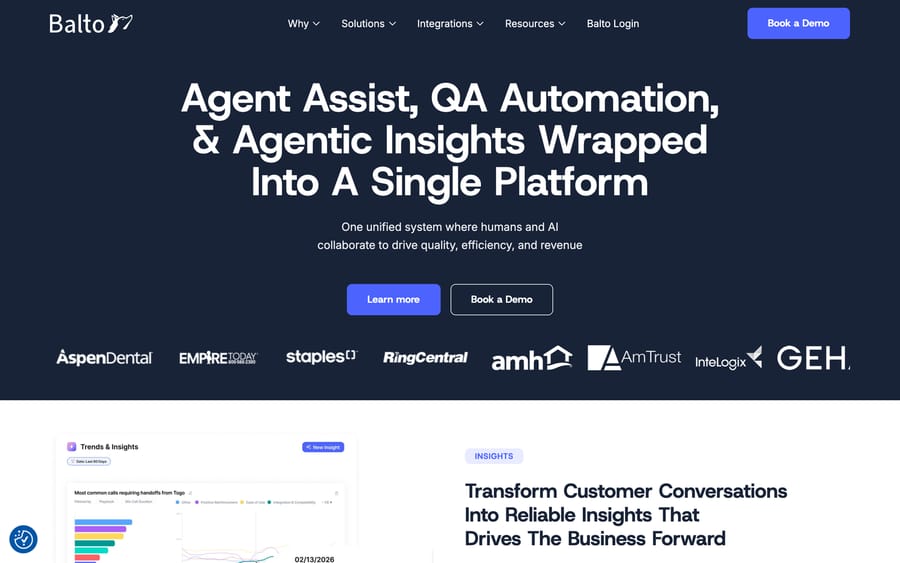
Balto is a contact center AI platform, founded in 2017 in St. Louis by Marc Bernstein, Chris Kontes, and Davidson Girard. It has raised somewhere in the range of $52 to $60 million across several funding rounds, including a $10 million Series A in 2020 led by Sierra Ventures. Third-party estimates put 2024 revenue at $22.1 million, up from $9.7 million the year before, and customer count around 3,200, though those specific figures are analyst estimates, not numbers Balto has confirmed itself.
The company positions its product as "one unified system where humans and AI collaborate to drive quality, efficiency, and revenue," and it sells into insurance, healthcare, banking, collections, home improvement, and BPO contact centers. Named customers on its site include Aspen Dental, Empire Today, Staples Canada, RingCentral, AmTrust, InteLogix, and GEHA.
How Balto's AI works
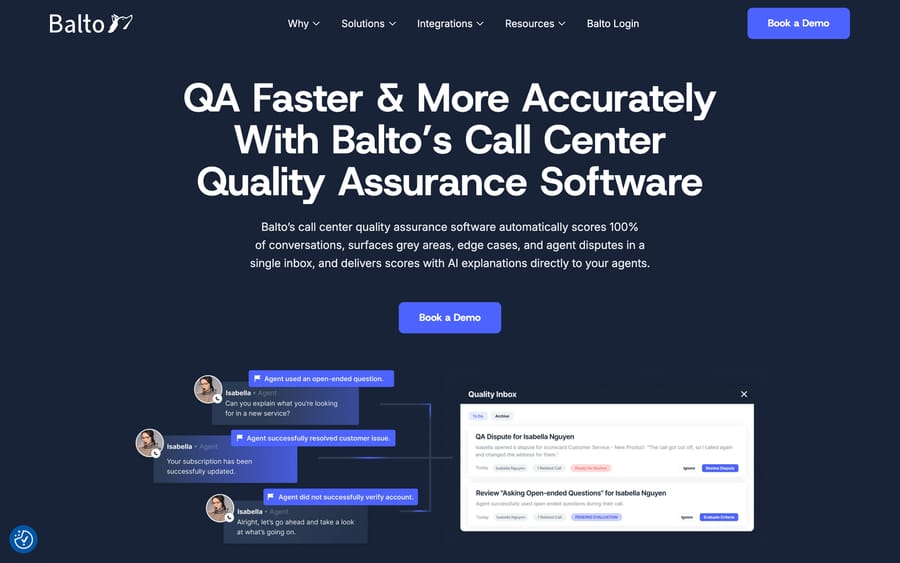
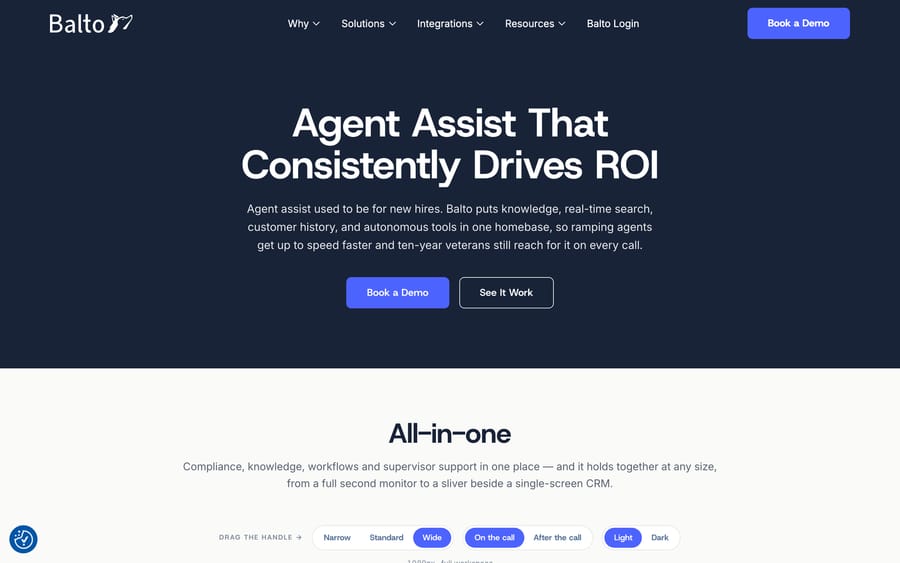
Balto's core product, Agent Assist, surfaces knowledge, real-time search results, and customer history directly in an agent's workspace during a live call, so a new hire and a ten-year veteran are working from the same real-time guidance instead of one relying on memory and the other on a script. Underneath that sits automated Quality Assurance, which the company says scores 100% of conversations, well beyond the small manual sample most QA teams can realistically review, surfacing disputes and edge cases in what it calls a Quality Inbox. The incentive for a QA team to buy this is straightforward: a system that scores every call instead of a 2% sample catches problems a spot-check would simply never see.
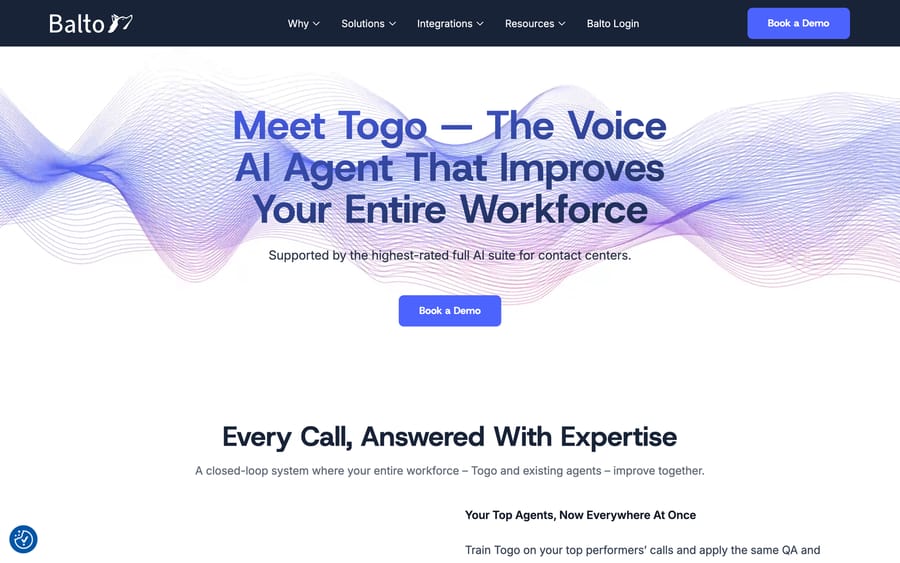
The newer piece is Togo, a voice AI agent built to handle high-volume, repeatable calls like scheduling and account verification on its own, with human agents handling the calls Togo hands off. Balto frames this as a closed loop: Togo's handoffs and outcomes feed back into the same QA and coaching system that scores human agents, so both are measured and improved against the same standard instead of two disconnected systems.
Key features
- Agent Assist with real-time knowledge search and customer history surfaced during live calls.
- Togo, a voice AI agent for high-volume, repeatable call types like scheduling and verification.
- Quality Assurance automation scoring 100% of conversations, with a Quality Inbox for disputes and edge cases.
- Coaching that generates recommendations tailored to an individual agent's actual call performance.
- Compliance monitoring that flags risk in real time, during the call, instead of in a review days later.
- Omnichannel support unifying voice and digital conversations in one system.
Balto pricing
Balto does not publish pricing. Its /pricing URL returns a 404, and every call to action on the site leads to "Book a Demo."
We checked for a real number before writing "not published," and unlike several vendors in this guide series, we found one: Vendr lists Balto's median annual contract value at $101,014, with a range from $39,231 to $105,883. That's a genuinely useful data point for budgeting a real evaluation, even though it isn't published by Balto itself, and it puts Balto in a similar enterprise-contract range to comparable real-time guidance platforms.
Named customer evidence, since third-party reviews were out of reach
We wanted to check G2, Capterra, and TrustRadius for a real rating the way we do for every vendor in this series. All three were unreachable during this research (blocked access on every attempt, and no cached alternative was available), so we're reporting that limitation directly instead of guessing at a number. What we could verify instead: attributed, named quotes from Balto's own published case studies. Ivonne Ortiz, Director of Training & Quality at InteLogix, described the shift from manual call review to Balto's system: call review time dropped from 30-plus minutes to under five, and after-call work was cut by more than half. Chip Kennedy, VP of Shared Services at the same company, called the rollout "seamless" and said Balto "delivered a partnership," not just a product. At Credit Control, Nick Jarman reported calibration scores climbing from the high 70s and low 80s into the 90s and sometimes 100% within three to four months, alongside faster new-hire ramp times. These are vendor-published case studies, not independent reviews, so read them as Balto's strongest examples, not a representative sample.
Pros and cons
Pros
- A specific, credible mechanism: 100% conversation scoring plus real-time in-call guidance, not a vague "AI-powered coaching" claim.
- Real, attributed customer case studies with named executives and specific before-and-after metrics.
- A genuine product line extension into voice AI agents (Togo) that ties back into the same QA and coaching data as human agents.
- A real Vendr-sourced contract figure to budget against, even without a published price list.
Cons
- No pricing page at all, missing even a "starting at" figure that several direct competitors offer.
- No accessible third-party review data (G2, Capterra, TrustRadius) at the time of this research, so there's no independent counterweight to the vendor's own case studies.
- The 2024 revenue and customer-count figures come from third-party analyst estimates, not confirmed company numbers.
- Enterprise-only positioning and a $39K-plus typical contract floor rule out smaller teams evaluating on a limited budget.
Who Balto is best for
Balto fits contact centers, particularly in regulated or compliance-heavy industries like insurance, healthcare, banking, and collections, that need to score every call instead of a small sample and want real-time guidance for agents on live calls. The InteLogix and Credit Control case studies both point to a specific kind of buyer: a training or quality leader trying to replace slow, manual call review with something that scales.
It's the wrong fit if you're a smaller team without an enterprise procurement process, since Vendr's contract range starts near $40,000 a year. It's also the wrong tool if your actual problem is a support team's email and chat ticket queue. That's a help-desk automation problem, priced and built differently.
Balto AI vs alternatives
| Balto | Observe.AI | Macha | |
|---|---|---|---|
| Model | Real-time agent assist, QA automation, and a voice AI agent (Togo) | Purpose-built AI agents for resolution, real-time assist, and coaching | AI agent layer on your existing help desk |
| Best for | Compliance-heavy contact centers needing 100% call scoring | Enterprise contact centers wanting end-to-end resolution plus assist | Support teams on Zendesk, Freshdesk, Front, or Gorgias |
| Pricing | Not published; Vendr median $101,014/yr (range $39,231-$105,883) | Not published; demo-gated | From $299/mo for 750 tickets (~$0.40/ticket), published |
| Reviews | Not accessible at time of research | Not accessible at time of research | N/A (new category on G2) |
| Self-serve trial | No | No | $50 of free usage, no credit card |
| Setup | Enterprise deployment with Balto's team | Enterprise deployment with Observe.AI's team | Built, tested and monitored by the Macha team |
| Replaces your help desk? | Not applicable; not a help desk product | Not applicable; not a help desk product | No, it deliberately augments it |
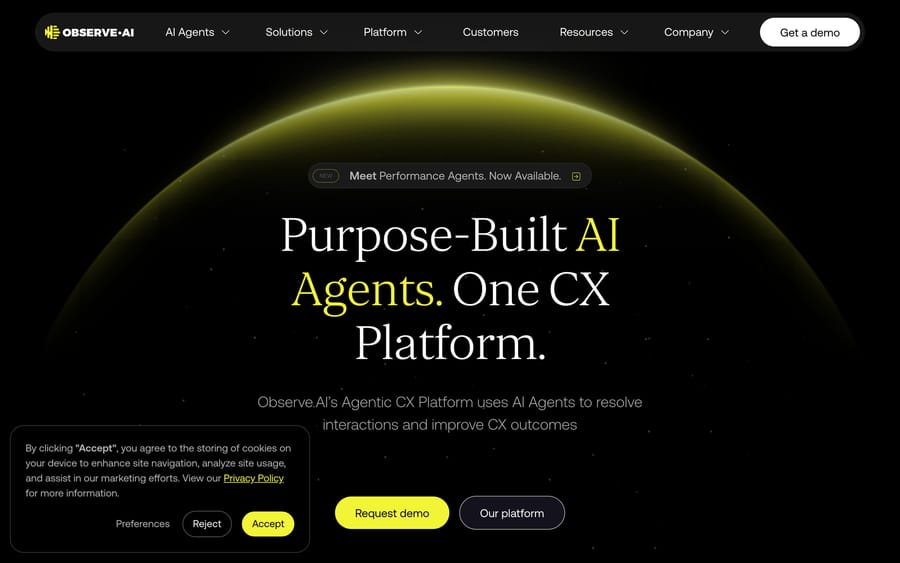
Observe.AI is the closest direct comparison: both companies sell real-time agent assist plus automated quality and coaching into enterprise contact centers, and both keep pricing off their public sites entirely. The practical difference in a bake-off comes down to how each vendor's AI agent (Togo versus Observe.AI's resolution agents) handles the calls it takes over, which is worth testing directly on your own call types instead of judging from either company's marketing.
Neither vendor touches a support team's ticket backlog, which is a different problem. If your bottleneck is email and chat tickets, Macha runs as an agent layer on top of the help desk you already use, priced per ticket instead of per enterprise contract.
How we researched this
We pulled product claims directly from balto.ai (home, /voice-ai-agent/, /real-time-agent-assist/, /call-center-quality-assurance-software/, and three named case studies), fetched 2026-09-17; /pricing returned a 404, confirming no public pricing page exists. Vendr's contract-value data was fetched directly. Founding and funding details came from a WebSearch cross-referencing Tracxn, GetLatka, and SiliconANGLE's coverage of Balto's Series A; GetLatka's revenue and customer-count figures are its own third-party estimates. We attempted G2, Capterra, and TrustRadius for a review rating and all three were inaccessible, and this session's WebSearch budget was used up before a cached-search fallback could be tried, so this guide has no third-party rating to report, only the vendor's own named case-study quotes, which we've labeled clearly as such. Observe.AI's homepage was fetched directly.
FAQ
What is Balto AI? A contact center AI platform combining real-time agent assist, automated quality assurance that scores every call, coaching, and a voice AI agent called Togo for handling high-volume calls.
How much does Balto AI cost? Balto doesn't publish pricing. Vendr, a third-party procurement data source, lists a median annual contract value of $101,014, with deals ranging from roughly $39,000 to $106,000 a year.
Is Balto AI good, based on reviews? We couldn't access G2, Capterra, or TrustRadius for a rating during this research. What's verifiable is Balto's own published case studies, including named executives at InteLogix and Credit Control reporting specific before-and-after metrics.
What is Togo? Togo is Balto's voice AI agent, built to handle repeatable, high-volume calls like scheduling and account verification, with its outcomes feeding into the same QA and coaching system used for human agents.
Does Balto have a free trial? No self-serve trial is listed. Every path on the site leads to booking a demo.
What are good alternatives to Balto? Observe.AI is the closest direct comparison, selling real-time agent assist and automated coaching into the same enterprise contact-center market, also without published pricing. Neither is a fit for a support team's email and chat backlog, which is a help-desk automation problem instead.
Who are Balto's named customers? Aspen Dental, Empire Today, Staples Canada, RingCentral, AmTrust, InteLogix, and GEHA appear on its site, with InteLogix and Credit Control providing detailed, attributed case studies.
If your actual bottleneck is a support team's ticket queue rather than live call volume, see how Macha's pricing works or start a trial.
Sources: Balto, Balto - Voice AI Agent (Togo), Balto - Real-Time Agent Assist, Balto - Quality Assurance, Balto - InteLogix case study, Balto - Credit Control case study, Vendr - Balto pricing data, Observe.AI.
Resolve tickets automatically with AI agents
Macha's AI agents work on top of the help desk you already use — no code.