







 Shopify
 Stripe
 Slack
 Notion
 Google Workspace
 Confluence


Best AI Agents for Gladly (2026): 11 Options Scored on How They Connect, What They Cost and Who Builds Them


The best AI agent for Gladly on our rubric is Macha, which runs inside Gladly, is set up and run for you by the Macha team, and costs about $0.40 per ticket. Gladly's own AI, Siena AI and Yuma AI tie for second on 7 out of 10: Gladly's AI does the most inside a conversation but leaves the build to you, while Siena and Yuma publish their prices. We scored 11 options that really work with Gladly on five criteria: how the connection is documented, what the agent can do inside a conversation, whether the price is published, who builds it, and who looks after it once it's live. Every check was made on November 21, 2026.
Key takeaways
- Macha scores 9 out of 10 as an AI agent for Gladly: it replies, writes internal notes, tags Topics, reassigns and starts outbound messages, with setup done by the Macha team.
- Siena AI scores 7 out of 10, is listed in Gladly's directory and publishes its price: a $750 monthly platform fee plus $0.90 per automated ticket.
- Gladly's own AI costs $1.50 per AI Resolution and $0.25 per AI Assist on its Shopify App Store listing, and scores 7 out of 10 because setup and tuning stay with your team.
- Gladly's app directory lists 62 apps, and its AI & Chatbots filter shows six: Ada, Amazon Connect, Flip, KODIF.ai, Netomi and Siena.
- Netomi's Gladly integration works through a dedicated Netomi Inbox and hands unsolved conversations to staffed Inboxes, per Gladly's integration toolkit page.

Which AI agents work with Gladly, ranked?
| # | Agent | How it connects to Gladly | Published price (Nov 21, 2026) | Who builds it | Score /10 |
|---|---|---|---|---|---|
| 1 | Macha | Gladly API token; 10 actions, 3 triggers | about $0.40 per ticket, $299/month for 750 tickets | Done for you by the Macha team, included | 9 |
| 2 | Gladly AI (built in) | Native | $1.50 per AI Resolution, $0.25 per AI Assist (Shopify listing) | Your CX admins; paid Gladly packages | 7 |
| 3 | Siena AI | Listed in Gladly's directory; connects one or more Gladly accounts | $750/month + $0.90 per automated ticket | Expert onboarding listed on the pricing page | 7 |
| 4 | Yuma AI | Yuma's own Gladly integration page | From $14,400/year (about $1.20 per resolution) | Yuma builds a Handbook from past tickets | 7 |
| 5 | Netomi | Listed in Gladly's directory; webhook + a Netomi Inbox | Quote only | Netomi builds and maintains the integration | 6 |
| 6 | Alhena AI | Alhena's own Gladly page; escalates by creating tickets in Gladly | Free (25 conversations), then from $199/month billed annually | Self-serve training | 5 |
| 7 | Ada | Listed in Gladly's directory; chat handoff | Quote only | Ada's no-code builder; Ada success manager | 5 |
| 8 | KODIF.ai | Listed in Gladly's directory and on Kodif's integrations page | Quote only | Not described | 3 |
| 9 | Linc | Listed in Gladly's directory | Quote only | Linc deploys ("zero additional lift") | 3 |
| 10 | DigitalGenius | Gladly named on DigitalGenius's integrations page | Quote only | Not described | 1 |
| 11 | Forethought | Gladly named on Forethought's integrations page | Quote only | Not described | 1 |
Scores use the rubric below. Disclosure: Macha publishes this blog and ranks itself first. Its score is computed the same way as everyone else's, and the one point it drops is real: Macha isn't listed in Gladly's app directory.
How did we score the agents?
We started from Gladly's integrations directory, which lists 62 apps. We read every detail page and kept the AI agents that answer customers. Then we checked the integration pages of the AI vendors that support teams ask us about most, to find agents that work with Gladly without being in Gladly's directory. Each agent gets 0, 1 or 2 points on five criteria.
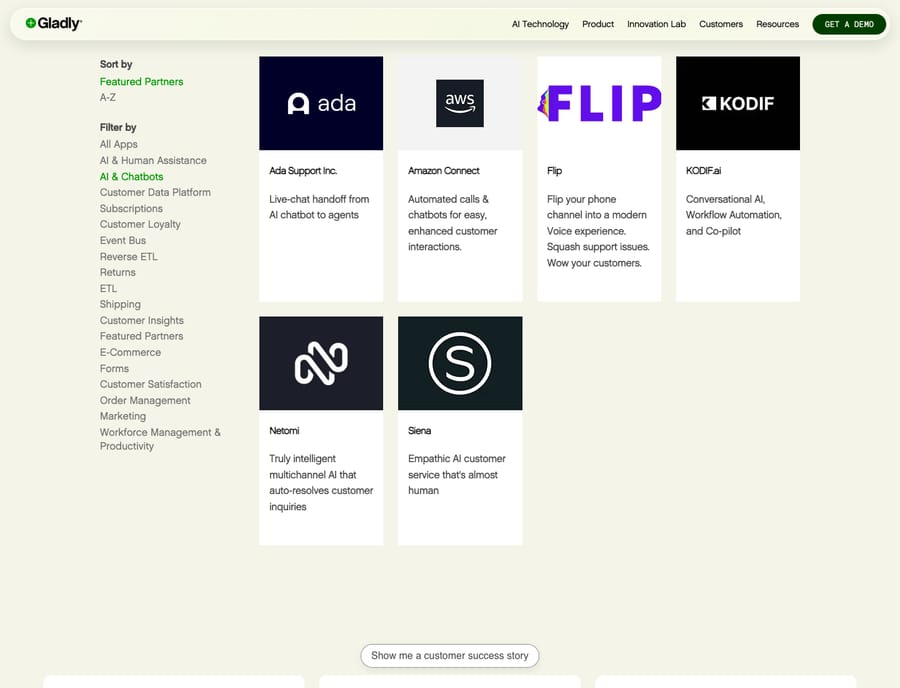
That filter mixes two kinds of product. Ada, KODIF.ai, Netomi and Siena are AI agents that answer customers in text channels. Amazon Connect and Flip are phone and contact-center tools, so they're out of scope here. Linc is in the directory without a category, and it's an AI agent, so it's in.
| Criterion | 2 points | 1 point | 0 points |
|---|---|---|---|
| Gladly connection documented | On Gladly's own directory or docs and on the vendor's site | One of the two | Neither |
| What it does inside Gladly | Replies in the Gladly conversation and changes it (status, assignee, notes or Topics), documented | Answers in its own widget or inbox and hands off, or is described only in general terms | Not described for Gladly |
| Published price | A full price you can budget from | Some prices, the rest quoted | Quote only |
| Implementation: who builds it | The vendor's team builds and tests it for you, included | Vendor onboarding or a paid package exists, and you do part of the build | You build it alone, or it's not described |
| Ongoing management after go-live | The vendor's team handles changes and tuning, included | A support channel or success manager, while changes stay with you | Not described |
Ties go to the higher "what it does" score, then the higher price score, then the higher connection score. The scores reward what you can check before a sales call. They don't measure answer quality, which you can only judge on your own conversations.
What does each AI agent do on Gladly?
1. Macha: done-for-you AI agents inside Gladly, 9/10
Macha connects to Gladly with an API token and works in your existing Inboxes. Its Gladly connector exposes 10 actions. Five read: Get Conversation, Get Conversation Messages, Get Message Item, Get Customer and List Agents. Five write: Reply to Conversation (on the customer's own channel), Update Conversation (reassign to an agent or Inbox, or change status), Send Outbound Message (email, SMS or chat to an existing customer), Add Internal Note and Add Topics. Three triggers start an agent: New Conversation, New Customer Message and a Custom Webhook you can point any Gladly webhook event at.
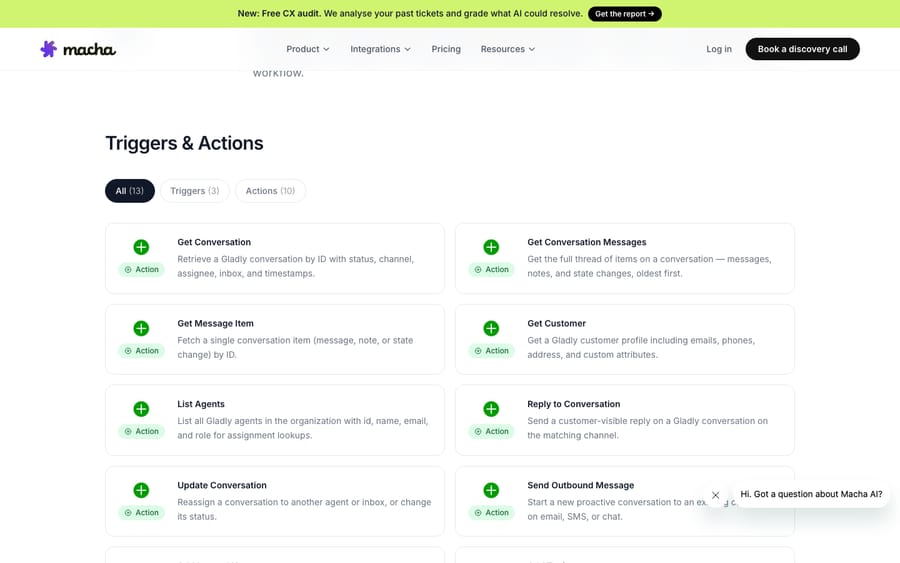
That capture shows 8 tools; the other two, Add Internal Note and Add Topics, are listed on Macha's Gladly integration page.
In practice that means an agent can answer "where's my order?" with a Shopify lookup and reply on chat or SMS, tag the Topic, and close the loop (order status use case; our guide to automating order status in Gladly compares it with Gladly's Track Order Guide). It can also write its draft as an internal note for a person to approve first, which is how every Macha rollout starts (internal note drafts). Routing to the right Inbox is a third common job (routing use case), and answering overnight while your team is offline is a fourth (after-hours use case).
The part that scores Macha's 2s on the last two criteria is who does the work. The Macha team analyzes about a month of your past conversations, builds the knowledge base and the agent, tests it on past conversations, and runs it in safe mode until the drafts are right. A dedicated success manager then handles new categories, instruction changes and new tools. That's included on the trial and on every plan, at about $0.40 per ticket ($299/month for 750 tickets). One ticket is one conversation with one person, charged once however many messages it takes (pricing).
Scores: connection 1 (Macha's docs only; it isn't in Gladly's directory), what it does 2, price 2, implementation 2, ongoing 2.
Macha fits teams already on Gladly that want an AI agent working in their own Inboxes and don't have an admin with spare weeks to build and tune one. It's the wrong fit if you only want a chat widget on your website and no changes inside Gladly. More on the Gladly product page.
2. Gladly AI: built in, priced per outcome, 7/10
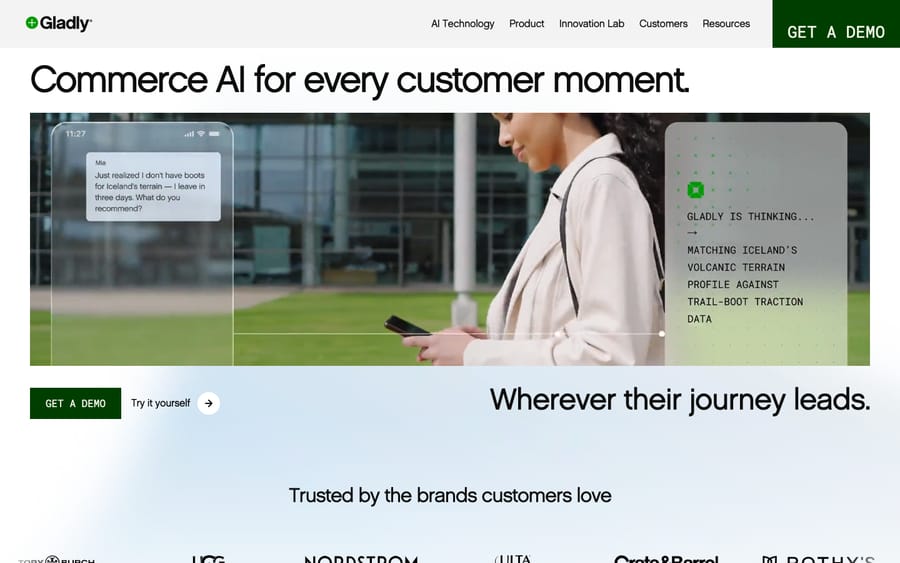
Gladly's own AI agent, called Sidekick until a February 2026 rename, answers from your Public Answers, follows Guides you write in plain language, runs Shopify actions such as order tracking and cancellation, and hands off to a person. Our Gladly AI explainer covers it in depth, and Gladly AI versus an AI agent layer compares it with third-party agents at 1,000 to 10,000 conversations. Because it's native, it scores top marks on connection and on what it can do.
Its rates are public only on Gladly's Shopify App Store listing: $1.50 per AI Resolution, $0.25 per AI Assist and $120 a month per team member, with a 30-day free period. Enterprise contracts are quoted. Charging $0.25 for an assist means Gladly earns on a conversation the AI touched once and handed back, so the incentive is worth watching: track assists as closely as resolutions. Our Gladly pricing guide does the math at real volumes.
The build is yours. Gladly says your CX team configures it, and its paid implementation packages cover the platform rather than the AI (our implementation guide has the package prices and the six-week average).
Scores: connection 2, what it does 2, price 1, implementation 1, ongoing 1.
Best for: Shopify brands already on Gladly with an admin who can own Public Answers and Guides every week.
3. Siena AI: in Gladly's directory, with a published price, 7/10
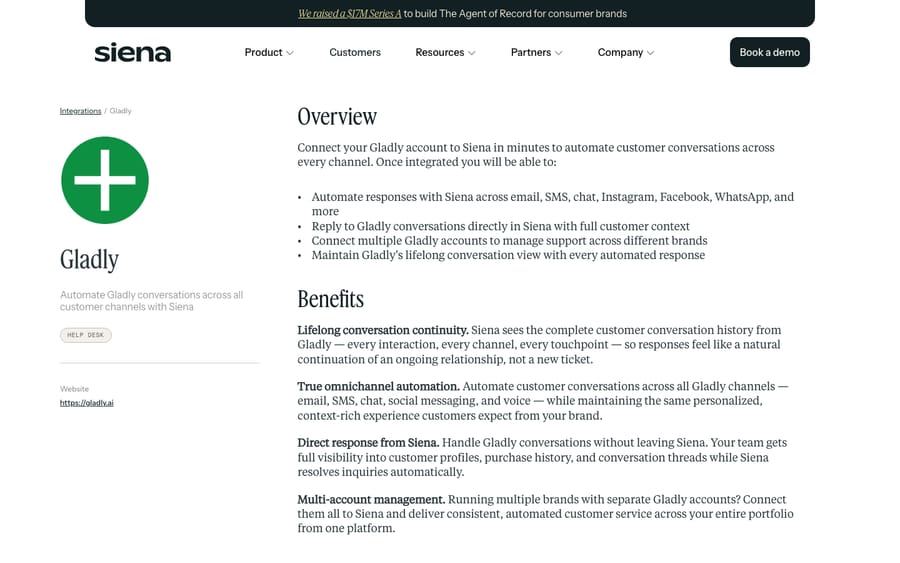
Siena calls itself an "empathic" AI agent for consumer brands and appears in Gladly's directory as "Empathic AI customer service that's almost human." Its own Gladly page says you connect your Gladly account "in minutes" and then Siena automates responses across email, SMS, chat, Instagram, Facebook, WhatsApp "and more," replies to Gladly conversations from inside Siena, and can connect several Gladly accounts for multi-brand teams. It also says it keeps Gladly's lifelong conversation view with every automated response.
Siena's pricing page is the clearest of any vendor here: a $750 monthly platform fee, $0.90 per automated ticket, and a "Support & Implementation" line covering expert onboarding and dedicated Slack support, with no separate price shown. The page now asks for your details before it sends a quote, so confirm the figures on the call.
Siena's page documents replies from inside Siena but doesn't say what Siena changes on the Gladly conversation itself (status, assignee, notes or Topics), so it scores 1 on what it does. Ask for that list on a demo.
Scores: connection 2, what it does 1, price 2, implementation 1, ongoing 1.
Best for: multi-brand consumer companies with several Gladly accounts that want one AI vendor across them.
4. Yuma AI: ecommerce-focused, priced per full resolution, 7/10
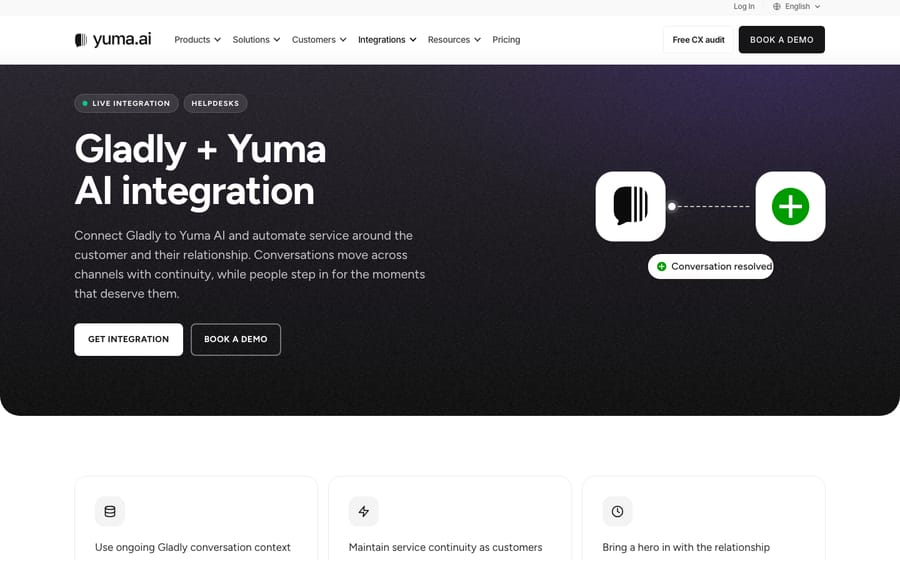
Yuma isn't in Gladly's directory, but its own Gladly integration page is marked "Live integration." It says Yuma uses the ongoing Gladly conversation context, keeps continuity as customers switch channels, and hands off to an agent with the customer's goal and Yuma's progress still visible in Gladly. The page doesn't list individual Gladly actions, which is why it scores 1 on what it does.
Yuma's pricing page is unusually detailed. It bills only for a "full resolution," a ticket Yuma handled start to finish with no human involved. Annual plans run from $14,400 a year (about $1.20 per resolution, 12,000 resolutions) to $90,000 (about $0.75), each with a 12-month commitment, and the implementation fee is listed as $0. The getting-started steps on its Gladly page read "Connect Gladly," "We build your Handbook from past tickets" and "Go live on a share of tickets."
Scores: connection 1, what it does 1, price 2, implementation 2, ongoing 1 (Slack support on Starter; a dedicated account manager on Growth).
Best for: DTC brands with enough volume to commit to a year of resolutions and that want to pay only when no person touches the ticket.
5. Netomi: an AI Inbox inside Gladly, 6/10
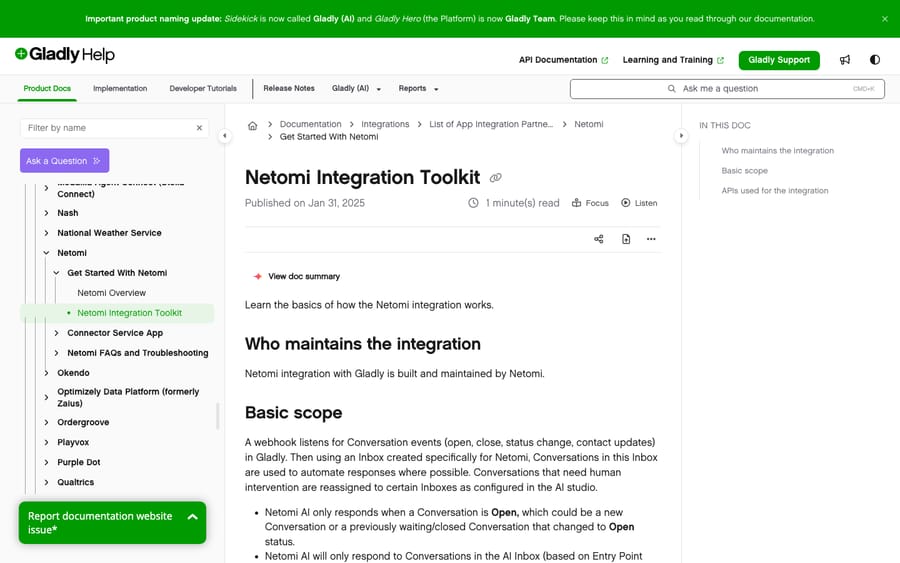
Netomi is in Gladly's directory, and Gladly documents exactly how it works. Its Netomi integration toolkit says the integration "is built and maintained by Netomi." A webhook listens for Conversation events, Netomi answers Conversations that land in a dedicated AI Inbox, and anything it can't solve is reassigned to a staffed Inbox you configure. The page lists the Gladly APIs it uses: reading conversations, items and customer profiles, replying by email, updating the assignee or Inbox, closing conversations and updating the customer profile.
That's the most precise public description of any third-party agent on Gladly. Two cautions: Gladly's own listing page says the integration "is currently being built out-of-the-box in partnership between Gladly and Netomi," and Netomi's integrations URL redirected to its homepage when we checked, so we couldn't confirm the Gladly integration from Netomi's side. Ask Netomi which channels it answers on Gladly today. There's no public price.
Scores: connection 2, what it does 2, price 0, implementation 1, ongoing 1.
Best for: large contact centers that already buy enterprise AI on a contract and want the AI to own a clearly bounded Inbox.
6. Alhena AI: published plans, handoff into Gladly, 5/10
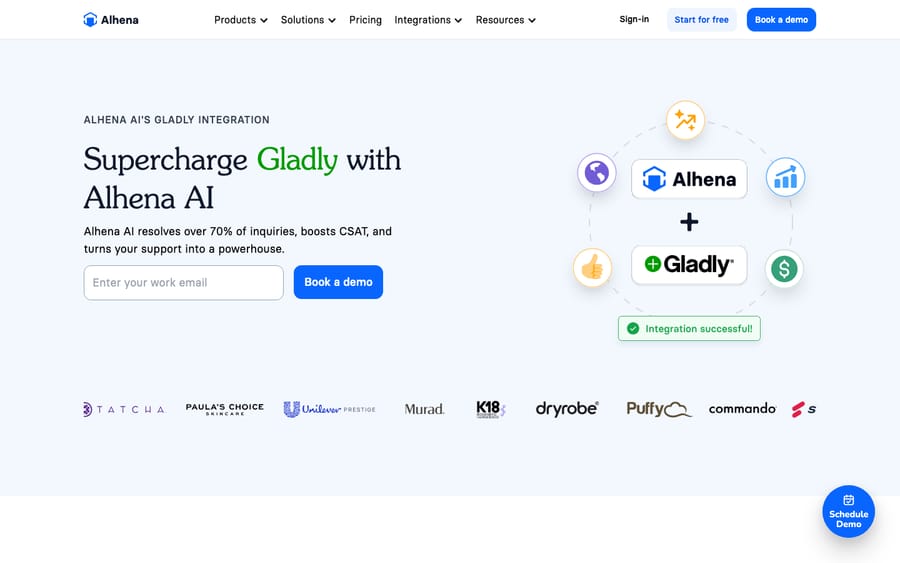
Alhena (formerly Gleen) isn't in Gladly's directory, but its own Gladly integration page describes the setup. Alhena answers support and pre-purchase questions on chat, email, SMS and messaging apps, escalates complex issues to live agents by "creating detailed tickets in Gladly," and offers an Agent Assist copilot that it says lives inside Gladly. You can route traffic between Alhena and your agents, for example only after hours.
Its pricing page is public: a free plan with 25 conversations a month, then Essentials at $199 a month billed annually (200 conversations), Growth at $499 (550) and Scale at $999 (1,200), with custom Enterprise plans that add a dedicated CSM. Alhena says it trains itself from your FAQs, knowledge base, past tickets and canned responses, so the build is largely self-serve.
Scores: connection 1, what it does 1, price 2, implementation 0, ongoing 1 (a dedicated CSM on Enterprise).
Best for: smaller ecommerce brands that want to try an AI agent on Gladly traffic with a free tier before committing.
7. Ada: chat automation with a handoff into Gladly, 5/10
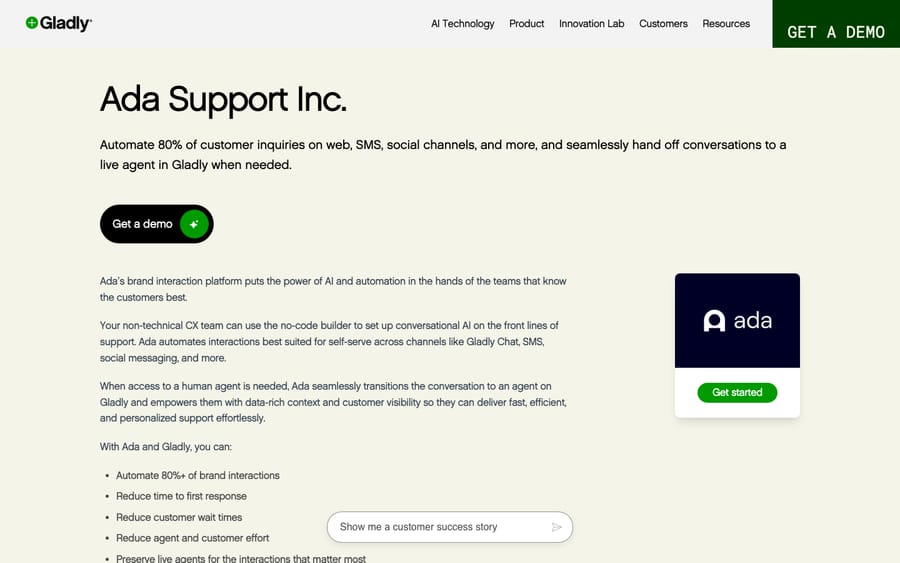
Ada is listed in Gladly's directory as "Live-chat handoff from AI chatbot to agents," and Gladly's help center says the Ada integration is built and maintained by Ada. Ada's listing promises automation on web, SMS and social channels and a contextual handoff to a Gladly agent when a person is needed. The setup doc has you embed both Gladly's chat and Ada on your site.
So Ada answers in its own experience and passes the conversation into Gladly, rather than replying inside Gladly conversations. That's why it scores 1 on what it does. Ada's site blocked our fetch on November 21, and it doesn't publish prices.
Scores: connection 2, what it does 1, price 0, implementation 1, ongoing 1.
Best for: enterprises that want one chatbot across web, app and social channels, with Gladly as the human team's workspace.
8. KODIF.ai: on Gladly's list, light on Gladly detail, 3/10
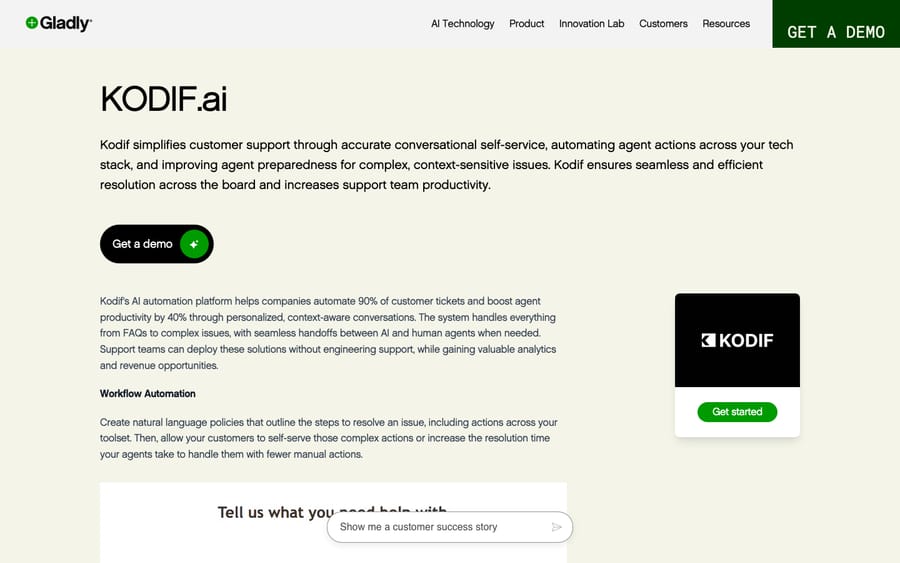
KODIF.ai appears in Gladly's directory ("Conversational AI, Workflow Automation, and Co-pilot") and lists Gladly as a help desk card on its integrations page, labeled "People-first inbox," while its Zendesk card says "Resolve & tag" and its Gorgias card "Resolve & macro." Kodif's site carried a banner announcing a merger with Cavalry when we checked. The Gladly listing describes natural-language policies, self-service conversations and an agent copilot, but not what Kodif writes back into Gladly.
Scores: connection 2, what it does 1, price 0, implementation 0, ongoing 0.
9. Linc: retail CX automation, 3/10
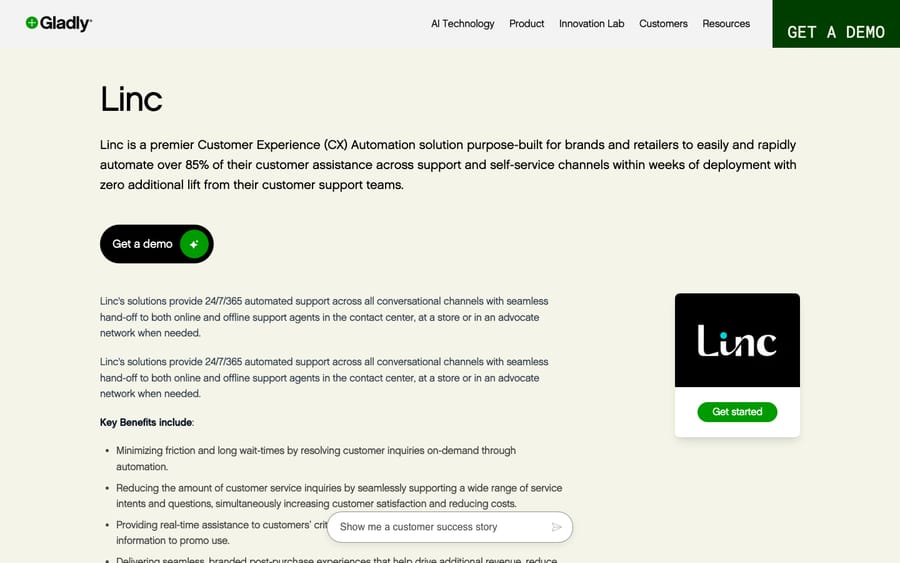
Linc is in Gladly's directory, described as a CX automation solution for brands and retailers that automates "over 85%" of customer assistance "within weeks of deployment with zero additional lift from their customer support teams," with handoff to agents in the contact center or in store. Linc's own homepage didn't mention Gladly when we checked, and there's no price.
Gladly's listing says Linc deploys it, but neither page says whether the build is included in the price, so implementation scores 1.
Scores: connection 1, what it does 1, price 0, implementation 1, ongoing 0.
Best for: enterprise retailers that want an outsourced automation build, especially for post-purchase and order updates.
10 and 11. DigitalGenius and Forethought: Gladly on the list, nothing more, 1/10 each
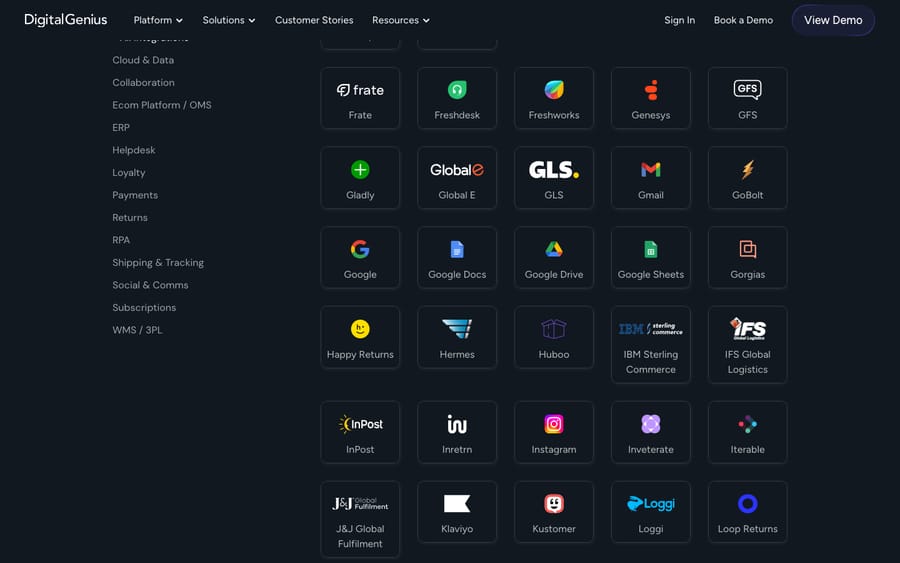
DigitalGenius names Gladly among the systems on its integrations page, and Forethought lists Gladly under Helpdesks & CRM on its integrations page. Neither page describes what the agent does on Gladly, neither appears in Gladly's directory, and neither publishes a price. Forethought's site also now says it "is now part of Zendesk," so ask about its roadmap for other help desks before you commit.
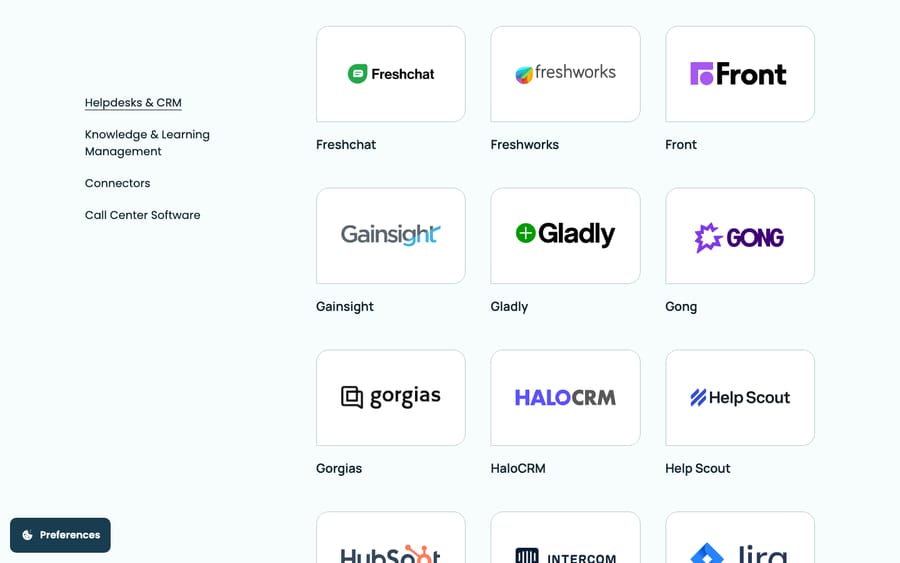
Scores, both: connection 1, what it does 0, price 0, implementation 0, ongoing 0.
What do the prices look like at 1,500 conversations a month?
The vendors bill on different units, which is the whole difficulty. Here's one worked example: a brand where AI handles 1,500 conversations a month and fully resolves 60% of them (900), handing 600 to people.
| Agent | Billing unit | Monthly cost in this example |
|---|---|---|
| Macha | Per ticket, whatever the outcome | $599/month for 1,500 tickets, setup and success manager included |
| Gladly AI | Per AI Resolution + per AI Assist | 900 × $1.50 + 600 × $0.25 = $1,500, before seats |
| Siena AI | Platform fee + per automated ticket | $750 + 1,500 × $0.90 = $2,100 (if every handled ticket counts as automated) |
| Yuma AI | Per full resolution, annual bundle | Starter covers 1,000 resolutions a month at $1,200 ($14,400 a year), so 900 fits |
| Alhena AI | Conversations per plan | Scale covers 1,200 conversations at $999 a month billed annually, so 1,500 needs more than Scale; Enterprise is quoted |
| Netomi, Ada, Linc, KODIF, DigitalGenius, Forethought | Quoted | Not published |
Our assumptions: the 60% resolution rate is illustrative, not a forecast; Siena's page doesn't say whether a ticket handed off counts as automated, so the $2,100 is its upper bound; Yuma's figure is its annual price divided by 12. Per-resolution pricing earns the vendor more as the AI resolves more, which sounds aligned with you until a vague "resolution" definition decides your bill. Ask every vendor for its definition in writing.
Which AI agents don't work with Gladly?
Some well-known AI support agents had no Gladly page or listing we could find on November 21, 2026: eesel AI (its Gladly integration URL returned 404), Fini, Lorikeet, Zowie, Decagon and Sierra. That's a snapshot, not a verdict, since vendors add help desks often. Ask any vendor not on this list to show you a live Gladly connection before a demo. And if your real problem is Gladly itself rather than its AI, our Gladly alternatives roundup compares the help desks teams move to.
Gladly's directory also has an "AI & Human Assistance" filter with AgentsOnly, HiOperator and Simplr (it also shows KODIF.ai and Slack). The first three are staffing services that pair people with AI, not AI agents you configure, so we left them out of the scores. Simplr's site now redirects to Asurion.
How do you choose an AI agent for Gladly?
- Decide who builds and runs it. This is the biggest cost difference and the one the per-ticket prices hide. Gladly's AI is yours to build and tune. Siena and Yuma offer onboarding; Alhena trains itself from your content. Macha's team builds, tests and runs it for you. If you want an agency to do the build, our list of Gladly implementation partners shows which ones take on AI work.
- Check what it writes back. An agent that only answers in its own widget and hands off (Ada's model) leaves your Gladly Topics, notes and assignments to people. One that replies inside the conversation and updates it (Macha, Netomi, Gladly's own AI) keeps reporting in Gladly accurate.
- Price it at your volume, with the unit spelled out. Per resolution, per assist, per automated ticket and per ticket give very different bills at the same volume.
- Don't run two AIs on one channel. If you add a third-party agent, decide which channel or Inbox it owns and keep Gladly's AI off there, or you pay twice for the same conversation.
- Start in draft mode. Whatever you pick, start with drafts a person approves, then turn on public replies for one category once the drafts are right. That's how Macha's done-for-you setup runs every rollout.
Common questions
What is the best AI agent for Gladly?
On our rubric, Macha (9/10), because it replies, writes notes, tags Topics, reassigns and sends outbound messages inside Gladly, and the Macha team builds and manages it for about $0.40 per ticket. Gladly's built-in AI, Siena AI and Yuma AI tie on 7/10: Gladly's AI does the most inside a conversation if you have an admin to run it, Siena is the strongest option listed in Gladly's own directory, and Yuma publishes the most detailed price.
Does Gladly have its own AI agent?
Yes. Gladly's AI, formerly Sidekick, answers customers from Public Answers, follows Guides and runs Shopify actions. Its Shopify App Store listing prices it at $1.50 per AI Resolution and $0.25 per AI Assist, plus $120 a month per team member.
Can I use a third-party AI agent with Gladly's AI switched on?
You can, but split the work by channel or Inbox. Netomi's integration, for example, only answers conversations in its own AI Inbox. If two AIs answer the same conversation you pay both vendors and confuse your reporting.
Which AI agents are listed in Gladly's app directory?
Of the 62 apps we counted on November 21, 2026, the AI & Chatbots filter shows six: Ada, Amazon Connect, Flip, KODIF.ai, Netomi and Siena. Four of those answer customers in text channels; Amazon Connect and Flip are phone tools. Linc is listed without a category. The AI & Human Assistance filter holds staffing services that pair people with AI (AgentsOnly, HiOperator, Simplr), plus KODIF.ai and Slack.
How much does an AI agent for Gladly cost?
Published prices on November 21, 2026: Macha about $0.40 per ticket; Gladly AI $1.50 per resolution and $0.25 per assist; Siena $750 a month plus $0.90 per automated ticket; Yuma from $14,400 a year; Alhena free for 25 conversations a month, then from $199 a month billed annually. Netomi, Ada, Linc, KODIF, DigitalGenius and Forethought quote on request.
Can an AI agent on Gladly draft replies for review instead of sending them?
Yes, if it can write internal notes. Macha's Gladly connector has an Add Internal Note action, so an agent can post its draft as a note that customers never see, and a person sends the reply. Gladly's notes API makes this possible for other vendors too; ask each one whether it uses it.
How we researched this
On November 21, 2026 we read the data behind Gladly's integrations directory (62 apps) and every app's detail page, plus Gladly's help docs: the List of App Integration Partners, the Netomi integration toolkit and the Ada setup pages. We then read each AI vendor's Gladly or integrations page and its pricing page: Siena, Yuma, KODIF.ai, Linc, DigitalGenius and Forethought. Ada's site returned an error to our fetch, so its entry relies on Gladly's pages. Gladly AI rates come from its Shopify App Store listing. Screenshots of vendor pages were captured the same day.
Macha's Gladly capabilities come from Macha's own Gladly connector, whose tool screen is shown above; we didn't run third-party agents on a live Gladly account. The cost table is our arithmetic on stated assumptions. Scores are ours, and no vendor was contacted. If you build an AI agent that works with Gladly and isn't here, write to us with your Gladly page and we'll score it on the same rubric.
To see Macha's agents on your own Gladly conversations, start with $50 of free usage (about 125 tickets), no credit card, no time limit, or read how it works on the Gladly integration page.