Intercom
 Shopify
 Stripe
 Slack
Slack Notion
 Google Workspace
 Confluence

What Are the Best Decagon AI Alternatives in 2026? 10 Options Compared by Price


Decagon is valued at $4.5 billion after a $250M Series D in January 2026, sells only through custom enterprise contracts, and has no pricing page; third-party data puts its median deal around $386K a year. The alternatives range from Sierra and Ada at the same enterprise scale to per-resolution agents built into Zendesk, Intercom and Gorgias, and self-serve options priced per ticket.
Key takeaways
- The closest Decagon alternatives are Sierra and Ada for enterprise-built agents, Zendesk AI agents and Intercom Fin for published per-resolution pricing, and Fini, eesel or Macha for self-serve starts.
- Decagon has no public pricing, and third-party data points to a roughly $50K a year platform fee plus about $0.99 per conversation, with a Vendr median contract around $386K.
- Zendesk AI agents cost $1.50 per resolution on a committed plan or $2.00 pay-as-you-go, while Intercom Fin charges $0.99 per outcome with a 50-outcome minimum off Intercom.
- Gorgias charges $0.90 per resolved conversation on most plans and from $1 on Starter, while Fini charges $0.89, $0.69 or $0.49 per resolved ticket by plan.
- Macha prices per ticket from $299 a month for 750 tickets up to $3,999 for 10,000 tickets, with a $50 free-usage trial covering about 125 tickets.

The best Decagon AI alternatives in 2026 are Sierra and Ada if you still want an enterprise-built agent, Zendesk AI agents or Intercom Fin if you want published per-resolution pricing ($1.50 and $0.99), and Fini, eesel or Macha if you want to start without a sales cycle. Decagon itself has no pricing page; third-party data puts its median contract around $386K a year. That's a fine fit for a high-volume consumer brand or a fintech with a dedicated CX-ops team, and a poor fit for almost everyone else.
| If you want | Look at | How it bills |
|---|---|---|
| An enterprise, custom-built agent like Decagon | Sierra, Ada | Quote-only; outcome or resolution based |
| The agent built into your help desk | Zendesk AI agents, Intercom Fin, Gorgias | $1.50, $0.99 and $0.90 per resolution |
| An agent layer on the desk you already run | Macha | Per ticket, from $299/mo for 750 tickets |
| Retail logistics and returns | DigitalGenius, Gorgias | From ~$1,000/mo; per resolution |
| Self-serve, pay as you go | Fini, eesel AI | $0.49 to $0.89 per resolution; $0.40 per ticket |
Below are ten products that resolve customer conversations, grouped by who they serve and how their pricing compares to Decagon's. For each we cover what it does, who it's for, the pricing model, and how it stacks up against Decagon specifically. We checked vendor pricing and documentation in September 2026, re-checked the Fin, Intercom, Gorgias, Fini and eesel pages on 24 September, and link to our deep-dive guides rather than repeat them here.
Disclosure: Macha publishes this blog. Macha is one of the ten tools below — an AI agent layer that runs on Zendesk, Freshdesk, Gorgias, Front, HubSpot or Intercom. It's described against the same criteria as everything else on this page, sits in the group those criteria put it in, and carries the same "where it falls short" line as every other entry.

Why do teams look for a Decagon alternative?
Decagon is genuinely good at what it does — we cover the product itself in depth in our complete Decagon AI guide. The reasons to look elsewhere are rarely about quality — they're about fit and commercial terms. The honest list:
- It's enterprise-only. Decagon sells to large brands with serious ticket volume. There's no self-serve tier, no free trial, and no SMB on-ramp. If you're a startup or mid-market team, you're not the target customer.
- Pricing is opaque and quote-only. There's no public pricing page. You talk to sales, share your volume, and get a custom quote. Third-party sources peg a ~$50K/year platform fee plus roughly ~$0.99 per conversation (Decagon's most popular model), with a Vendr median annual contract around $386K (range ~$95K–$590K+). Numbers like these are negotiated, so treat them as directional.
- It's a custom build, not a switch-on tool. Decagon agents are configured to your brand, systems, and workflows — powerful, but it means an implementation project, not an afternoon. Time-to-value is measured in weeks.
- Long sales cycle. Procurement, security review, and a custom build mean the path from "interested" to "live" is a multi-month enterprise motion, not a credit-card signup.
None of that makes Decagon wrong — it makes it specific. If you want lighter pricing, a faster setup, a tool that lives inside your existing helpdesk, or something you can pilot without a sales cycle, the alternatives below are where to look.
How did we evaluate these alternatives?
A quick note on method so you can weigh the list. Pricing is taken from each vendor's official page where one exists, and from cited third-party sources (Vendr, G2, eesel, Fin's pricing teardowns) where pricing is quote-only — flagged as approximate in every case. Capabilities are checked against current product documentation. We ran first-hand captures of the vendor sites referenced here, and Macha is our own product, which we flag wherever it appears. The single most important thing to compare isn't the headline number — it's the billing unit, because that decides your real bill:
Update (September 2026): Salesforce completed its acquisition of Fin, the company that renamed itself from Intercom on May 12, 2026, on September 10, 2026, in a deal worth about $3.6 billion, and plans to fold it into Salesforce's Agentforce. Worth weighing in any long-term Intercom or Fin decision.
- Per conversation — pay for every conversation the agent touches, solved or not (Decagon's main model). Predictable, but you pay for misses.
- Per resolution / outcome — pay only when the agent fully solves something (Intercom Fin, Fini, Gorgias, Zendesk, often Ada, Sierra). Clean alignment, but "resolution" is vendor-defined — read the definition.
- Per ticket — pay one flat rate per thread, however many replies it takes (Macha, from $299/mo for 750 tickets, ~$0.40/ticket). Best when you want one predictable charge regardless of how much work a thread takes. Note: eesel calls its model "pay-per-task," but it's effectively a flat ~$0.40 per support ticket — similar in shape to Macha's own per-ticket rate.
- Per platform / flat fee — enterprise commitments layered on top of one of the above (Sierra, Decagon, Ada).
All figures below are approximate, vendor-set, and current as of September 2026 — confirm on each vendor's page before signing.
The list is grouped, not ranked. The numbers are document order so you can point at an entry, not a score. The groups run in order of how much of your current setup you'd have to change to adopt them:
- Enterprise CX agent platforms — the direct Decagon rivals: a standalone platform, sales-led, with the same procurement shape.
- AI agents built into the major helpdesks — no separate vendor at all, just a line on the contract you already have.
- The AI agent layer on top of your helpdesk — a new vendor, but no new platform and no migration.
- Ecommerce-built AI agents — narrower, because the value sits in store, carrier and returns data you only have if you're a retailer.
- Flexible, usage-priced challengers — the smallest commitment, and the shallowest feature set.
Within a group the order isn't a ranking either, and a tool comes off the list if it stops selling, stops publishing enough detail to describe how it bills, or turns out to only draft replies rather than resolve.
Which enterprise platforms compete directly with Decagon?
If you genuinely need an enterprise-grade, custom-built agent and Decagon just isn't the right partner, these are its closest peers. Same league, same quote-only reality.
1. Sierra
What it does: Founded by Bret Taylor (former Salesforce co-CEO and an OpenAI board member) and Clay Bavor, Sierra is an "agent operating system" for building enterprise AI agents across chat, voice, SMS, WhatsApp, email, and ChatGPT — agents that take actions like processing refunds or saving cancellations, not just answering. It's widely seen as the category's flagship and raised $950M at a $15.8B valuation in May 2026. Who it's for: Large enterprises that want a bespoke, brand-owned agent and have the team to build and maintain it. Pricing model: Outcome-based — you pay when the agent resolves, saves a cancellation, or completes an upsell. No public pricing; third-party benchmarks land around $150K–$350K+/year, blended across per-conversation and per-outcome. vs. Decagon: The most direct head-to-head — both are quote-only, build-heavy, six-figure platforms. Sierra leans harder on outcome pricing and multi-channel (including voice and ChatGPT); Decagon emphasizes per-conversation simplicity and analytics. Neither solves the "I want something self-serve and cheap" problem. Where it falls short: it's the most expensive option on this page by a wide margin, and an "agent operating system" expects you to bring people to operate it — budget the headcount, not just the contract. No public pricing and no self-serve trial; G2 showed 130 reviews at 4.5/5 when we read it on 22 September 2026, a thin base for a vendor at this price. Go deeper: Our complete Sierra AI guide.

2. Ada
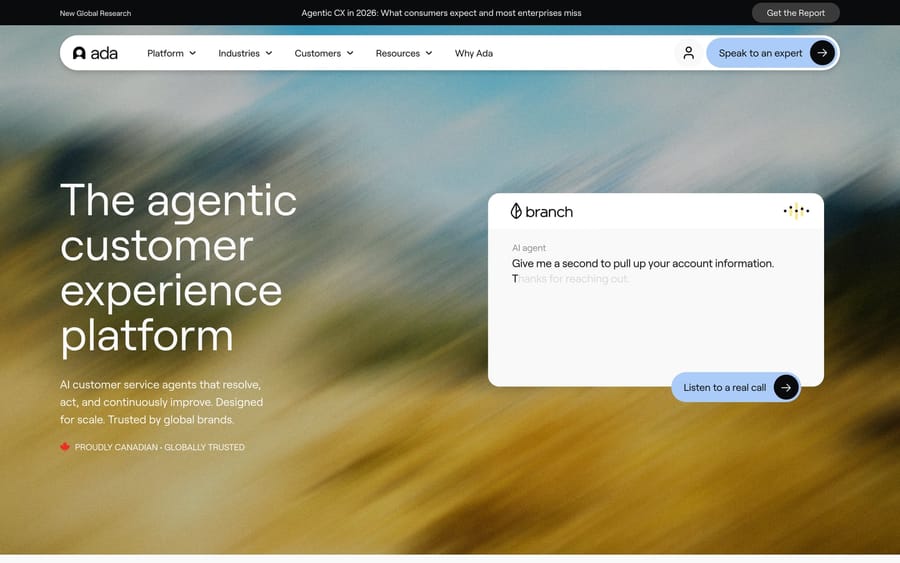
What it does: One of the longer-standing players, Ada is an AI agent platform focused on automated resolutions across channels and 50+ languages, with strong no-code authoring for non-technical teams. Who it's for: Mid-market to enterprise brands that want a mature, multilingual agent and a less engineering-heavy setup than Sierra or Decagon. Pricing model: Quote-only, structured around automated resolutions or conversation volume. Reported per-resolution rates run roughly $1–$3.50; entry deals start around $30K/year and enterprise contracts reach $100K–$300K+. vs. Decagon: A gentler enterprise on-ramp. Ada's no-code authoring means less reliance on a custom build, and entry contracts can start lower than Decagon's typical commitment — though at the top end the two converge on six figures (Vendr's median lands near $70K/year). Where it falls short: quote-only with no self-serve trial and deployments that run 8–16 weeks, so it's no faster to prove out than Decagon. Buyers rate Ada 4.6 on G2 while end users rate the same product near 2.0 on Trustpilot, citing context loss between turns and difficulty reaching a human — read both before assuming the admin experience predicts the customer one. Go deeper: Our complete Ada AI guide.
What about the AI agents built into the major helpdesks?
If you already run a helpdesk — or are willing to consolidate onto one — its native agent skips a separate vendor relationship entirely. Less integration work; you're tied to that platform's roadmap and pricing.
3. Zendesk AI agents

What it does: Zendesk's native AI agents resolve tickets autonomously across messaging and email, trained on your help center and business rules. Zendesk has bought its way to the front of this race — acquiring Ultimate (2024, now "Zendesk Advanced AI") and Forethought (closed March 2026, its largest deal in ~20 years). Who it's for: Existing Zendesk customers who want resolution without adopting a separate vendor. Pricing model: Per automated resolution — $1.50 per resolution on a committed plan, $2.00 pay-as-you-go, on top of your Suite or Support seats, with a resolution allowance included on plans and overage billed automatically. vs. Decagon: Far more transparent and far cheaper to start — published per-resolution rates and no six-figure platform fee. Where it falls short: it's the highest per-resolution rate on this page, and it scales with your success rather than your effort — 3,000 resolutions a month is $4,500 at the committed rate. You have to be (or become) a Zendesk customer, the agent is bounded by Zendesk's ecosystem rather than built around your stack, and you inherit Zendesk's roadmap: Ultimate and Forethought are still being folded together, so the packaging has moved twice in two years.
4. Forethought (now part of Zendesk)
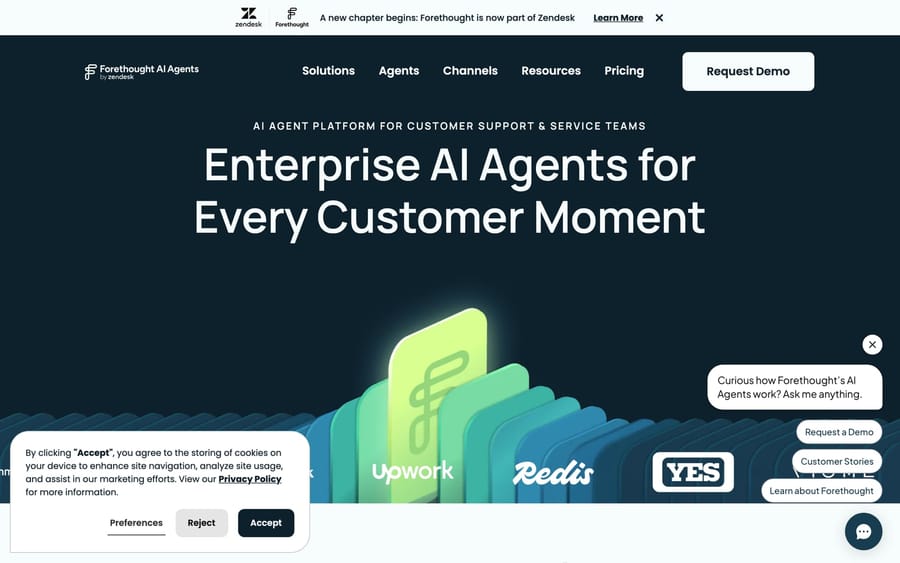
What it does: Forethought pioneered agentic, self-learning support automation — intent prediction, deflection, and assist — before Zendesk acquired it in March 2026. Its capabilities are being absorbed into Zendesk's premium AI tiers. Who it's for: Practically, future Zendesk customers — standalone Forethought is winding into the Zendesk stack. Pricing model: Historically hybrid — a platform fee plus roughly ~$0.12 per deflection — with Vendr data showing a ~$59.5K/year median. Expect this to migrate to Zendesk's resolution-based pricing. vs. Decagon: Historically a cheaper, deflection-priced alternative; going forward it's less a standalone Decagon rival than a reason to look hard at Zendesk's AI roadmap. Where it falls short: it's mid-migration. Pricing, packaging and roadmap are all being absorbed into Zendesk's Resolution Platform, so anything you sign today is priced against a product being rebuilt around a new owner's model — and the standalone product's independent future is the one thing you cannot get a straight answer on. Go deeper: Our complete Forethought AI guide.
5. Intercom Fin
What it does: Fin is the AI agent from the company formerly called Intercom (renamed Fin in May 2026) and the most-cited per-resolution product in the category. It resolves conversations across Intercom's messenger, email, and other channels, and Intercom sells Fin to run on other helpdesks too. Who it's for: Intercom customers, and SaaS/product teams that want a polished, fast-to-deploy agent with transparent, public pricing. Pricing model: $0.99 per resolved outcome (charged once per conversation regardless of how many actions Fin takes), with a 50-outcome monthly minimum when Fin runs on another help desk, and a 14-day trial. "Qualification" outcomes bill at $9.99 each; channel fees (SMS, WhatsApp, voice) stack on top. vs. Decagon: The transparency answer. Public per-resolution pricing, no quote, no six-figure floor — you can model your bill before talking to anyone. The trade-off is that Fin is most powerful inside Intercom's ecosystem, whereas Decagon is a channel-agnostic custom build. Where it falls short: the meter runs on the vendor's definition of an outcome. Salesforce's acquisition announcement cites a 76% average resolution rate, a vendor number; whatever Fin doesn't close still lands on your human team, so the $0.99 buys only the share it resolves. Qualification outcomes bill at $9.99 each and channel fees stack on top. And as of September 10, 2026 the vendor is Salesforce, with Fin folding into Agentforce — a roadmap change you're buying into. Go deeper: Our complete Intercom Fin guide.

Can you add an AI agent layer on top of your current helpdesk?
Between the agents built into a helpdesk and the ones built for a single vertical sits a third shape: a third-party agent that runs inside the desk you already have. It asks for a new vendor but no new platform and no migration, which is why this group comes after the native agents and before the ecommerce-native ones.
6. Macha

What it does: This is our product, so here is the mechanism rather than the pitch. Macha isn't a helpdesk and isn't a standalone platform you deploy as your front line. It's an AI agent layer that runs on top of Zendesk, Freshdesk, Gorgias, Front, HubSpot or Intercom. It connects over the helpdesk API and runs configured agents against incoming tickets. An agent is a set of written instructions plus the tools it's allowed to call: read the ticket, its comments, its custom fields and attachments, search past tickets, search connected knowledge (help center, Notion, Confluence, Google Docs, a website), then write back a public reply, an internal note, tags, status, priority or field values. Any HTTP API can be added as a custom tool — an order lookup, a subscription cancel, a warranty check. Each agent runs in one of three modes you can switch between: internal note only, a draft for a human to send, or an autonomous reply, and a simulation replays your real past tickets before any of it goes live. Who it's for: Teams committed to Zendesk, Freshdesk, Gorgias, Front, HubSpot or Intercom that want a capable agent without ripping out their helpdesk or signing a six-figure enterprise contract. Pricing model: One plan priced on monthly ticket volume — $299 for 750 tickets, $599 for 1,500, $1,199 for 3,000, $1,999 for 5,000, $2,999 for 7,500 and $3,999 for 10,000, custom above that. That's about $0.40 a ticket at every tier, billed monthly. A ticket is one thread with one person, charged once however many messages and tool calls it takes; an email ticket, a live chat and a Copilot session each count once. Every feature is on every tier, seats are unlimited, there are no overages — agents pause at the limit rather than auto-billing — and setup, agent building and monitoring are done by the Macha team rather than sold as a services line. The trial is $50 of free usage, about 125 tickets, no credit card and no time limit. See Macha for Zendesk for how the layer works. vs. Decagon: Decagon is an enterprise, custom-built, quote-only platform you deploy as your agent; Macha is a layer that adds agents to the helpdesk you already run, at a price you can read off a page.
Where it falls short: We're a much smaller company than Decagon, Sierra or Ada, with no G2 or Capterra profile to check us against and no analyst coverage — if your procurement process requires third-party review volume, we will fail it. Macha is not a helpdesk, so it's a line item on top of one rather than a replacement for it, and if you're not on Zendesk, Freshdesk, Gorgias, Front, HubSpot or Intercom, Decagon or one of the native agents above fits your stack better. There is no voice channel: email, chat and the agent-facing Copilot only, where Decagon covers voice. And an agent does what its instructions say, so a vague instruction produces a vague agent — the setup work is real, which is why we do it with you rather than handing over an empty console.
Which AI agents are built for ecommerce?
Retail and DTC support has its own shape — WISMO, returns, exchanges, order edits — and these agents are built around it, with carrier, returns, and store integrations baked in.
7. Gorgias Automate

What it does: Gorgias is the dominant Shopify-era helpdesk, and its Automate AI agents resolve order-status, returns, and product questions using connected store data. Who it's for: Shopify and DTC brands already on (or considering) Gorgias. Pricing model: $0.90 per resolved conversation on most plans, from $1 on Starter, per Gorgias's own pricing explainer; interactions beyond your allowance cost $1.50 on Support + Shopping Assistant plans and $1.00 to $2.00 on monthly support-only plans. Conversations handed to a human are billed as ordinary helpdesk tickets. Watch the billing nuance that third-party pricing breakdowns flag: an AI resolution can also count toward your helpdesk ticket volume. vs. Decagon: A purpose-built, far cheaper ecommerce option. If your tickets are mostly order-status and returns, Gorgias's store-native resolution will likely match Decagon's value at a fraction of the cost and setup — without a six-figure commitment. Where it falls short: it runs on Gorgias and nowhere else, so adopting it means adopting a helpdesk, not just an agent. If the double-count applies to your plan, one automated resolution moves two meters on your bill, and outside Shopify-shaped ecommerce the store-data advantage that makes it good disappears.
8. DigitalGenius
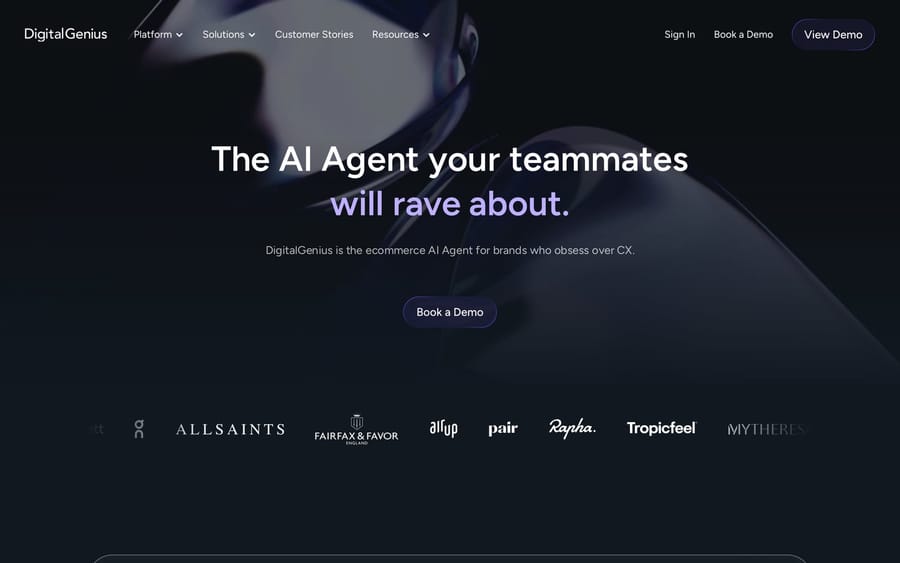
What it does: Purpose-built for ecommerce, DigitalGenius combines conversational AI with visual AI (image recognition for product defects/returns) and deep integrations to carriers, ERPs, and warehouses to resolve order tickets end-to-end. Who it's for: High-volume retailers and DTC brands with complex logistics and returns operations. Pricing model: Usage-based, tiered, starting around $1,000/month with custom enterprise quotes; implementation runs $1,000–$50,000 and there's no free trial. vs. Decagon: A vertical specialist where Decagon is a generalist. For complex retail logistics, DigitalGenius's carrier/ERP integrations and visual AI go deeper than a general-purpose agent — but for non-retail use cases Decagon is the broader platform. Where it falls short: no free trial and a separately quoted implementation of $1,000–$50,000 mean you commit before you see a resolution rate on your own queue — the same problem you're leaving Decagon over. If your tickets are billing, account or software questions, most of what you're paying for goes unused.
Which alternatives are usage-priced with no contract?
If the enterprise platforms feel heavy and you want fast setup with pay-for-what-you-use economics, these are the antidote to Decagon's commitment.
9. Fini
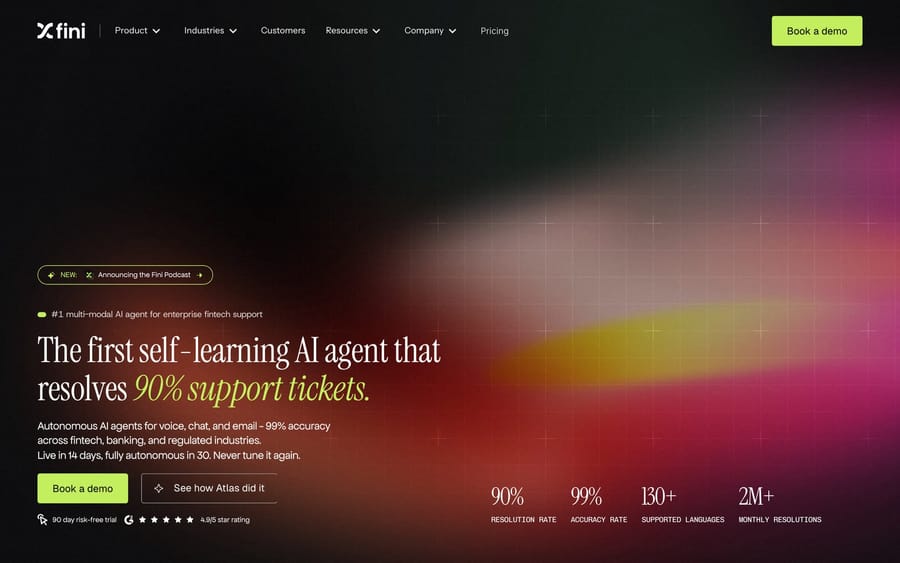
What it does: Fini is a self-improving AI support agent that plugs into your existing helpdesk and knowledge, with a focus on multi-modal resolution and clean human handoff. Who it's for: Mid-market support teams that want outcome pricing without enterprise contracts or implementation fees. Pricing model: Tiered per resolved ticket: $0.89 on Growth, $0.69 on Scale, $0.49 on Enterprise, with implementation included and no seat charges. Enterprise customers get a 90-day free pilot. vs. Decagon: Outcome-aligned and dramatically cheaper to start. You pay only when Fini solves something, with no annual commitment at all — at the cost of Decagon's deeper enterprise controls and custom build. Where it falls short: there's no free tier below Enterprise, so on Growth or Scale evaluating it costs money from the first ticket. It's a small vendor with a thin public review base (~47). And the billing unit carries the definitional problem per-resolution pricing always has: someone else decides what "resolved" means.
10. eesel AI
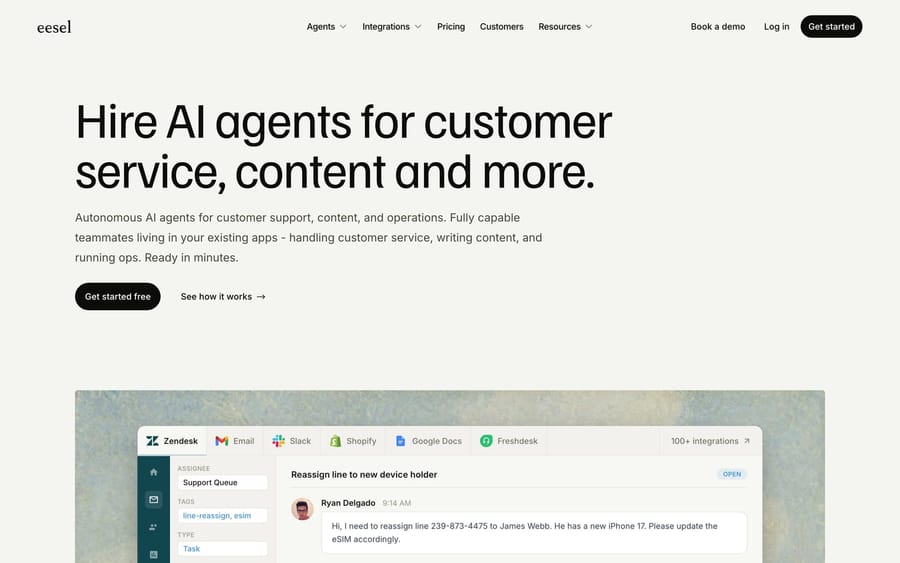
What it does: eesel connects to your helpdesk and docs and resolves tickets with a notably low-friction, self-serve setup — you can start without talking to sales. Who it's for: Small to mid-sized teams that want to switch on an agent cheaply, test it, and scale spend deliberately. Pricing model: Pay-per-task at $0.40 per support ticket — no platform fee, no seat charges and no monthly minimum on self-serve, free until you've used $50, with a default spending limit of $250 a month that you can change; an annual commitment paid upfront saves up to 25%. A separate Enterprise tier adds a $1,000/month flat platform fee on top of the same usage (dedicated solutions engineer, higher knowledge limits, SSO, HIPAA), so it costs more than self-serve at any volume. Despite the "per-task" label, this is effectively a flat per-ticket (per-conversation) rate, not per-granular-action billing — you pay one fixed amount per ticket regardless of how many lookups or steps the agent takes inside it. vs. Decagon: The opposite philosophy. Where Decagon is sales-led and quote-only, eesel is self-serve and transparent — the easiest way to pilot an agent without a sales cycle. It won't match Decagon's enterprise depth, but most teams evaluating Decagon don't need that depth to start. Where it falls short: feature depth is shallower than the enterprise platforms, heavy generations bill at $4.00 rather than $0.40, and the $1,000/month Enterprise platform fee arrives the moment you need SSO or HIPAA — the self-serve price is not the price at scale. Setup is self-serve, which also means the configuration work is yours.
How do the Decagon alternatives compare on price and reviews?
| Product | Pricing model | Deployment | G2 rating (reviews) | Best for (vs. Decagon) |
|---|---|---|---|---|
| Decagon | Per-conversation (~$0.99) or per-resolution; ~$50K+/yr fee | Standalone, custom build | Few public reviews (enterprise, sales-led) | High-volume consumer/fintech with budget |
| Sierra | Outcome-based (~$150K–$350K+/yr) | Standalone, build-heavy | 4.5/5 (130) | Bespoke enterprise agents |
| Ada | Per-resolution (~$1–$3.50) or per-convo; ~$30K+/yr | Standalone, no-code authoring | 4.6/5 (~170) | Multilingual, gentler enterprise on-ramp |
| Zendesk AI agents | ~$1.50/resolution committed, $2 PAYG | Native to Zendesk | 4.3/5 (6,800+, full suite) | Transparent pricing, existing Zendesk teams |
| Forethought (now Zendesk) | Hybrid fee + ~$0.12/deflection (migrating) | Folding into Zendesk | — (folding into Zendesk) | Zendesk roadmap watchers |
| Intercom Fin | $0.99 per resolution | Native to Intercom (+ others) | 4.6/5 (1,100+) | Transparent, fast-deploy SaaS teams |
| Macha | Per ticket, from $299/mo for 750 tickets (~$0.40/ticket) | Layer on Zendesk, Freshdesk, Gorgias, Front, HubSpot, Intercom | Newer entrant — no public reviews | Teams on one of those desks adding AI |
| Gorgias Automate | $0.90/resolution most plans, from $1 on Starter | Native to Gorgias | 4.6/5 (800+) | Shopify / DTC, cheaper ecommerce |
| DigitalGenius | Usage-based, from ~$1,000/mo | Standalone, ecommerce | Limited public reviews | Complex retail logistics/returns |
| Fini | $0.89 / $0.69 / $0.49 per resolved ticket | Plugs into your helpdesk | Strong but small sample (~47) | Outcome pricing, no enterprise contract |
| eesel AI | $0.40 per ticket (pay-per-task) | Self-serve, plugs in | 4.7/5 (~16) | Self-serve pilot, no sales cycle |
Pricing is approximate, vendor-set, and current as of September 2026 — confirm on each vendor's page before buying. G2 ratings and review counts captured September 2026 and move over time; full reviews on G2 sit behind a login wall, and enterprise, sales-led vendors (Decagon, Sierra) carry far smaller public review bases than self-serve products.
What do users say about these tools?
Ratings only tell you so much, so here's the texture from real reviewers. A pattern worth noting up front: the self-serve products carry large public review bases (Zendesk, Fin, Gorgias, Ada all have hundreds-to-thousands of G2 reviews), while the enterprise, sales-led platforms carry smaller bases: Sierra showed 130 G2 reviews on 22 September 2026, and Decagon's count is thinner still, because those deals close in procurement, not on review sites. Full G2 reviews also sit behind a login wall, and many are attributed only by role and industry. A representative sample (lightly trimmed, attribution as G2 publishes it):
- On Zendesk AI agents, the upside and the onboarding friction in two voices: "The generative AI service is a favorite of mine because it helps us create multi-level responses based on our knowledge base, addressing customer queries without needing a live agent." — Mudit T., Sr. Manager eCommerce Operations, Retail (G2). And the flip side: "the way that they are set up is a little burdensome to actually onboard." — Paul S., Head of Customer Experience, Small Business (G2, ~2025).
- On Fini, reviewers consistently praise the hands-on team over the tech: "Deep and the team are incredibly knowledgeable and make implementation a breeze." — Jacqueline M. (G2). The recurring caveat is the small sample (~47 reviews) behind the strong sentiment.
- On Sierra, the most-cited gripe is the one this whole article is about — opacity: "limited transparency on technical details and pricing, which makes it harder to fully assess long-term costs and integration." — G2 reviewer (attributed by role only). Several reviewers also note the agent can lose context in longer conversations.
- On Intercom Fin and Gorgias, the dominant theme across high ratings (both ~4.6/5) is the same pricing anxiety: Fin reviewers warn the $0.99-per-resolution model "becomes unpredictable and expensive at scale," and Gorgias reviewers repeatedly flag that an AI resolution can be billed twice (once as an AI fee, once as a helpdesk ticket) — the single most common complaint in its reviews.
The honest read: every vendor here has happy reviewers; the differences are in what gets complained about — onboarding (Zendesk), bill predictability (Fin, Gorgias), and transparency (Sierra, Decagon). Weigh the complaints that match your situation, not just the star count.
How do you choose a Decagon alternative?
You don't pick the "best" agent in the abstract — you pick the one that fits your stack, your volume, and your appetite for commitment. A short decision path:
- Decide if you actually need enterprise-custom. If you genuinely have the volume, the CX-ops team, and the budget for a bespoke six-figure agent, the real shortlist is Decagon vs. Sierra vs. Ada — compare them on channels, outcome vs. conversation pricing, and implementation depth. If you don't need that, skip this whole tier; it's where most of the cost and the sales cycle live.
- Start from your helpdesk. On Zendesk, Freshdesk, Gorgias, Front, HubSpot or Intercom? Look at the native agent (Fin on Intercom), or Macha, a layer that adds agents without replatforming. On Gorgias/Shopify? Gorgias Automate. The lowest-friction option is usually the one that lives where your team already works.
- Match the billing unit to your reality. Per-conversation (Decagon) is predictable but you pay for misses. Per-resolution (Fin, Fini, Ada) rewards a clean, FAQ-heavy queue. Per-ticket (eesel, Macha) fits queues where you want one predictable charge regardless of how many replies a thread takes. Model your real volume against each — the cheapest sticker rarely wins at scale.
- Be honest about implementation. Decagon, Sierra, Ada, and DigitalGenius can be excellent and can also mean weeks of setup. Fini, eesel, Fin, and Macha get you live far faster.
- Pilot before you commit. This is the biggest argument against Decagon's model: a six-figure annual commitment is hard to walk back. Wherever you can, run the agent on a real slice of your queue and measure actual resolution rate and CSAT before you sign — vendor-claimed deflection (often 60–80%) and your reality can diverge a lot.
Frequently asked questions
What are the best alternatives to Decagon AI? For enterprise-custom agents in Decagon's league, Sierra and Ada are the closest rivals. If you want transparent, public pricing, Intercom Fin and Zendesk AI agents lead. For ecommerce, Gorgias and DigitalGenius are purpose-built. For fast, usage-priced setups with no sales cycle, Fini and eesel stand out. And if you're on Zendesk, Freshdesk, Gorgias, Front, HubSpot or Intercom and want to add an AI layer without replatforming, Macha is built for that.
How much does Decagon cost compared to alternatives? Decagon is quote-only — third-party data points to a ~$50K/year platform fee plus roughly ~$0.99 per conversation, with a Vendr median annual contract around $386K. By contrast, Intercom Fin publishes $0.99/resolution, Zendesk charges ~$1.50/resolution, Fini runs $0.89 to $0.49 per resolved ticket by volume, and eesel is $0.40/ticket with no platform fee on self-serve (its Enterprise tier adds a $1,000/mo platform fee on top of usage). Most alternatives are dramatically cheaper to start and don't require a six-figure commitment. (Decagon figures are negotiated and approximate.)
Is there a self-serve alternative to Decagon? Yes. Decagon has no free trial or self-serve tier. eesel (free until you've used $50), Intercom Fin (public pricing, a 14-day trial, and a 50-outcome minimum off Intercom), and Macha ($50 of free usage, about 125 tickets, on top of Zendesk, Freshdesk, Gorgias, Front, HubSpot or Intercom, no card, no time limit) all let you start without a sales cycle.
Which Decagon alternative is best if I already use Zendesk? Zendesk's own AI agents (built partly on the acquired Ultimate and Forethought tech) are the most native option. If you want an AI agent layer that resolves on top of Zendesk without adopting Zendesk's resolution pricing or roadmap, Macha is built for exactly that. The same agents run on Zendesk, Freshdesk, Gorgias, Front, HubSpot and Intercom.
Is Macha a Decagon competitor? Not directly. Decagon is an enterprise, custom-built support agent you deploy as your front line; Macha is an AI layer that adds resolution on top of an existing Zendesk, Freshdesk, Gorgias, Front, HubSpot or Intercom helpdesk, priced per ticket. If you need an enterprise-custom standalone agent, Decagon (or Sierra/Ada) is the category; if you want to add AI to the helpdesk you already run, that's Macha.
Which Decagon alternative should you pick?
Decagon is a strong, well-funded enterprise platform, and a poor fit for anyone who isn't a high-volume brand ready for a custom build and a six-figure commitment. The best Decagon alternative depends on what's pushing you away. If it's the build-heavy enterprise model itself, Sierra and Ada are the closest peers. If it's the opaque, quote-only pricing, Intercom Fin, Zendesk AI agents, Fini, and eesel all publish their numbers. If it's cost and setup, the usage-priced challengers win. And if you're committed to Zendesk, Freshdesk, Gorgias, Front, HubSpot or Intercom and want an AI layer that resolves more without a rip-and-replace, Macha is built for that one job. Whichever you shortlist, pin down the billing unit, read the resolution definition, and pilot on real tickets before you sign — that's what separates a deflection rate on a slide from one in your dashboard.
Vendors and pricing verified against vendor pricing and documentation pages, September 2026. AI pricing in this category is changing fast — confirm current terms on each vendor's site before buying.
Simple per-ticket AI pricing
One thread with one person is one charge, however many replies it takes.