Shopify
 Stripe
 Slack
Slack Notion
 Google Workspace
 Confluence

The Best AI Automations to Set Up in Gorgias (with AI)


Most ecommerce support queues are not made of a thousand different questions — they are made of a handful of questions asked a thousand times. Where is my order, can I return this, please change my shipping address, cancel my order, pause my subscription. Those five patterns account for a huge share of every DTC brand's tickets, and every one of them is a good candidate for automation. This guide is a playbook: the highest-ROI AI automations to set up when Gorgias is your help desk, mapped to the real ticket types they cover, with an honest look at what native Automate handles well and where a dedicated AI agent layer earns its keep. The goal is fewer repetitive tickets and faster answers, without pretending any single tool resolves everything.

Start with the ticket types, not the tools
The mistake teams make is shopping for features before they've counted their tickets. Open your Gorgias views, sort by tag or intent for the last 30 days, and you'll almost always find the same top five: WISMO (where is my order), returns and exchanges, address or order changes, cancellations, and subscription management. Rank them by volume, then automate top-down. That order matters because the automation with the most leverage isn't the fanciest one — it's the one that sits on top of your biggest tag.
Gorgias groups its automation under Automate, which spans deterministic Rules and Flows (if-this-then-that logic and guided decision trees) and the generative AI Agent that reads a ticket, reasons about intent, and can take real actions in your store. Both matter. Rules are perfect for tagging and routing; the AI Agent is where the resolution happens. For a full tour of how those pieces fit, our complete guide to Gorgias Automate and AI and the deeper Gorgias AI Agent explained walk through the setup end to end.
The five automations worth setting up first
Here's the playbook, ordered roughly by how much queue each one clears for a typical Shopify brand. For each, the ticket type it maps to, the data or action it needs, and the honest catch.
| Automation | Maps to ticket type | Needs | The catch |
|---|---|---|---|
| WISMO / order tracking | "Where is my order?", "tracking hasn't updated" | Live order + fulfillment lookup, identity check | Needs real-time carrier/order data, not a canned reply |
| Returns & exchanges | "I want to return this", "wrong size" | Return eligibility rules, policy, return-label generation | Eligibility windows and final-sale rules must be enforced |
| Address / order change | "Change my shipping address", "add an item" | Write access to the order before fulfillment | Only safe pre-fulfillment; timing is everything |
| Cancel order | "Cancel my order", "I ordered by mistake" | Order status check, cancel/refund action | Must check whether it's already shipped |
| Subscription management | "Skip next box", "pause", "swap product" | Subscription-app read/write (e.g. Recharge) | Requires a connected subscription tool, not just Shopify |
1. WISMO / order tracking. This is almost always the biggest tag, and the best first automation. Per Gorgias, the AI Agent can "automate WISMO tickets with real-time order tracking," pulling the current status and returning it in the conversation (Gorgias AI Agent support skills). The bar for doing it well is a live lookup keyed to the customer's order and email — a static "orders usually ship in 3–5 days" macro doesn't count as resolution.
2. Returns & exchanges. Gorgias can "make exchanges and returns easy with personalized links," generating the right return flow inside the ticket. The work here is less about the reply and more about the rules: the automation has to check the purchase date against your return window, respect final-sale items, and route exchanges correctly. Get the eligibility logic right and this quietly clears a second big tag.
3. Address and order changes. "Modify orders in real-time, catching urgent edit requests" is exactly the kind of task where minutes matter — an address fix is only useful before the order is picked and packed. This one is high-value but demands write access and a hard guardrail: never edit a fulfilled order.
4. Cancel order. Closely related, and a good automation precisely because the logic is crisp: check status, and if it hasn't shipped, cancel and refund; if it has, pivot to a return. It's a decision tree with a real action at the end.
5. Subscription management. Gorgias highlights keeping "subscribers happy with instant address and order modifications." Skips, pauses, swaps, and next-charge-date changes are pure retention work — but they usually require a connected subscription app (Recharge, Loop, etc.), not just Shopify, so confirm the integration before you promise it.
What native Gorgias Automate does genuinely well
Credit where it's due. Gorgias built Automate for ecommerce, and it shows. The Rules and Flows engine is fast, deterministic, and transparent — ideal for auto-tagging by intent, routing VIPs, deflecting with a help-center article, and running structured self-service flows for the exact five patterns above. The AI Agent is genuinely capable on Shopify: it can look up an order, start a return, issue a refund, and edit shipping details from inside the conversation, and Gorgias reports automation rates and misship reductions that real brands see in practice. If your stack is Shopify-centric and your top tickets are the classic five, native Automate will move real volume out of your queue on day one.
Two honest constraints are worth naming. First, the AI Agent's order actions are Shopify-first — Gorgias documents them around Shopify, and third-party analyses note they aren't supported the same way on BigCommerce, Magento, or WooCommerce (myAskAI's Gorgias Automate guide). Second, there's a reported 72-hour reporting delay before an automated interaction is confirmed as resolved, which slows how fast you can iterate on your rules.
The billing model — read this before you scale
Here's where you need to plan deliberately, because the automation math and the billing math are two different things. Gorgias charges for AI on a resolution basis: roughly $0.90 per resolved interaction on annual and most plans, around $1.00 on Starter/monthly, with included allowances from 90 to 2,500+ interactions and overages near $1.50 each (Gorgias AI Agent pricing). A "resolution" is a conversation the AI closes entirely on its own.
The nuance that trips teams up is how a resolution interacts with the helpdesk ticket. Gorgias' own pricing page states that when the AI can't finish and hands off, you're "not charged for both" the ticket and the resolution. Independent breakdowns push back, reporting that in practice an AI resolution also counts as a helpdesk ticket, so two fees can stack on one conversation (myAskAI's pricing analysis). Whichever way it nets out on your invoice, the structural point holds: resolution-based pricing ties your bill to outcomes, and outcomes are the part you control the least. A WISMO ticket that needed three tool calls and one that needed one both bill the same flat resolution — you're paying for the finish line, not the work.
This is the seam where a different cost model matters, and it's worth understanding both before you scale.
Where an AI agent layer has the edge
An AI agent layer sits on top of your help desk rather than replacing it — the category of AI agents for customer service exists to do the reasoning-and-action work that rules alone can't. Macha is one such layer, and its connector to Gorgias is live: you connect it to the Gorgias you already run, and it reads and writes the same tickets your team works today. It does not replace Gorgias or its Rules and Flows — it adds an agent that can reason across your data and take real actions. The step-by-step Gorgias + Macha setup covers the connection.
Two things change with a dedicated layer. The first is breadth of action. Instead of a Shopify-first set of built-in skills, Macha agents call whatever you wire up through a custom tool — your OMS, your 3PL's tracking API, your subscription app, your ERP — so a WISMO lookup or an address change isn't limited to what one platform ships out of the box. The Macha Agents list below shows the shape of it: purpose-built automations, each with its own tools, triggers, sub-agents, and mode.
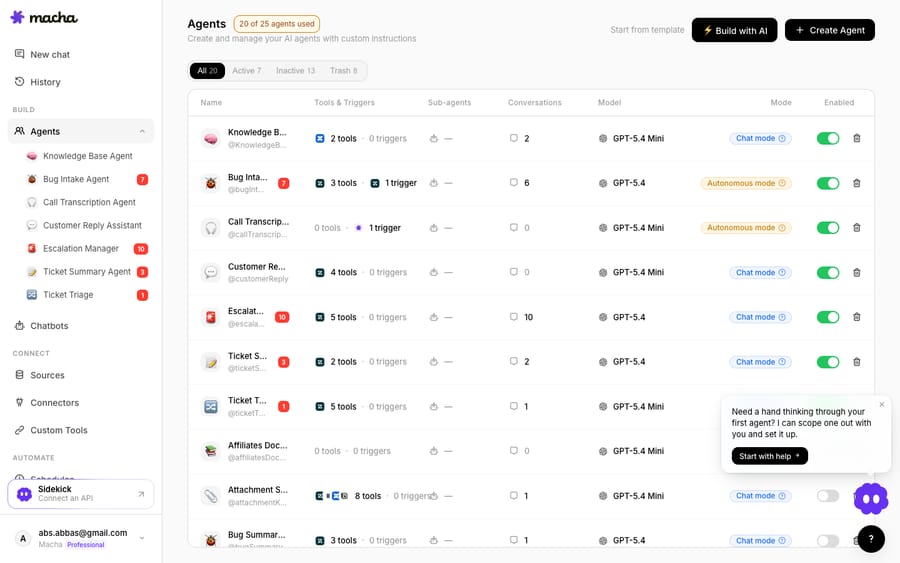
The second is the cost model. Macha bills in credits consumed per AI action — a tool call, a reply, a triage decision — rather than a flat fee per resolution. That reframes the whole conversation from deflection (a canned answer that closes a ticket) versus resolution (a fee tied to a fuzzy outcome) toward automation: you pay for the actions your agents actually take, whether or not any single conversation ends in a tidy "resolved." For work where outcomes vary — a WISMO that needs three lookups, a return that needs an eligibility check plus a label — paying per action instead of per outcome is easier to predict. See the pricing page for how credits work; there are no per-resolution charges to model.
The clean division of labour: keep Gorgias as your help desk and let its Rules and Flows do the deterministic tagging and routing, then layer AI agents on top for the reasoning-heavy, multi-system automations — WISMO across your real fulfillment stack, returns with your true eligibility rules, subscription changes in your actual subscription app.
FAQ
What are the best automations to set up first in Gorgias? Start with your highest-volume tags. For most ecommerce brands that's WISMO (order tracking), returns and exchanges, address/order changes, cancellations, and subscription management. Automate top-down by volume so your effort lands on the biggest tickets first.
Does Gorgias Automate work outside Shopify? Gorgias' AI Agent order actions are documented around Shopify. Third-party analyses report they aren't supported the same way on BigCommerce, Magento, or WooCommerce, so confirm your platform before relying on native order actions.
How does Gorgias charge for AI automations? On a resolution basis — roughly $0.90 per resolved interaction on annual/most plans and about $1.00 on Starter/monthly, with included allowances (90 to 2,500+) and overages near $1.50. A resolution is a conversation the AI closes on its own; check your own plan and invoice for how resolutions and helpdesk tickets interact.
How is Macha's pricing different? Macha charges credits per AI action taken — a tool call, a reply, a triage decision — rather than a flat fee per resolution. Because ecommerce outcomes vary, paying per action tends to be more predictable than paying per resolution. See the pricing page for details.
Do I have to replace Gorgias to add Macha? No. Macha is an AI agent layer that runs on top of the Gorgias you already use through a live connector. It reads and writes your existing tickets and works alongside Gorgias' Rules and Flows — it does not replace your help desk.
Ready to automate by ticket type instead of by default flow? Start a free trial of Macha and connect it to your Gorgias in minutes.
Add AI agents to your Gorgias
Macha reads the ticket, drafts the reply and takes the action, inside the Gorgias you already run.