Intercom
 Shopify
 Stripe
 Slack
Slack Notion
 Google Workspace
 Confluence

Bland AI: The Complete Guide (2026)


Bland AI is an enterprise voice AI platform that builds, deploys, and monitors AI phone agents on its own infrastructure rather than reselling a third-party voice stack. This guide covers what it actually does, its real per-minute pricing across every tier, including a Scale plan that appears only in its billing docs, its funding and customer claims, honest G2 ratings, and where it fits next to a text-based support AI.

We build AI agents for customer service ourselves, though not for voice specifically, so we read Bland the way any buyer comparing voice AI vendors would: what a call actually costs at volume, what founders and investors are on record saying about the hard parts of voice AI, and what real users report once they're past the demo.
What is Bland AI?
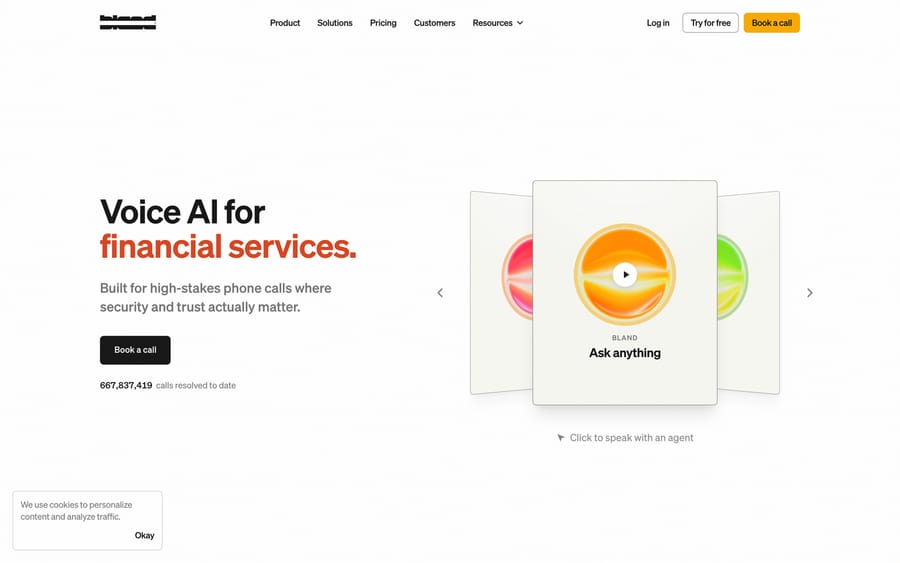
Bland was founded in 2023 by Isaiah Granet and Sobhan Nejad, and has raised over $100 million in under three years: a $16 million Series A in August 2024, a $40 million Series B led by Emergence Capital in January 2025, and a $50 million Series C led by Dell Technologies Capital in June 2026, with HubSpot Ventures, Archerman Capital, and Tribeca Venture Partners also participating. Backers named in press coverage of the round include Y Combinator, Upfront Ventures, Scale Venture Partners, Affirm co-founder Max Levchin, ElevenLabs CTO Piotr Dąbkowski, and Twilio founder Jeff Lawson. "Most voice AI systems are built for simple interactions," CEO Isaiah Granet said at the Series C announcement. "We are focused on the calls that are hardest to automate."
That framing shows up directly in who Bland sells to. The homepage headline is "Voice AI for _____," and the blank rotates through the regulated industries it targets: financial services when we captured it, elsewhere healthcare, insurance and logistics. There's no general chatbot pitch anywhere on it. Bland reports 667+ million calls resolved to date on its own counter, and cites customer results including MyPlanAdvocate ($40M added in five months), American Way Health ($430M+ in additional annual revenue), and IHFA ($750K saved by retiring its IVR), alongside named customers Kin Insurance, Mutual of Omaha, and TravelPerk. These are Bland's own reported figures; we found no independent audit of any of them.
How Bland AI's technology works
The core technical claim is vertical integration: Bland runs its own custom speech models tuned for phone audio specifically, rather than chaining together a third-party speech-to-text model, an LLM, and a third-party text-to-speech model the way many voice AI wrappers do. Bland's own marketing states this keeps latency under 400ms and means customer audio data never passes through outside providers, a claim it backs with SOC 2 Type II, HIPAA, and PCI DSS certification.
That sub-400ms figure is worth treating carefully. A third-party evaluation firm, Coval, reportedly measured real-world latency in the 700-900ms range in practice, well above Bland's advertised number, according to search-indexed review commentary we could find (we could not independently run this benchmark ourselves). The gap between an advertised lab number and a measured production number is common in voice AI generally: network conditions, the complexity of the agent's instructions, and whether a call involves a tool call (looking up an account, checking a database) all add real latency a homepage number won't reflect.
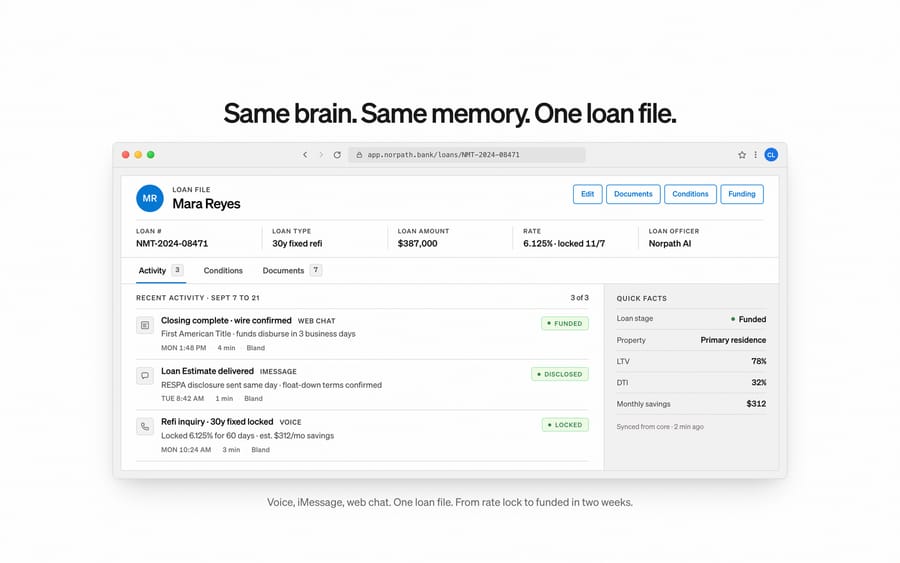
Beyond voice specifically, Bland markets unified memory across channels: the same agent identity persists across a phone call, an iMessage thread, SMS, and web chat, so a customer who calls about a mortgage rate lock and later texts a follow-up question gets an agent that already has the context. Bland's own product page frames this as one continuous record, illustrated with a mocked mortgage-refinance scenario showing a rate lock, a disclosure, and a funded loan all logged against one file.
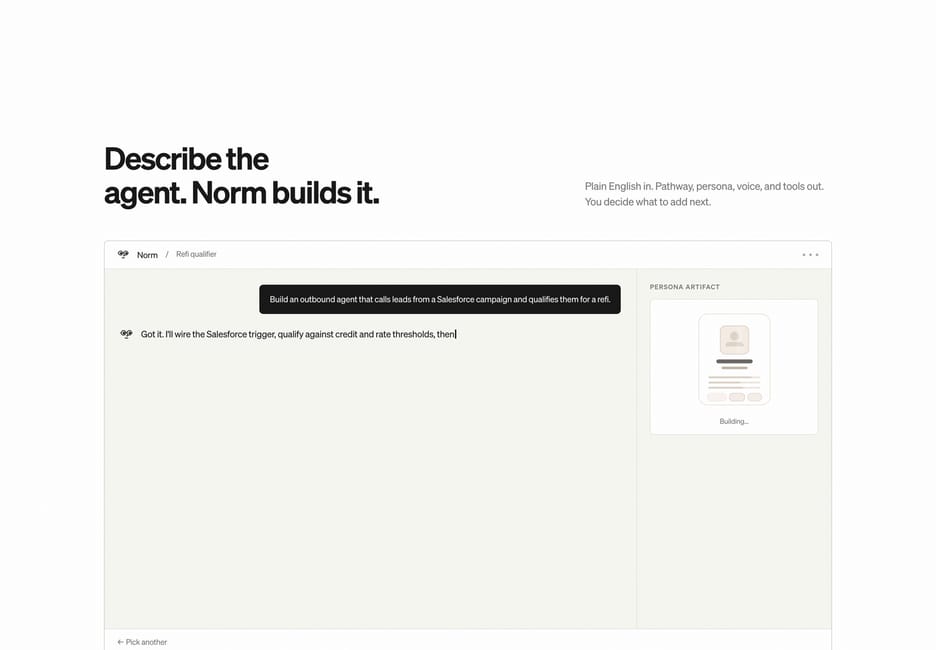
Agent building itself runs through a tool Bland calls Norm: you describe an agent in plain language ("build an outbound agent that calls leads from a Salesforce campaign and qualifies them for a refi"), and Norm assembles the pathway, persona, voice, and tool connections from that description.
G2 reviewers we found describe Norm favorably for getting started fast (one hackathon reviewer went from "zero to a working voice escalation system in a few hours"), with the caveat that "most builders outgrow Norm and end up using alternatives for complex scenarios" once requirements get past the initial pathway.
Key features
- Custom, phone-tuned speech models run on Bland's own infrastructure instead of a chained third-party stack.
- Norm, a natural-language agent builder that generates the pathway, persona, voice, and tool wiring from a plain-English description.
- Cross-channel memory across voice, iMessage, SMS, and web chat under one agent identity.
- 40+ language support with real-time translation, per Bland's own site.
- Enterprise compliance: SOC 2 Type II, HIPAA, and PCI DSS certifications, with BAA, SSO, and data residency available on Enterprise.
- On-prem/VPC deployment options for regulated customers who can't send call data to a shared cloud.
- Real-time observability for monitoring live and historical call performance.
Bland AI pricing
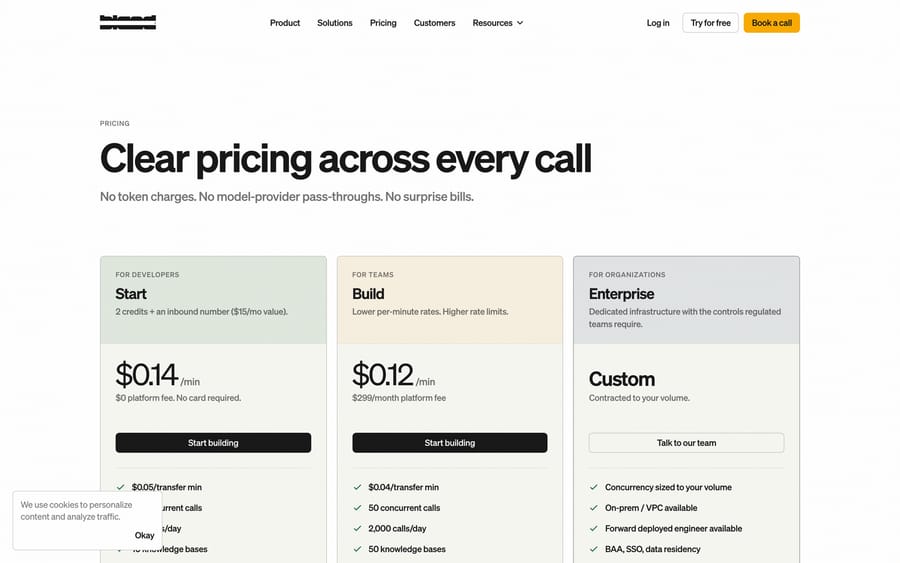
Bland's pricing page publishes real, itemized pricing across three tiers, with no separate token or model-provider charges layered on top. Its billing docs list a fourth self-serve plan, Scale, that the pricing page doesn't show:
| Plan | Per-minute rate | Transfer rate | Platform fee | Concurrent calls | Calls/day | Voices | Knowledge bases |
|---|---|---|---|---|---|---|---|
| Start (developers) | $0.14/min | $0.05/min | $0 (includes 2 free credits + a $15/mo inbound number) | 10 | 100 | 1 | 10 |
| Build (teams) | $0.12/min | $0.04/min | $299/month | 50 | 2,000 | 5 | 50 |
| Scale (billing docs only) | $0.11/min | $0.03/min | $499/month | 100 | 5,000 | 15 voice clones | Not listed |
| Enterprise (organizations) | Custom | Custom | Custom | Unlimited | Unlimited | Unlimited | Unlimited |
No card is required to start on the free tier. Enterprise adds dedicated infrastructure, on-prem/VPC deployment, a forward-deployed engineer, custom voice actors, a signed BAA, SSO, and data residency options, all contracted to volume. Because Scale appears only in the docs, confirm with Bland that you can buy it before you plan around it.
Telephony is where Bland's own pages disagree. The pricing page FAQ says "Telephony is billed separately, on your own carrier or Bland's at pass-through cost." The billing docs' SIP table says calls through Bland's SIP endpoints are billed at the plan rate with "SIP cost included," and Bland's developer index describes per-minute pricing that "covers LLM, TTS, STT, and telephony in a single line item." If you bring your own Twilio (BYOT), your carrier bills you directly and Bland still charges its rate. Ask which applies to your numbers before you sign; the worked examples below price minutes at the plan rate only.
Worked example: a support line running 2,000 calls a month at an average 4 minutes each is 8,000 minutes. On Build, that's 8,000 × $0.12 = $960 in usage plus the $299 platform fee, about $1,259/month before any transferred calls are added at $0.04/min extra. The same 8,000 minutes on Start is 8,000 × $0.14 = $1,120 with no platform fee, $139 cheaper, and 2,000 calls spread over a month is about 67 a day, comfortably inside Start's 100-calls/day cap.
Do the break-even and the tier structure explains itself. Build discounts the rate by exactly 2 cents a minute, so the $299 fee only pays for itself at 299 ÷ 0.02 = 14,950 minutes a month, roughly 3,700 four-minute calls. Below that, Build costs you money. The reason to move anyway is the ceilings, not the rate: Start caps you at 10 concurrent calls and 100 a day, and a 2,000-call month that arrives in Monday-morning spikes will hit the concurrency wall long before it hits the daily one. So the incentive in this tier structure isn't really the discount Bland advertises. It's headroom, sold as a discount, and the honest question at signup is "how peaky is my call volume," not "how many minutes do I use." That is a fairer deal than the common alternative, which is gating basic usage behind a fee on day one.
One more number worth having in your head if you're weighing voice against the rest of your support volume, because per-minute and per-conversation pricing don't compare on sight. Those same 2,000 calls cost $1,120 on Start, which is $0.56 a call, and that figure moves with call length: a queue averaging 6 minutes instead of 4 costs $0.84 a call for exactly the same number of customers helped. Text conversations are priced the other way round. Macha charges about $0.40 a ticket at every tier, once per thread, however many messages it takes. The point isn't that one number beats the other. It's that a voice budget scales with how long people talk and a ticket budget doesn't, so a team modeling both channels should run them separately instead of blending them into one "conversations per month" figure.
Enterprise pricing is where most regulated buyers actually land, and it's worth knowing what's being negotiated before that call happens. Because Enterprise removes the per-tier caps entirely (unlimited concurrency, voices, and knowledge bases) and adds a forward-deployed engineer, the real variable in that conversation is call volume and compliance scope (on-prem vs. shared cloud, which regions need data residency), not a published rate card. Budget for a procurement cycle if HIPAA or a signed BAA is a hard requirement, since that pushes past self-serve Build regardless of volume.
Pros and cons
Pros
- Real, published per-minute pricing with no token pass-throughs, a rarity in enterprise voice AI.
- Vertically integrated speech stack aimed specifically at phone-call latency and quality, not a general chatbot repurposed for voice.
- Enterprise compliance (SOC 2 Type II, HIPAA, PCI DSS) and on-prem/VPC options genuinely matter for the regulated industries Bland targets.
- A free, no-card-required tier for testing before any commitment.
Cons
- The advertised sub-400ms latency doesn't match every independent measurement we could find; a third-party evaluation reportedly found 700-900ms in practice.
- G2's volume is thin (11 reviews) and some are flagged as seller-invited, so the 5.0/5 average is a weak signal on its own.
- Norm handles a first agent well but multiple reviewers report outgrowing it once a use case gets past a single pathway.
- The $299/month Build platform fee is a real jump from Start's $0 fee, with the concurrency and rate-limit ceiling as the reason to pay it.
What actual users say
G2 shows Bland with a 5.0 out of 5 rating from 11 reviews, checked 2026-09-17. G2 returns a 403 to every automated fetch, so we read this off the title of G2's own seller page as Google has it indexed ("Bland AI Products | Read 11 Reviews on G2"). The review count is solid; the star average is secondhand. Worth flagging directly: several of those 11 reviews are marked seller-invited or incentivized on G2's own site, and some older, lower-volume listings put Bland closer to 3.3 out of 5, so an 11-review 5.0 average is a genuinely small, favorable-leaning sample rather than a broad market signal.
On the builder experience, one reviewer used Bland to trigger outbound calls, deliver context, and capture structured responses from free-form speech, going from "zero to a working voice escalation system in a few hours," and praised Norm specifically: "it made designing the conversation flow much more natural, which improved how users responded during calls." On the harder edges, reviewers describe getting structured output from free-form speech as requiring "careful prompt iteration," and debugging as harder than a typical API flow "since it's unclear whether issues trace to the prompt, transcription, or flow." The recurring pattern across what we found: developers and ops-heavy teams praise the flexibility and call quality, while less technical reviewers cite the learning curve and time to get a production-ready agent live.
How we researched this: we checked Bland's homepage, pricing page, and product page directly on 2026-09-17, and re-checked the pricing page against Bland's billing docs on 2026-09-19 (the source of the Scale plan and the telephony wording), including two below-the-fold sections we captured with a one-off Playwright script since the product demo loads on scroll. Funding and founder details come from a WebSearch of press coverage plus a direct fetch of Bland's own Series C press release. G2's review page blocked our direct fetch, so its rating and the quotes above are cited secondhand from search snippets instead of a page we read ourselves. We could not independently verify the 700-900ms third-party latency figure or find attributed job titles for the G2 quotes.
Who Bland AI is best for
Bland fits teams in regulated industries, insurance, healthcare, lending, or logistics, that specifically need phone calls handled by AI and have the compliance requirements (HIPAA, PCI DSS, on-prem/VPC) to justify vetting a dedicated voice infrastructure vendor over a general-purpose voice API. The published per-minute pricing and no-card free tier also make it realistic for a smaller team to test real call volume before committing to Build's $299/month fee.
It's a weaker fit for a team whose actual support problem lives in a text-based help desk queue rather than on the phone. Bland doesn't do email, ticket triage, or chat-widget support natively; it's a voice-first (plus iMessage, SMS, and web chat) platform built around call handling specifically. A team modeling its cost against Bland should model volume on the channel it actually runs: a support operation that's 90% email tickets and 10% phone calls gets a much smaller slice of value from a voice-specialist vendor than the vendor's own homepage implies.
Bland AI vs alternatives
| Bland AI | Parloa | Macha | |
|---|---|---|---|
| Model | Vertically integrated voice AI platform, phone-call focused | Enterprise conversational AI platform for contact centers | AI agent layer on your existing help desk |
| Best for | Regulated industries needing compliant, high-volume phone automation | Large contact centers wanting a broader conversational AI suite | Teams on Zendesk, Freshdesk, Gorgias, or Front |
| Pricing | $0.11-$0.14/min, published, plus $0-$499/mo platform fee (Scale in the billing docs only); telephony terms differ between pricing page and docs | Not independently verified here; see the Parloa guide | From $299/mo for 750 tickets (~$0.40/ticket), published |
| Setup | Self-serve on Start/Build; forward-deployed engineer on Enterprise | Sales-led, enterprise onboarding | Built, tested, and monitored by the Macha team |
| Trial | Free tier, no card required | Demo-gated | $50 free usage |
| Replaces your help desk? | No, it's a voice-call layer on top of existing systems | No, layers onto existing contact-center systems | No, deliberately augments it |
Bland and Parloa both specialize in voice, but at different scales: Bland's self-serve, published per-minute pricing suits a team that wants to test real call volume before an enterprise contract, while Parloa's positioning leans further into the large enterprise contact-center motion typical of the broader conversational AI category. If your calls are outbound and revenue-facing rather than inbound support, Regal AI is the closer comparison again, since it pairs voice with SMS for sales and lifecycle teams. None of the three replaces a text-based help desk, and none is meant to.
Macha sits at a different layer and covers a different channel: instead of automating phone calls, it's an AI agent layer that runs on top of a help desk a team already uses (Zendesk, Freshdesk, Gorgias, Front, HubSpot or Intercom), handling the email and chat tickets that make up most support queues. A team with a genuine phone-support volume problem should still look at Bland or Parloa for that channel specifically; a team whose tickets are mostly email and chat gets more direct value modeling its cost against Macha's per-ticket pricing than against a per-minute voice rate. See Macha's pricing or start with $50 of free usage against real tickets.
FAQ
What is Bland AI? Bland is an enterprise voice AI platform, founded in 2023, that builds and deploys AI phone agents on its own custom speech infrastructure rather than a chained third-party voice stack, aimed at regulated, high-stakes call automation in industries like healthcare, insurance, and financial services.
How much does Bland AI cost? Start is $0.14/minute with no platform fee and no card required. Build is $0.12/minute plus a $299/month platform fee, with higher concurrency and rate limits. Bland's billing docs also list a Scale plan at $0.11/minute plus $499 a month, with 100 concurrent calls and 5,000 calls a day, which the pricing page doesn't show. Enterprise is custom, contracted to volume, with dedicated infrastructure and on-prem/VPC options. Telephony may cost extra: the pricing page says it's billed separately at pass-through cost, while the billing docs say SIP cost is included on Bland's endpoints.
Does Bland AI have a free trial? Yes. The Start tier requires no card and includes 2 free credits plus a complimentary inbound phone number, capped at 10 concurrent calls and 100 calls/day.
Is Bland AI's sub-400ms latency claim accurate? Bland advertises sub-400ms response latency. A third-party evaluation reportedly measured real-world latency closer to 700-900ms in practice, a gap common in voice AI once network conditions and tool calls are factored in. We could not independently verify either number with our own benchmark.
Who founded Bland AI, and who backs it? Isaiah Granet and Sobhan Nejad founded Bland in 2023. The company has raised over $100 million, including a $50 million Series C in June 2026 led by Dell Technologies Capital, with earlier rounds backed by Emergence Capital, Y Combinator, Upfront Ventures, and individual investors including Twilio founder Jeff Lawson.
What do real users say about Bland AI? G2 shows a 5.0 out of 5 rating from 11 reviews, though several are flagged as seller-invited, making it a small and favorable-leaning sample. Reviewers praise fast setup with the Norm builder and call quality; recurring complaints cite a real learning curve and outgrowing Norm on complex use cases.
What is Norm? Norm is Bland's natural-language agent builder: describe an agent's job in plain English, and it generates the conversation pathway, persona, voice, and tool connections automatically.
Is Macha an alternative to Bland AI? Not directly. Bland is a voice-call specialist; Macha is an AI agent layer that runs on top of a help desk a team already uses (Zendesk, Freshdesk, Gorgias, Front, HubSpot or Intercom), covering email and chat tickets rather than phone calls. A team with real phone volume fits Bland or Parloa; a team whose queue is mostly email and chat fits Macha.
Sources: Bland AI, Bland AI pricing, Bland AI product, Bland Series C announcement (PR Newswire). G2's review page for Bland blocked our direct fetch; its rating and quotes are cited secondhand above.
Resolve tickets automatically with AI agents
Macha's AI agents work on top of the help desk you already use — no code.