Intercom
 Shopify
 Stripe
 Slack
Slack Notion
 Google Workspace
 Confluence

Brainfish AI: The Complete Guide (2026)


Brainfish sells what it calls "ambient AI": a computer-vision layer that watches how people actually use a product's interface, builds a live map of where they get stuck, and answers or intervenes before a support ticket gets filed. This guide covers what Brainfish actually does, how its computer-vision mechanism works, what it costs (its own page names no number, and two third-party guesses disagree with each other), where it stops, and how it compares to Kapa AI and to running an AI agent layer on the help desk you already use.

What is Brainfish?
Brainfish is a Sydney-based AI startup, launched in April 2023, building a customer support product it now frames as "the knowledge layer for AI agents." The company raised $9.8 million AUD (about US$6.4 million) in a pre-Series A round in July 2025, led by Prosus Ventures with Peak XV Partners, Macdoch Ventures, and Black Sheep Capital participating, per SmartCompany, bringing its total raised to roughly $13 million. That same coverage reports the platform serving more than five million end users globally, with Mad Paws (an Australian pet-sitting marketplace) and Airtasker named as customers, and funds earmarked for a US headquarters in San Francisco.
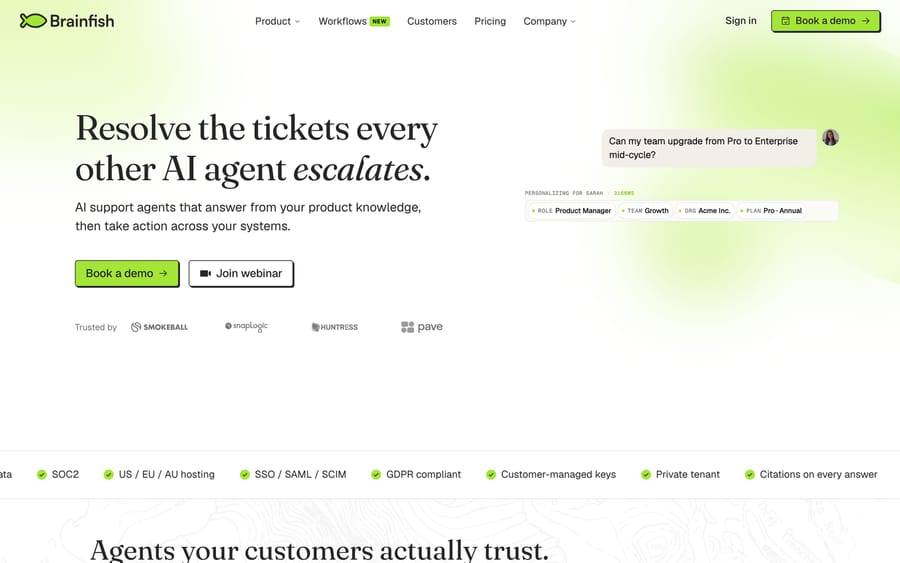
Our direct fetch of brainfishai.com was rate-limited on every attempt, so we captured the screenshot above with a headless browser instead, which got through. It's the primary source for what the site says today, including a customer set (Smokeball, SnapLogic, Huntress, Pave) that's different from, and likely newer than, the Mad Paws/Airtasker names in the 2025 funding coverage.
The product's pitch has shifted over its short life: it started as an AI-powered help center and knowledge base, and its current homepage headline is "Resolve the tickets every other AI agent escalates," with the subhead "AI support agents that answer from your product knowledge, then take action across your systems," a step toward agentic automation and beyond just a smarter search box over documentation.
How we researched this: brainfishai.com blocked our automated fetcher (HTTP 429) on every attempt on 2026-09-15, so page content here comes from headless-browser screenshots instead of scraped text; G2 and TrustRadius both returned HTTP 403 directly, so review evidence below comes from the same product's AWS Marketplace listing, which mirrors 4 of its G2 reviews. Company and funding facts are cross-checked between Product Hunt and SmartCompany's funding coverage. We could not independently verify the vendor-reported 70-90% ticket reduction figure or get a live quote for its own sales-gated pricing tier.
How Brainfish's AI works
Brainfish's mechanism is genuinely different from a chatbot trained on a help center: it embeds a computer-vision pipeline, via a code snippet, that watches how users actually move through a product's interface. According to a third-party technical deep dive on Skywork, that observation layer combines with existing knowledge sources (help docs, product videos) to build what Brainfish calls a "living product map," a model of the product that updates as the product itself changes, instead of going stale the way a static help center does.
From that map, the AI does two things. First, it answers questions with synthesized responses and inline citations back to source documentation, the way Mad Paws reportedly uses it to explain a complex cancellation policy without a customer having to read the whole terms-of-service page. Second, it acts proactively: when the computer-vision layer detects hesitation or a friction pattern, the AI can surface a tutorial or guidance before the user asks for help at all. That second piece is what "ambient" is doing in the marketing: the AI isn't waiting in a chat window, it's watching the product itself.
Key features
- Computer-vision observation: a code-snippet pipeline that tracks in-product user behavior to detect friction and build a live map of the product.
- Self-learning documentation: automatically generates and refreshes help articles from real usage and product demos, launched as a named feature in February 2025.
- Real-time product knowledge: keeps the AI's understanding of the product current as it changes, launched November 2025.
- Agent Assistant and Slack integration: lets internal teams query product knowledge without leaving Slack.
- Themes: categorizes incoming questions to surface adoption barriers and content gaps for the product team as much as the support team.
- Inline-cited answers: synthesized responses that link back to the specific source document, so a reader can check the underlying policy instead of trusting a flat AI summary.
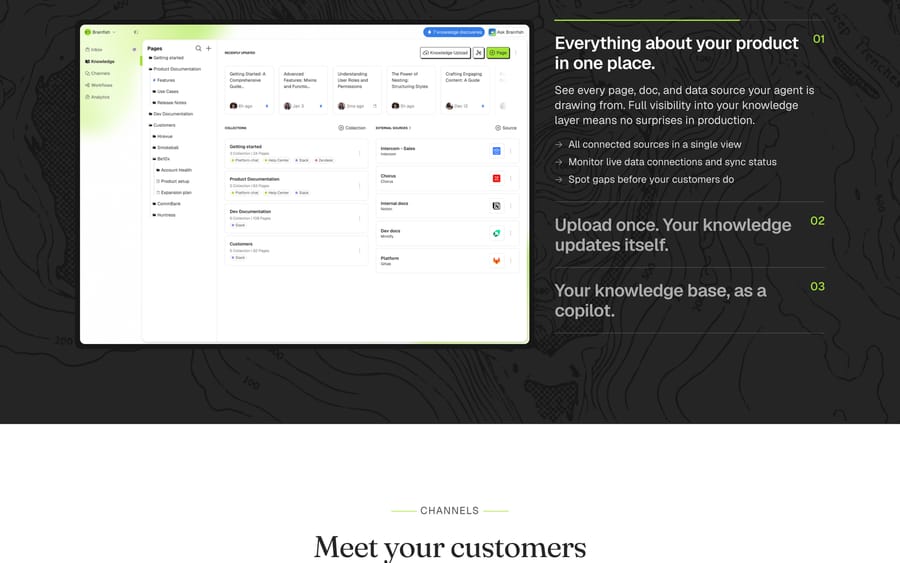
That knowledge layer is the older half of the product. The newer half, launched under the name Ballet, is a visual workflow builder: you assemble steps like "Zendesk action → fetch HubSpot contact → verify user plan" into a flowchart the AI executes against real tools, not just a documentation search.
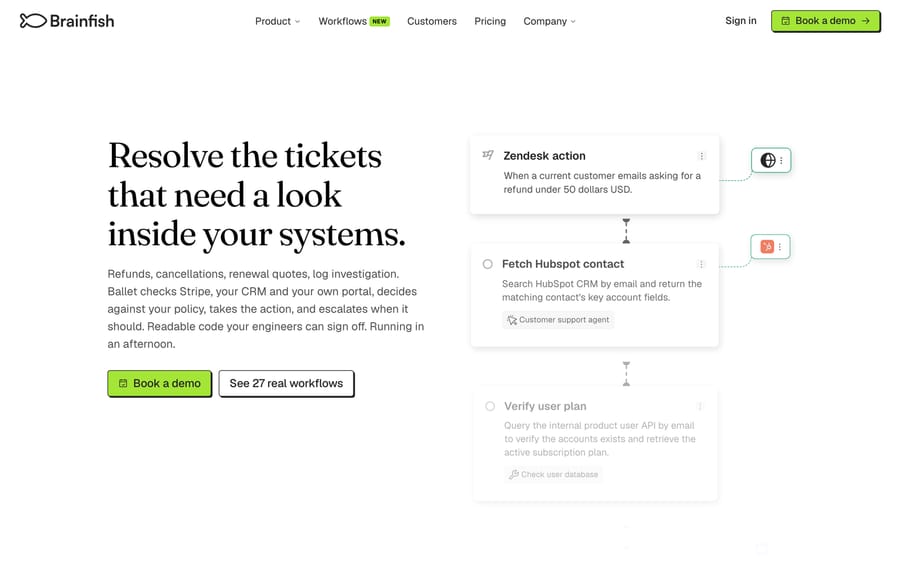
Brainfish's own workflows page lists 27 templates pulled from real support queues (refunds, cancellations, account deletion, intent-aware triage), each showing the integrations it touches: Zendesk, HubSpot, Stripe, PayPal, and "+ any API." That's a meaningfully different pitch from the original ambient-AI framing. Ballet competes more directly with a rules-and-actions automation layer than with a help-center search box.
Brainfish pricing
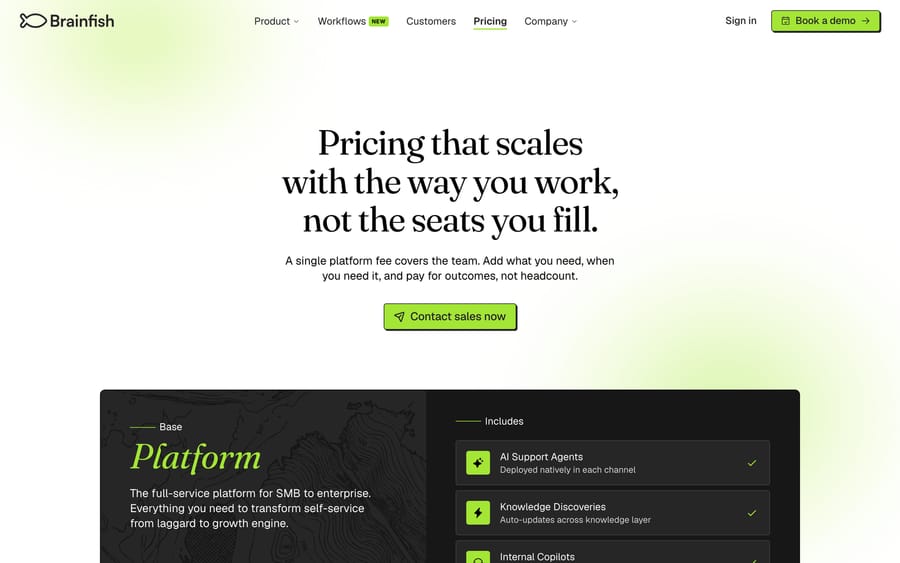
Brainfish's own pricing page names no number. A screenshot capture of the live page (our direct fetch was rate-limited) confirms what it says once you can load it: "Pricing that scales with the way you work, not the seats you fill," structured as a base "Platform" tier (described on the page as "the full-service platform for SMB to enterprise") plus add-ons, gated entirely behind a "Contact sales now" button.
That's where most vendor guides stop and call the pricing "not published." It isn't, on Brainfish's own site. But Brainfish also resells through the AWS Marketplace, and that listing (for its "Growth Plan," seller-verified, product ID prodview-fqu4tj7jkruo4) names real line-item prices on a 12-month contract:
| Line item | 12-month contract price |
|---|---|
| Platform fee (base) | $17,400/yr (~$1,450/mo) |
| AI Actions, per 5-unit bucket | $5,640 |
| Per integration | $3,000 |
| Localization / translation | $1,992 |
| Seats, 6th and up (per seat) | $30 |
| AI Answers, per 1,000 | $1,800 |
| Implementation (one-time) | $5,000 |
24-month and 36-month terms cut the total by up to 50% and 67% respectively, per the same listing. That real number changes the verdict on the two third-party guesses we'd otherwise be stuck weighing against each other: bestaiagents.ai's $795/month badly undercounts it, while the Skywork deep dive's $1,500/month base tier lands close to the real $1,450/month-equivalent platform fee, before any of the metered add-ons or the $5,000 setup fee.
Two caveats worth stating plainly: an AWS Marketplace listing is one specific packaged plan, not necessarily what Brainfish quotes a given buyer directly, and it's for the "Growth Plan" specifically; its own pricing page implies a broader range from SMB to enterprise. A vendor that gates its main pricing page behind "contact sales" is optimizing for negotiated deal size on its biggest accounts. Selling a fixed-price version through a cloud marketplace at the same time is how it still catches the buyer who wants a number before they'll take the call.
What Brainfish users say
Checked 2026-09-15. Brainfish's own G2 and TrustRadius pages both blocked direct access during this research, so the review evidence here comes from Brainfish's AWS Marketplace listing, which mirrors 4 of its G2 reviews: 4.6 out of 5 stars (75% five-star, 25% four-star). That's a small sample, worth naming directly rather than treating as a settled verdict on a product with 5 million claimed end users.
The mirror shows first-name-plus-last-initial attribution only, no reviewer role or company size, which limits how much weight to put on any one quote:
- Kim L.: "I love how easy it is to use, and I really appreciate how responsive the entire Brainfish team has been."
- Eliza C.: "Brainfish suggests updates to our content based on how users interact with our platform."
- David C.: "What I like the best is that it is quick and easy to integrate into the website."
None of the four reviews in this sample raise a complaint; the recurring theme is ease of setup and the self-updating content loop, which lines up with the product's own pitch. A 4-review sample can't tell you what a larger, more critical cohort would say, so treat this as directional rather than conclusive, and check G2 directly if you can get past its access wall.
Pros and cons
Pros
- A genuinely distinct mechanism: computer-vision observation of real product usage, well beyond a chatbot over static docs.
- Proactive intervention based on detected friction, instead of waiting for a user to open a chat widget.
- Self-updating documentation addresses a real, common failure mode (stale help centers) directly.
- Reported results (70-90% ticket reduction, sub-second response times, per the Skywork deep dive citing early adopters) are strong, if unaudited.
Cons
- Expensive relative to a self-serve tool: its own pricing page names no number, but its AWS Marketplace "Growth Plan" listing shows a $17,400/year platform fee plus metered add-ons and a $5,000 one-time implementation fee, a five-figure annual commitment before you've added a single seat past five.
- The company is young (launched 2023) and has repositioned its core pitch at least once, from AI help center to AI agents that "resolve inside your systems," which is worth watching for continued direction changes.
- A computer-vision pipeline embedded in your product is a bigger technical commitment than a support widget or a help-desk plugin.
- Customer references found in research (Mad Paws, Airtasker) are limited in number for evaluating fit across industries, and the public review sample (4 reviews) is too small to lean on.
Who Brainfish is best for
Brainfish fits product-led companies with a genuinely complex in-product experience, complicated policies, multi-step flows, features that generate real confusion, where watching actual user behavior can catch problems a support ticket log alone would miss. It suits teams that already treat documentation as a product surface worth investing in, since the self-learning docs feature only pays off if there's real product knowledge to learn from.
It's a weaker fit for a team that wants a quick, self-serve setup with a published price before talking to sales, given the five-figure AWS Marketplace pricing and the unpublished direct-sale number, or for a support operation whose real problem is ticket volume inside an existing help desk instead of in-product friction. If your support tickets mostly land in Zendesk, Freshdesk, Gorgias, or Front and the fix is automating replies there, that's a different kind of tool than what Brainfish is built to be. See our Decagon AI guide for a vendor built specifically around that ticket-queue problem.
Brainfish vs alternatives
| Brainfish | Kapa AI | Macha | |
|---|---|---|---|
| Model | Ambient AI: computer-vision observation + self-updating knowledge | AI support agent trained on technical/developer documentation | AI agent layer on your existing help desk |
| Best for | Product-led companies with complex in-product flows | Dev tools and technical products with a docs-heavy support load | Teams on Zendesk, Freshdesk, Gorgias, or Front |
| Core mechanism | Watches product usage to detect friction proactively | Answers from ingested documentation and past support content | Acts inside real tickets per plain-English instructions |
| Pricing | Not published direct; AWS Marketplace "Growth Plan" shows ~$17,400/yr platform fee plus add-ons | See Kapa AI guide | From $299/mo for 750 tickets (~$0.40/ticket), published |
| Setup | Embed a computer-vision code snippet plus connect knowledge sources | Connect documentation sources | Built, tested, and monitored by the Macha team |
| Replaces your help desk? | No, sits alongside the product | No, sits alongside support channels | No, deliberately augments it |
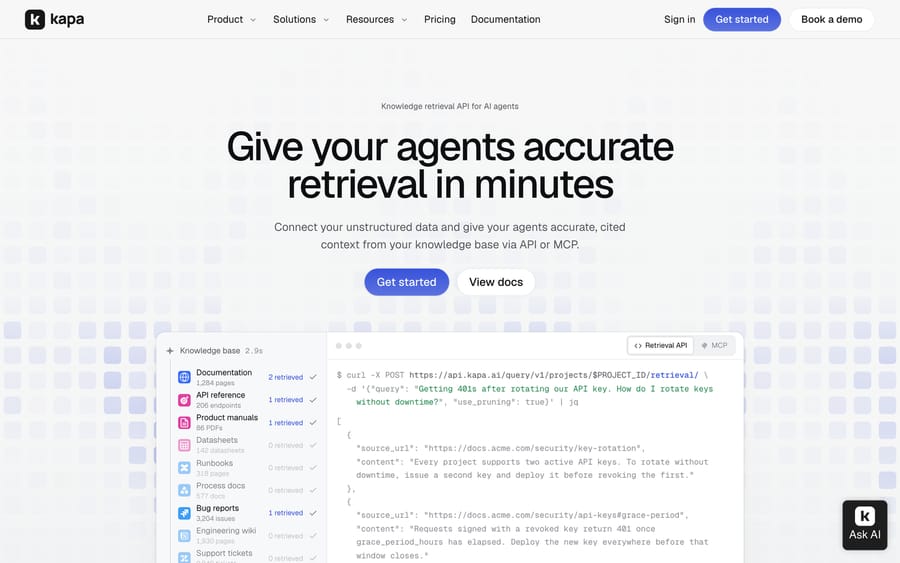
Brainfish and Kapa AI both start from a knowledge-and-documentation angle instead of a ticket queue, but Brainfish's computer-vision layer is a meaningfully different mechanism from ingesting a docs site. If your problem is genuinely in-product confusion rather than support ticket volume, Brainfish's category is the more direct fit. If the actual bottleneck is the ticket queue in a help desk your team already runs, an AI agent layer like Macha, priced and published rather than quote-gated, is the more direct comparison; see Macha pricing or Macha on your help desk.
FAQ
What is Brainfish AI? Brainfish is an "ambient AI" support platform that uses computer vision to observe how users interact with a product's interface, builds a live model of the product, and answers questions or intervenes proactively based on detected friction.
How much does Brainfish cost? Brainfish's own pricing page names no number and routes everyone to "Contact sales now." Its AWS Marketplace listing for the "Growth Plan" does publish real prices, though: a $17,400/year platform fee, metered add-ons (AI Actions, integrations, seats past five, localization), and a $5,000 one-time implementation fee on a 12-month contract. A direct quote from Brainfish's sales team may land somewhere else.
When was Brainfish founded, and who backs it? Brainfish launched in April 2023 in Sydney, Australia, and raised roughly $13 million total, including a $9.8 million AUD pre-Series A round in July 2025 led by Prosus Ventures.
What does "ambient AI" mean for Brainfish specifically? It refers to a computer-vision pipeline that watches real user behavior inside a product, instead of an AI that only responds when a user opens a chat window or searches a help center.
Who are Brainfish's customers? Press coverage names Mad Paws and Airtasker, both Australian companies, alongside a claim of serving more than five million end users globally.
Does Brainfish replace a help desk like Zendesk? No. It's positioned as a knowledge and in-product guidance layer, not a ticketing system; teams typically still run a help desk alongside it for the tickets that do get filed.
What's a good Brainfish alternative? Kapa AI is a comparable knowledge-and-documentation-focused AI agent, more oriented toward developer and technical documentation specifically. If your real bottleneck is ticket volume in an existing help desk, Macha runs as an AI agent layer on top of Zendesk, Freshdesk, Gorgias, or Front instead.
Is Brainfish a new or established company? New and growing quickly: founded in 2023, it has raised roughly $13 million and shipped several named feature launches through 2025, but it's still a young company relative to more established AI support vendors.
If your team is comparing AI vendors across categories rather than just within one, our Sierra AI guide covers a broader conversational-agent platform worth putting on the same shortlist.
Whichever of these fits your actual problem, if it's ticket volume inside Zendesk, Freshdesk, Gorgias, or Front rather than in-product friction, you can start a Macha trial with $50 of free usage and no credit card, or check current pricing first.
Sources: Brainfish's own site, brainfishai.com, returned repeated HTTP 429 rate-limit errors on every direct fetch attempt during this research; the homepage, pricing, product and workflows screenshots in this guide were captured with a headless browser instead. Product Hunt: Brainfish, SmartCompany funding coverage, Skywork deep dive on Brainfish's ambient AI, bestaiagents.ai: Brainfish, AWS Marketplace: Brainfish Growth Plan pricing, AWS Marketplace: Brainfish Growth Plan reviews.
Resolve tickets automatically with AI agents
Macha's AI agents work on top of the help desk you already use — no code.