Intercom
 Shopify
 Stripe
 Slack
Slack Notion
 Google Workspace
 Confluence

Crescendo AI: The Complete Guide (2026)


If you've been shortlisting AI customer-service vendors in 2026, Crescendo AI stands out for doing something most of its peers don't: it doesn't just sell you software, it sells you the outcome. Crescendo is a managed "Augmented AI" contact center — a blend of AI agents and human experts, run as a service, priced per resolution rather than per seat or per license. That model has propelled a company founded in 2024 toward $100M+ in ARR in under two years, but it also makes Crescendo genuinely different from the self-serve AI tools it's often compared against.

This guide is an honest, researched answer to the questions buyers actually ask about Crescendo AI: what it is, how its Augmented AI model works, what it realistically costs, where it's strong, where it isn't, and how it compares to the alternatives. We build an AI support product ourselves, so we'll be upfront about that — but the goal here is a real guide to Crescendo, not a pitch. Where a number is a third-party estimate rather than a confirmed figure, we say so.
What is Crescendo AI?
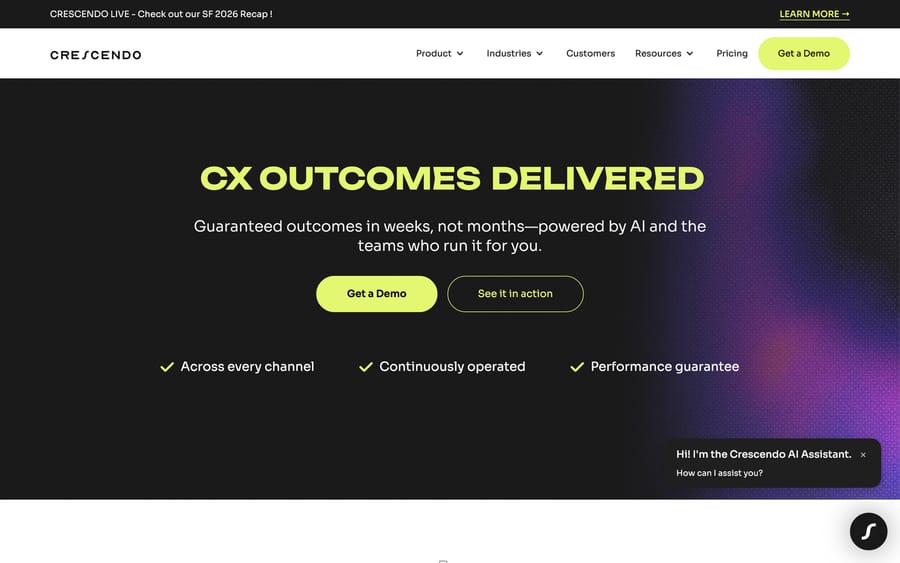
Crescendo's homepage, blending AI with human CX outcomes.
Crescendo is a fully managed, AI-native customer-service company. Rather than handing you a chatbot builder and wishing you luck, Crescendo operates the whole customer-support function for you — AI answers the common questions, human agents step in for the rest, and Crescendo manages knowledge, workflows, quality, and staffing as a single service (Crescendo.ai).
The company was founded in 2024 by Matt Price (CEO), along with Anand Chandrasekaran, Andy Lee, and Slava Zhakov — a team with deep customer-experience and platform pedigree. Very early on, Crescendo made an unusually bold move for a young company: on October 2, 2024 it acquired PartnerHero, a well-known customer-operations (BPO) firm, reportedly adding 200+ customers and roughly 3,000 human CX professionals to what had been a ~20-person startup (GlobeNewswire). That acquisition is the key to understanding Crescendo: it isn't a pure-software play, it's a BPO reimagined around AI.
PartnerHero mattered for reasons beyond headcount. It brought a real book of business — publicly referenced customers including Airtable, Khan Academy, sweetgreen, TOMS, and Udemy — plus the operational muscle to run staffed, managed support at scale (Crescendo News). It also inverted the usual startup story: instead of a young AI vendor slowly building services capacity, Crescendo bolted an AI brain onto an existing, revenue-generating human operation on day one. Crescendo has said the combined company was already EBITDA-positive with a reported ~$50M in ARR at the time of the deal — an unusual profile for an AI startup that age.
By September 2025, Crescendo announced it was on track to exceed $100M in ARR by year-end (a company-reported figure) — remarkable for a business less than two years old (Crescendo News). Alongside the PartnerHero acquisition in October 2024, Crescendo had also reportedly closed ~$50M in total financing led by General Catalyst (a round widely reported as its Series C), reportedly at a ~$500M valuation. Since then the company has continued to expand the software side of the house — adding agentic and multimodal AI capabilities and marketing accuracy figures reported as high as ~99.8% for AI responses on tuned deployments (a vendor-reported metric worth pressure-testing against your own ticket mix) (Crescendo).
How Crescendo's "Augmented AI" works
Crescendo's headline concept is Augmented AI: the idea that AI and humans should work as one integrated system, not as separate tools you stitch together yourself (Crescendo: Augmented AI).
AI Assistants handle the common cases
Crescendo's AI Assistants answer routine customer questions across chat, messaging, voice, email, and SMS, grounded in your knowledge base and connected systems (Crescendo). This is the deflection layer — the tickets that don't need a human get resolved by AI, instantly and around the clock. Crescendo has leaned hard into voice in particular, positioning voice assistants that handle real end-to-end conversations rather than routing menus, and it markets agentic behavior — the AI querying systems, taking actions, and resolving issues, not just answering FAQs. The stated goal is genuine resolution, not scripted deflect-and-hand-off.
"Superhuman" agents handle the rest
When the AI reaches the edge of its confidence — a nuanced complaint, a judgment call, an emotionally charged conversation — it hands off to a human agent. Crescendo brands these as "Superhuman" agents: human experts equipped with AI assistance and full context (an agent-assist layer that surfaces suggested replies and knowledge in real time), so the handoff feels seamless to the customer. Because Crescendo staffs and manages these people — a capability that came almost entirely from the PartnerHero acquisition — you're not hiring, training, scheduling, or QA-ing them yourself. This is the piece most pure-software competitors simply don't have: when the bot can't finish the job, there's a real, managed human behind it under the same contract.
Crescendo manages the whole loop
The differentiator isn't any single feature — it's that Crescendo runs the entire operation: knowledge-base management, agentic workflows, QA, staffing, escalation design, and continuous optimization. Crescendo's own team handles AI configuration and tuning, and the company markets fast go-lives — implementations measured in a few weeks rather than months, with several published accounts of customers moving from low accuracy into the high 90s within a couple of weeks of iteration. For a support leader, the pitch is "one vendor, one bill, one outcome" instead of assembling an AI tool, a BPO, a QA process, and an ops team separately — and then owning the seams between them.
Integrations and channels
Crescendo connects to the systems support teams already run. Published integrations include help desks and contact-center platforms such as Zendesk, Salesforce, Kustomer, Gorgias, Amazon Connect, and Genesys Cloud, commerce and billing systems like Shopify and Stripe, and knowledge sources including Microsoft Dynamics, SharePoint, OneDrive, Google Drive, and Box (Crescendo: Apps & Integrations). Channel coverage spans phone/voice, live chat, messaging, email, and SMS as one omnichannel layer. Crescendo also markets vertical-specific depth: in retail and e-commerce it can query orders and inventory to automate returns and exchanges; in financial services it supports identity verification and billing inquiries. The important framing point is that Crescendo uses these integrations to operate support on your behalf — it plugs into your help desk rather than asking you to run agents inside it yourself.
Key features
- Omnichannel AI support — AI Assistants across chat, voice, and email from one platform.
- Human-in-the-loop by design — Superhuman agents for escalations, staffed and managed by Crescendo.
- Fully managed service — knowledge management, workflow building, QA, and 24/7 coverage included.
- Agent Assist — an AI copilot layer for the human "Superhuman" agents, surfacing suggested responses, knowledge, and context in real time.
- CSAT scoring on 100% of interactions — Crescendo uses AI to evaluate satisfaction across every conversation, not a sampled subset, which is what makes its outcome guarantee measurable.
- Total Outcomes Guarantee — Crescendo publicly guarantees quality, speed, and customer satisfaction (CSAT), tying its own commercials to performance (Crescendo: Total Outcome Guarantee).
- Outcome-based commercials — you pay per resolution, aligning Crescendo's revenue with resolved tickets rather than software seats.
Crescendo AI pricing
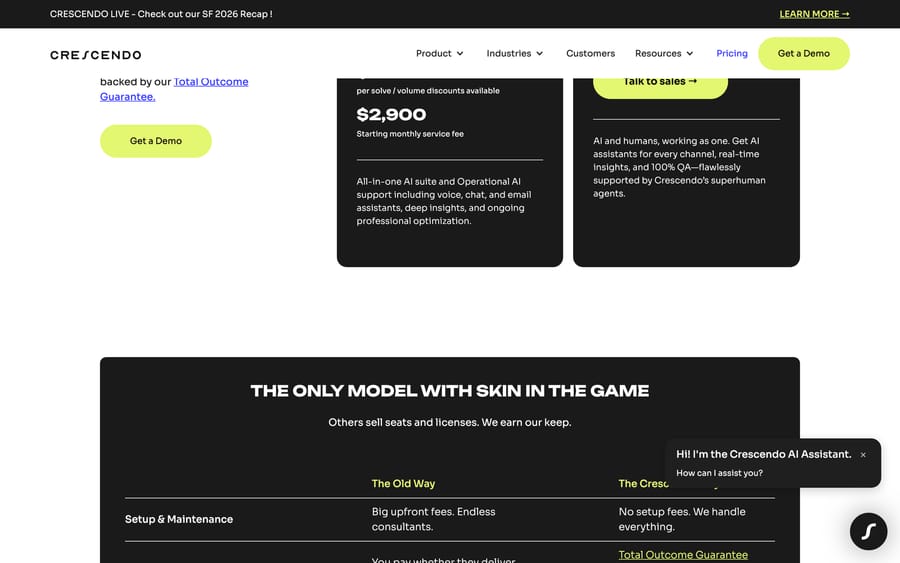
Crescendo's pricing page.
Crescendo's pricing is outcome-based: you and Crescendo estimate how many resolutions you'll need per month, and you pay per resolution. If you exceed the estimate, you keep paying the same per-resolution rate (Crescendo: Pricing).
The important nuance is that the price includes the whole managed service — 24/7 coverage, human handoff, agentic workflows, knowledge-base management, setup, and ongoing management are all bundled into that per-resolution number. That makes Crescendo hard to compare apples-to-apples against pure-software AI agents, which bill separately and leave the operational work to you.
How the model actually works
The mechanics are worth understanding, because "per resolution" hides a few decisions:
- A resolution is billable only when it clears the bar. Crescendo assesses CSAT on 100% of interactions and, per its own positioning, only bills when its AI and human agents meet or exceed the agreed-upon performance metrics (Crescendo). So the guarantee and the pricing are the same mechanism: you're paying for outcomes that pass quality, speed, and satisfaction thresholds, not for every attempt.
- AI resolutions and human resolutions are priced differently. A ticket the AI closes on its own costs less than one that needs a Superhuman agent, because a human's time is more expensive. Your blended cost therefore depends heavily on your automation rate — the higher the share the AI can genuinely resolve, the lower your effective per-resolution price.
- Volume is forecast, not capped. You and Crescendo estimate monthly resolutions and set a rate; if you go over, you keep paying the same per-resolution rate rather than hitting an overage penalty (Crescendo: Pricing). That's friendlier for spiky or growing volumes than a fixed seat count.
The cost drivers to model
Whether Crescendo is cheap or expensive for you comes down to a handful of variables:
- Ticket mix. Repetitive, knowledge-answerable tickets are ideal — AI resolves them cheaply. Complex, judgment-heavy, or emotionally loaded tickets pull work toward humans and raise blended cost.
- Total volume. High volume amortizes the setup and management effort baked into the price; very low volume can make the managed-service overhead feel expensive per ticket.
- Channel and coverage needs. 24/7, multilingual, and voice coverage cost more than business-hours chat and email.
- How much you'd otherwise spend. The honest comparison isn't Crescendo vs. a $500/month SaaS tool — it's Crescendo vs. your fully loaded support cost (agents, managers, QA, tooling, and a separate AI vendor). Against that baseline, a bundled outcome price can look very different.
On specific figures
Crescendo doesn't publish a full price list, and buyers should treat any number below as a third-party estimate to verify directly:
- Reported base of roughly $2,900/month for the managed AI service, plus approximately $1.25 per resolved ticket for the AI-only tier.
- A tier that adds 24/7 human (Superhuman) support at a higher per-ticket rate — figures around $2.25 (and some teardowns as high as ~$2.99) when a human is involved.
These figures come from third-party teardowns rather than Crescendo's own price sheet, so confirm the current numbers with Crescendo before budgeting. The model overall is genuinely different from per-seat or per-message SaaS pricing, and its appeal depends heavily on your ticket mix and how much human coverage you need.
Per-resolution vs. per-ticket: an honest contrast
This is the trade-off buyers most often get wrong, so it's worth being precise. Crescendo bills per resolution — a unit of outcome. A platform like Macha bills per ticket — one charge per thread, however many replies it takes. Neither is inherently better; they optimize for different things.
Per-resolution pricing shifts risk onto the vendor: if the AI (or human) doesn't resolve the ticket to standard, you don't pay for it, and the vendor is motivated to close cases. The catch is that "resolution" is a negotiated definition, cost scales with the human involvement your ticket mix demands, and the number lives inside a sales conversation — you don't fully control or self-serve it.
Per-ticket pricing is transparent and self-serve: you can see and model exactly what a plan costs at your volume, and you pay the same amount whether a thread takes one reply or several. The catch is that you own the outcome — the platform doesn't guarantee resolution or supply the humans; that's your team's job. In short: per-resolution buys you an outcome with someone else accountable for it; per-ticket buys you controllable, ownable automation you run yourself. Which is right depends entirely on whether you want to outsource accountability or keep it.
Pros and cons
Pros
- Truly hands-off. If you want outcomes without building and operating an AI support stack yourself, Crescendo does the whole job — including staffing humans.
- Aligned incentives. Paying per resolution (with a public outcomes guarantee) means Crescendo only wins when tickets actually get resolved.
- AI + human as one system. The Augmented AI model avoids the awkward gap between "the bot" and "the humans" that plagues many DIY setups.
- Serious scale, fast. A reported $100M+ ARR trajectory and ~3,000 CX professionals mean it can handle large, complex support operations.
- Fast implementation. Because Crescendo does the configuration work, published go-lives are measured in weeks — attractive if you don't have internal bandwidth to build and tune agents.
- Strong voice and omnichannel story. End-to-end voice, chat, messaging, email, and SMS under one operation is genuinely hard to assemble yourself.
Cons
- Less control. A managed service means you're handing off ownership of your support operation — great for some teams, a dealbreaker for others who want to keep support in-house.
- Opaque, custom pricing. Per-resolution economics can be excellent or expensive depending on volume and complexity, and the real numbers require a sales conversation.
- You don't own the stack. If you want to build, tune, and own your own AI agents on top of the help desk you already run, a managed BPO-style model is the opposite of that.
- BPO lock-in. Because Crescendo runs staffing and operations, switching later is a bigger lift than swapping a software tool — you're unwinding a service relationship, not just cancelling a license.
- Less institutional knowledge in-house. When a partner owns support, your own team learns less from the ticket stream over time — a real consideration for product-led companies that treat support as a feedback loop.
Who Crescendo AI is best for
Crescendo is a strong fit for teams that want to outsource the outcome, not just buy a tool — typically mid-market and enterprise support orgs with high volume, real complexity, and a willingness to let a partner own operations. If you'd rather not hire, train, and manage agents, and you value a single accountable vendor with a performance guarantee, Crescendo's model is compelling.
It's a weaker fit if you want to keep support in-house and own your AI agents, if you already have a help desk you're happy with, or if you want transparent, self-serve, usage-based pricing you can model yourself.
Crescendo AI vs alternatives
The honest way to think about Crescendo is that it sits at the "fully managed service" end of the market. Most alternatives sit further toward "software you run yourself." Here's a balanced comparison, including our own product, Macha.
| Crescendo | Fin (Intercom) | Macha | |
|---|---|---|---|
| Model | Managed AI + human service (BPO-style) | AI agent inside Intercom's help desk | AI agent layer on top of your existing help desk |
| You run operations? | No — Crescendo does | Yes | Yes |
| Human agents included? | Yes (Superhuman, staffed by Crescendo) | No | No |
| Pricing model | Per resolution (bundled managed service) | Per resolution | Per ticket (from $299/mo for 750 tickets) |
| Pricing transparency | Custom / sales-led | Published per-resolution rate | Published, self-serve, model-it-yourself |
| Setup effort for you | Low (Crescendo configures) | Medium | Medium — build agents in plain English |
| Who owns the outcome? | Crescendo (with guarantee) | You | You |
| Help desk | Plugs in / operates the function | Intercom-native | Works with Zendesk, Freshdesk, Front, Gorgias, Intercom |
| Channels | Voice, chat, messaging, email, SMS | Chat, email (Intercom) | Depends on your help desk's channels |
| Best for | Outsourcing the whole outcome | Intercom-based teams | Teams that want to own and build their own agents |
A quick, honest note on where we differ: Macha isn't a managed service and isn't trying to be. We're an AI-agent layer that runs on top of the help desk you already use, priced per ticket (not per resolution), where you build and control agents in plain English. If you want a partner to run support for you, Crescendo is the more natural fit. If you would rather buy the software and keep the team, Decagon and Intercom Fin are the two that show up opposite Crescendo most often. If you want to keep your team and help desk and just add capable AI agents you own, that's our lane. Both are valid — they're just different bets. You can also compare Fin directly via Fin's own Crescendo comparison for a competitor's perspective.
How we researched this
This guide is built from Crescendo’s own site — its product, pricing and careers pages — its published case studies, and press coverage of the PartnerHero acquisition that gave it the human side of the service; the per-resolution figures quoted here are Crescendo’s own published numbers as read when the post was written. On September 21, 2026 we re-checked the internal links in this post and added the comparisons above, and we did not re-price the service on that pass. Crescendo sells through a sales cycle, so we have not run it ourselves, and G2 turned away every request we made that day.
Frequently asked questions
What is Crescendo AI? Crescendo AI is a fully managed, AI-native customer-service company. It combines AI Assistants with human "Superhuman" agents in a single service it calls Augmented AI, and it manages knowledge, workflows, QA, and staffing for you rather than selling standalone software.
How does Crescendo AI pricing work? Crescendo uses outcome-based, per-resolution pricing. You estimate monthly resolutions with Crescendo and pay per resolved ticket, with the full managed service bundled in. Third-party teardowns cite roughly $2,900/month plus about $1.25 per AI resolution (or ~$2.25 when a human is involved), but these are estimates — confirm current pricing with Crescendo.
Who founded Crescendo AI and when? Crescendo was founded in 2024 by Matt Price (CEO), Anand Chandrasekaran, Andy Lee, and Slava Zhakov. In October 2024 it acquired PartnerHero, reportedly adding 200+ customers and around 3,000 human CX professionals.
What is Crescendo's "Augmented AI"? Augmented AI is Crescendo's model of AI and human agents working as one integrated system. AI handles routine questions across chat, voice, and email; humans handle escalations with AI assistance and full context.
Is Crescendo AI a help desk? No. Crescendo is not a help-desk replacement in the ticketing-system sense — it's a managed AI-plus-human support operation that integrates with the help desks and contact-center platforms you already use, such as Zendesk, Salesforce, Kustomer, Gorgias, Amazon Connect, and Genesys Cloud. What it replaces is the staffing and operating of your support function, not necessarily your ticketing tool.
Does Crescendo AI include human agents, or just AI? Both. That's the core of its "Augmented AI" model. AI Assistants handle routine questions across chat, voice, email, and SMS, and Crescendo's own "Superhuman" human agents — staffed largely through its 2024 PartnerHero acquisition — handle escalations with AI assistance and full context. You don't hire or manage those humans yourself.
What channels and integrations does Crescendo support? Crescendo covers voice/phone, live chat, messaging, email, and SMS as one omnichannel layer, and integrates with platforms including Zendesk, Salesforce, Kustomer, Gorgias, Amazon Connect, Genesys Cloud, Shopify, Stripe, Microsoft Dynamics, SharePoint, OneDrive, Google Drive, and Box.
How is Crescendo's per-resolution pricing different from per-ticket pricing? Crescendo charges for outcomes (resolutions that meet agreed quality, speed, and CSAT thresholds), which shifts delivery risk onto the vendor but means cost scales with how much human involvement your tickets need. Per-ticket pricing (used by platforms like Macha) charges per resolved thread regardless of how many messages it takes — transparent and self-serve, but you own the outcome and supply your own agents. Neither is universally cheaper; it depends on your ticket mix, volume, and whether you want to outsource accountability or keep it in-house.
What are good alternatives to Crescendo AI? If you want a managed service, Crescendo's closest peers are other outcome-based CX providers and AI-forward BPOs. If you'd rather keep support in-house, software-first options like Fin (Intercom) or an AI-agent layer such as Macha — which runs on top of your existing help desk and prices per ticket — are worth evaluating.
See how a build-it-yourself AI agent compares. Macha adds AI agents on top of the help desk you already run — Zendesk, Freshdesk, Front, Gorgias, or Intercom — priced per ticket, built in plain English. Explore Macha for customer service, see transparent pricing, or learn how custom tools let your agents take real actions. Start a free trial at dashboard.getmacha.com/signup.
Resolve tickets automatically with AI agents
Macha's AI agents work on top of the help desk you already use — no code.