





 Shopify
 Stripe
 Slack
 Notion
 Google Workspace
 Confluence


Crisp vs Chatwoot (2026): Hosted Simplicity or Open-Source Control?


Crisp and Chatwoot are both shared inboxes for chat, email and messaging apps, sold on opposite terms. Crisp is a hosted service priced per workspace: $45 a month for 4 agents up to $295 for 20, with credits for its Hugo AI agent included. Chatwoot is open source, with its core under the MIT license: free to run on your own server, or $19 to $99 per agent a month on Chatwoot Cloud, with its Captain AI metered in credits. Pick Crisp if you want a finished product with a fixed bill. Pick Chatwoot if you need to own the code, host the data yourself or pay nothing for software. Prices below come from both vendors' sites, checked on November 21, 2026.
Key takeaways
- Crisp charges $45, $95 or $295 a month per workspace, while Chatwoot Cloud charges $19, $39 or $99 per agent a month.
- Chatwoot's Community Edition is free to self-host on the MIT-licensed core, but it doesn't include Captain, Chatwoot's AI agent.
- Crisp includes Hugo AI credits of $5, $25 or $75 a month, and Chatwoot Cloud includes 300, 500 or 800 Captain credits, with extras at $20 per 1,000.
- For 8 agents, Crisp Essentials costs $95 a month, while Chatwoot Cloud costs $152 on Startups or $312 on Business.

Crisp or Chatwoot: which should you pick?
| If you are... | Pick | Why |
|---|---|---|
| A small team that wants chat live today with no servers | Crisp | Hosted, with a free 2-agent plan and a 14-day trial of every feature |
| A team that must keep customer data on its own infrastructure | Chatwoot | The Community Edition runs on your own server |
| A developer-led team that wants to change the product's code | Chatwoot | MIT-licensed core on GitHub; enterprise features under a separate commercial license |
| A team of 5 to 10 agents on a budget | Crisp | $95 covers 10 agents; Chatwoot Cloud charges per agent |
| A team of 2 that wants a free cloud inbox | Either | Crisp Free (2 agents) and Chatwoot Hacker (2 agents, 500 conversations a month) |
| Wanting the cheapest AI agent with no setup | Crisp | Hugo credits are included in every paid plan |
How does Crisp pricing compare with Chatwoot pricing?
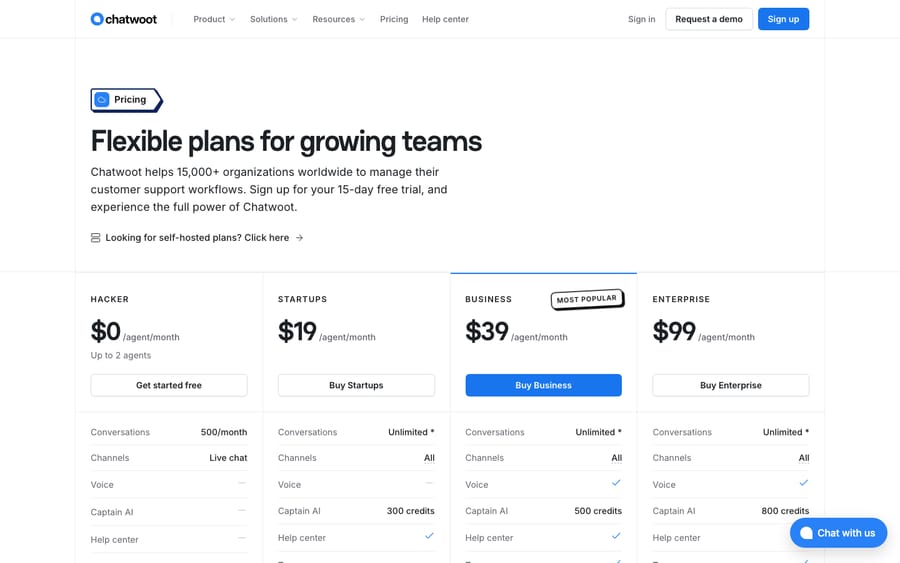
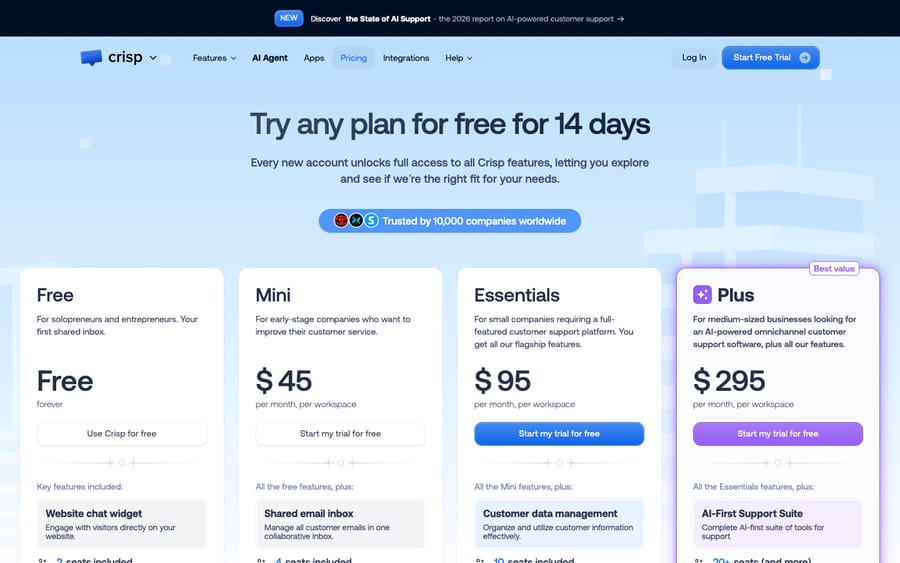
We checked Crisp's pricing page, both of Chatwoot's pricing pages and Chatwoot's GitHub repository on November 21, 2026 and captured the screenshots below.
| Crisp (hosted, per workspace, per month) | Chatwoot Cloud (per agent, per month) | Chatwoot self-hosted (per agent, per month) | |
|---|---|---|---|
| Free | $0: 2 agents, chat widget, shared inbox, no AI | Hacker, $0: up to 2 agents, 500 conversations a month, 30-day retention, no Captain | Community Edition, $0, no Captain |
| Entry | Mini, $45: 4 agents, $5 AI credit | Startups, $19: 300 Captain credits, 1-year retention | Premium Support, $19, Captain included |
| Mid | Essentials, $95: 10 agents, $25 AI credit | Business, $39: 500 Captain credits, 2-year retention | n/a |
| Top | Plus, $295: 20+ agents, $75 AI credit | Enterprise, $99: 800 Captain credits, 3-year retention | Enterprise Edition, $99, Captain included |
| Extra capacity | $10 a month per extra agent | $20 per 1,000 extra Captain credits | Your own server costs |
| Trial | 14 days, every feature, no card | 15 days | n/a |
Sources: Crisp pricing, Chatwoot pricing and Chatwoot self-hosted plans. Chatwoot's paid cloud plans list unlimited conversations under fair use. Chatwoot also offers its Startups plan free of charge to open-source projects, and asks nonprofits to email it for an arrangement. Our Crisp pricing breakdown works through Crisp's plans as real monthly bills.
The pricing models follow from the business models. Crisp sells a hosted product, and per-workspace pricing is how it makes a small team's decision easy: $95 is $95 whether 3 or 10 people log in. Chatwoot gives the software away and earns from people who would rather pay than run it: hosting, retention, support and Captain. That gives Chatwoot a clear incentive: its paid tiers sell convenience and AI on top of software you could run for free, so the free tier is generous on features and the paid tiers charge for the parts that cost Chatwoot money to provide.
What does each cost for a team of 8?
| Crisp Essentials | Chatwoot Cloud Startups | Chatwoot Cloud Business | Chatwoot Community (self-hosted) | |
|---|---|---|---|---|
| Software | $95 covers 10 agents | 8 × $19 = $152 | 8 × $39 = $312 | $0 |
| AI included | $25 of Hugo credit, about 450 conversations | 300 Captain credits | 500 Captain credits | None |
| Hosting | Included | Included | Included | Your server, backups and upgrades |
| Rough monthly software bill | $95 | $152 | $312 | $0 plus infrastructure and staff time |
At 8 agents Crisp is the cheaper hosted option, and the gap grows with each agent until Crisp's 10-agent cap on Essentials. At 3 agents Crisp Mini is still cheaper: $45 against 3 × $19 = $57 for Chatwoot Startups. The order only reverses if the team needs Crisp's Essentials features, such as WhatsApp, Instagram or the knowledge base, which cost $95; Chatwoot Startups includes all channels and a help center at $57, though teams and automation rules need Business ($39 an agent, $117 for 3).
Two line items on Chatwoot's cloud table change the choice between its own tiers. Voice is ticked on Business and Enterprise but not on Startups, and data retention runs from 30 days on Hacker to 1, 2 and 3 years on the paid plans. A team that needs phone support or keeps conversation history for audits will land on Business at $39 an agent, which is where Crisp's per-workspace price looks strongest.
We didn't put a dollar figure on Captain usage. Chatwoot's pricing page lists the credit allowances and the $20 per 1,000 top-up rate, but the pages we read don't say how many credits a conversation consumes, so a per-conversation cost would be a guess. Crisp's plans imply about $0.056 per Hugo conversation ($25 for about 450), with pay-as-you-go available past the allowance at a rate Crisp doesn't publish.
Self-hosting isn't free in practice. The Community Edition costs nothing to license, but someone has to provision the server, run upgrades, handle backups and keep the email and messaging channel connections working. For a team with a DevOps person already, that's a small marginal cost. For a team without one, it's the reason Chatwoot Cloud exists.
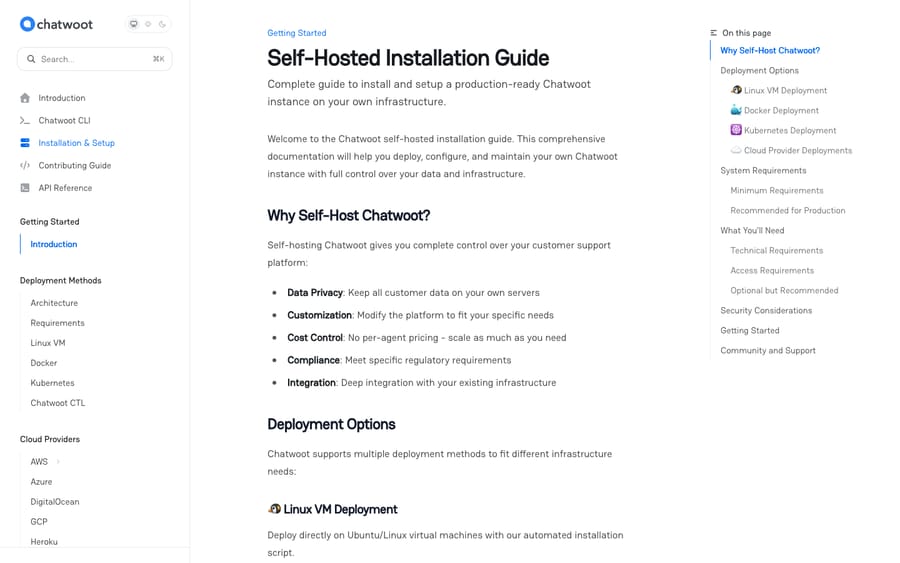
Chatwoot's self-hosted installation guide lists Linux VM, Docker, Kubernetes and cloud-provider deployments, with system requirements and security considerations to read before you pick one. Our Chatwoot pricing guide goes deeper on the self-hosted path.
What does the open-source license change?
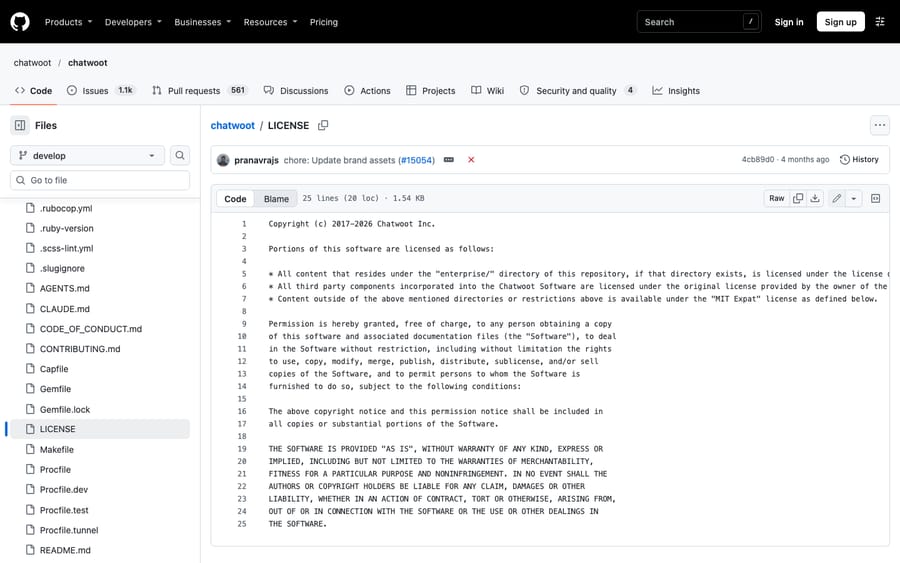
Chatwoot's GitHub repository says the project is "Released under the MIT License," and had 40.3k stars when we read it on November 21, 2026. The repository's LICENSE file adds a carve-out: everything under the enterprise/ directory is under a separate Chatwoot Enterprise License, which allows production use only with a paid subscription or a valid enterprise license for the right number of seats. The MIT terms cover the rest. Its README lists live chat, email, Facebook, Instagram, Twitter, WhatsApp, Telegram, Line and SMS as supported channels. For the MIT core, three things follow:
- Data location is your choice. On the Community Edition, conversations live in your own database, in whatever region or data center you pick. That matters for teams with strict data-residency rules or customers who ask where their chats are stored. Crisp is not far behind here: its pricing page lists "EU-Hosted: Your data is hosted on European servers" and a data processing agreement, which covers many EU teams without running a server.
- You can change the product. A developer can add a field, change the widget or build a channel connector in the MIT core without waiting for a vendor roadmap. Changing the enterprise features for production use needs the commercial license.
- The core stays available. If Chatwoot Cloud raises prices, the self-hosted Community Edition stays open. Captain and the other enterprise features stay on paid plans either way.
Crisp is a closed, hosted product, and its pricing page lists hosted plans only. You get a finished widget, mobile apps, a knowledge base and 100+ integrations on Plus without running anything, and you accept Crisp's roadmap and prices in exchange.
What AI does each sell, and what does it cost?
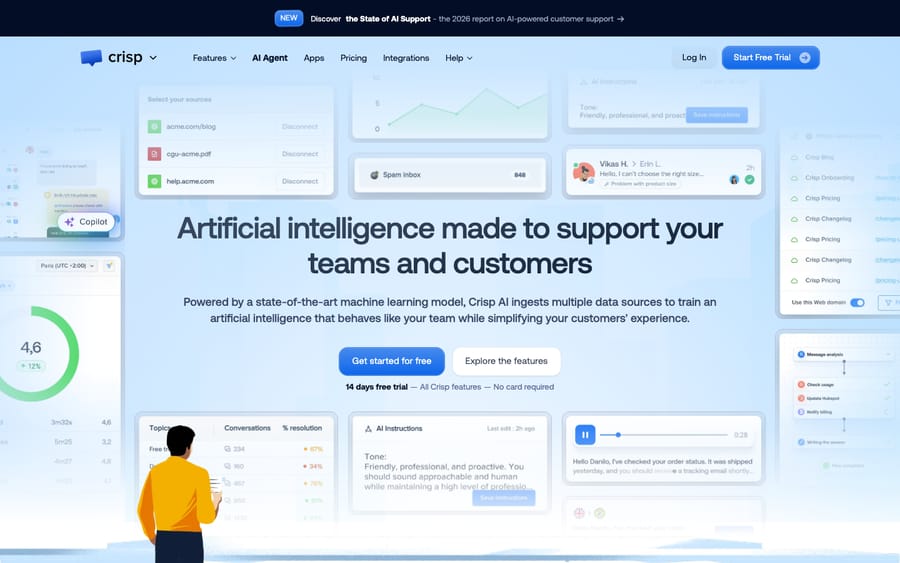
Crisp sells Hugo. Crisp's AI page lists web chat, WhatsApp, Messenger, Instagram and email as the channels where Hugo's workflows run, trained on your knowledge base, website and documents, with a handoff to a person when it can't answer. Crisp's February 1, 2026 AI update says each plan includes a free monthly credit allowance ($5 on Mini for about 90 conversations, $25 on Essentials for about 450, $75 on Plus for about 1,350) and that pay-as-you-go can be enabled "to keep Hugo running without interruption." Hugo can trigger actions through one-click integrations and through n8n, Zapier or Make. More in our Crisp AI explainer.
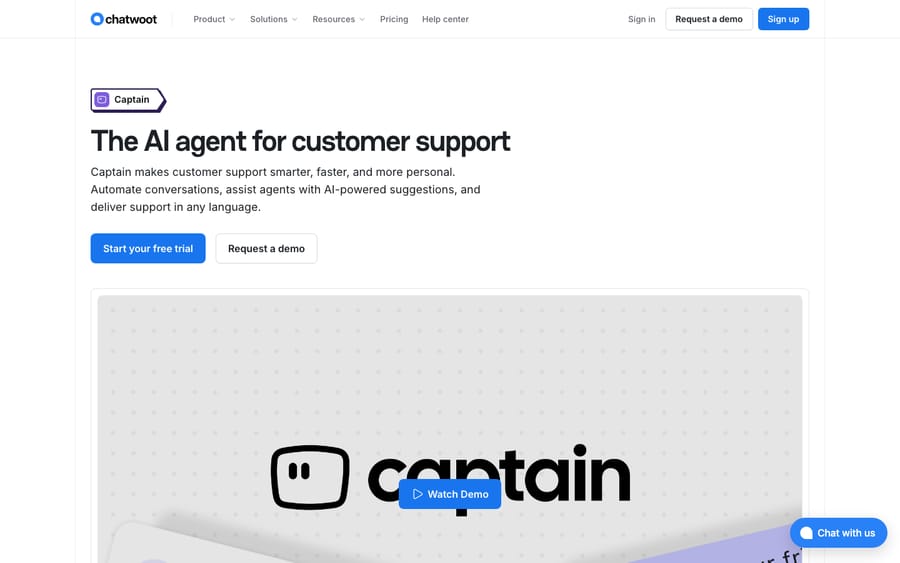
Chatwoot sells Captain. Chatwoot's Captain page describes an AI assistant that automates first responses using your help center and FAQs and "seamlessly hands off to human agents when needed," plus a Copilot that helps agents draft, improve and translate replies, Smart FAQs that spot questions your help center doesn't answer, and Memories that keep context from past conversations. Captain is on every paid Cloud plan with a credit allowance, and on the paid self-hosted plans; the self-hosted plans page says it connects to OpenAI's GPT models. The free Community Edition and the Hacker cloud plan don't include it.
In practice, Hugo's cost is easy to forecast from the allowance, and it comes with every paid Crisp plan. Captain gives a self-hosting team AI without leaving Chatwoot, but it means a paid plan, and its credit consumption needs testing on your own traffic before you can budget it.
What do users say?
Public review signals differ in kind. Crisp's Trustpilot page showed a TrustScore of 1.9 from 56 reviews on November 21, 2026, with recent reviews repeating slow support replies and accounts suspended or hard to close; Trustpilot pages for software draw mostly from unhappy customers, so read the themes rather than the score. Chatwoot had no Trustpilot reviews at all. Its user feedback lives on GitHub instead: the repository showed about 1.1k open issues and 561 open pull requests, with commits landing the day before we looked. That's a sign of an active project, and also a reminder that a self-hosting team reads issue threads where a Crisp customer would open a support ticket. G2 and Capterra returned 403 to our fetch, so we don't quote their ratings.
Who is each built for?
Crisp fits small and mid-size SaaS and ecommerce teams that want chat, email and messaging apps in one hosted inbox, priced so that 10 agents cost $95. It suits teams with no one whose job includes running servers.
Chatwoot fits teams with engineering capacity and a reason to own the stack: data-residency requirements, a product they want to customize, a public-sector or open-source project, or a firm policy against closed SaaS for customer data. Chatwoot Cloud also fits a small team that likes the open-source model and wants per-agent pricing below most commercial rivals.
If neither fits, our best Crisp alternatives list covers hosted options at other price points, and our list of free Crisp alternatives compares Chatwoot's Community Edition with the other $0 options.
What breaks if you move between Crisp and Chatwoot?
Both have APIs, so contacts and conversation history can be moved by script or migration service. Our Crisp API guide covers what Crisp's REST API exposes and how to authenticate. Chatwoot's open source helps here: the data model is public, so a developer can see exactly where each field lands. What doesn't move is configuration. Crisp's chatbot scenarios, workflows, shortcuts and Hugo training are rebuilt in Chatwoot as automation rules, canned responses and Captain content, and the reverse holds going the other way. Channel connections (WhatsApp numbers, Instagram accounts, email forwarding) need reconnecting to the new tool, which is often the slowest step because it involves Meta's business verification or your email provider.
Where Macha fits
Macha runs inside Crisp. It doesn't connect to Chatwoot as of November 2026, so a team on Chatwoot would need to move its inbox to Crisp or another supported desk to use it. Macha currently runs on Zendesk, Freshdesk, Gorgias, Front, Gladly, Crisp, HubSpot or Intercom. It fits teams that want an AI agent working inside their existing inbox without building and tuning it themselves.
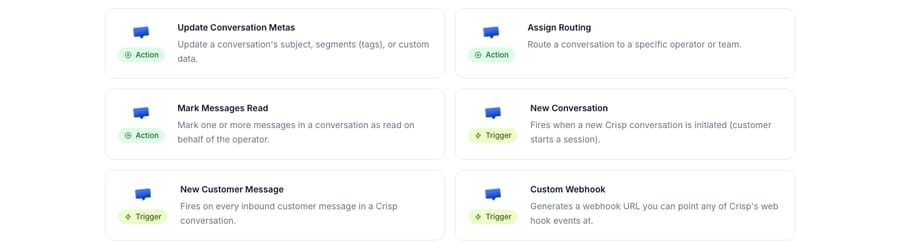
On Crisp, Macha's agent reads conversations and customer profiles, replies on the customer's channel, drafts replies as internal notes for review, updates segments, changes the conversation state and routes to an operator or team. It starts automatically on a new conversation or a new customer message. With Macha's Shopify and Stripe connectors, or a custom API tool that Macha's team sets up during onboarding, it can look up an order, a subscription or an account before it replies. The internal-note drafts use case and the after-hours use case show both modes.
The difference from Hugo and Captain is who does the work. Both are self-serve: your team writes the content and tunes the agent. Macha is done for you. The Macha team analyzes your past conversations, builds the knowledge base and the agent, and runs it in safe mode until the drafts are right, included on the trial and every plan at about $0.40 per ticket, which covers setup and a dedicated success manager who handles your changes. Plans start at $299/month for 750 tickets. That costs more per conversation than Hugo's included credits, and it's a hosted service, so a team whose reason for Chatwoot is keeping everything on its own servers should weigh that. See Macha on Crisp.
Common questions
Is Chatwoot cheaper than Crisp?
Self-hosted, Chatwoot's Community Edition costs nothing to license, though you pay for the server and the upkeep. On cloud plans Crisp is usually cheaper: 3 agents cost $57 a month on Chatwoot Startups against $45 on Crisp Mini, and 8 agents cost $152 against $95 for Crisp Essentials, which covers up to 10. Chatwoot comes out ahead only when a small team needs features Crisp keeps on Essentials, such as WhatsApp or a knowledge base.
Is Chatwoot an open-source alternative to Crisp?
Yes. Chatwoot's core is released under the MIT license, with enterprise features under a separate commercial license, and it covers the same core jobs: live chat, email and messaging apps in a shared inbox. Crisp adds a more finished hosted product and included AI credits; Chatwoot adds self-hosting and access to the code.
Does Chatwoot have AI like Crisp's Hugo?
Yes, Captain, which answers first responses from your help center and hands off to people, plus agent-side Copilot features. It's included on paid Cloud plans with 300, 500 or 800 credits a month, and on the paid self-hosted plans, but not on the free Community Edition or Hacker plan.
Can I self-host Crisp?
Crisp is sold as a hosted service, and its pricing page lists hosted plans only. Teams that need to self-host usually look at Chatwoot.
Can I use Macha with Chatwoot?
No. As of November 21, 2026, Macha doesn't connect to Chatwoot. It runs inside Crisp, where it reads and replies to conversations, drafts internal notes and routes conversations.
How we researched this
- Vendor pages: crisp.chat/en/pricing, chatwoot.com/pricing, Chatwoot self-hosted plans, Chatwoot Captain and the Chatwoot GitHub repository, all fetched November 21, 2026, with screenshots captured the same day. Crisp AI details from Crisp's February 1, 2026 update.
- Computed figures: the 8-agent and 3-agent bills are our arithmetic from list prices. Crisp's per-conversation rate ($25 ÷ 450 ≈ $0.056) is implied, not published. We did not compute a Captain cost per conversation, because the pages we read don't state how credits are consumed.
- User sentiment: Crisp's Trustpilot page and Chatwoot's, read November 21, 2026 and paraphrased without reviewer names; GitHub counts from the repository and its LICENSE page, read the same day. Self-hosting options from Chatwoot's self-hosted installation guide.
- Self-hosting costs: not priced, because they depend on your infrastructure.
- Macha: capabilities on Crisp come from Macha's own Crisp connector and the Crisp integration page, captured above on November 21, 2026. Macha is our product. We have not run Hugo or Captain on live traffic for this comparison; their features come from the vendors' public pages.