





 Shopify
 Stripe
 Slack
 Notion
 Google Workspace
 Confluence


Crisp vs Zendesk (2026): Prices, AI Costs and When to Move Up


Crisp is a chat-first inbox for small teams, and Zendesk is a full ticketing system for support organizations at volume. Crisp costs $45 to $295 a month per workspace, covering 4 to 20 agents, with credits for its Hugo AI agent included. Zendesk Suite costs $55 to $115 per agent a month billed annually, and its AI agents bill $2.00 per automated resolution past a small included allowance. A team of under 10 that mostly chats should start on Crisp. A team running email, phone and chat at volume, with SLAs and reporting to answer for, belongs on Zendesk. Prices below come from both vendors' pricing pages, checked on November 21, 2026.
Key takeaways
- Crisp charges $45, $95 or $295 a month per workspace, while Zendesk Suite charges $55 or $115 per agent a month billed annually.
- Zendesk bills its AI agents $2.00 per automated resolution pay-as-you-go, with 5 included per agent on Suite Team and 10 on Suite Professional.
- Crisp's Hugo AI agent runs on a monthly credit allowance of $5, $25 or $75, which Crisp says covers about 90, 450 or 1,350 conversations.
- For 8 agents and 1,000 AI conversations a month, our rough math puts Crisp Essentials near $126 and Zendesk Suite Team near $2,360.
- Macha runs inside both Crisp and Zendesk, so a team moving between them keeps the same AI agent setup approach.

Crisp or Zendesk: which should you pick?
| If you are... | Pick | Why |
|---|---|---|
| A team of 2 to 10, mostly chat | Crisp | $95 covers 10 agents on Essentials |
| Handling email, phone, chat and social at volume | Zendesk | Ticketing, telephony and omnichannel routing; IVR and skills-based routing on Suite Professional |
| Reporting agent performance and backlog to leadership | Zendesk | Prebuilt analytics dashboards from Support Team up, with deeper reporting on higher plans |
| Selling on WhatsApp, Instagram and SMS | Crisp | All in one inbox from the $95 Essentials plan |
| Wanting the AI bill fixed in advance | Crisp | Credits are included; overflow is opt-in pay-as-you-go |
| Needing a large app marketplace and deep admin controls | Zendesk | Triggers and automations go far deeper, and its pricing page lists 1,800+ apps, partners and integrations |
| Wanting an AI agent built and run for you on either | Add Macha | Macha runs inside both |
How does Crisp pricing compare with Zendesk pricing?
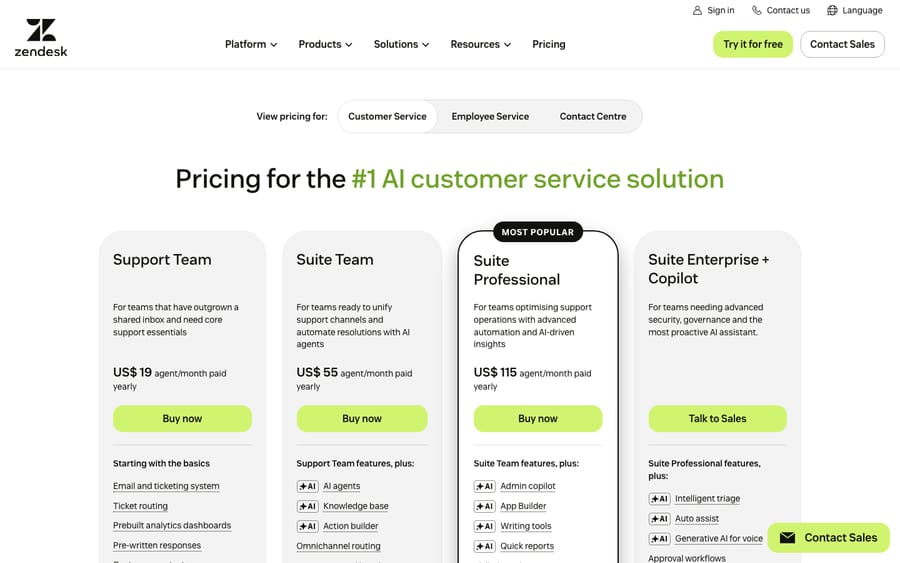
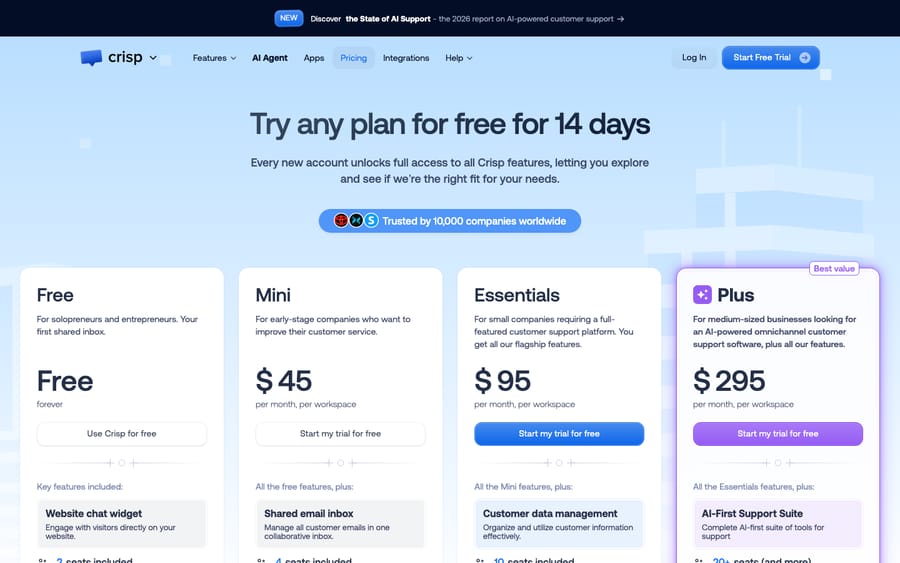
We checked both pricing pages on November 21, 2026 and captured the screenshots below.
| Crisp (per workspace, per month) | Zendesk (per agent, per month) | |
|---|---|---|
| Free | $0, 2 agents, chat widget and shared inbox | No free plan |
| Entry | Mini: $45, 4 agents | Support Team: $19 yearly, $25 monthly (email ticketing) |
| Mid | Essentials: $95, 10 agents | Suite Team: $55 yearly, $69 monthly |
| Top | Plus: $295, 20+ agents | Suite Professional: $115 yearly, $149 monthly |
| Enterprise | Custom | Suite Enterprise + Copilot: talk to sales |
| Extra agents | $10 a month each | One more seat at the plan price |
| AI agent | Hugo credits included: $5, $25 or $75 a month | 5 automated resolutions per agent (Team) or 10 (Professional), then $2.00 each pay-as-you-go |
| Agent-assist AI | Included in the plans | Copilot: $50 per agent a month, billed yearly, on Suite Professional and higher only |
Sources: Crisp pricing and Zendesk pricing. Zendesk also lists a lower committed rate for automated resolutions; on our fetch it displayed in pounds (£1.30), so we use the US$2.00 pay-as-you-go rate below. Crisp lists monthly prices and says yearly billing can be enabled in the app.
The billing unit tells you who each vendor is built to sell to. Crisp charges per workspace because its buyers are small teams that compare it to free tools; a flat $95 for 10 agents is an easy yes. Zendesk charges per agent because its buyers are support departments that add headcount, and every new agent is new revenue. On AI, Zendesk's per-resolution charge means it earns more as its AI closes more tickets, which gives it every reason to make the AI good and no reason to cap the bill. Crisp's included credits do the opposite: they keep AI cheap enough that a small team turns it on. Our Crisp pricing breakdown has worked monthly bills for Crisp at four team sizes.
What does each cost at 8 agents and 1,000 AI conversations a month?
Here is the arithmetic for one team: 8 agents, and 1,000 conversations a month handled end to end by the AI agent. For Zendesk we treat each of those as an automated resolution, which is the generous case for Crisp, since Zendesk bills resolutions rather than every AI conversation.
| Crisp Essentials | Zendesk Suite Team | Zendesk Suite Professional | |
|---|---|---|---|
| Seats | $95 covers 10 agents | 8 × $55 = $440 | 8 × $115 = $920 |
| AI included | $25 of credit, about 450 conversations | 8 × 5 = 40 resolutions | 8 × 10 = 80 resolutions |
| AI beyond that | 550 more, about $31 at the implied rate | 960 × $2.00 = $1,920 | 920 × $2.00 = $1,840 |
| Rough monthly total | about $126 | about $2,360 | about $2,760 |
Crisp doesn't publish its Hugo pay-as-you-go rate. Its plans imply about $0.056 a conversation ($25 for about 450), so the $31 is our estimate from that ratio. Zendesk says Copilot "can be added to Professional and higher plan levels," so it isn't available on Suite Team; on Suite Professional, Copilot for all 8 agents adds 8 × $50 = $400 a month, taking that column to about $3,160.
The gap is wide because the products are different sizes. At 8 agents, Zendesk's seats alone cost more than three times Crisp's plan, and the AI line is where the totals separate. If your AI resolves only 300 of those conversations, Zendesk Suite Team falls to about $440 + 260 × $2.00 = $960. It's still the bigger bill, but you're paying for deeper ticketing, telephony, routing and analytics than Crisp offers.
Which wins on features?
| Capability | Edge | Why |
|---|---|---|
| Live chat | Crisp | Chat is Crisp's origin; Zendesk's messaging is capable but one channel among many |
| Messaging apps | Crisp | WhatsApp Business, Instagram DMs, SMS, Line and Viber from Essentials |
| Email ticketing | Zendesk | Ticket statuses, forms, fields and views go much deeper; Crisp's ticketing system is a Plus feature |
| Voice | Zendesk | Telephony on Suite Team and an IVR phone menu on Suite Professional; Crisp's pricing page lists answering phone calls and outbound calls from Crisp, without contact-center routing |
| Routing and business rules | Zendesk | Triggers, automations and omnichannel routing |
| Reporting and routing | Zendesk | Prebuilt dashboards on every plan and skills-based routing on Suite Professional; Crisp adds advanced analytics on Plus |
| Knowledge base | Depends | Crisp's knowledge base starts on Essentials ($95); Zendesk's starts on Suite Team, not Support Team |
| AI agent | Depends | Zendesk's AI is built into a larger system; Hugo is cheaper per conversation |
| Price for a small team | Crisp | $45 to $95 total against $55 to $115 per agent |
| Setup time | Crisp | A chat widget and inbox in an afternoon; Zendesk takes real admin work |
Crisp treats support as a shared inbox where chat and messaging come first and a few people answer everything. Zendesk treats every request as a ticket with a status, an assignee, routing rules and an audit trail, which is what a team of 30 needs and more structure than a team of 4 wants.
What AI does each sell, and what does it cost?
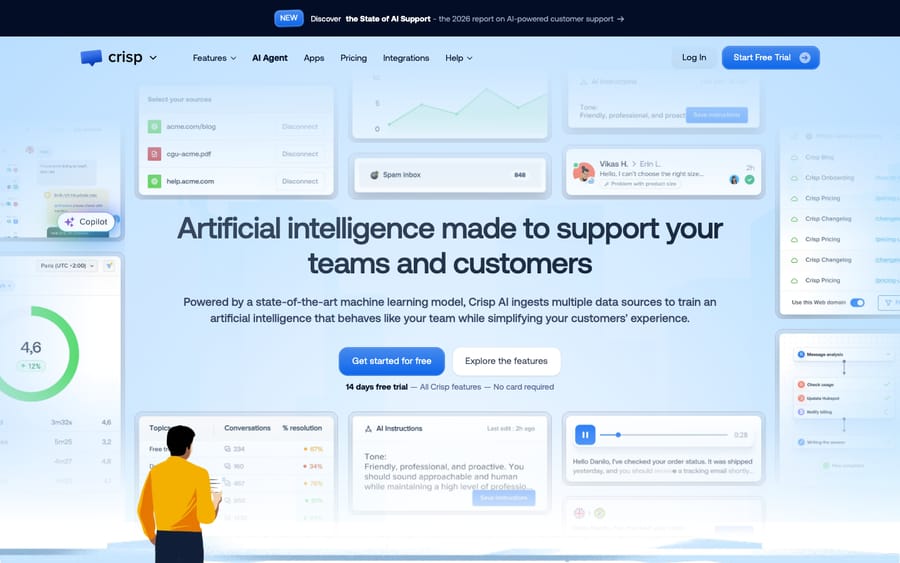
Crisp sells Hugo. Crisp's AI page lists web chat, WhatsApp, Messenger, Instagram and email as the channels where Hugo's workflows run, trained on your knowledge base, website and documents, with a handoff to a person when it can't answer. In its February 1, 2026 AI update, Crisp says each plan includes a free monthly credit allowance ($5 on Mini for about 90 conversations, $25 on Essentials for about 450, $75 on Plus for about 1,350) and that pay-as-you-go can be enabled "to keep Hugo running without interruption." Hugo can trigger actions through one-click integrations and through n8n, Zapier or Make. Our Crisp AI explainer covers the credit pool in detail.
Zendesk sells AI agents and Copilot. Its AI agents are billed on automated resolutions: 5 per agent a month are included on Support Team and Suite Team, 10 on Suite Professional, and each one past that costs $2.00 pay-as-you-go. Copilot, Zendesk's agent-assist AI, is a $50 per agent add-on billed yearly, available on Suite Professional and higher. For how Zendesk's AI pricing compares with Intercom's Fin, see Zendesk vs Intercom.
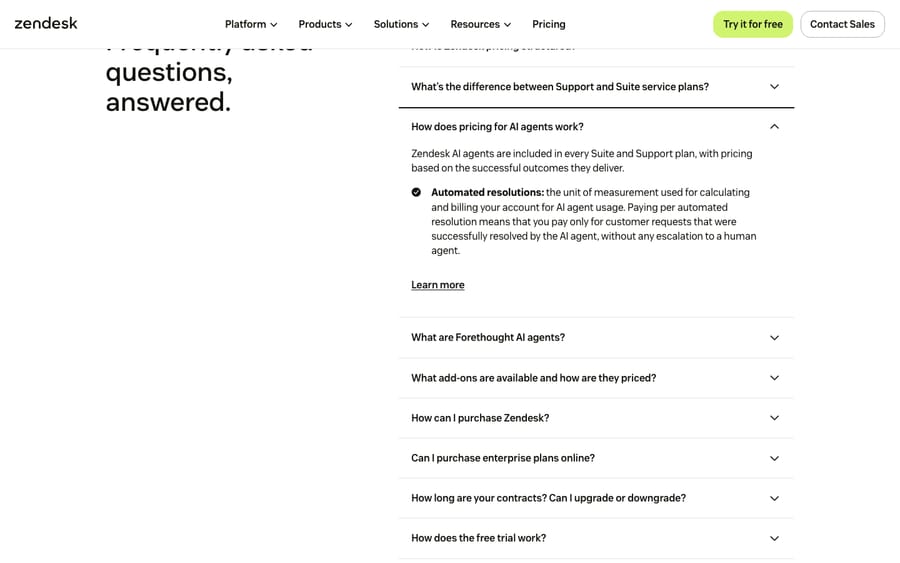
Per unit, Hugo inside its allowance costs about 6 cents a conversation, and Zendesk's AI costs $2.00 a resolution. That's a factor of more than 30. The comparison isn't fully like for like (a resolution is a narrower thing than a conversation), but even if only a third of Hugo's conversations resolve, Crisp's AI stays far cheaper.
Who is each platform built for?
Crisp fits small and mid-size teams, often SaaS startups and online stores, where 2 to 20 people answer chat, email and messaging apps from one inbox. It suits a team where the founder still answers some chats, where WhatsApp or Instagram matters as much as email, and where a fixed monthly bill is worth more than deep configuration. Crisp's Free plan and $45 Mini plan make it a common first help desk.
Zendesk fits support departments with a ticket volume that needs structure: multiple teams or brands, email and phone alongside chat, SLA targets, and a manager who reports on handle time and backlog. It suits companies that will hire more agents next year and want routing, business rules and analytics that scale with them. Zendesk's Support Team plan at $19 per agent is the email ticketing plan; the Suite plans are where chat, messaging, AI agents and omnichannel routing come together.
If the person who sets up the help desk will also answer chats this afternoon, start with Crisp. If you have, or plan to hire, someone whose job is running the help desk, Zendesk repays that person's time.
What do users say about Crisp and Zendesk?
We read both vendors' Trustpilot pages on November 21, 2026; G2 and Capterra returned 403 to our fetch, so we don't quote their ratings. Zendesk's TrustScore was 1.7 from 748 reviews and Crisp's was 1.9 from 56. Trustpilot pages for software draw mostly from unhappy customers, so the themes matter more than the scores. Zendesk's recent reviews center on slow or automated support replies, an interface reviewers call confusing or slow, and cancellation trouble; a reviewer from Saudi Arabia wrote on July 8, 2026 that "they do not reply unless you want to upgrade or increase seats." Crisp's center on slow support replies and accounts suspended or hard to close, with one free-plan user praising the help they got. A reviewer from Chile summed up the complaint on October 21, 2026: "Support is friendly but useless." Our Crisp review reads those complaints alongside the G2 and Capterra praise.
When should a team move from Crisp to Zendesk?
Most teams that move do it for one of three reasons. Email volume outgrows a chat inbox and they need ticket forms, fields and views. Leadership asks for reporting and routing a shared inbox can't give, such as skills-based routing on Suite Professional. Or phone volume grows past answering calls in the inbox and the team wants an IVR menu and call routing in the same system as its tickets.
What moves: contacts, conversation history and help-center articles, through each vendor's API or a migration service. Our roundup of Crisp migration tools compares the services that move Crisp data. What doesn't: Crisp's chatbot scenarios, workflows and shortcuts, which are rebuilt as Zendesk triggers, automations and macros, and the AI setup, which is configured from scratch. Budget for the admin time. Zendesk's business rules give you condition-by-condition control, and someone has to write them.
Moving the other way, from Zendesk to Crisp, usually happens when a small team is paying for structure it doesn't use. Check that Crisp's simpler routing and reporting cover what your Zendesk triggers and views were doing before you cancel. If Crisp isn't the right landing spot, our best Crisp alternatives list covers others.
Where Macha fits
Macha runs inside both Crisp and Zendesk, which matters for a team that might move from one to the other: the agent's instructions, knowledge and tools carry over, and only the help-desk connection changes. Macha currently runs on Zendesk, Freshdesk, Gorgias, Front, Gladly, Crisp, HubSpot or Intercom.
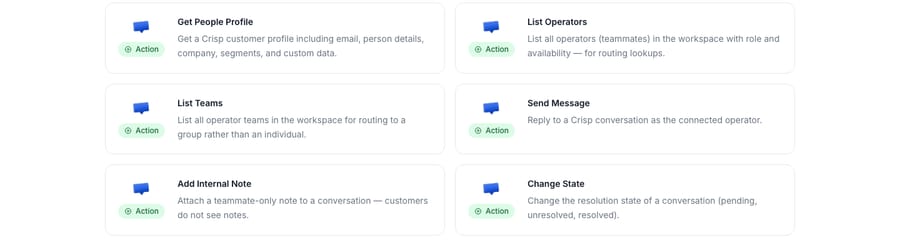
On Crisp, Macha's agent reads conversations and customer profiles, replies on the customer's channel, drafts replies as internal notes for review, updates segments, changes the conversation state and routes to an operator or team. It starts automatically on a new conversation or a new customer message. On Zendesk, it reads tickets, custom fields and attachments, searches past tickets, and writes public replies, internal notes, tags, status, priority and custom field values. With Macha's Shopify and Stripe connectors, the same agent can check an order or a subscription before replying. The Crisp routing use case and the internal-note drafts use case show the Crisp side.
The difference from Hugo and Zendesk's AI agents is who does the work. Both are configured by your team. Macha is done for you: for a team on Zendesk, that means the Macha team analyzes about a month of your past tickets, writes the agent's instructions from how your agents already answer, and keeps its replies as internal notes on the ticket until your team is happy with them, included on the trial and every plan at about $0.40 per ticket, which covers setup and a dedicated success manager who handles your changes. One conversation is one charge however many messages it takes, and plans start at $299/month for 750 tickets.
Against Zendesk's $2.00 per automated resolution, Macha's per-ticket price is lower and doesn't depend on a vendor's definition of resolved. Against Hugo's included credits, Macha costs more per conversation; what you get for it is an agent that takes actions in Shopify, Stripe or your own APIs, built and maintained by people who do it every day. Macha fits teams that want an agent acting inside the ticket and would rather not build it themselves. See Macha on Crisp and Macha on Zendesk.
Common questions
Is Crisp cheaper than Zendesk?
Yes, by a wide margin for small teams. Crisp Essentials is $95 a month for 10 agents; 10 agents on Zendesk Suite Team cost $550 a month billed yearly. Crisp also includes AI credits, while Zendesk bills $2.00 per automated resolution beyond a small allowance.
Is Crisp a Zendesk alternative?
For small, chat-first teams, yes. For teams that need email ticketing at volume, IVR and call routing, skills-based routing and deep reporting, Crisp covers less. Crisp's own ticketing system is on its $295 Plus plan.
Does Zendesk have a free plan like Crisp?
No. Zendesk's cheapest plan, Support Team, is $19 per agent a month billed yearly, and its AI agents page offers a 14-day free trial with no credit card. Crisp's Free plan covers 2 agents with the chat widget and shared inbox, without AI credits, and Crisp's AI page offers a 14-day trial of paid plans with no card.
How does Zendesk AI pricing compare with Crisp Hugo?
Zendesk charges $2.00 per automated resolution pay-as-you-go, with 5 or 10 per agent included depending on the plan. Crisp includes $5, $25 or $75 of Hugo credit a month, which it says covers about 90, 450 or 1,350 conversations.
Can I keep my AI agent if I move from Crisp to Zendesk?
Hugo stays in Crisp and Zendesk's AI agents stay in Zendesk. Macha runs inside both, so its agent, knowledge and tools move with you and only the help-desk connection changes.
How we researched this
- Vendor pricing: crisp.chat/en/pricing and zendesk.com/pricing, fetched November 21, 2026, with screenshots captured the same day, plus Zendesk's AI agents page.
- Crisp AI: Crisp's AI update of February 1, 2026, fetched November 21, 2026.
- Computed figures: the 8-agent example is our arithmetic from list prices. Crisp's per-conversation rate ($25 ÷ 450 ≈ $0.056) is implied, not published. Treating 1,000 AI conversations as 1,000 Zendesk resolutions is an assumption and the most expensive case for Zendesk; your resolution count will be lower.
- User sentiment: Trustpilot pages for Crisp and Zendesk, read November 21, 2026; quotes are attributed by country and date, without reviewer names.
- Macha: Crisp capabilities come from Macha's own Crisp connector and the Crisp integration page, captured above; Zendesk capabilities from Macha's Zendesk connector. Macha is our product. We have not run Hugo or Zendesk's AI agents on live traffic for this comparison; their features come from the vendors' public pages.