Intercom
 Shopify
 Stripe
 Slack
Slack Notion
 Google Workspace
 Confluence

DRUID AI: The Complete Guide (2026)


DRUID AI is an enterprise agentic AI platform used by more than 300 companies to automate a reported 1.2 billion conversations, with named customers including Société Générale, Generali, Erste Group, McDonald's, and the NHS. This guide covers what the platform actually does, a close look at which customer results are independently checkable versus asserted only on the homepage, what it costs since DRUID doesn't publish pricing, and how it compares to Kore.ai and Macha for teams evaluating enterprise conversational AI against a lighter, help-desk-native option.

DRUID sells itself as infrastructure for orchestrating AI agents across an entire enterprise. Its own language is "route tasks across AI agents, enterprise systems, and people to complete end-to-end processes," which is a materially bigger claim than a support-chat vendor makes.
What is DRUID AI?
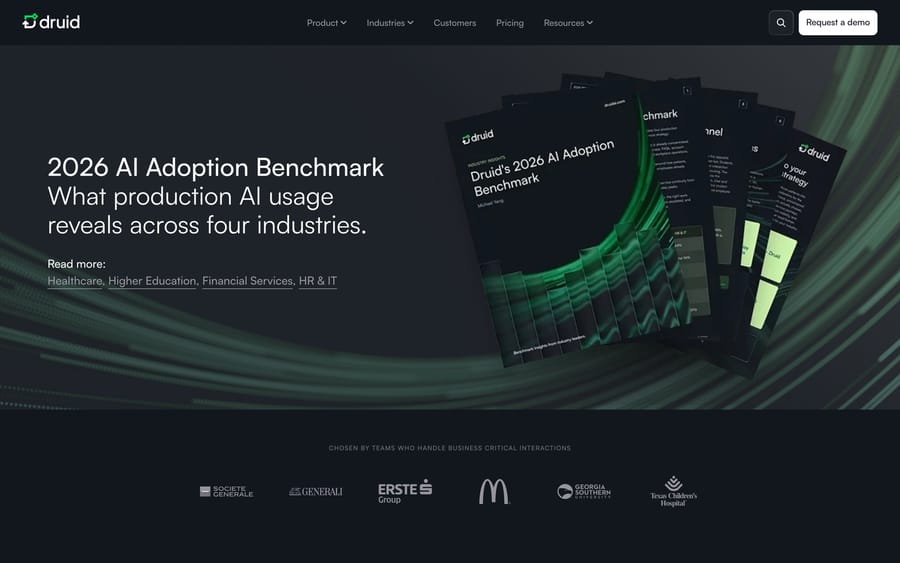
DRUID AI is an enterprise AI agent platform built around what it calls the Druid Conductor, an orchestration layer that builds "agentic AI flows with logic, real business skills, integrations, and human handoff." It serves both customer-experience use cases (healthcare, higher education, banking, insurance, retail) and employee-experience use cases (HR, IT helpdesk, sales and marketing) from the same underlying platform. DRUID was named in the 2026 Gartner Magic Quadrant for Conversational AI Platforms, a real, checkable piece of third-party recognition independent of the company's own marketing claims.
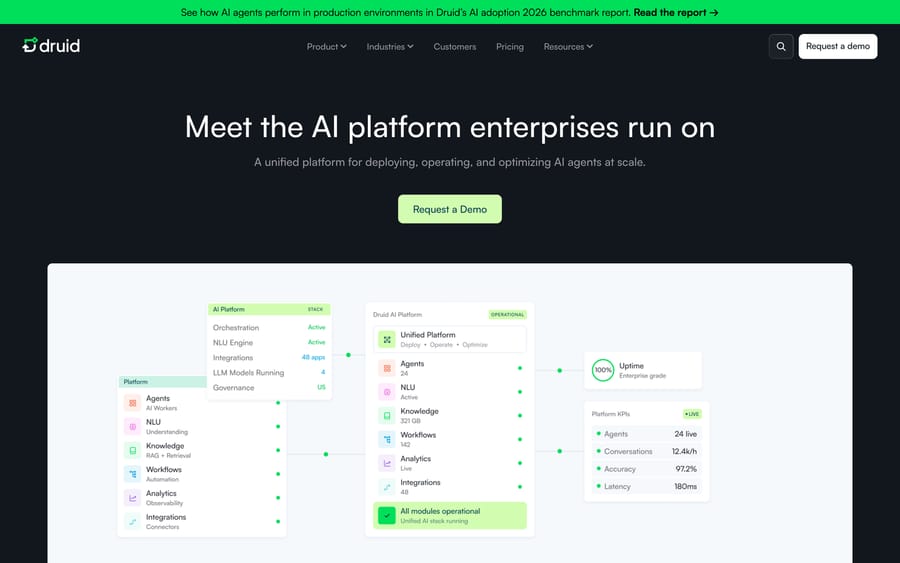
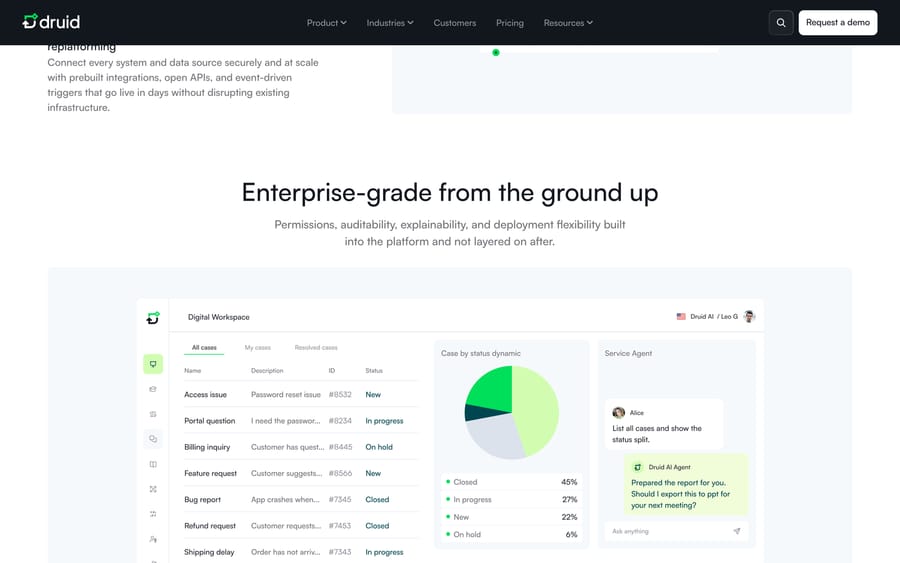
The core product surfaces are an AI Agent Builder (no-code/low-code), AI Voice Agents, a library of pre-built agent templates, omnichannel integrations, analytics dashboards, and AI governance tooling for permissions and auditability. That governance emphasis, DRUID's platform page states permissions, auditability, explainability, and deployment flexibility are "built into the platform and not layered on after", is aimed squarely at the same enterprise buyer other platforms in this category chase: one that needs to explain an automated decision after the fact, not just get one.
Which customer results are actually verifiable
This is worth a dedicated section, because DRUID's homepage and its individual case studies tell two different stories, and a buyer deserves to know that before repeating a number internally.
DRUID's homepage states an 85% first-contact resolution rate for common inquiries in healthcare, $2.4 million in additional enrollment revenue attributed to Georgia Southern, 96% accuracy for MatrixCare's AI agents, and 65% automatic query resolution at Liberty Global. Those are specific, attractive numbers.

We fetched the individual case studies for two of those relationships directly. The university case study, titled on DRUID's own site as "Southeast Georgia State university" (not the "Georgia Southern" name used on the homepage, where a Georgia Southern University logo also appears separately in the customer strip), contains no quantified enrollment-revenue figure anywhere in its visible content: only a general quote about retention, satisfaction, and institutional reputation. The Liberty Global (Liberty Shared Services) case study similarly reports the operational shape of the deployment, around 10,000 queries a month handled by six AI agents across business units, but states no resolution percentage or before/after comparison.
None of this means the homepage numbers are false. It means the strongest, most specific evidence a prospective buyer can act on, an attributed number inside the actual case study for that customer, isn't there for two of DRUID's four headline statistics. Ask directly, during a sales conversation, for the underlying case study or reference call that supports whichever number gets used to sell you.
Key features
- Druid Conductor: orchestrates AI agents, enterprise systems, and human handoff into one end-to-end process, beyond a single-turn chatbot exchange.
- No-code/low-code AI Agent Builder, plus a library of pre-built agent templates by industry.
- AI Voice Agents alongside chat and omnichannel messaging.
- Governance built into the platform: permissions, auditability, and explainability, positioned as native rather than bolted on.
- Analytics and observability, visible in DRUID's own platform diagram as live conversation counts, accuracy, and latency metrics.
DRUID AI pricing
DRUID AI does not publish pricing. Its pricing page states the company works with "300+ enterprises" automating "1.2B+ conversations" and invites a quote request that promises "an AI Pricing plan you can explain and control," a pricing model "tailored to your use case," and an ROI discussion built around your specific process volumes and costs.
We have no reliable published number or third-party estimate to cite for DRUID specifically. Given the scale of its customer base (McDonald's, Société Générale, NHS) and the platform's orchestration-and-governance positioning, budget for an enterprise sales and integration cycle similar in shape to other agentic AI platforms in this category, on top of any monthly usage rate.
The incentive worth naming: a fully custom, quote-per-deal pricing model lets DRUID price each enterprise account close to what that deployment is worth to them, the same logic that drives most enterprise software toward opaque pricing. It also means two enterprises of similar size can land at very different numbers depending on how hard each negotiates, so treat the "ROI discussion" the pricing page promises as a starting point, not the final word.
What actual users say
We could not produce an independent real-user rating for DRUID AI. G2's and Capterra's reviews pages both returned errors to direct access, and TrustRadius did the same. That gap means the strongest public evidence available is DRUID's own case studies, which, as the section above shows, don't always carry the specific numbers the homepage attributes to them. Ask for a customer reference directly during evaluation instead of relying on published testimonials alone.
Pros and cons
Pros
- Real third-party recognition (2026 Gartner Magic Quadrant for Conversational AI Platforms) independent of vendor marketing.
- Governance and auditability built into the platform, a real differentiator for regulated industries like banking and healthcare.
- Broad customer base at meaningful scale: Société Générale, Generali, Erste Group, McDonald's, and the NHS all appear as named logos.
- Combines orchestration, a no-code builder, voice, and analytics in one platform, instead of several point tools.
Cons
- No published pricing anywhere, and no reliable third-party estimate exists.
- Two of the four headline customer statistics on DRUID's homepage aren't substantiated in the individual case studies for those same customers, and one case study names the institution inconsistently.
- No accessible independent review platform (G2, Capterra, and TrustRadius all blocked automated access), so a buyer is working mostly from DRUID's own materials.
- Broad, orchestration-first positioning may be more platform than a smaller team needs if the actual requirement is automating a single support inbox.
Who DRUID AI is best for
DRUID fits teams at a large enterprise, a bank, insurer, healthcare system, university, or retailer, that need to orchestrate AI agents across multiple systems and departments, with governance and auditability as a hard requirement, not an afterthought. The Gartner Magic Quadrant placement and the customer roster (banks, an NHS deployment, McDonald's) point at that same buyer.
It's the wrong choice for a team that wants to see a price before a sales call, or one that only needs to automate a single support channel instead of orchestrating processes across several systems and departments. A 15-person support team on one help desk gets little value from an orchestration platform built to route work across "AI agents, enterprise systems, and people."
DRUID AI vs alternatives
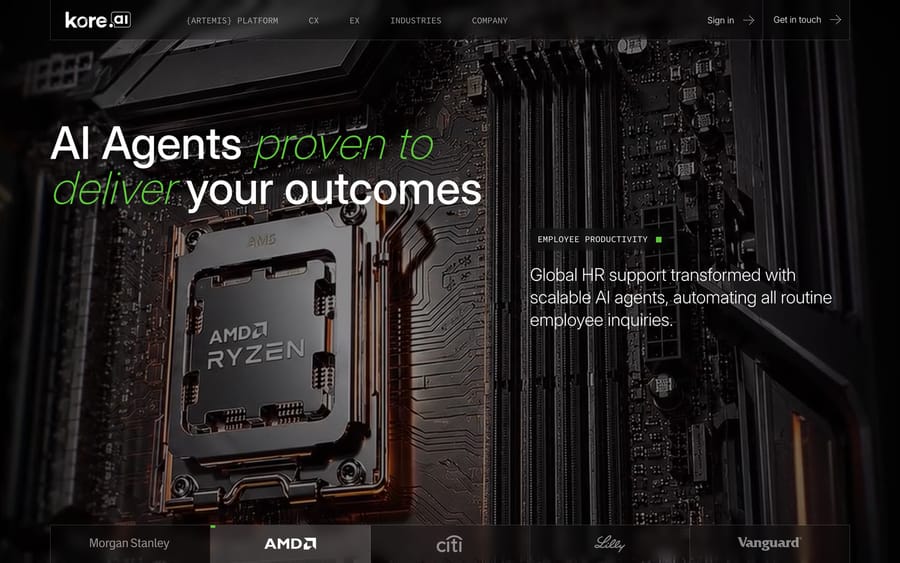
The closest comparison is Kore.ai, another enterprise conversational AI platform serving banking, healthcare, and other regulated industries with a similarly broad orchestration positioning. Kore.ai also publishes no pricing page, consistent with enterprise, sales-led software in this category generally.
| DRUID AI | Kore.ai | Macha | |
|---|---|---|---|
| Model | Enterprise agent orchestration (Druid Conductor) across CX and EX | Enterprise conversational AI across many industries | AI agent layer on your existing help desk |
| Best for | Large enterprises needing governance and cross-system orchestration | Enterprise contact centers across many verticals | Teams on Zendesk, Freshdesk, Gorgias, or Front |
| Pricing | Unpublished, sales-led | Unpublished, sales-led | From $299/mo for 750 tickets (~$0.40/ticket), published |
| Third-party recognition | 2026 Gartner Magic Quadrant for Conversational AI Platforms | Also independently rated by analyst firms | N/A (newer platform) |
| Self-serve trial | No | No | $50 free usage |
| Replaces your help desk? | No, layers onto existing enterprise systems | No, layers onto an existing CCaaS/CRM stack | No, sits on top of Zendesk, Freshdesk, Gorgias, or Front |
Both DRUID and Kore.ai compete for the same enterprise buyer: one running processes across multiple systems and departments who needs governance built in, not bolted on. For our detailed take on Kore.ai specifically, see our guide to Kore.ai. Neither vendor reaches a support team's ticket queue inside a help desk; that's where Macha fits instead, published per-ticket pricing and a self-serve trial as an AI agent layer inside Zendesk, Freshdesk, Gorgias, or Front. For more on how enterprise orchestration platforms compare to help-desk-native agents, see our guide to AI agents for customer service.
How we researched this
We fetched DRUID AI's homepage, pricing page, platform overview, and its Southeast Georgia and Liberty Global case studies directly on 2026-09-17, using its sitemap to find real case-study URLs. We checked those two case studies specifically because the homepage attributes named figures to those same customers, and found neither case study contained the cited numbers. G2, Capterra, and TrustRadius all returned errors to direct access, so we could not verify an independent review rating. Kore.ai's homepage (captured previously for its own guide) is reused here for the comparison.
FAQ
What is DRUID AI? DRUID AI is an enterprise agentic AI platform built around an orchestration layer (the Druid Conductor) that routes work across AI agents, enterprise systems, and people, serving both customer-experience and employee-experience use cases.
How much does DRUID AI cost? DRUID doesn't publish pricing. Every quote is custom, based on use case and scale, following a "Request Pricing" conversation. There's no reliable third-party estimate to cite.
Are DRUID AI's customer results verified? Partially. DRUID's homepage attributes specific figures (85% first-contact resolution, $2.4M in enrollment revenue, 96% accuracy, 65% resolution) to named customers, but the individual case studies we checked for two of those customers contained no matching quantified results. Ask for a direct reference before treating a homepage statistic as settled.
Is there a free trial? No self-serve trial is published. Every path on the pricing page leads to a "Request Pricing" form.
Has DRUID AI been recognized by analysts? Yes. DRUID AI is named in the 2026 Gartner Magic Quadrant for Conversational AI Platforms, which is independent, checkable recognition distinct from the company's own case studies.
What are good alternatives to DRUID AI? Kore.ai is the closest comparison: another enterprise conversational AI platform with unpublished, sales-led pricing serving similar regulated industries. For a team running a single help desk instead of a multi-system enterprise process, a lighter, help-desk-native AI agent is a better fit than either vendor.
Does DRUID AI replace a help desk? No. It orchestrates agents across an enterprise's existing systems and departments. It isn't a general-purpose ticket queue for a single support inbox.
Does DRUID AI have good reviews? We couldn't confirm through an independent platform. G2, Capterra, and TrustRadius all returned errors to automated access at the time of writing, so DRUID's own case studies and its Gartner Magic Quadrant placement are the strongest public evidence available.
Ready to automate the ticket queue with published, per-ticket pricing instead of a sales-led enterprise contract? See how Macha's pricing works or start a trial on top of the help desk you already run.
Sources: DRUID AI, DRUID AI pricing, DRUID AI platform overview, Southeast Georgia State university case study, Liberty Shared Services case study, Kore.ai.
Resolve tickets automatically with AI agents
Macha's AI agents work on top of the help desk you already use — no code.