Intercom
 Shopify
 Stripe
 Slack
Slack Notion
 Google Workspace
 Confluence

Espressive: The Complete Guide (2026)


Espressive is an enterprise AI company best known for Barista, a conversational virtual support agent that helps employees resolve IT, HR, and workplace requests through natural language. If you're evaluating AI for an internal service desk — the ServiceNow-style world of password resets, access requests, benefits questions, and ticket deflection — Espressive is a name you'll run into, and this guide covers what it does, how the AI works, what it costs, and the alternatives worth comparing.

This is a neutral, research-driven guide for IT, HR, and service-management leaders shortlisting AI support tools. We cover the strengths and the trade-offs honestly, including where Espressive fits and where it doesn't.
What is Espressive?
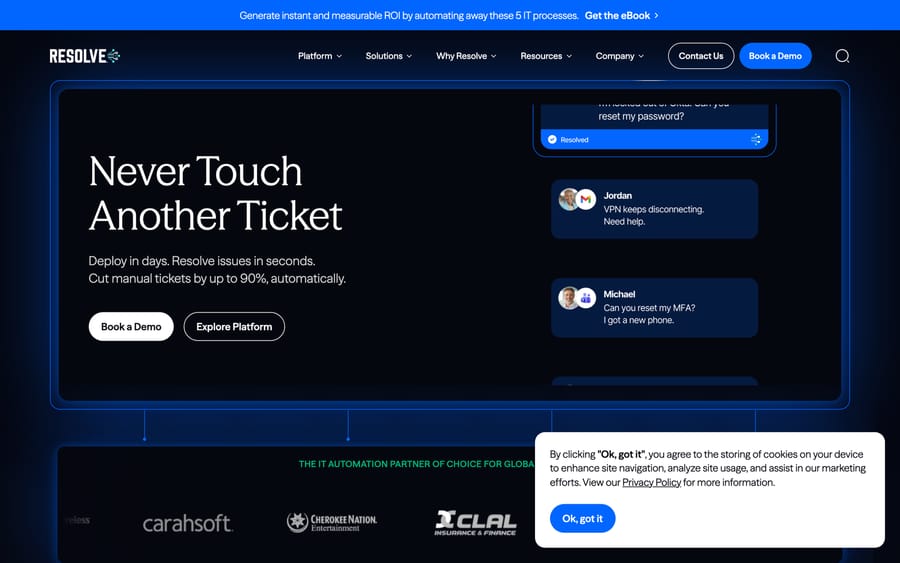
Espressive's homepage, focused on AI-based employee/IT self-service.
Espressive is a Santa Clara-based company reportedly founded in 2017 by Pat Calhoun (a former McAfee executive). Its flagship product, Barista, is an AI-based virtual support agent (VSA) that gives employees a single front door for support: instead of hunting through portals or filing tickets, an employee asks Barista a question in plain language and it resolves the request or routes it correctly.
Importantly, Espressive is focused on employee and IT service management (ITSM) — not customer-facing (CX) support. Its home turf is the internal help desk: IT, HR, facilities, finance, and other shared-services teams. That focus is worth keeping in mind, because many "AI support agent" tools are built for external customers, and the requirements are quite different. An employee asking "why can't I get into the VPN?" is a fundamentally different interaction from a customer asking "where's my order?" — different identity model, different systems of record, different escalation paths, and different tolerance for error.
Espressive markets Barista under a few consistent themes: a single "front door" for all employee support, an AI model tuned to employee language rather than generic web chat, and measurable ticket deflection that takes load off human agents. The company positioned itself early as the "first AI-based employee self-service solution to automate processes while maintaining compliance," and much of its differentiation has centered on that employee-language model and its no-code administration.
Espressive reportedly raised a $30 million Series B led by Insight Partners (with General Catalyst and Wing Venture Capital), taking total funding to roughly $53 million as of its last public raise. In September 2025, Espressive was acquired by Resolve (formerly Resolve Systems), an IT automation and orchestration company — a signal that the market is consolidating conversational AI, ITSM, and automation into broader "autonomous service desk" platforms. Resolve framed the deal around its "Zero Ticket™" IT mission: the goal of resolving employee issues before they ever become a ticket. Espressive's conversational AI and LLM frameworks are being folded into Resolve's agentic-automation platform alongside Resolve's own agents — RITA (a resolution agent) and Jarvis (a workflow-builder agent) — to add stronger natural-language understanding and contextual resolution. If you're evaluating Espressive today, you're effectively evaluating a product mid-integration into a larger portfolio, which matters for roadmap and contract diligence.
How Espressive's AI works
Barista is built on Espressive's proprietary NLP and what the company calls the Employee Language Cloud (sometimes referred to as an employee language model, or ELM) — a large, continuously growing model of how employees actually phrase requests. Espressive has claimed the Employee Language Cloud recognizes reportedly over 2 billion employee-language phrases out of the box, and that it learns new phrases, synonyms, and topics automatically as employees interact with it. The idea is that internal support has its own vocabulary ("I need VPN," "my badge won't work," "when does open enrollment start," "spin up a new laptop for a new hire"), and a model pre-trained on that language deflects more accurately from day one than a generic chatbot you have to train from scratch.
The Barista Control Center
The administrative brain behind Barista is the Barista Control Center — a no-code (Espressive calls it "zero-code") console for shaping the virtual agent without engineering effort. It's typically described around three core modules:
- Language Expander — localizes and extends the employee language model so Barista understands your organization's specific terms, acronyms, and system names.
- Conversation Center — designs dynamic, interactive conversation flows and dialog logic.
- Integration Designer — connects Barista to virtually any API-enabled third-party system so it can take action (look up an order status, provision access, check a benefits record), not just answer questions.
A notable operational detail for enterprise buyers: Barista deployments ship with two instances — a sub-production and a production environment. Admins build, localize, and validate content and integrations in sub-production, test rigorously, then push approved changes to production. For regulated or change-controlled IT organizations, that staging discipline is a meaningful feature, not just a nicety.
Agent-side assistance
On top of the employee-facing conversational layer, Espressive has added Barista Agent Co-Pilot — capabilities that assist human service-desk agents directly: generating knowledge articles, summarizing and populating ticket fields, and translating languages. The Co-Pilot can be embedded in existing contact-center and service-desk tools such as NICE CXone, Amazon Connect, Genesys, and ServiceNow Agent Workspace, so it augments agents inside the tools they already live in rather than forcing another window.
The overall pattern is: Barista deflects common requests autonomously through chat, integrates with your ITSM system to create and track tickets, escalates anything it can't close to humans with proper workflows and audit trails, and — through the Co-Pilot — speeds up the humans who handle what's left.
Key features
- Employee virtual support agent — a single conversational front door for IT, HR, facilities, and workplace requests.
- Employee Language Cloud (ELM) — NLP pre-tuned to internal-support language (2B+ phrases) with continuous learning.
- Barista Control Center — no-code administration via Language Expander, Conversation Center, and Integration Designer modules.
- Sub-production / production instances — built-in staging and test environment for safe change management.
- ITSM integration — connects to ServiceNow, Ivanti, Jira Service Management, Zendesk, and other platforms to create, update, and track tickets from chat.
- REST API integration — the Integration Designer connects Barista to essentially any API-enabled system, so it can trigger actions and fulfill requests end-to-end.
- Automated deflection — resolves high-volume requests like password resets and access issues without a human touching them.
- Barista Agent Co-Pilot — agent-side assistance (knowledge generation, ticket-field population, translation) deployable into existing contact-center systems.
- Structured escalation — proper handoff, visibility, and audit trails for anything the AI can't close.
Espressive markets strong outcomes — vendor-reported employee adoption rates of ~80–85% and help-desk call-volume reductions of ~50–70% — though, as always, treat vendor benchmarks as ceilings, not guarantees, and verify them against your own environment during a pilot.
Integrations and deployment
Espressive's value depends heavily on integration, because deflection only matters if the AI can actually do things in your systems. Barista is designed to sit in front of the leading ITSM platforms — ServiceNow (the most common pairing), Ivanti, Jira Service Management, and Zendesk among others — creating, updating, and tracking tickets so employees never have to touch the underlying portal. Beyond ITSM, the Integration Designer lets teams wire Barista into HRIS, identity/access, collaboration, and custom internal systems through REST APIs.
On the deployment surface, Barista typically meets employees where they already work — web/self-service portals, and collaboration tools like Microsoft Teams and Slack — so support is a message away rather than a portal login away. Because it's an enterprise product, expect a guided onboarding: connecting systems, localizing the language model in the Control Center, designing conversation flows, validating in sub-production, and rolling out to employees. This is not a same-afternoon self-serve setup; it's an implementation project, which is appropriate for its target buyer but worth planning for.
Espressive pricing
Espressive uses a quote-only enterprise pricing model — there is no public list price, no self-serve tier, and no published per-seat rate. Licensing is typically based on total employee headcount rather than usage, delivered through custom annual contracts, with costs fixed upfront regardless of how many employees actually use Barista.
What drives the cost
Because pricing is bespoke, the number you're quoted will move on a handful of factors. Expect the main cost drivers to be:
- Number of employees / seats — the primary lever, since licensing is headcount-based. More employees under support means a larger contract.
- Volume and scope — how many departments (IT only, or IT + HR + facilities + finance) and how much ticket volume you're deflecting.
- Integrations and complexity — the number and difficulty of system integrations (ServiceNow, HRIS, custom REST APIs) built through the Integration Designer.
- Implementation and services — enterprise onboarding, language-model localization, and any professional services or premium support.
- Contract term — multi-year commitments and enterprise-wide rollouts are negotiated individually.
That structure is common for enterprise ITSM software, but it has real implications. First, cost forecasting is hard during evaluation — you can't sanity-check a quote against a public rate card. Second, headcount-based licensing decouples cost from value: you pay the same whether adoption is 30% or 85%, so the ROI case rests entirely on driving high adoption. Third-party reviewers such as Workativ and PeerSpot flag the pricing opacity as a recurring evaluation friction. If you're comparing tools on cost, you'll need to request a quote, model total cost of ownership across the full contract, and — given the recent Resolve acquisition — re-confirm current packaging and terms directly, since post-acquisition pricing and bundling can change.
We deliberately avoid quoting a dollar figure here: any single number floating around review sites is unverified and environment-specific, and publishing it would mislead more than it helps. The honest answer is "it depends on your headcount and scope — get a quote."
Pros and cons
Pros
- Purpose-built for internal/employee support, with a language model genuinely tuned to that domain (2B+ phrases out of the box).
- Strong ITSM integration (ServiceNow, Ivanti, Jira Service Management, Zendesk) and structured escalation with audit trails.
- No-code Barista Control Center with a proper sub-production/production staging workflow — mature change management for enterprise IT.
- Agent Co-Pilot extends value to human agents, not just deflection, inside tools they already use.
- Vendor-reported high adoption (~80–85%) and meaningful call-volume reduction (~50–70%).
- Meets employees where they work — web portal, Microsoft Teams, Slack.
Cons
- Quote-only, headcount-based pricing makes cost forecasting difficult and can penalize low adoption — you pay the same whether people use it or not.
- Enterprise-scale product with an implementation project attached — likely overkill (and over-priced) for smaller teams that want same-day setup.
- Focused on internal ITSM/HR; not designed for customer-facing CX support, so it's the wrong tool if that's your goal.
- Post-acquisition roadmap under Resolve is still settling as Barista integrates with Resolve's RITA/Jarvis agents and "Zero Ticket" platform — worth diligence on continuity, packaging, and support.
- Depth of value depends on integration effort; a shallow deployment that can't take actions will underperform its own benchmarks.
Who Espressive is best for
Espressive is best for mid-to-large enterprises with a high-volume internal service desk — organizations running ServiceNow (or similar ITSM), with thousands of employees generating repetitive IT and HR tickets, that want to deflect that volume, take real actions in back-end systems, and assist their agents. It fits organizations that already think in terms of change control and staging, can staff an implementation, and will invest in driving adoption to earn back a headcount-based license.
It's a poor fit if you're a smaller company that wants transparent, usage-based pricing and a fast self-serve rollout — or if your goal is customer-facing support rather than employee support. Those are genuinely different problems, and this is where an honest guide has to say so rather than pretend one tool covers both.
Espressive vs alternatives
The right tool depends heavily on whether you're solving employee (internal) support or customer (external) support — they're different problems.
| Espressive (Barista) | Moveworks | Aisera | Macha | |
|---|---|---|---|---|
| Primary use case | Employee/IT service desk (ITSM) | Employee/IT service desk (ITSM) | Employee IT/HR + some CX | Customer-facing support (CX) |
| Deploys on | Standalone + ITSM (ServiceNow, Ivanti, JSM) | Standalone + ITSM, Teams/Slack | Standalone + ITSM | AI layer on top of your help desk (Zendesk, Freshdesk, Front, Intercom, Gorgias) |
| AI approach | Employee Language Cloud (2B+ phrases) | Enterprise LLM + reasoning | Domain-specific LLMs | Agents you build in plain English + custom tools |
| Pricing | Quote-only, per employee | Quote-only, enterprise | Quote-only, enterprise | Per ticket, from $299/mo for 750 tickets |
| Setup | Enterprise onboarding + staging | Enterprise onboarding | Enterprise onboarding | Connect help desk, build agents in plain English |
| Best for | Large internal help desks | Large internal help desks | Enterprises spanning IT + CX | CX teams automating on their existing stack |
If you're specifically weighing internal-support alternatives, Moveworks and Aisera are the closest head-to-head competitors — both enterprise, both ITSM-oriented, both quote-only. Resolve's own automation portfolio (now Espressive's parent, with its RITA and Jarvis agents) is also worth a look, since Barista is being integrated into it. Other names in the internal-support space include ServiceNow's own Virtual Agent / Now Assist, Leena AI, and Workativ.
If you're weighing customer-facing alternatives, Espressive isn't really in that race — the relevant comparison set is CX-native tooling (including Macha, below), Intercom Fin, Zendesk AI, and similar.
An honest note on Macha: Macha solves a different problem than Espressive, and we'd rather be clear about the fit than oversell. Macha is an AI agent layer that runs on top of the help desk your customer support team already uses — Zendesk, Freshdesk, Front, Intercom, or Gorgias — instead of asking you to rip and replace it. You build agents in plain English, connect them to your own systems with custom tools, and pay per ticket rather than per employee, so cost tracks the automation you actually get. That's a natural fit if your goal is deflecting and automating customer tickets.
If, on the other hand, your goal is an employee IT/HR service desk — password resets, access requests, onboarding, benefits questions, all wired into ServiceNow — Espressive (or Moveworks/Aisera) is the more natural fit, and we'd point you there rather than force a comparison. The single most important step in this evaluation is deciding which problem you're actually solving: employee support and customer support look similar on a feature list but differ in identity, systems of record, and success metrics. Pick the tool built for your side of that line.
How we researched this
This guide is built from Espressive’s own product and documentation pages, its published customer stories, and the Resolve acquisition announcements that explain where Barista now sits; Espressive does not publish prices, so the figures in the pricing section are reported ranges rather than quotes. On September 21, 2026 we re-checked the internal links in this post and added the comparisons above, and we did not obtain a quote on that pass. Espressive is demo-gated, so nothing here comes from hands-on use, and G2 turned away every request we made that day.
Frequently asked questions
What is Espressive? Espressive is an enterprise AI company whose main product, Barista, is a conversational virtual support agent that helps employees resolve IT, HR, and workplace requests in natural language. It's focused on internal service management, not customer-facing support.
What is Espressive Barista? Barista is Espressive's AI-based virtual support agent. It deflects common employee requests (like password resets), integrates with ITSM tools such as ServiceNow to create and track tickets, and escalates complex cases to human agents. It's administered through the no-code Barista Control Center.
What is the Barista Control Center? The Barista Control Center is the no-code admin console for Barista. It has three core modules: Language Expander (extend and localize the employee language model), Conversation Center (design conversation flows), and Integration Designer (connect to any API-enabled system). Deployments include separate sub-production and production instances so you can test changes before pushing them live.
What is Espressive's Employee Language Cloud? It's Espressive's proprietary NLP model — sometimes called an employee language model (ELM) — tuned specifically to how employees phrase internal-support requests. Espressive says it recognizes over 2 billion phrases out of the box and keeps learning new terms and acronyms as employees interact with Barista.
What ITSM systems does Espressive integrate with? Barista integrates with leading ITSM platforms including ServiceNow (the most common pairing), Ivanti, Jira Service Management, and Zendesk, plus HRIS and other systems via REST APIs through the Integration Designer. It also deploys into collaboration tools like Microsoft Teams and Slack.
How much does Espressive cost? Espressive uses quote-only enterprise pricing, typically licensed by total employee headcount with fixed annual costs. There is no public list price. Cost is driven mainly by number of employees/seats, scope and volume, integration complexity, and implementation services, so you'll need to request a quote and model total cost of ownership across the full contract term.
Was Espressive acquired? Yes. Espressive was acquired by Resolve (formerly Resolve Systems), an IT automation and orchestration company, on September 10, 2025, to advance Resolve's "Zero Ticket" IT vision. Barista's conversational AI is being integrated with Resolve's RITA and Jarvis agents. Confirm current product, roadmap, and pricing details given the acquisition.
Does Espressive do customer support? No — Espressive is built for employee/internal support (IT, HR, facilities, finance), not customer-facing (CX) support. If you need to automate customer tickets, you'll want a CX-native tool rather than Espressive.
What are the best Espressive alternatives? For internal/IT support, Moveworks, Aisera, ServiceNow's Now Assist, Leena AI, and Workativ are the closest alternatives. For customer-facing support, Macha offers an AI agent layer on top of your existing help desk (Zendesk, Freshdesk, Front, Intercom, Gorgias) with transparent per-ticket pricing (from $299/month for 750 tickets) — a different use case from Espressive's employee-support focus.
Automating customer support instead of internal IT? Macha adds AI agents on top of Zendesk, Freshdesk, Front, Intercom, or Gorgias — built in plain English, priced per ticket. Explore Macha's AI agents for customer service or see pricing.
Resolve tickets automatically with AI agents
Macha's AI agents work on top of the help desk you already use — no code.