






 Shopify
 Stripe
 Slack
 Notion
 Google Workspace
 Confluence


Fin After the Salesforce Deal: What Changes at Your Intercom Renewal (2026)


Salesforce completed its acquisition of Fin, the company formerly called Intercom, on September 10, 2026, and so far the list prices haven't moved: seats are still $29, $85 and $132 a month billed annually and Fin is still $0.99 per outcome, as they were on June 2. What changed is the owner, the roadmap and the brand, and neither Salesforce press release says anything about pricing, existing contracts or how long Fin stays a standalone product. That makes your next renewal the place to get those answers in writing.
Key takeaways
- Salesforce signed to buy Fin for about $3.6 billion on June 15, 2026 and completed the deal on September 10, 2026, making Fin part of Salesforce's AI Labs.
- Intercom's list prices on November 21, 2026 match the June 2, 2026 Wayback copy: $29, $85 and $132 per seat billed annually, and $0.99 per Fin outcome.
- The November pricing page adds a $19 Essential seat marked for new customers, which a renewing customer shouldn't assume applies to them.
- Neither Salesforce press release says anything about pricing, existing contracts or whether Fin stays available as a standalone product.
- Intercom's pricing FAQ says downgrades typically take effect at renewal, so seat cuts and plan changes belong in the renewal conversation.
What actually happened, and when?
| Date | Event | Source |
|---|---|---|
| May 12, 2026 | Intercom renames the company Fin; the help desk keeps the name Intercom | Fin's rename post |
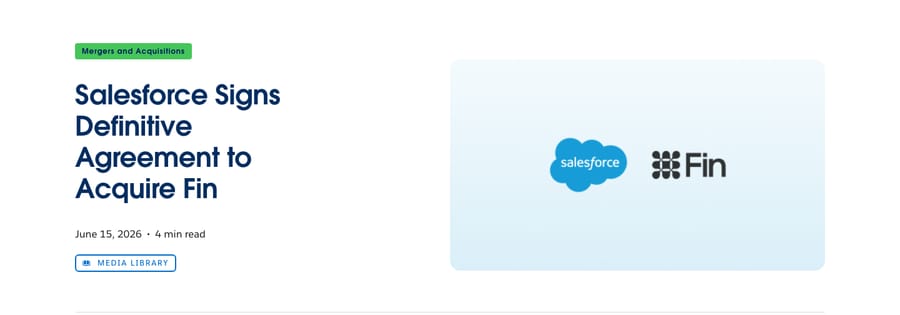
| June 15, 2026 | Salesforce signs a definitive agreement to buy Fin for about $3.6 billion | Salesforce press release |
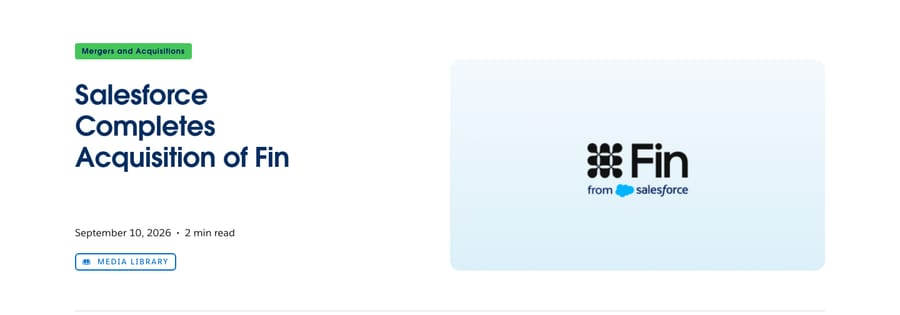
| September 10, 2026 | Salesforce completes the acquisition; Fin joins Salesforce's AI Labs | Salesforce press release |
| November 21, 2026 | Fin's pricing page carries a "Fin from Salesforce" logo; list prices unchanged since June | fin.ai/pricing and intercom.com/pricing |
The rename and the sale are two separate events a month apart. The May post says "The name Intercom will still live on as the name of our customer service software platform," and that Intercom 2, a rebuild of the platform, had just launched. So you still buy Intercom, the help desk, and Fin, the AI agent, from a company that's now called Fin and owned by Salesforce. Our What is Intercom explainer covers the product itself.
What did Salesforce say it will do with Fin?
Read the two releases for what they commit to and what they leave out.
What they say. The June release describes Fin's agent as running on its own model, Apex, across live chat, email, WhatsApp, SMS, phone and Slack, for more than 30,000 companies. It says Fin's "packaged offerings" would complement Agentforce's "customizable platform" with faster-to-deploy options, "well-suited for SMB and some commercial organizations," and that the combined offering spans quick-to-launch agents to enterprise transformations. The September release adds that Fin will become part of Salesforce's AI Labs and "will continue to serve its customers, advance its AI agent capabilities," and that Fin "works seamlessly with the help desks and systems companies already use." Marc Benioff's line was "The #1 customer agent meets the #1 CRM."
What they don't say. Neither release mentions prices, existing contracts, renewal terms, or whether Fin stays available without Salesforce products over time. The September release doesn't repeat the purchase price.
Salesforce's incentive follows from what it sells. It sells Agentforce, and the June release frames Fin as the fast, packaged option beside it, aimed at smaller customers. An acquirer that positions a product as the entry point to a bigger platform has a reason to keep it easy to buy, and also a reason, over time, to make the bigger platform the natural next step. Neither of those shows up in the price list yet. Both are reasons to keep your contract short and portable.
Has Intercom or Fin pricing changed since the deal?
Not on the list prices. We compared the Wayback Machine's copy of intercom.com/pricing from June 2, 2026, two weeks before the agreement, with the live page on November 21:
| Item | June 2, 2026 (Wayback) | November 21, 2026 (live) |
|---|---|---|
| Essential seat, billed annually | $29 a month | $29 a month, shown beside $19 "New customers save 35%" |
| Advanced seat, billed annually | $85 a month | $85 a month |
| Expert seat, billed annually | $132 a month | $132 a month |
| Fin AI Agent | From $0.99 per outcome | From $0.99 per outcome |
| What counts as an outcome | Resolution confirmed, no further help asked, or a Procedure completed incl. handoffs | Same wording |
| Contracts | Optional; required for Enterprise, Premier Support and custom terms | Same wording |
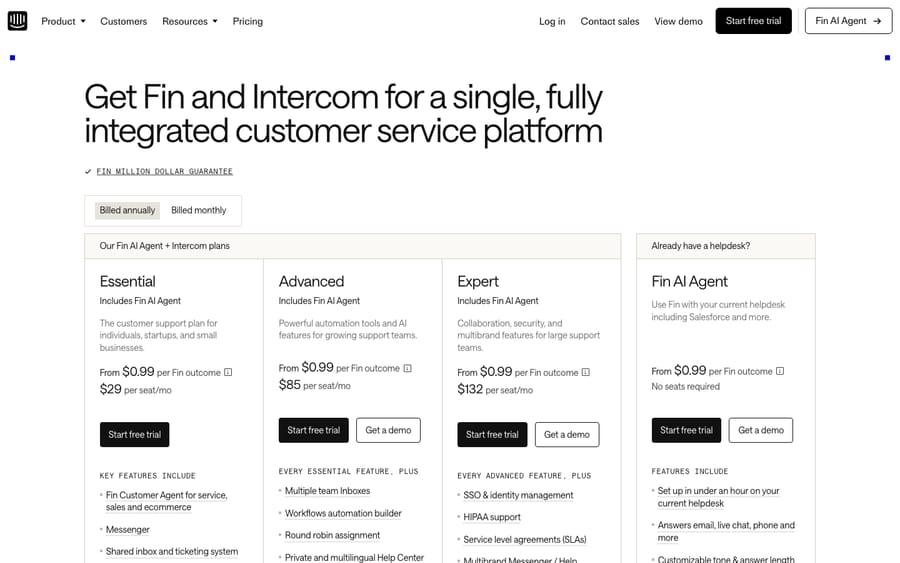
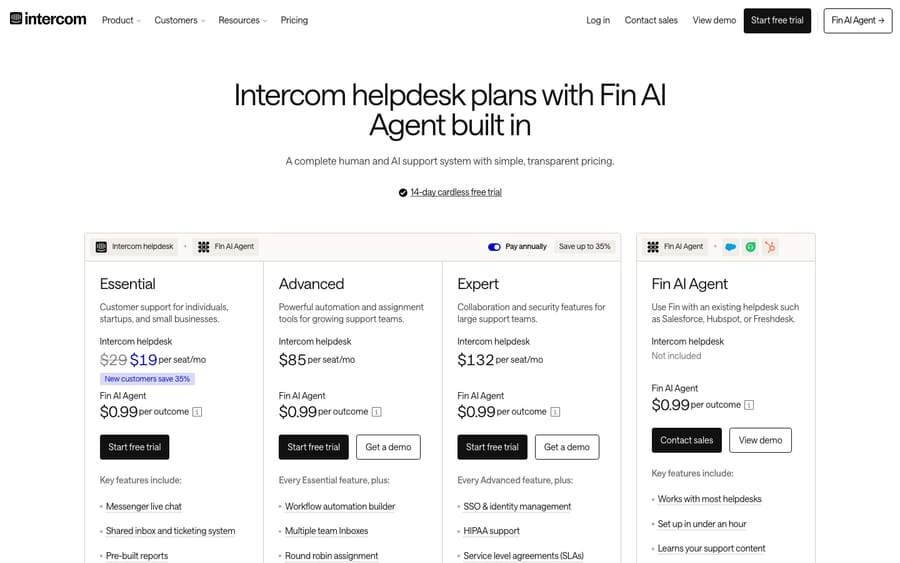
Two details matter at renewal. The $19 Essential price is labeled for new customers, so it's a discount you'd have to ask for, not one you'll get by default. And Fin's own pricing page now lists Fin on Intercom at "$19 per seat/mo" for the help desk, while intercom.com shows $29 billed annually; read the plan and billing period on any quote line by line. The rest of the add-ons on intercom.com: Copilot at $29 per agent a month billed annually or $35 monthly, the Pro add-on from $100 a month with 6,000 credits, and Proactive Support Plus at $99 a month. Our Intercom pricing explainer and Fin pricing breakdown go through each one.
What should you ask before you renew Intercom?
Intercom's FAQ says "Downgrades typically take effect at renewal" and that contracts are optional on Essential and Advanced. So the renewal is both your best moment to change what you pay for and the moment you can lock in terms. These are the questions we'd put in writing:
- Price protection. Is the per-seat price and the $0.99 outcome rate fixed for the full term? What notice do you get before a change at the next renewal?
- The outcome definition. Today an outcome includes a customer who simply doesn't ask for more help after Fin replies, and a Procedure that ends in a handoff. Ask for that definition in the contract, so a change to what counts doesn't change your bill mid-term.
- Minimums. Fin on another help desk carries a minimum monthly commitment ("e.g. 50 outcomes") per the FAQ. Ask whether any minimum applies on your plan, and whether it changes with a multi-year term.
- Product continuity. The releases say Fin "will continue to serve its customers" but don't say for how long or in what packaging. Ask what happens to your contract if Fin is repackaged into, or bundled with, Agentforce.
- Data and subprocessors. Your conversations now sit with a Salesforce company. Ask for the current data processing terms and subprocessor list, and how you'll be notified of changes.
- Exit terms. Confirm the notice period and how you export conversations, contacts and articles. Our guide to exporting Intercom conversations lists the six methods and what each misses.
- Seat count. If AI now handles a share of your volume, cut seats at renewal, because Intercom says downgrades take effect then.
Which Intercom customers does the deal affect most?
Not every account carries the same exposure. Four situations are worth sorting yourself into before the renewal call:
| Your situation | What the deal changes for you | What to do at renewal |
|---|---|---|
| Small team on Essential or Advanced, monthly billing | Little so far; list prices are unchanged and monthly self-serve billing keeps your commitment short | Stay monthly, and ask for the new-customer seat price |
| Annual contract with a large Fin outcome volume | Your bill depends on the outcome definition and rate, which the releases don't address | Lock the $0.99 rate and the outcome definition for the term |
| Already on Salesforce Service Cloud or Sales Cloud | You may be offered Fin and Agentforce together | Compare the bundle against each product priced alone |
| Fin running on Zendesk, Freshdesk or another help desk | Fin's pricing page still sells this route, with a monthly minimum | Confirm the minimum and how long the route stays available |
A team that fits the first row has the least to negotiate and the most freedom; the deal mostly means watching the next price page. A team in the second row has the most money riding on wording, because outcome pricing makes the definition of an outcome the price. The third row is where a bundle can be good value or a way to move you onto a bigger contract, and the only way to tell is to ask for each line priced separately. If you're in the fourth row, you're using Fin as an agent on someone else's help desk, which matches the "rapid deployment on existing systems" the September release describes as one end of Salesforce's offering. That's a good sign for the route, but it isn't a written commitment, so ask for one.
How do you keep your AI portable through a renewal?
The cleanest hedge is to separate the help desk decision from the AI decision. If the agent answering your customers is Fin, your AI roadmap is Salesforce's roadmap. If it's an agent that sits on top of Intercom through its API, you can keep Intercom, change the agent, or later change the help desk, without rebuilding the other half.
That's the case for an agent layer, and it's also its cost: another vendor, another contract, another integration. Our Fin vs AI agent layer comparison works through that trade, and the Fin alternatives roundup lists the options. Threads in r/intercom this year show the bill, not the ownership, is what pushes most teams to look: one team said its Fin bill had roughly tripled in 14 months as volume tripled (thread), and a long-time customer complained that Intercom's own support had slipped (thread), with one reply pointing to the Salesforce purchase.
Where does Macha fit at an Intercom renewal?
Macha runs AI agents inside the help desk a team already uses, and Intercom is one of Zendesk, Freshdesk, Gorgias, Front, Gladly, Crisp, HubSpot or Intercom. It fits teams that want to keep Intercom as their inbox but don't want their AI tied to one vendor's roadmap. Macha connects to Intercom by sign-in and replies, adds internal notes, tags, assigns and closes conversations; if you ever move help desks, the agent, its knowledge base and its instructions carry over, with the Intercom tools swapped for the new desk's connector.
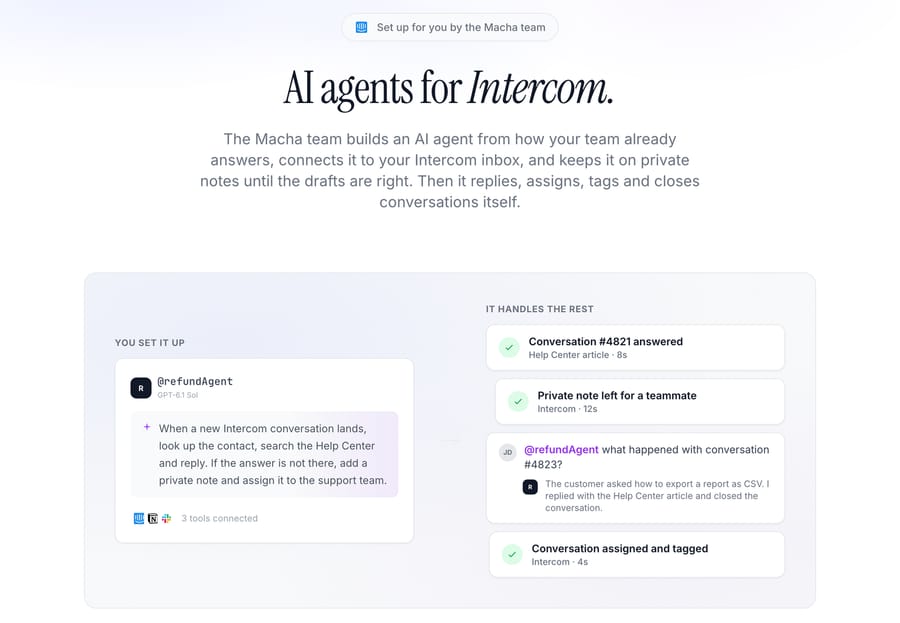
The Macha team does the setup: it analyzes about a month of your past conversations, builds the knowledge base and the agent, and runs it in safe mode with drafts as internal notes until you approve them. The price is about $0.40 per ticket, one charge per conversation however many messages it takes, from $299/month for 750 tickets, monthly with no annual contract, and it includes a dedicated success manager who handles your changes. A practical timing: start the trial ($50 of free usage (about 125 tickets), no credit card, no time limit) a month or two before your Intercom renewal on the categories Fin handles worst, so you renew knowing which seats and outcomes you still need. More on Macha on Intercom, the Intercom connector, the done-for-you setup and pricing, plus a direct comparison in Macha vs Intercom Fin.
Common questions
Who owns Intercom now?
Salesforce. The company renamed itself from Intercom to Fin on May 12, 2026, Salesforce agreed to buy it on June 15, 2026, and the acquisition completed on September 10, 2026. The help desk is still called Intercom.
Did Fin's price go up after the Salesforce acquisition?
Not on the list prices. Fin was $0.99 per outcome on Intercom's pricing page on June 2, 2026 and still was on November 21, 2026, and seat prices were unchanged. Individual contract renewals aren't public.
Will Fin become part of Agentforce?
Salesforce hasn't said so. The June release says Fin's offerings will complement Agentforce, and the September release says Fin becomes part of Salesforce's AI Labs and will keep serving its customers. Neither describes merging the products.
Can I still use Fin without Salesforce products?
Yes, today. Fin sells on Intercom and on other help desks; its pricing page lists Freshdesk, Salesforce and Zendesk among the help desks it works with.
What is Intercom 2?
Intercom 2 is a complete rebuild of the Intercom platform. Fin's May 12, 2026 rename post said it had just launched and that the company was increasing its investment in it. It's the help desk side of the business, sold alongside Fin, and the post that announced the rebuild came a month before the Salesforce agreement. If your renewal quote moves you onto it, ask what changes in your workflows and reports before you sign.
Should I sign a multi-year Intercom contract in 2026?
Only with written price protection and a clear outcome definition. Intercom's Essential and Advanced plans are available monthly or annually without a contract, so a shorter term keeps your options open while the owner's plans for Fin are still unannounced.
How we researched this
Every acquisition fact comes from Salesforce's two press releases (June 15 and September 10, 2026) and Fin's rename post of May 12, 2026, all read on November 21, 2026. Current prices come from intercom.com/pricing and fin.ai/pricing on November 21, and the earlier prices from the Wayback Machine copy of intercom.com/pricing captured June 2, 2026; we checked both pages ourselves and compared them line by line. We didn't speak to Salesforce or Fin sales staff, and renewal terms for individual contracts aren't public, so the checklist is a set of questions, not a description of what you'll be offered. Reddit threads were read through the arctic-shift archive and paraphrased without usernames. We make Macha, which competes with Fin.
If your Intercom renewal is coming up, start a trial on the categories Fin handles worst first, so you go into the renewal with your own numbers.