







 Shopify
 Stripe
 Slack
 Notion
 Google Workspace
 Confluence


Best Gladly Integrations (2026): 23 Apps Scored on What Your Team and Gladly AI Can Do With Them


The best Gladly integrations are Shopify, Skio and Smile.io, which score 10 out of 10 on our rubric: Gladly builds them, agents can take real actions from the conversation, and Gladly AI can take those actions too under rules you set. The three tie on every tie-break, so they're listed alphabetically. Loop Returns, Corso, Klaviyo and Recharge follow at 9. Gladly's public directory lists 62 apps, but its help center documents about 30 newer "App Platform" apps, and several strong ones (Zuora, Chargebee, Redo, Yotpo) appear only in the docs. We read Gladly's own documentation for 23 integrations on November 21, 2026 and scored each on five criteria.
Key takeaways
- Shopify, Skio and Smile.io score 10 out of 10 because Gladly builds them and Gladly AI can act in them, such as Shopify refunds and Skio subscription changes, under rules an admin controls.
- Gladly's integrations directory lists 62 apps, 48 with a full detail page and 14 as listing cards only, checked on November 21, 2026.
- Gladly's help center documents 30 App Platform apps, and some of them, including Zuora, Chargebee, Redo and Yotpo, aren't in the public directory.
- Gladly offers two Loop apps: Loop Returns, built by Gladly, lets Gladly AI generate return links, while Loop Order Tracking is built by Loop.
- Installing the AfterShip app doesn't add its nine agent actions until each form is registered in Org Manager, per Gladly's own setup doc.

Which Gladly integrations score highest?
| # | Integration | Category | Builder (per Gladly's docs) | What agents can do in the conversation | Gladly AI access | Score /10 |
|---|---|---|---|---|---|---|
| 1 | Shopify | Ecommerce | Gladly | Refund, cancel, discount | Actions, gated by Guides | 10 |
| 2 | Skio | Subscriptions | Gladly | 12 forms | 28 actions | 10 |
| 3 | Smile.io | Loyalty | Gladly | Adjust points, buy a reward | Actions when enabled | 10 |
| 4 | Loop Returns | Returns | Gladly | View returns | Return links, return exceptions | 9 |
| 5 | Corso | Shipping protection | Corso | File a shipping claim | Claim action + 5 lookups | 9 |
| 6 | Klaviyo | Marketing | Gladly | Unsubscribe from email | Data in Guides | 9 |
| 7 | Recharge | Subscriptions | Gladly | Skip, swap, delay, cancel, refund and more | Data in Guides | 9 |
| 8 | AfterShip | Returns and tracking | Not stated | 9 forms (returns, claims, labels) | Lookups + return-portal links | 8 |
| 9 | Redo | Returns | Not stated | 5 actions | Data + actions | 7 |
| 10 | Yotpo | Reviews and loyalty | Not stated | Adjust points, reply to review, record action | 3 actions | 7 |
| 11 | Zuora | Subscription billing | Not stated | 5 actions (cancel, skip, credit, refund) | Actions, confirmation enforced | 7 |
| 12 | Okendo | Reviews and loyalty | Not stated | Reply to a review | Data in Guides | 7 |
| 13 | Qualtrics | CSAT and surveys | Gladly | Survey responses on the timeline | None | 7 |
| 14 | ShipStation | Shipping | Not stated | Read-only lookups | 3 lookups | 6 |
| 15 | Delighted | CSAT and surveys | Delighted | Survey responses on the timeline | None | 6 |
| 16 | Simplesat | CSAT and surveys | Simplesat | Survey results (per Simplesat's docs) | None | 6 |
| 17 | AWS EventBridge | Event streaming | Not stated | None (events leave Gladly) | None | 5 |
| 18 | Fivetran | Data warehouse | Fivetran | None (data leaves Gladly) | None | 5 |
| 19 | MaestroQA | QA | MaestroQA | None (read-only pull) | None | 5 |
| 20 | Attentive | SMS marketing | Attentive | Replies arrive as Gladly Tasks | None | 5 |
| 21 | Chargebee | Subscription billing | Not stated | Payment link, retention offer, cancel | Not stated | 5 |
| 22 | HubSpot | CRM | Not stated | Read-only cards | Not stated | 4 |
| 23 | Assembled | Workforce management | No Gladly doc found | None in Gladly | None | 2 |
Ties are broken by Gladly AI access, then directory listing, then the builder score, then alphabetically. We credit a builder when any Gladly toolkit or app page names one. Facts come from Gladly's help docs, read November 21, 2026; each entry below links its doc.
How did we pick and score them?
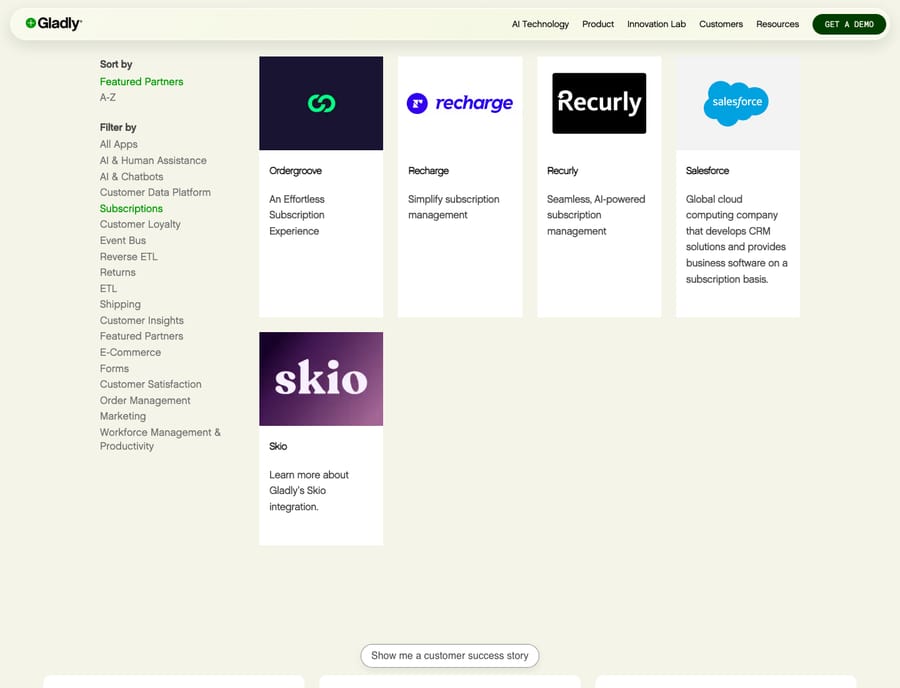
We read the page data behind Gladly's integrations directory and counted 62 apps: 48 with a full detail page and 14 listing cards only (Aircall, Amazon Connect, Slack, Salesforce and Jira among them). Then we read Gladly's documentation index, which lists 30 "App Platform" overview pages. App Platform is Gladly's newer way of building integrations, with a card on the Customer Profile, actions in the compose menu and, often, actions Gladly AI can call. Several App Platform apps aren't in the public directory, so a team that only browses the directory misses them.
Gladly's incentive explains the shape of the newer apps. Gladly bills its AI per outcome, $1.50 per AI Resolution on its Shopify App Store listing, so every action Gladly AI can complete inside a conversation is another resolution it can bill without a person. That's why so many App Platform apps expose actions to the AI, not just to agents.
We picked 23 integrations that cover the contact reasons consumer brands handle most (orders, subscriptions, returns, loyalty, marketing consent), plus the CSAT, QA, workforce and data tools a Gladly admin gets asked about. Each scores 0, 1 or 2 on five criteria.
| Criterion | 2 points | 1 point | 0 points |
|---|---|---|---|
| Builder documented | Gladly's docs say Gladly builds and maintains it | Gladly's docs name the partner as builder, or don't say | No Gladly doc |
| What agents can do in the conversation | Write actions (refund, cancel, update) | Read-only cards, lookups or posted responses | Nothing inside Gladly |
| Gladly AI access | Gladly AI can call actions | Gladly AI can read the data in Guides | Not documented |
| Gladly documentation | Setup page plus an overview or toolkit | One page | None |
| Directory listing | Full detail page | Listing card only | Help docs only |
The scores reward what a team can do from inside a Gladly conversation, because that's where an integration saves handle time. They don't measure the partner's product. Gladly hosts example source code for several App Platform apps, including Loop's own order-tracking app, in a public GitHub repository, so we didn't treat hosting as proof of who built an app.
Which ecommerce and subscription apps matter most?
1. Shopify, 10/10
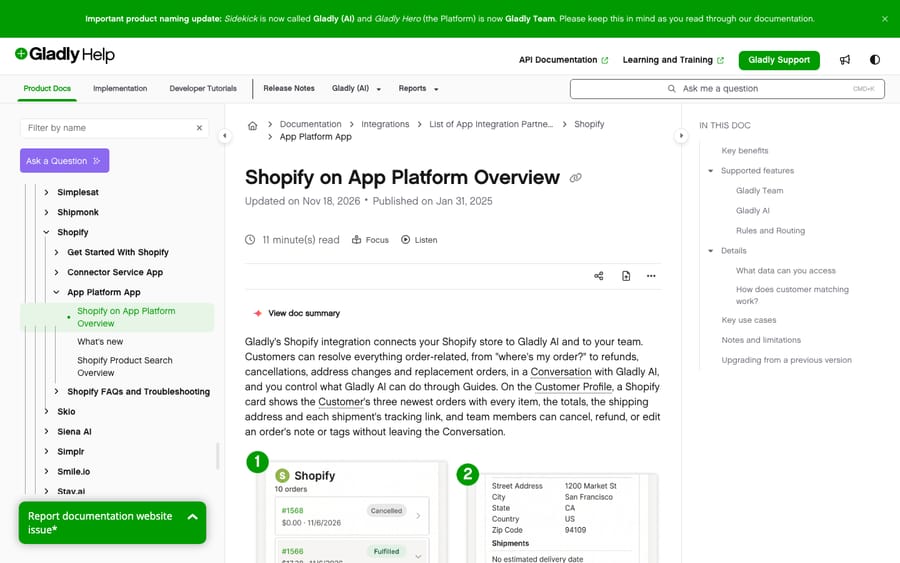
Shopify's is the deepest integration we read. Gladly's Shopify integration toolkit says it's built and maintained by Gladly, links Customer Profiles to Shopify customers by email, and lets agents cancel or refund orders and create discounts without leaving Gladly. The App Platform version, updated on November 18, 2026, connects Shopify to Gladly AI too: customers can resolve tracking, cancellations, refunds, address changes and replacement orders in a conversation, and Guides decide exactly which actions the AI may take. Gladly says refund amounts are previewed and confirmed with the customer before they're issued.
BigCommerce and Magento also have Gladly-built integrations and full directory pages; Spree's is built by a partner called Upside. Macha's own Shopify connector is separate from Gladly's and is covered in the AI section below. For the order-status workflow end to end, see how to automate order status in Gladly.
2. Skio, 10/10
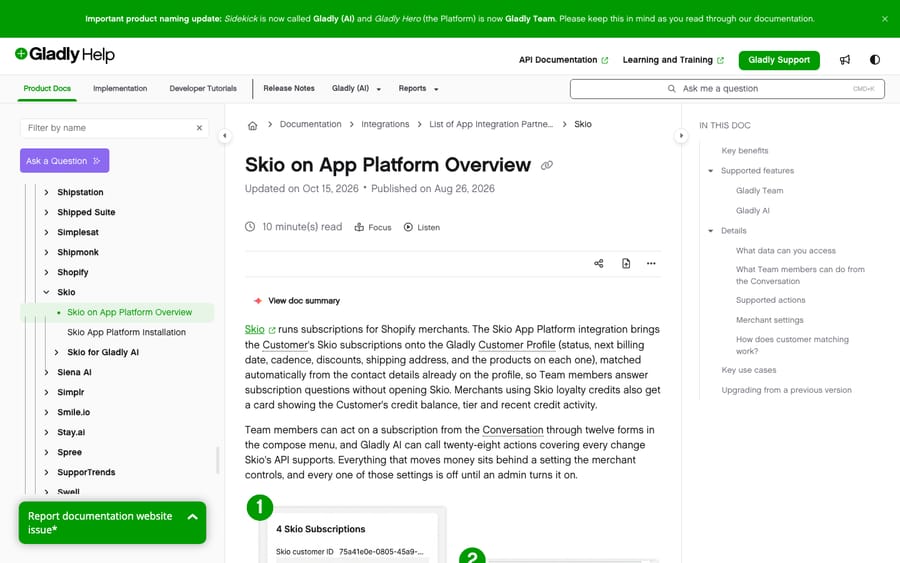
Skio's App Platform doc is the most thorough subscription integration we read. The Skio card shows each subscription's status, next billing date, cadence, discounts, shipping address and products, plus loyalty credits if you use them. Team members get twelve forms in the compose menu, and Gladly AI can call twenty-eight actions "covering every change Skio's API supports." Every action that moves money sits behind a setting that's off until an admin turns it on. Gladly's Skio toolkit says Gladly builds and maintains it.
If you run Loop Subscriptions instead, Gladly documents an App Platform app for it too, updated November 18, 2026, with 25 change actions and 11 lookups available to Gladly AI. We didn't score it here.
7. Recharge, 9/10
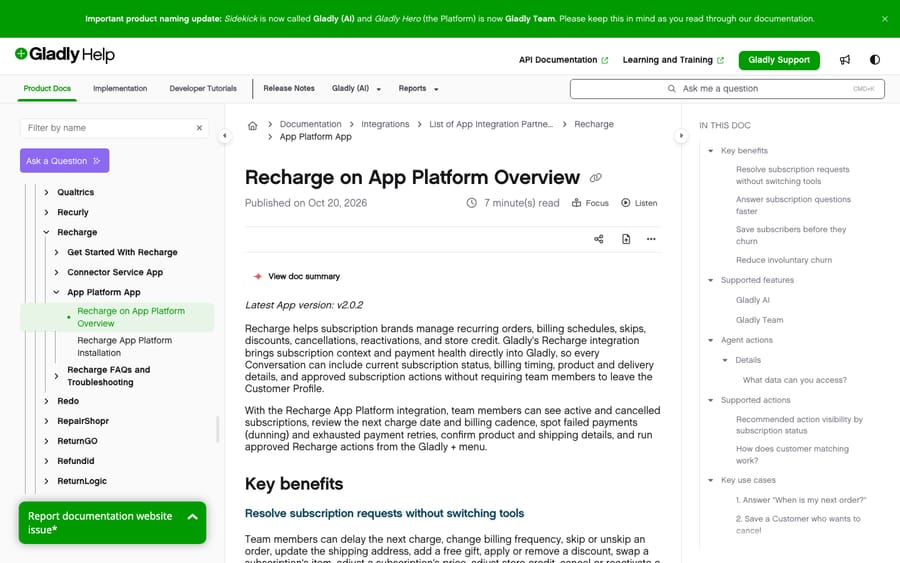
Recharge has two Gladly integrations. The original, which Gladly's Recharge toolkit says is built and maintained by Gladly, pulls subscription details onto a Subscription Transaction Card. The App Platform version adds actions: delay the next charge, change frequency, skip or unskip, update the address, add a free gift, apply or remove a discount, swap an item, adjust price or store credit, cancel or reactivate, and refund a charge. It also shows failed payments, so an agent sees dunning before the customer mentions it. Recharge data is available to Gladly AI in Guides for questions like "When is my next order?", but the doc doesn't list Recharge actions for the AI.
Ordergroove and Recurly have full directory pages too. Zuora and Chargebee are under billing, below.
Which returns, shipping and loyalty apps are worth adding?
3. Smile.io, 10/10
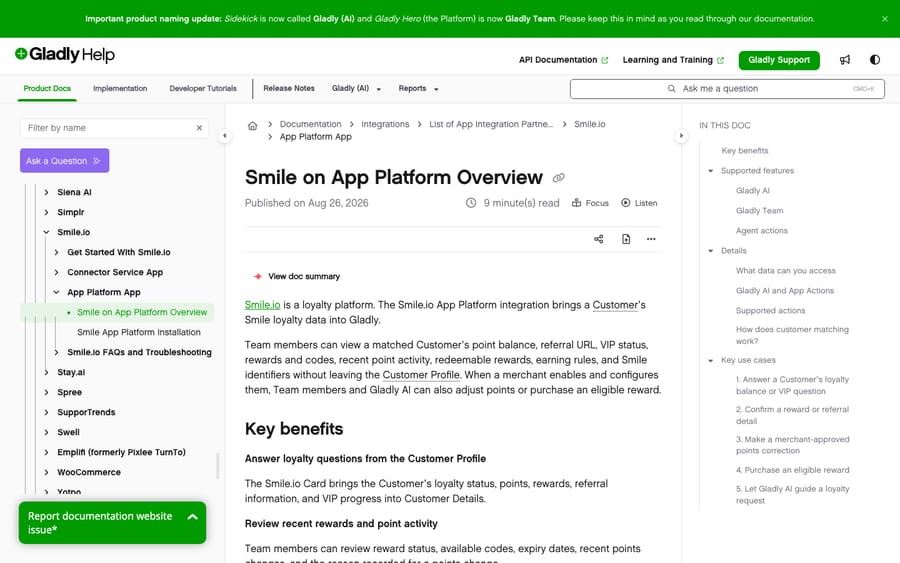
The Smile.io app shows points balance, referral URL, VIP status, rewards and codes, recent point activity and earning rules. When a merchant enables it, team members can adjust points or buy an eligible reward. Gladly AI gets the same two actions only after an admin wraps each one in a custom Gladly App Action and adds it to a Guide; "the Smile app does not install a preconfigured App Action or Guide." Seven read-only Data Pulls reach Gladly AI without that step. Gladly's Smile toolkit says Gladly builds and maintains the integration.
4. Loop Returns, 9/10
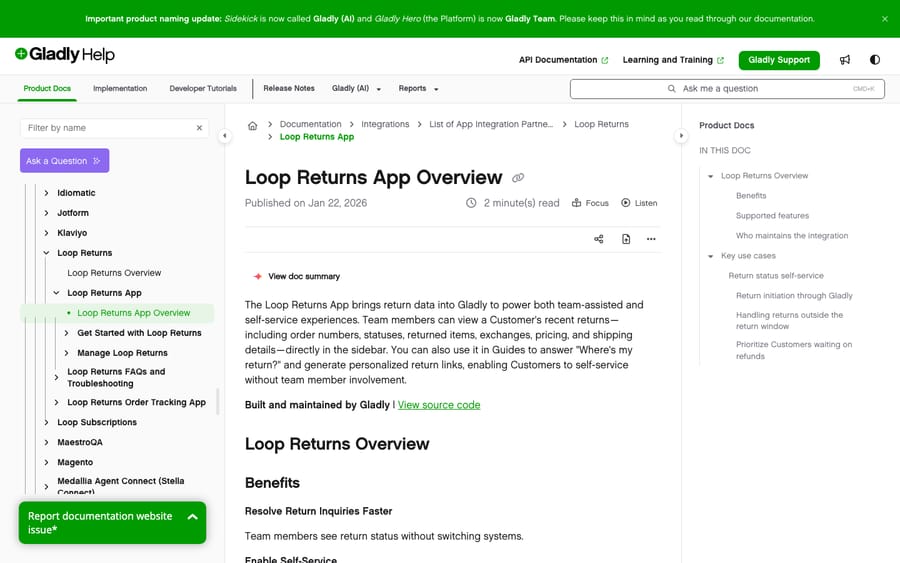
Gladly offers two Loop apps, and they aren't built by the same company. The Loop Returns App, updated January 22, 2026, is "Built and maintained by Gladly." Team members can view a customer's recent returns, and Gladly AI, through Guides, can generate return links and grant return exceptions; Rules can route on return attributes. The Loop Order Tracking app is "Built and maintained by Loop" and adds tracking data without actions. Install both if your team handles return and delivery questions.
5. Corso, 9/10
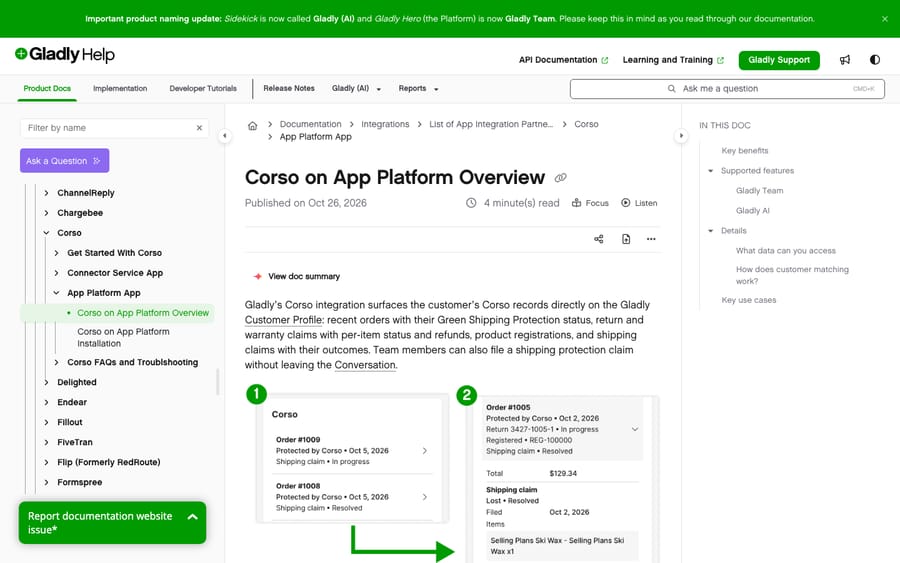
Corso sells shipping protection and handles returns and warranty claims, and its Gladly integration is built and maintained by Corso, per Gladly's Corso toolkit. Its Gladly card shows recent orders with protection status, claims, product registrations and shipping claims. Agents can file a shipping protection claim from the conversation, and Gladly AI gets that claim action plus five lookups (order, claim, registration, an order's shipping claims, carrier tracking), each limited to records under the customer's email.
8. AfterShip, 8/10
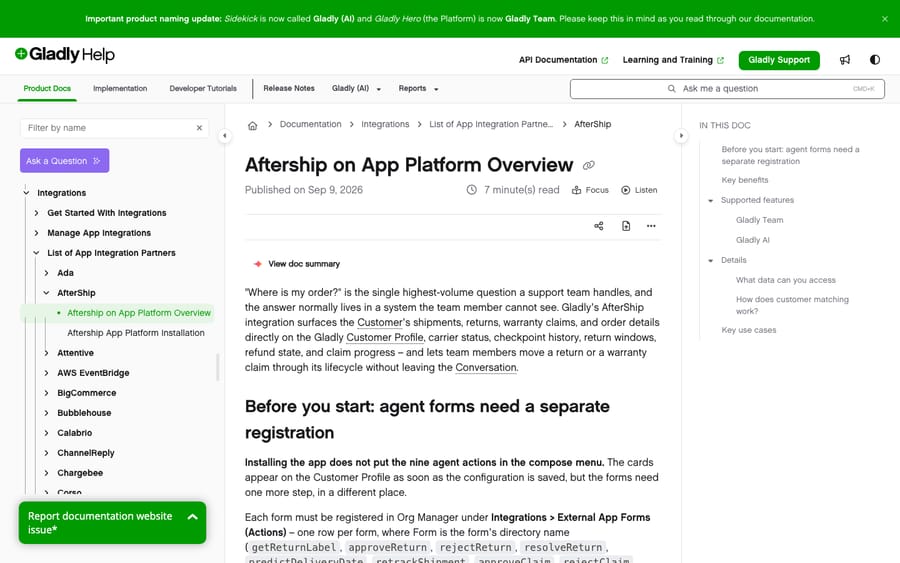
AfterShip's App Platform app surfaces shipments, returns, warranty claims and order details on the profile, with nine agent forms: get a return label, approve, reject or resolve a return, predict a delivery date, retrack a shipment, approve or reject a claim, and check which claim resolutions the merchant's rules allow. Gladly's doc carries two warnings. Installing the app doesn't put the forms in the compose menu: each must be registered in Org Manager, and "publishing there replaces the whole list," so add rows rather than overwrite them. And return rejection, claim rejection and claim processing are off by default and enforced in the action itself, "so an AI or Workflow caller cannot walk past them." AfterShip is a listing card in the directory.
9. Redo, 7/10, and 14. ShipStation, 6/10
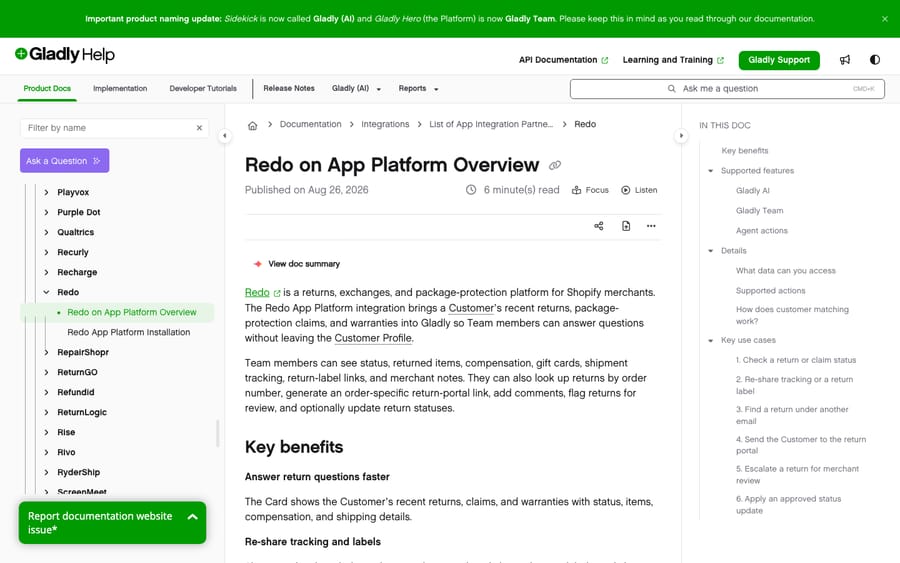
Redo's App Platform app shows returns, package-protection claims and warranties, with five actions (look up a return, generate a return-portal link, comment, flag for review, and optionally update status). Gladly's doc says actions available to team members are also available to the AI, under the same configuration gates. Redo isn't in the public directory.
ShipStation's app is read-only by design: it "never changes an order, a label or a shipment," and answers "where is my order?" with order, label and fulfillment lookups. Gladly's doc says "all three lookups are available to Gladly AI, Team Assist and workflows," which is what lifts it to 6. Narvar, Shipped Suite, ReturnLogic and ShipHero are also in the directory.
10. Yotpo and 12. Okendo, 7/10 each
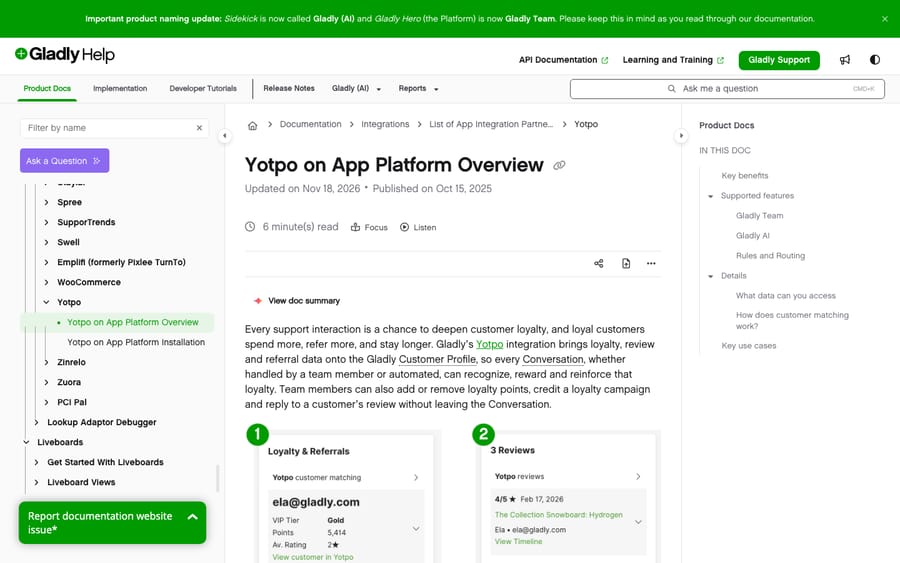
Yotpo's App Platform app gives three forms (adjust points, record a campaign action, reply to a review), and Gladly's doc says the same three can be added to Gladly AI and Workflows, "held to the same confirmation and limits as the forms." It isn't in the public directory. Okendo shows reviews with photos, points, enrollment and VIP tier, lets an agent post a public or private reply to a review, and shares loyalty details with Gladly AI in Guides. Zinrelo and Emplifi are also listed.
How do marketing, billing and CSAT tools connect?
6. Klaviyo, 9/10
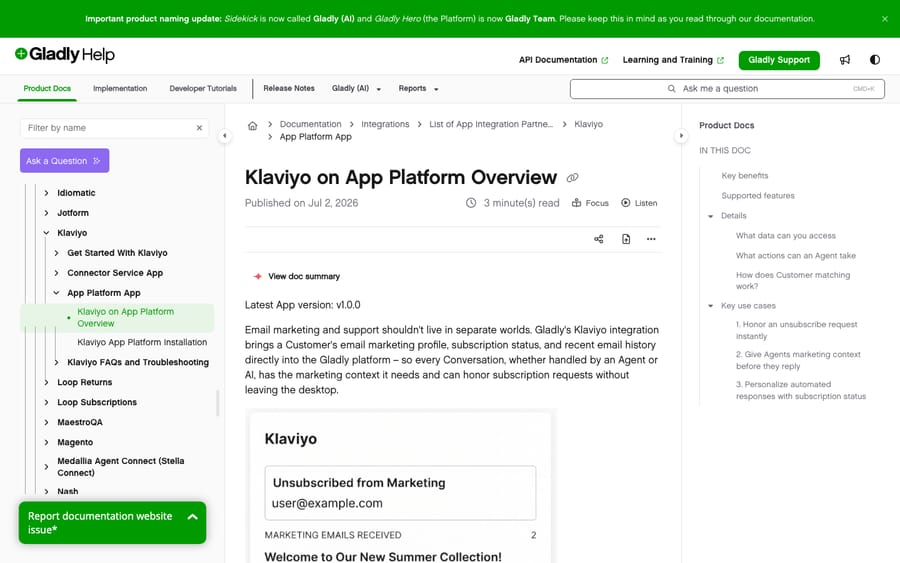
Klaviyo shows why the App Platform matters. The original integration, which the Klaviyo toolkit says Gladly built and maintains, only sends "started" and "closed" conversation events to Klaviyo so it can pause marketing emails while a conversation is open; Klaviyo sends nothing back. The App Platform version brings the customer's consent status and recent email history into Gladly and lets an agent unsubscribe the customer on the spot. Gladly AI can read Klaviyo data in Guides.
11. Zuora, 7/10, and 21. Chargebee, 5/10
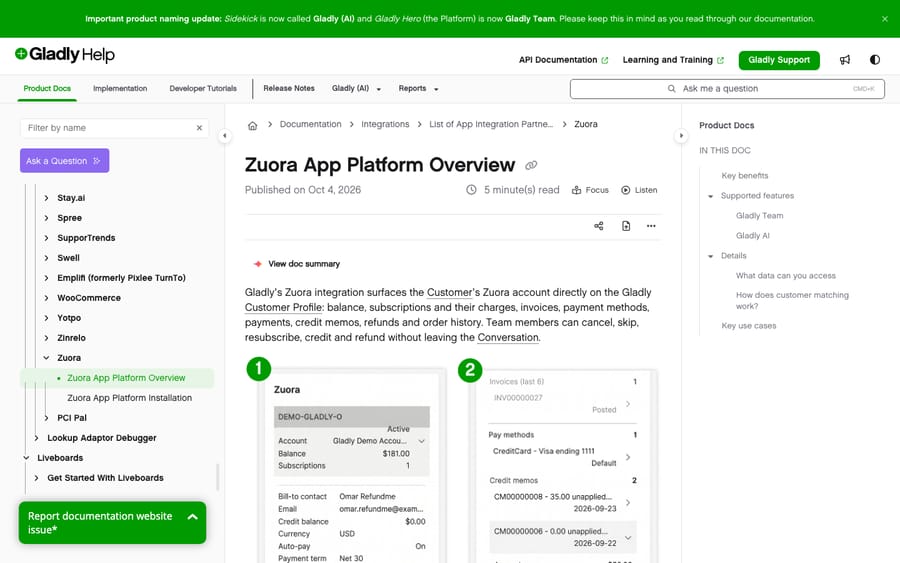
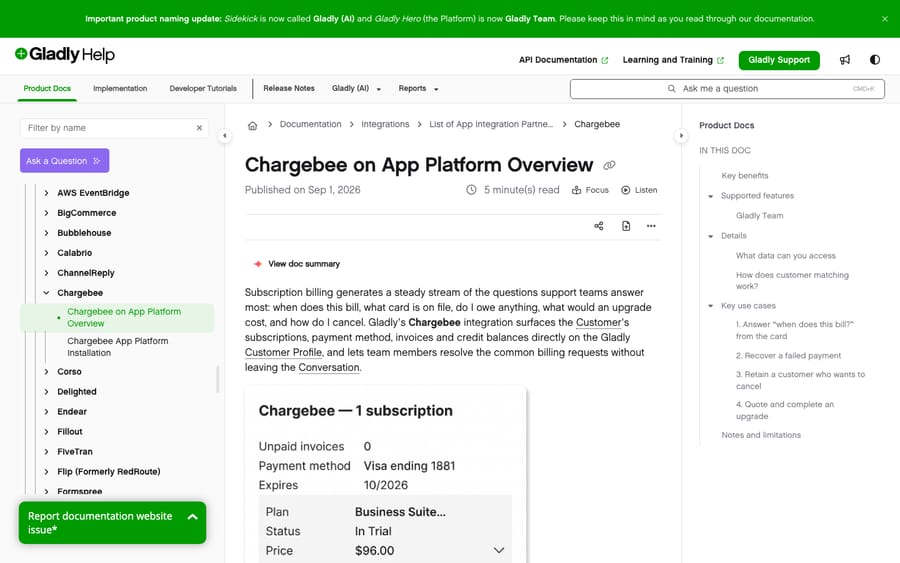
Zuora's app shows balance, subscriptions, invoices, payment methods, credit memos and refunds, with five actions: cancel, skip, resubscribe, credit and refund. Each needs an explicit confirmation and a comment, enforced in the action "so Gladly AI or a Workflow cannot skip it either," and refunds have a per-request cap. Chargebee's app can send a payment-update link or a retention offer, preview an upgrade, update addresses and cancel; no action charges a card, and the doc doesn't mention Gladly AI. Neither is in the public directory.
13. Qualtrics, 15. Delighted and 16. Simplesat
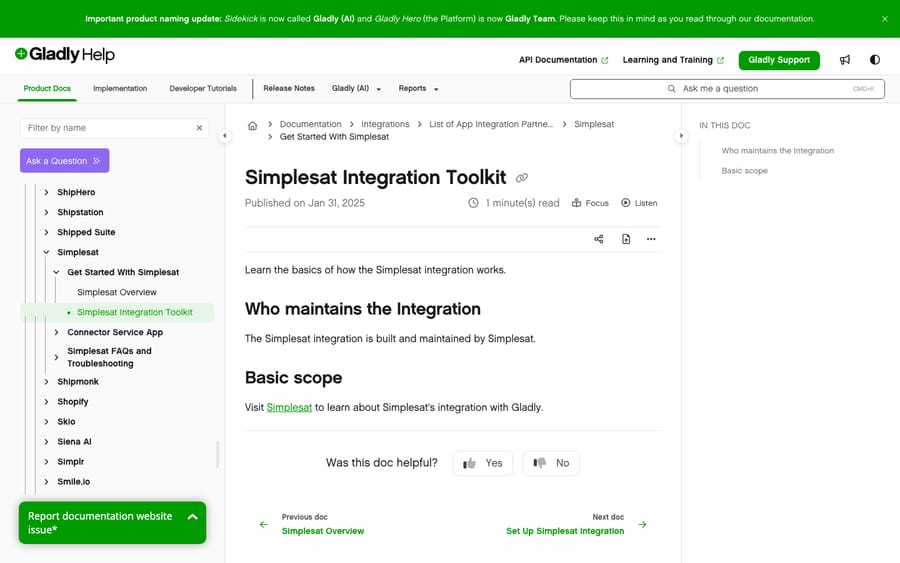
All three put survey results into Gladly. Gladly builds the Qualtrics integration (7/10): Gladly sends a conversation-closed event, and Qualtrics sends the survey response back to the conversation timeline. Delighted (6/10) is built by Delighted and posts scores and comments to the timeline, optionally as Tasks for follow-up. Simplesat (6/10) is built by Simplesat; Gladly's page names the builder and links to Simplesat's own setup guide. Medallia and Medallia Agent Connect are also in the directory.
20. Attentive, 5/10
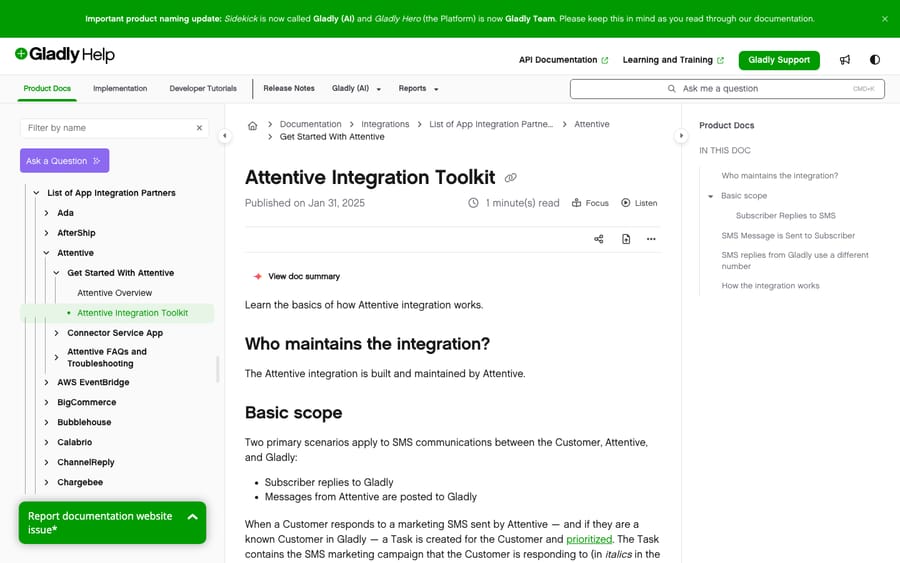
Attentive's integration is built and maintained by Attentive, per its toolkit. When a known customer replies to a marketing SMS, Gladly creates a Task containing the campaign message and the reply. Gladly tells you to configure it with your Attentive CSM or Attentive's White Glove team.
22. HubSpot, 4/10
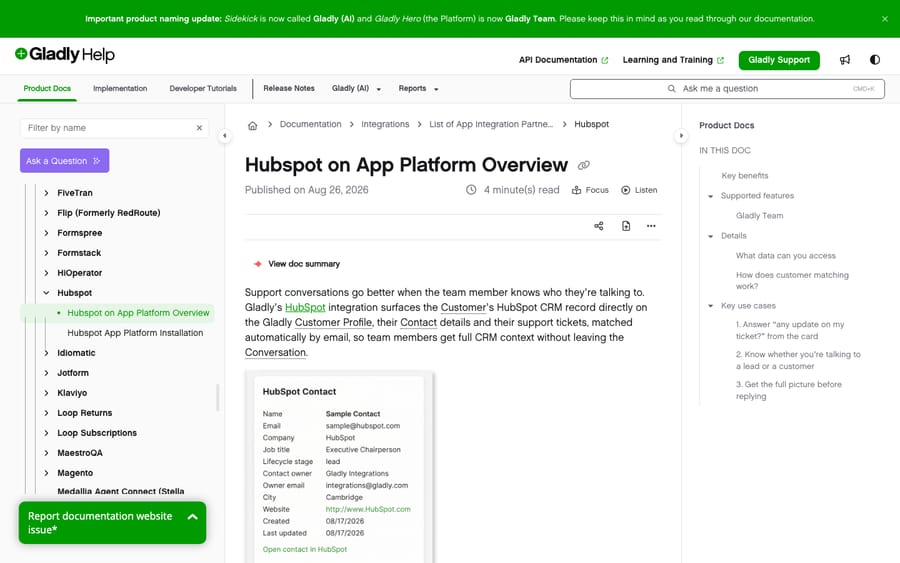
HubSpot's App Platform app shows the CRM contact (lifecycle stage, lead status, owner) and recent HubSpot tickets, matched by email. It's read-only. Salesforce appears in the directory as a listing card.
17, 18, 19 and 23. Data and operations tools
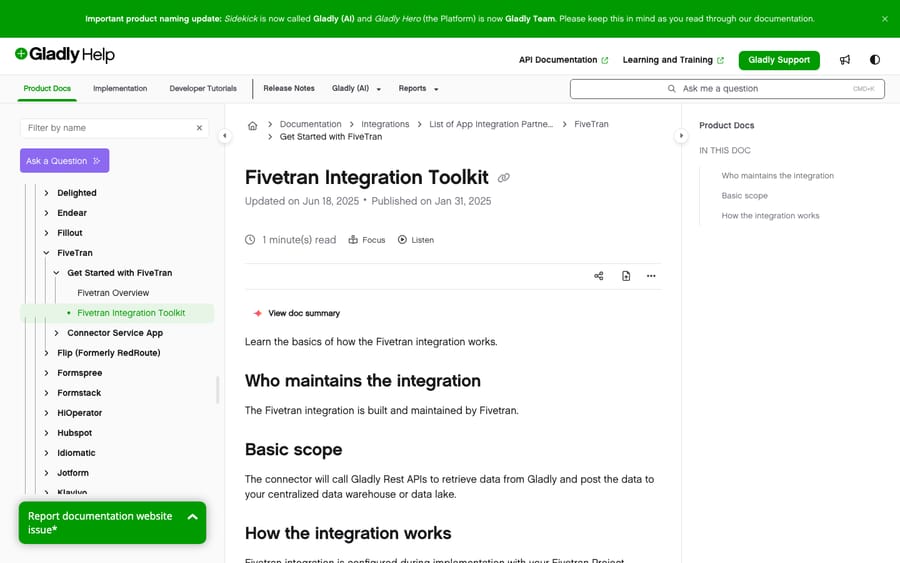
- Fivetran (5/10): built by Fivetran per its toolkit; it copies Gladly data to your warehouse through Gladly's REST APIs and is configured with Fivetran's project manager. HighTouch does the reverse, syncing warehouse data into Gladly, and Segment sends customer data in.
- AWS EventBridge (5/10): added from Gladly's Apps page per the setup doc; it streams Gladly events to AWS for your engineers.
- MaestroQA (5/10): built by MaestroQA and read-only per its toolkit. It pulls conversations, agents, Topics and reports so graders can score conversations; nothing flows back into Gladly.
- Assembled (2/10): workforce management, featured in the directory, but we found no Assembled page in Gladly's help center. Playvox and Calabrio are the other WFM options; Calabrio's integration is built by Calabrio.
Phone systems sit outside this scoring: Gladly has its own voice channel, and Aircall, Amazon Connect and Flip appear in the directory (Aircall and Amazon Connect as listing cards).
Which AI tools can act inside Gladly?
Every integration above makes Gladly or its AI better informed. A separate group of products answers customers. Gladly's directory filter "AI & Chatbots" shows Ada, Amazon Connect, Flip, KODIF.ai, Netomi and Siena. We ranked those and the AI agents outside the directory in our guide to the best AI agents for Gladly.
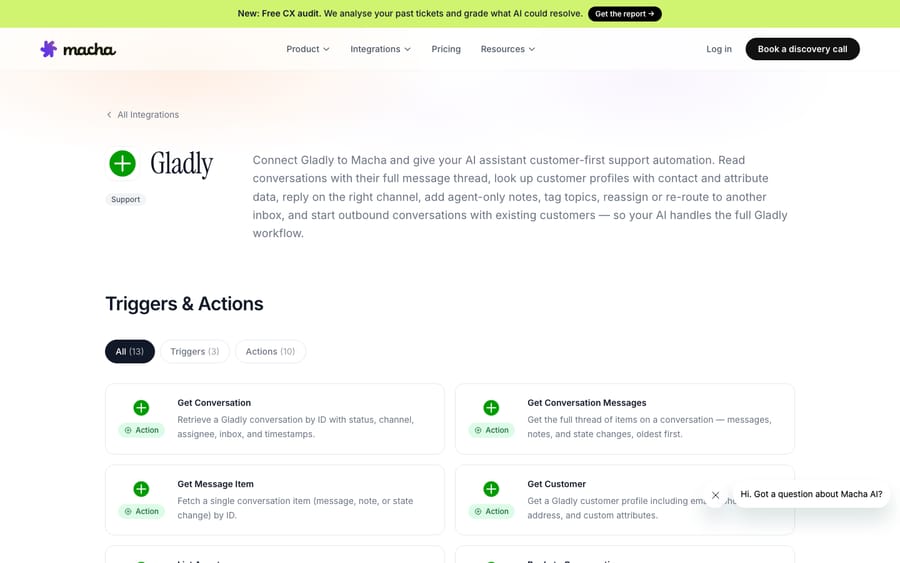
Macha is the done-for-you option, though it isn't listed in Gladly's directory. It connects with a Gladly API token and works in your Inboxes: its Gladly integration lists 10 actions, so an agent reads conversations, messages and customer profiles, replies on the customer's channel, writes internal notes, adds Topics, reassigns or changes status, and sends outbound messages. Agents start on a new conversation or a new customer message. Through Macha's own connectors it also looks up Shopify orders and Stripe payments, so it can answer "where's my order?" with a real tracking number (order status use case), triage a refund request before a person sees it (returns use case) or route a conversation to the right Inbox (routing use case).
The Macha team analyzes your past conversations, builds the agent, tests it, and runs it in safe mode with internal-note drafts until they're right, at about $0.40 per ticket with a dedicated success manager on the trial and every plan (pricing). Macha fits teams already on Gladly who want the AI work done for them rather than another app to configure. Details are on the Gladly product page.
In what order should you add Gladly integrations?
- Your store platform (Shopify, BigCommerce or Magento). Order context answers the largest share of consumer contacts, and Gladly AI can't track or cancel an order without it.
- Subscriptions, if you sell them (Skio, Recharge, Ordergroove, Zuora or Chargebee). Subscription changes are where write actions save the most time.
- Returns and shipping (Loop, Redo, AfterShip, Corso). Pick the one you already run; don't buy a returns tool for its Gladly integration.
- Marketing consent (Klaviyo App Platform). It's quick, and unsubscribing from the conversation ends a common complaint loop.
- Loyalty, reviews and CSAT (Smile.io, Yotpo, Okendo, Qualtrics) once the basics are live.
- QA, WFM and data (MaestroQA, Assembled, Playvox, Fivetran) when volume justifies them.
Before you switch on any action for Gladly AI, read its gates. The App Platform apps we read share a pattern: money-moving actions are off until an admin enables them, and the limits apply to people, Workflows and AI alike. Turn them on one at a time and read a week of conversations. Our Gladly AI explainer covers how Guides control those actions.
Common questions
How many integrations does Gladly have?
Gladly's public directory listed 62 apps on November 21, 2026: 48 with a full page and 14 listing cards. Its help center documents 30 App Platform apps, some of which (Zuora, Chargebee, Redo, Yotpo, HubSpot) aren't in the directory, so the real number of supported integrations is higher than 62.
What is the Gladly App Platform?
It's Gladly's framework for integrations that show a card on the Customer Profile and add actions to the conversation's compose menu. Gladly's docs describe App Platform versions of Shopify, Recharge, Klaviyo, Loop, Skio, Smile.io, AfterShip and others, and many of them expose actions to Gladly AI and Workflows. Partners can build them too: Loop builds its own order-tracking app.
Can Gladly AI take actions in other apps?
Yes, where the integration exposes them. Gladly's docs say Gladly AI can call Shopify actions governed by Guides, 28 Skio actions, Corso's claim action and lookups, Smile.io point adjustments when enabled, Loop return links and exceptions, ShipStation's three lookups, Yotpo's three actions, and Redo and Zuora actions under the same gates as team members, and AfterShip's lookups and return-portal links. Recharge, Klaviyo and Okendo share data with Guides but don't list AI actions.
Does Gladly integrate with Zapier?
We found no Gladly app in Zapier's directory on November 21, 2026 (the Gladly URL returned 404). For custom connections Gladly offers its REST API, webhooks and Lookup Adaptors (our Gladly API guide covers all three), and Celigo lists a Gladly connector.
Can I build a custom Gladly integration?
Yes. Gladly's Introduction to App Integrations describes custom integrations built with Lookup Adaptors, which pull customer data from your own systems onto the profile, and Gladly's implementation team can help. Macha also connects to any system with an API through a custom tool that the Macha team sets up during onboarding.
How we researched this
On November 21, 2026 we read the data behind Gladly's integrations directory (62 apps) and clicked each category filter to record its members. We then read Gladly's documentation index and the toolkit or App Platform pages for the 23 integrations above, in their markdown versions on help.gladly.com, and captured the doc screenshots shown. We checked every builder line and every Gladly AI line against the doc it came from. Facts about each integration come from Gladly's own docs, not partner marketing; where a doc doesn't say who builds an app, the table says "Not stated." We didn't install these apps on a Gladly account, so the scores reflect documented capability, not tested behavior. Macha's capabilities come from Macha's own Gladly connector and its public integration page, captured the same day. If you maintain a Gladly integration that belongs here, send us your Gladly doc page and we'll score it on the same rubric.
Comparing desks? Our Gorgias integrations roundup scores the same categories there, and our Gladly pricing guide covers what the AI costs per outcome. To see an AI agent working inside your own Gladly, start with $50 of free usage (about 125 tickets), no credit card, no time limit and the Macha team's done-for-you setup.