
 Shopify
 Stripe
 Slack
Slack Notion
 Google Workspace
 Confluence

Front AI Answers Was Discontinued: What Replaces It in 2026?


Front AI Answers is no longer available for purchase, and Front now points teams to Autopilot, an add-on AI agent billed $0.05 for triage, $0.39 for a handoff or $0.89 for a resolution per conversation. Front's Compose and Copilot still help teammates (Smart QA is now Enterprise only), and an agent layer such as Macha can sit on top of Front for questions that need live order or account data.
Key takeaways
- Front AI Answers is no longer available for purchase, and Front's help center directs teams to Autopilot Resolve, an add-on AI agent billed once per conversation at $0.05 for triage, $0.39 for a handoff or $0.89 for a resolution.
- Front's pricing page lists seats at $25 for Starter, $65 for Professional and $105 for Enterprise per seat per month, billed annually.
- Front sells Copilot as a $20 a seat per month add-on on Starter and Professional and includes it in Enterprise, while Smart QA is Enterprise only as of October 2026.
- Front's AI Compose lets teammates draft, translate or summarize replies, with a cap of 200 Compose actions per teammate per day.
- Macha runs on top of Front through a native connector and bills per ticket rather than per resolution, starting at $299 a month for up to 750 tickets, with setup by the Macha team and a dedicated success manager included.

Front AI Answers is no longer available for purchase, and Front now sends buyers to Autopilot, an add-on AI agent that front.com/pricing lists at "starting at $0.05 /conversation" with a Talk to Sales button (checked 24 September 2026); Front's help center bills each conversation once at the highest level reached, $0.05 for triage, $0.39 for a handoff and $0.89 for a resolution (as of October 2026). Autopilot is an add-on on every plan, including Enterprise; Front's own seats start at $25 a seat per month billed annually.
| Front AI product | Status | Price on front.com/pricing (24 Sept 2026) |
|---|---|---|
| AI Answers | Legacy, no longer for sale | n/a |
| Autopilot | Current AI agent, add-on on all plans | $0.05 triage / $0.39 handoff / $0.89 resolution per conversation (help center, October 2026) |
| Copilot | Current, assists teammates | $20 a seat per month add-on; included in Enterprise |
| Smart QA | Current, scores conversations | Enterprise only as of October 2026; no longer a Starter or Professional add-on |
| AI Compose | Current, drafts and translates | Up to 200 Compose actions per teammate per day |
| Seats | Starter / Professional / Enterprise | $25 / $65 / $105 a seat per month, billed annually |
What actually happened to Front AI Answers?
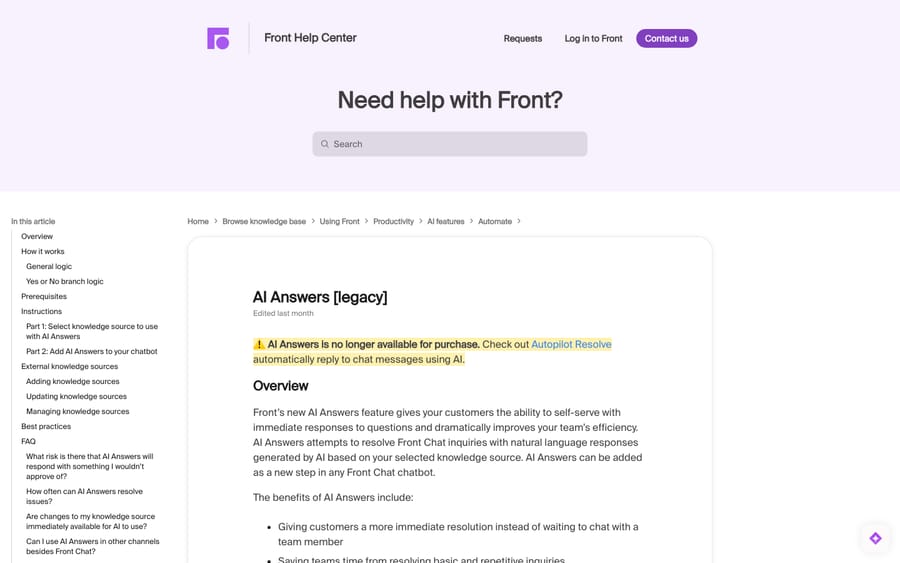
AI Answers is gone as a purchasable product. Front's own help center still hosts the article, but it now opens with a plain deprecation banner. Per Front's AI Answers (legacy) documentation, the notice reads: "AI Answers is no longer available for purchase. Check out Autopilot Resolve to automatically reply to chat messages using AI."
AI Answers was Front's earlier bot, working mostly inside Front Chat to answer customer questions from your knowledge content. Its replacement, Autopilot, is a more capable agent, but the swap is not optional. If you were relying on AI Answers, or you came looking to add it, the only path Front offers now is to migrate to Autopilot as an add-on on the current plan editions.
For a team that had tuned AI Answers to its own inbox, a forced migration is a real cost: new configuration, new billing model, and the uncertainty of whether the new agent behaves the way the old one did. That is the friction people are actually feeling when they search "Front AI Answers" in 2026 and find a dead end. For the fuller picture of Front's AI stack, our Front AI explained breakdown maps every piece.
Where is native Front AI still worth using?
It would be dishonest to treat Front's current AI as a downgrade across the board: in several places it is very good, and if you are on Front already you should use it.
Autopilot is a real agent, not a canned-answer bot. Front positions it around Playbooks: you define a workflow once, a quote request, a scheduling task, a refund check, and Autopilot runs it, collecting missing details from the customer and touching connected systems along the way. Front states that Autopilot "learns from your actual customer conversations and help content, so it works from day one," and that it "learns on the job, using real outcomes from your team to improve how it responds." For a shared-inbox team juggling support, sales, and ops in one place, that workflow-first framing fits Front's collaborative model well.
AI Compose and Copilot speed up the humans. Compose lets a teammate draft, polish, translate, or summarize in a couple of clicks. Front's pricing page caps it at 200 Compose actions per teammate per day, which is plenty for daily drafting. Copilot surfaces context and suggested replies inside the conversation. Smart QA (Enterprise only as of October 2026) scores conversations automatically so leads can coach without reading every thread. None of this is filler; it is genuinely useful assistive AI for a busy team.
So the honest read is: Front's native AI is strong at assisting the agent and at running defined workflows. The tension shows up in two places: how it is billed, and what happens on the messy, open-ended questions that do not fit a Playbook.
How is Front AI billed, and where does deflection stop short of resolution?
Front's AI is add-on-priced, and the shape of that pricing matters. Front's own pricing page (checked 24 September 2026) lists seats at $25 (Starter, up to 10 seats), $65 (Professional, up to 50 seats) and $105 (Enterprise) per seat per month billed annually. Copilot is $20 a seat per month as an add-on on Starter and Professional and is included in Enterprise; Smart QA, once a $20 add-on, is Enterprise only as of October 2026. Autopilot is an add-on on every plan, listed at "starting at $0.05 /conversation". Front's Autopilot pricing (edited October 5, 2026) explains the rate: each conversation is billed once at the highest level reached, $0.05 for triage, $0.39 for a handoff and $0.89 for a resolution. Earlier third-party trackers, such as Chatarmin's 2026 Front pricing breakdown, described Autopilot as billed per resolved case at about $0.89, which matches Front's Resolution level. Our Front pricing explained post covers the tiers in more depth.
The subtler issue is the difference between deflection and resolution. Front's own levels show the split: a handoff, where the agent drafts or acts and a human takes over, costs $0.39, and a full resolution $0.89, and much of what any inbox bot does is deflect: it answers what it can from help content, then hands off. The genuinely hard questions, the ones that need this customer's actual order, invoice, or account state, are exactly the ones a knowledge-only agent cannot close. And AI Answers' original weakness is instructive here: an AI that cannot ground itself in your past conversations and live data will confidently miss the cases where the answer lives outside the help center.
This is the seam where a dedicated AI agent layer earns its place, not by replacing Front, but by resolving the conversations native AI can only route or deflect.
What can you add on top of Front instead of relying on Autopilot alone?
Macha is an AI agent layer that runs on top of the Front you already use through the Macha–Front connector. It does not replace Front, your shared inboxes, your rules, or Autopilot. The connector reads full conversation threads, posts public replies or internal comments, updates tags, statuses and custom fields, and assigns teammates. You keep everything you have. Macha adds the reasoning-and-resolution layer that a forced Autopilot migration does not automatically give you.
Two things make the difference.
It is grounded, and it shows its work. When a Macha agent answers, it cites the sources it used, a specific help doc, a playbook, a past conversation, so a support lead can see why the agent said what it said. That auditability is precisely what a legacy answer-bot lacked. The category of AI agents for customer service exists to do this reasoning-heavy work that keyword deflection cannot.
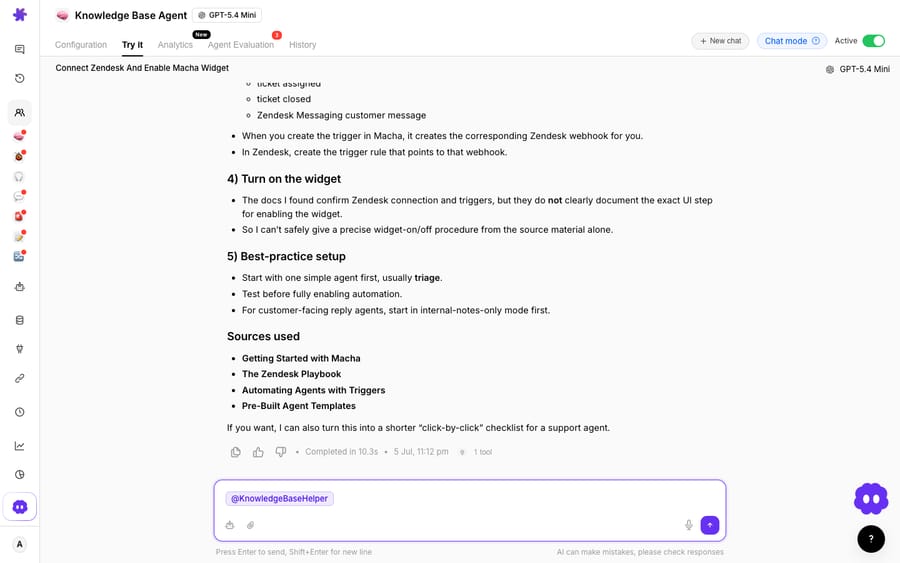
(These screenshots show Macha demo-org agents demonstrating the capability. Front is not a connected connector in this demo; they illustrate how a grounded agent answers, not a live Front conversation.)
It reaches your live systems. A grounded answer often needs data that lives outside the help center: an order status, a subscription state, a shipment. A custom tool turns your REST API into something the agent can call mid-conversation, so it can move from "here is the policy" to "here is the status of your order." That is the line between deflection and true resolution.
The division of labour is clean: let Front's Autopilot and Compose do what they are good at, running defined Playbooks and assisting your teammates, and layer Macha's agent on top for the open-ended, data-dependent questions that need grounded reasoning. To wire it up, building an AI agent for Front and connecting Front to Macha to route conversations to AI walk through the mechanics. And on pricing: Macha bills per ticket, one conversation, charged once however many messages it takes, never per resolution. The plan starts at $299 a month for up to 750 tickets, about $0.40 a ticket, and setup is done for you: the Macha team analyzes your past Front conversations, builds the knowledge base and the agent, and runs it in safe mode, with drafts as internal comments in Front, until the drafts are right. The price also covers a dedicated success manager who handles your changes afterwards: new categories, instruction changes, new tools.
How do you move off AI Answers without losing coverage?
If AI Answers was doing real work for you, here is a pragmatic path forward.
- Accept the Autopilot migration for what it is good at. Move your defined, workflow-shaped tasks, quote requests, scheduling, structured intake, onto Autopilot Playbooks. That is squarely its strength.
- Inventory the questions that never fit a Playbook. The open-ended "where is my order," "why was I charged twice," "does my plan include X", the ones that need live data. These are the resolution gap.
- Connect Macha on top of your Front via the connector. The Macha team then points the agent at your help content and builds the custom tools for your live systems.
- Let sources do the QA. Because Macha cites what it used, you can review and trust its answers before you widen its autonomy, no black-box deflection.
- Measure resolution, not just deflection. Track how many of the gap questions actually get closed end to end, versus routed and re-opened.
| Legacy AI Answers | Front Autopilot | Macha agent layer (on top of Front) | |
|---|---|---|---|
| Status | Discontinued (no longer for sale) | Current native AI | Live connector, add-on layer |
| Best at | Chat FAQ deflection | Defined Playbooks / workflows | Grounded, data-dependent resolution |
| Grounds in past conversations | Limited | Learns from conversations + help content | Yes, plus live systems via custom tools |
| Shows its sources | No | Partially | Yes: explicit "Sources used" |
| Billing shape | Retired | Add-on, $0.05 triage / $0.39 handoff / $0.89 resolution per conversation | Per ticket, from $299/mo for 750, setup and a dedicated success manager included (see /pricing) |
FAQ
Is Front AI Answers discontinued? Yes. Front's help center marks AI Answers as legacy, and the article states it is "no longer available for purchase," directing teams to Autopilot Resolve instead. It is no longer a product you can buy.
What replaced Front AI Answers? Autopilot. It is a more capable AI agent built around Playbooks that can run multi-step workflows and, per Front, learns from your conversations and help content, rather than only answering chat FAQs.
Do I have to migrate to Autopilot? If you want Front's native AI agent going forward, effectively yes: AI Answers is retired. Autopilot is sold as an add-on on Starter, Professional and Enterprise, billed once per conversation at $0.05 for triage, $0.39 for a handoff or $0.89 for a resolution (Front's help center, as of October 2026). You can also add a grounded AI agent layer on top of Front for the questions Autopilot deflects rather than resolves.
How is a grounded AI agent layer different from Autopilot? Autopilot excels at defined workflows; a grounded layer like Macha focuses on open-ended, data-dependent questions: reading the conversation, pulling live order or account data through custom tools, and answering with explicit sources so you can audit every reply.
Does Macha replace Front? No. Macha connects to Front as a live connector and runs on top of your existing shared inboxes, rules, and Autopilot. It adds the resolution layer; it does not replace the platform you already collaborate in. The Macha team sets the agent up on your Front for you, included on the trial and every plan at about $0.40 a ticket.
Ready to close the gap AI Answers left behind? Start a free trial of Macha and connect it to your Front in minutes. The Macha team builds the first agent for you.