Intercom
 Shopify
 Stripe
 Slack
Slack Notion
 Google Workspace
 Confluence

Gridspace: The Complete Guide (2026)


Gridspace, the voice AI company founded in 2012 by Evan Macmillan, Anthony Scodary, and Nico Benitez, has rebranded as Guava (goguava.ai). This guide covers what the platform actually does today under its new name, its real usage-based pricing, reviews carried over from the Gridspace era, and honest alternatives for phone-based customer support.

We build AI agents for customer service ourselves, so we read this the way any buyer typing "gridspace" into a search bar would: is the company still around, what changed, and what does it cost now. Searching "gridspace" today lands you on a different logo, and that switch deserves a plain explanation up front.
What happened to Gridspace?
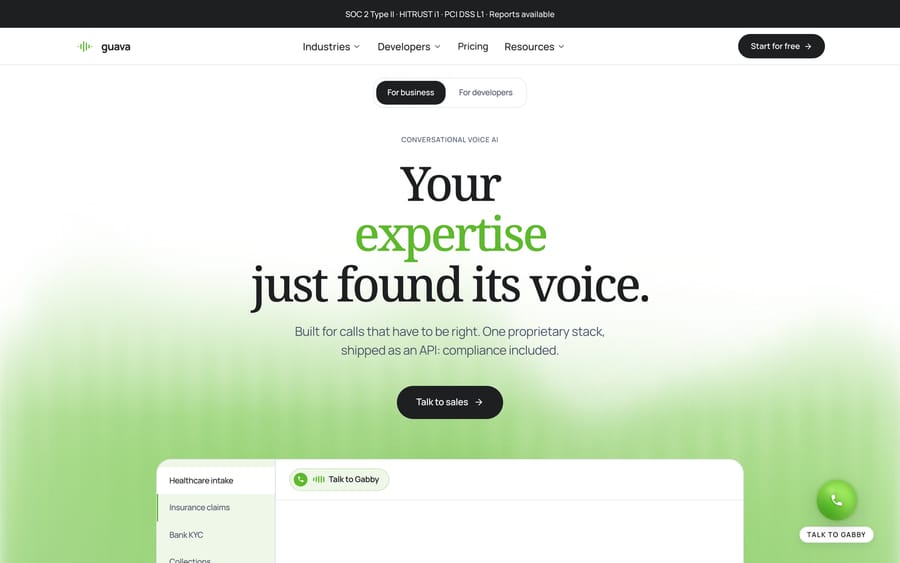
Typing gridspace.com into a browser now redirects to goguava.ai. That's a real, working 301 redirect; the domain is live, just relabeled. Several signals point to continuity here, more a rebrand than an acquisition or shutdown: Guava's own developer-docs subdomain is titled "Gridspace - Guava," Gridspace co-founder Anthony Scodary is listed as "Co-Founder at Guava" on LinkedIn, and Guava's homepage claims "13 years in regulated production," which lines up with a company founded in 2012. We could not find a single official announcement stating "Gridspace is now Guava" in plain language, so we're reading the redirect, the shared founder, and the shared docs branding as strong circumstantial evidence of a rebrand. There's no press release to point to directly.
Under the Gridspace name, the company built voice AI out of a collaboration adjacent to SRI Speech Labs (the lab behind Siri) and raised roughly $7.6 million across several rounds from investors including Wells Fargo and Mouro Capital, serving large contact centers in healthcare, finance, insurance, and retail. Guava's current positioning keeps that regulated-industry focus and adds a specific technical pitch: a proprietary, end-to-end voice stack shipped as a developer API, aimed at calls where compliance can't be an afterthought.
How Guava's technology works
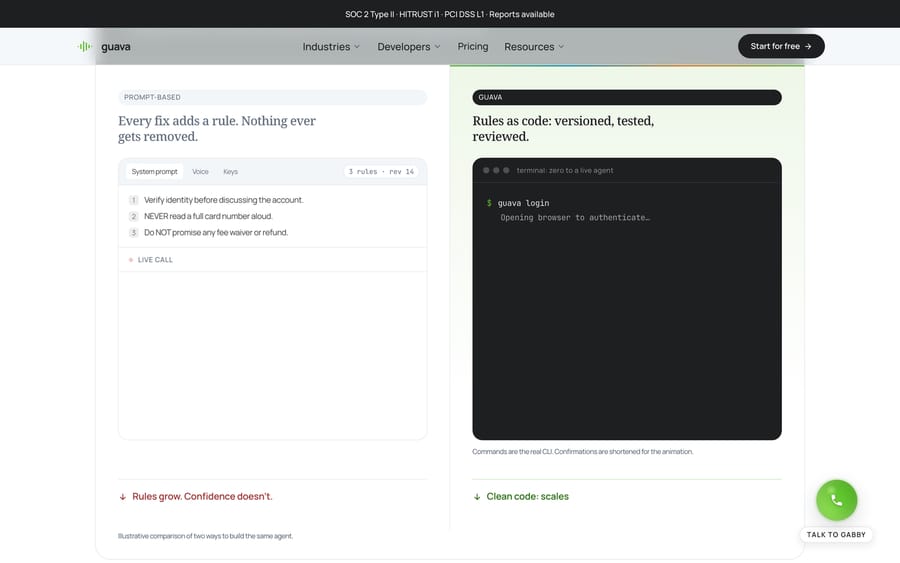
Guava's central technical argument is about how an agent gets configured, and it's worth understanding because it's a genuine mechanism difference underneath the marketing language. Guava frames most voice AI agents as "prompt-based": every fix to the agent's behavior adds another line to a growing prompt, with old rules never removed, so confidence in the agent's behavior degrades as the prompt grows. Guava's own approach is "rules as code": agent behavior lives in a versioned, testable configuration (the screenshot above shows a literal guava login CLI command and a rule set at "rev 14"), reviewed the way a team reviews a code change rather than edited as freeform prompt text.
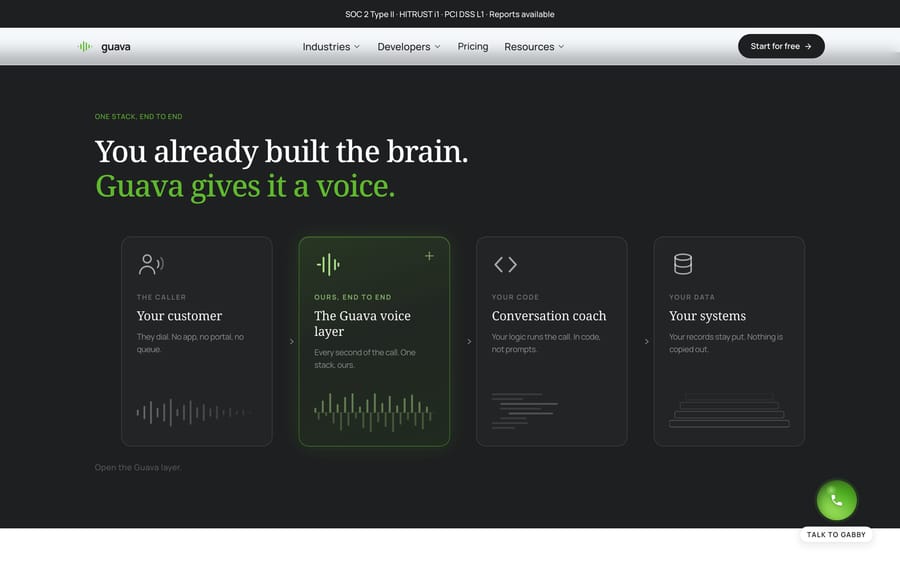
Architecturally, Guava positions itself as the layer that owns the entire call, speech recognition, turn-taking, and voice synthesis, while a customer's own code acts as a "conversation coach" that runs the actual business logic, and the customer's own systems and data stay untouched rather than being copied into Guava's infrastructure. That data-boundary claim is central to the compliance pitch: a bank or hospital can keep its own records in place while Guava handles only the call itself.
Key features
- Proprietary end-to-end voice stack: speech recognition, turn-taking, and synthesis owned by Guava rather than stitched from third-party APIs.
- "Rules as code" configuration: versioned, tested, and reviewed agent behavior instead of an ever-growing prompt.
- Compliance certifications on every plan: SOC 2 Type II, HITRUST i1, and PCI DSS Level 1, with no Enterprise-only gate.
- Python and TypeScript SDKs, with Guava's own claim of shipping a production voice agent in 10 minutes.
- Real integrated telephony, without a separate third-party phone system to stitch in.
- Industry-specific templates for healthcare intake, insurance claims, bank KYC, and collections calls.
Guava pricing
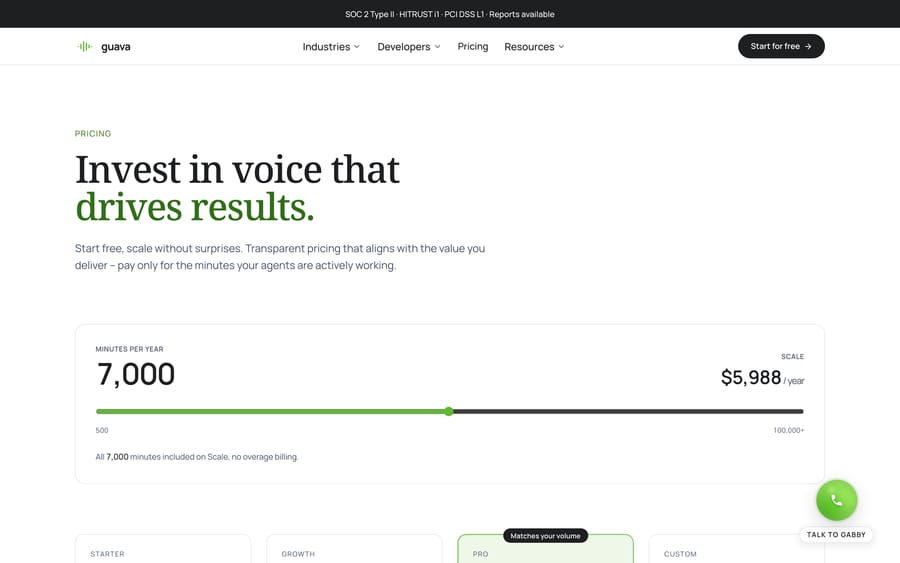
Guava publishes real, itemized pricing across four tiers, billed by the minute an agent is actively on a call:
| Plan | Price | Included minutes/year | Overage rate |
|---|---|---|---|
| Starter | Free | 500 | $0.15/min |
| Growth | $149/month | 1,500 | $0.14/min |
| Pro | $499/month | 7,000 | $0.13/min |
| Enterprise | Custom | Custom volume, no overage | Custom |
All plans include the SOC 2 Type II, HITRUST i1, and PCI DSS certifications at no extra cost, a genuinely unusual choice given how often compliance certifications get walled off behind an enterprise tier elsewhere in this category. Most vendors gate compliance behind Enterprise because it's the single strongest upsell lever they have; putting it on every tier is Guava betting that a regulated buyer converts faster with the objection removed than a vendor earns by holding it back. The per-minute rate drops as volume rises (from $0.15 on Starter to $0.13 on Pro), and Enterprise removes overage billing entirely in exchange for a custom volume commitment. Worked example: a support line running 7,000 minutes a year fits exactly on Pro at $499/month ($5,988/year, confirmed directly on Guava's own pricing slider); going even slightly over that on Growth's 1,500-minute allowance adds up fast at $0.14/min in overage, which is the practical trigger for upgrading a tier.
Pros and cons
Pros
- Published, calculable pricing with a live slider showing the exact annual cost at a given volume.
- Compliance certifications (SOC 2, HITRUST, PCI DSS) included on every tier, not gated behind Enterprise.
- A genuinely differentiated configuration model ("rules as code") aimed at a real failure mode of prompt-based agents.
- 13+ years of operating history in regulated industries, even under the previous Gridspace name.
Cons
- The rebrand itself is a research burden: a buyer searching "Gridspace" has to independently confirm Guava is the same company, since no official announcement states it plainly.
- G2 reviews carried over from the Gridspace era show only a single review, too thin to treat as a real market signal.
- The free Starter tier is capped at 500 minutes/year with limited concurrency and a watermark, useful only for a small proof of concept.
- Guava is a developer-facing API platform; a team without engineering resources to integrate Python/TypeScript SDKs will need more hand-holding than the self-serve pricing implies.
What actual users say
G2 still lists this product under its previous name, "Gridspace Contact Center AI," at 5.0 out of 5 from a single review. One enterprise reviewer wrote that Gridspace offered "innovative solutions and [was a] great partner to work with," praising the collaborative, supportive team. A single review is not a reliable signal in either direction, and we found no additional independent reviews under either the Gridspace or Guava name on Capterra or TrustRadius.
How we researched this: we checked and confirmed the gridspace.com to goguava.ai redirect ourselves, then checked Guava's homepage and pricing page directly on 2026-09-17, along with a scroll-captured product demo section. Company history (founding, funding, founders) and the rebrand evidence came from three WebSearch queries, the maximum we allow per post. We could not find an official rebrand announcement, a review count beyond G2's single review, or independent confirmation from Gridspace or Guava themselves that the two names refer to the same legal entity.
Who Guava is best for
Guava fits teams with real engineering capacity at a regulated business, healthcare, insurance, banking, government, or a BPO serving those industries, that want to build a compliant voice agent with real SDKs instead of a no-code builder, and that values calculable, published per-minute pricing over a sales-gated quote. The "rules as code" pitch specifically suits a team that's already hit the failure mode of a prompt-based competitor: rules that only ever accumulate, with nobody confident which one actually matters anymore.
It's a weaker fit for a non-technical team wanting a point-and-click agent builder, or a business outside regulated industries where the compliance certifications aren't a purchase driver. A team in that position gets less value from Guava's core differentiator and would do just as well, probably for less setup effort, on a more generalist voice AI platform.
Gridspace (Guava) vs alternatives
| Guava (formerly Gridspace) | Parloa | Macha | |
|---|---|---|---|
| Model | Compliance-first voice agent API for regulated industries | Enterprise conversational AI platform for contact centers | AI agent layer on your existing help desk |
| Best for | Engineering teams in healthcare, insurance, banking, government | Large contact centers wanting a broader conversational AI suite | Teams on Zendesk, Freshdesk, Gorgias, or Front |
| Pricing | $0-$499/mo published tiers, $0.13-$0.15/min, see pricing | Not independently verified here; see the Parloa guide | From $299/mo for 750 tickets (~$0.40/ticket), published |
| Setup | Self-serve API/SDK integration; Enterprise gets a forward-deployed engineer | Sales-led, enterprise onboarding | Built, tested, and monitored by the Macha team |
| Trial | Free tier, 500 min/year | Demo-gated | $50 free usage |
| Replaces your help desk? | No, it's a voice-call layer for regulated call types | No, layers onto existing contact-center systems | No, deliberately augments it |

Guava and Parloa both build voice AI for demanding call environments, but at different ends of the buying process: Guava is a self-serve, developer-first API with published pricing, while Parloa's enterprise contact-center positioning leans toward a sales-led motion. A regulated business with in-house engineering capacity gets to production faster on Guava's SDKs; a large enterprise contact center already running a sales-led procurement process may find Parloa's broader platform a more natural fit.
Macha sits outside this category entirely: instead of automating phone calls, it's an AI agent layer that runs on top of a help desk a team already uses (Zendesk, Freshdesk, Gorgias, or Front), for the email and chat tickets that make up most support queues. A regulated business with real phone-call compliance needs should still look at Guava specifically for that channel; a team whose queue is mostly email and chat gets more direct value modeling its cost against Macha's per-ticket pricing. See Macha's pricing or start with $50 of free usage against real tickets.
FAQ
Is Gridspace still around? The company is still operating, now under the name Guava (goguava.ai). Gridspace.com redirects to Guava's site, Gridspace's co-founder Anthony Scodary is listed as a Guava co-founder, and Guava's own claims about years in production match Gridspace's 2012 founding.
What is Guava (formerly Gridspace)? Guava is a voice agent API platform for regulated industries (healthcare, insurance, banking, government, BPOs), built around a proprietary end-to-end voice stack and a "rules as code" configuration model instead of accumulating prompt instructions.
How much does Guava cost? Starter is free (500 minutes/year). Growth is $149/month (1,500 minutes/year, $0.14/min overage). Pro is $499/month (7,000 minutes/year, $0.13/min overage). Enterprise is custom, with no overage billing.
What do real users say about Gridspace/Guava? G2 lists the product under its former name at 5.0 out of 5, but from a single review, too thin a sample to treat as a real signal. That reviewer praised the team as "a great partner to work with."
What compliance certifications does Guava have? SOC 2 Type II, HITRUST i1, and PCI DSS Level 1, included on every pricing tier rather than gated behind Enterprise.
Who founded Gridspace/Guava? Evan Macmillan, Anthony Scodary, and Nico Benitez founded Gridspace in 2012, raising about $7.6 million from investors including Wells Fargo and Mouro Capital. Anthony Scodary is listed as a co-founder of Guava today.
Is Macha an alternative to Guava? Not directly. Guava is a developer-focused voice-call API for regulated industries; Macha is an AI agent layer that runs on top of a help desk a team already uses (Zendesk, Freshdesk, Gorgias, or Front) for email and chat tickets. A team with real regulated phone-call volume fits Guava; a team whose queue is mostly email and chat fits Macha.
Sources: Guava, Guava pricing, Guava's developer docs (docs.gridspace.com, titled "Gridspace - Guava"). G2's listing for this product remains filed under "Gridspace Contact Center AI."
Resolve tickets automatically with AI agents
Macha's AI agents work on top of the help desk you already use — no code.