Intercom
 Shopify
 Stripe
 Slack
Slack Notion
 Google Workspace
 Confluence

Khoros: The Complete Guide (2026)


Khoros is an enterprise customer engagement platform built from the 2019 merger of Lithium Technologies and Spredfast, best known for online communities and social media management, and now rebuilding itself around two AI products: Aurora AI and Iris AI. The company was acquired by IgniteTech in May 2025 and laid off roughly two-thirds of its Austin staff within weeks, which is worth knowing before you read anything else on its site. This guide covers what Khoros actually does today, what its AI products are, what it costs based on real buyer data, what reviewers say, and where it fits next to Macha.

Macha builds AI agents for customer service that run inside a help desk a team already uses, so we read an enterprise platform like Khoros from that angle: how much of the cost is community and social infrastructure you may not need, versus the AI you're actually here for.
What is Khoros, and who owns it now?
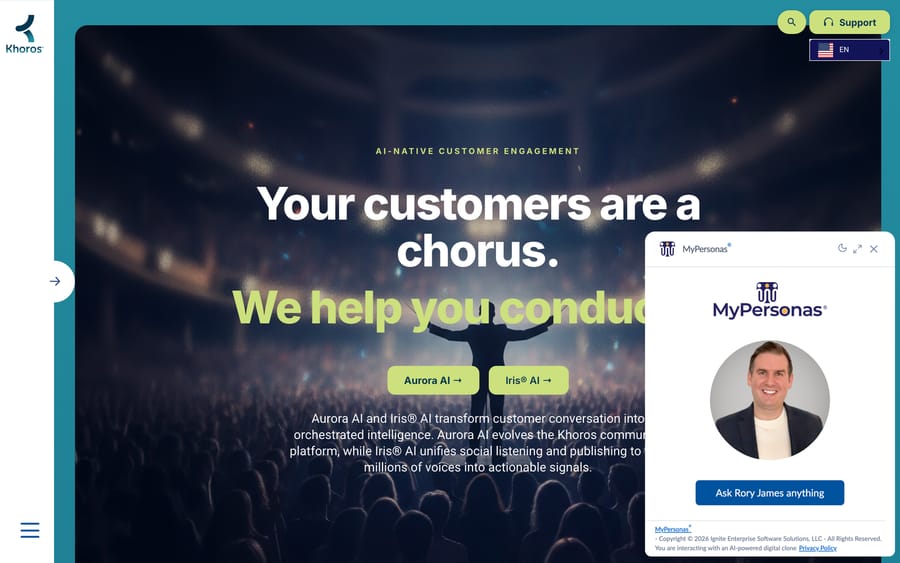
Khoros formed on March 5, 2019, when Vista Equity Partners merged two companies it had acquired: Lithium Technologies (founded 2001, community and social software) and Spredfast (founded 2008 in Austin, social campaign management). The combined company built a reputation serving Fortune 500 brands, running 300-plus enterprise communities and reporting over $500 million in support costs saved through self-service, with 1.8 billion community site visits a year.
The fact that changes how you should read the rest of this guide: in May 2025, IgniteTech acquired Khoros from Vista Equity Partners, and within weeks announced layoffs affecting 116 employees in Austin, roughly two-thirds of the company's local staff (Khoros reported 173 Austin employees in 2023). IgniteTech has a well-documented pattern of aggressive cost-cutting after acquisitions, and Khoros's own site now carries direct evidence of the new ownership: an AI chat widget in the corner of every page, branded "MyPersonas," copyrighted to "Ignite Enterprise Software Solutions, LLC." IgniteTech's stated plan is to rebuild Khoros around AI, which is the context for Aurora AI and Iris AI below.
How Khoros's AI works: Aurora AI and Iris AI
Khoros now sells two AI products, replacing what used to be a wider set of named modules (Communities, Care, Marketing):
- Aurora AI: the successor to Khoros's community platform ("Khoros Classic"), rebuilt with AI-native self-service that Khoros says deflects tickets by synthesizing answers directly out of past community conversations, rather than only returning a list of threads to search through. It also automates moderation, gamification and community analytics.
- Iris AI: a social media management platform for content creation, scheduling and cross-channel publishing, with social listening Khoros says spans billions of sources across 187 languages.
Aurora AI is explicitly positioned as an upgrade path, not a new product: Khoros's own comparison page frames it as "same foundation, modern interface" over Khoros Classic, meaning an existing Khoros customer is meant to migrate instead of starting over. That matters if you're evaluating Khoros fresh: a lot of the platform's depth (moderation queues, gamification, gated content) comes from two decades of community-software iteration, not from a 2026 AI rebuild.
Key features
- Aurora AI community platform: AI-native self-service, ticket deflection, automated moderation and analytics.
- Iris AI social platform: content creation, scheduling and cross-channel publishing with multilingual social listening.
- Enterprise scale: 300+ communities, Fortune 500 customer base, named accounts including Instacart, Visa, Zoom, Atlassian and Canon USA.
- Governance and security: enterprise-grade infrastructure Khoros describes as maintaining compliance while teams "move fast."
- Migration path from Khoros Classic, for existing customers instead of only new ones.
A real customer number, for scale
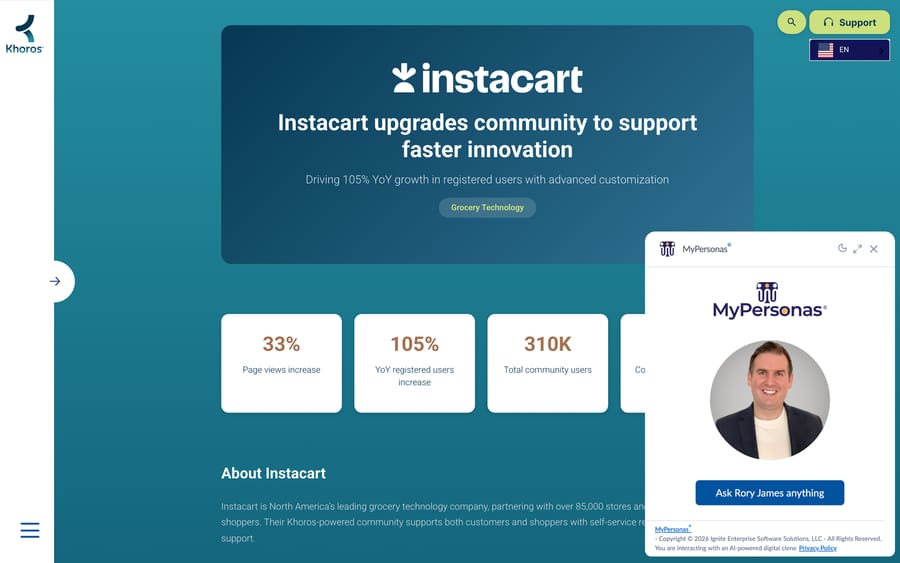
Khoros's Instacart case study reports a 33% increase in page views, 105% year-over-year growth in registered users, and 310,000 total community users after an Aurora migration. That's a genuinely large, named deployment, and it's a useful sense check on what "enterprise scale" means for this category: Khoros is built for a community with hundreds of thousands of members, not a support team fielding a few thousand tickets a month.
Khoros pricing (researched)
Khoros doesn't publish a rate card, and there's no calculator, trial signup, or self-serve tier anywhere on khoros.ai. Every engagement is quoted through sales, which is a normal incentive for a vendor selling six-figure enterprise contracts: a public number gives a smaller prospect a reason to walk away before a salesperson gets the chance to scope the deal to the account's actual budget.
The only quantified source we found is Vendr's aggregated buyer data, which reports a median annual contract of $164,649, with buyers saving an average of 24% off list through negotiation. Vendr's broader range runs from roughly $50,000 at the small end to $500,000-plus for large enterprise deployments, with module-level detail suggesting Care (customer service) contracts scale with agent count (roughly $60,000-$150,000 for 10-25 agents, exceeding $250,000 for 50-plus) and Communities contracts scale with community size and feature depth ($75,000-$200,000 mid-market, $300,000-plus enterprise). We checked for an AWS, Azure or GCP marketplace listing and a G2 pricing tab; neither surfaced a published number, so Vendr's buyer-reported data is the most concrete figure available.
Real-user reviews: what buyers say after they deploy
We checked two sources on 2026-09-17. Capterra rates Khoros Care 4.8/5 from 8 reviews. G2 rates Khoros Service 4.4/5 from 40 reviews, per a search-indexed summary (G2's page itself returned a 403 to direct automated access).
Direct quotes from Capterra reviewers of Khoros Care:
"Khoros Care integrates all the companies social media pages thus customer queries sent on any channel are well received and responded to by the administrators in real time." (CS Administrator, Telecommunications)
"...excellent at workflow management with its queue management, priority routing and configurable automatic routing." (Team Leader, Telecommunications)
"Khoros Care has a great User Interface and is powerful in responding cross-channels." (Freelance, Information Technology)
The recurring complaints: the platform gets complicated once you move past basic operations into specialized configuration, the mobile app needs work, costs climb as you add more social accounts, and a couple of reviewers flagged missing customization (report templates, Spanish-language support) as gaps. None of these read as dealbreakers, but they're consistent enough to plan around, especially the cost-scales-with-accounts pattern, which echoes the module-based pricing structure above.
Pros and cons
Pros
- Genuine enterprise scale and track record: 300+ communities, named Fortune 500 customers, two decades of community-software experience.
- Aurora AI's ticket deflection is built on real historical conversation data, not a cold-start knowledge base.
- Broad channel coverage across community, social and care in one platform.
- Real, verifiable customer results (Instacart's 105% user growth) instead of only vendor-stated averages.
Cons
- No published pricing anywhere; Vendr's median of $164,649/year is buyer-reported, not a rate card.
- The May 2025 IgniteTech acquisition and subsequent layoffs introduce real uncertainty about roadmap continuity and support depth.
- Built for large-scale communities and social operations; most of the platform is unused capacity for a team whose real problem is a help-desk ticket queue.
- Cost and complexity both scale with the number of social accounts and agents, which reviewers flag as a recurring friction point.
Who Khoros is best for
Khoros fits teams whose enterprise already runs (or wants to run) a branded online community at meaningful scale, alongside social media care across many accounts and channels, and that have the budget and procurement process for a six-figure annual contract. If you're evaluating Aurora AI specifically as a Khoros Classic customer deciding whether to migrate, that's a clearer, narrower decision than evaluating Khoros cold.
It's the wrong tool if the job is automating tickets inside a help desk your support team already uses day to day. Khoros doesn't lead with help-desk-native ticket handling, and a team whose real problem is a Zendesk or Freshdesk queue would be paying for community and social infrastructure it doesn't need to solve that problem, on top of taking on the uncertainty of a company mid-acquisition.
Khoros vs alternatives
| Khoros | Sprinklr | Macha | |
|---|---|---|---|
| Model | Community (Aurora AI) + social (Iris AI) enterprise platform | AI-native unified customer experience platform | AI agent layer on your existing help desk |
| Best for | Large enterprise communities and social care at scale | Enterprises unifying social, marketing and care | Teams on Zendesk, Freshdesk, Gorgias or Front |
| Pricing | Opaque; Vendr median about $164.6K/yr | Opaque; enterprise sales-led | From $299/month for 750 tickets (about $0.40 per ticket), published |
| Ownership | Acquired by IgniteTech, May 2025, post-acquisition layoffs | Independent, publicly traded | Independent |
| Replaces your help desk? | No, sits alongside CRM/community stack | No, sits alongside CRM/social stack | No, deliberately augments it |
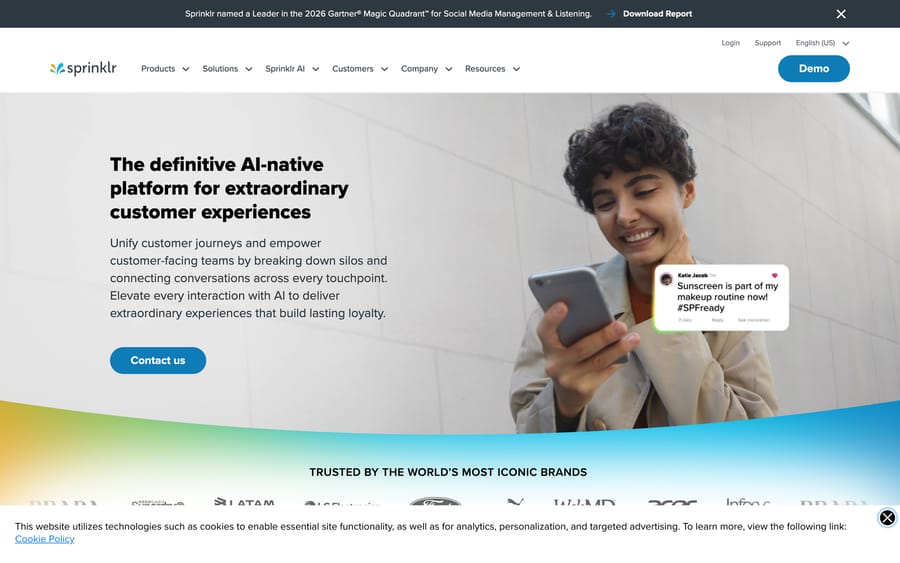
Sprinklr is the most natural comparison: another long-standing enterprise platform selling AI-native customer experience tools across social, community and care, at similarly opaque, sales-led pricing, without the recent ownership disruption Khoros is working through.
Macha is a different shape of product entirely. If the actual problem is a ticket backlog inside a help desk rather than community or social scale, Macha on your help desk is a narrower, faster-to-deploy option, and our Kore.ai guide covers another enterprise conversational AI platform worth comparing against Khoros's Aurora AI.
How we researched this: Khoros's own site (homepage, Aurora AI, Iris AI, the Aurora-vs-Classic comparison, and a customer story) was fetched and screenshotted directly on 2026-09-17. Company history came from Wikipedia. The IgniteTech acquisition and layoffs were verified against the Houston Chronicle and a PRNewswire release, cross-checked against a second outlet. Pricing came from Vendr's aggregated buyer data, since Khoros publishes no rate card and no marketplace listing surfaced a number. Review data came from Capterra (fetched directly) and G2 (via search-indexed summary).
FAQ
What is Khoros? Khoros is an enterprise customer engagement platform formed in 2019 from the merger of Lithium Technologies and Spredfast, focused on online communities (Aurora AI) and social media management (Iris AI).
Who owns Khoros now? IgniteTech acquired Khoros from Vista Equity Partners in May 2025. Within weeks, Khoros laid off 116 employees in Austin, about two-thirds of its local staff.
What is Aurora AI? Aurora AI is Khoros's AI-native community platform, the successor to "Khoros Classic," built to deflect tickets by synthesizing answers from historical community conversations and automating moderation and analytics.
How much does Khoros cost? Khoros doesn't publish pricing. Vendr's buyer-reported data shows a median annual contract of $164,649, with a broader range from about $50,000 to $500,000-plus depending on module and scale.
What do Khoros's reviews say? Capterra rates Khoros Care 4.8/5 from 8 reviews, and G2 rates Khoros Service 4.4/5 from 40 reviews. Reviewers praise cross-channel workflow management but flag rising costs as social accounts scale and a weaker mobile app.
Is Khoros good for a small support team? No. Khoros is built for large-scale communities and enterprise social care, with six-figure typical contracts. A small support team's ticket volume doesn't need this platform's community and social infrastructure.
What are the best Khoros alternatives? Sprinklr is the closest direct competitor, an AI-native platform covering social, community and care at similar enterprise scale and pricing. For teams whose real problem is help-desk ticket volume, Macha is a lighter, more targeted alternative.
Does the IgniteTech acquisition affect existing Khoros customers? It's reasonable to expect some disruption. IgniteTech's stated plan is to rebuild Khoros around AI, and the company cut roughly two-thirds of its Austin staff within a month of the acquisition closing, which is worth raising directly in any renewal or new-deal conversation.
Looking to automate tickets inside the help desk you already use, without a six-figure community platform contract? Start a Macha trial at dashboard.getmacha.com/signup or see pricing: $50 of free usage (about 125 tickets), no credit card, no time limit.
Sources: Khoros homepage, Khoros Aurora AI, Khoros Iris AI, Aurora vs Classic, Khoros Instacart customer story, Khoros, LLC on Wikipedia, Khoros to lay off 116 employees, Houston Chronicle, IgniteTech Acquires Khoros, PRNewswire, Khoros pricing, Vendr. Capterra ("Khoros Care," capterra.com) checked 2026-09-17.
Resolve tickets automatically with AI agents
Macha's AI agents work on top of the help desk you already use — no code.