Intercom
 Shopify
 Stripe
 Slack
Slack Notion
 Google Workspace
 Confluence

LivePerson: The Complete Guide (2026)


LivePerson is an enterprise conversational AI platform that has just changed hands: SoundHound AI completed its acquisition of LivePerson on September 4, 2026. This guide covers what LivePerson actually does under its new owner, how Conversational Cloud works, what it costs (the honest answer: a custom quote, but real numbers exist if you know where to look), what reviewers say on two very different platforms, and how it compares to the alternatives, including where an AI agent layer like Macha fits a team that doesn't need enterprise-scale conversational infrastructure.

We build AI agents for customer service ourselves, so this is written by people who have to evaluate platforms like this. We are not repeating a press release.
What is LivePerson?
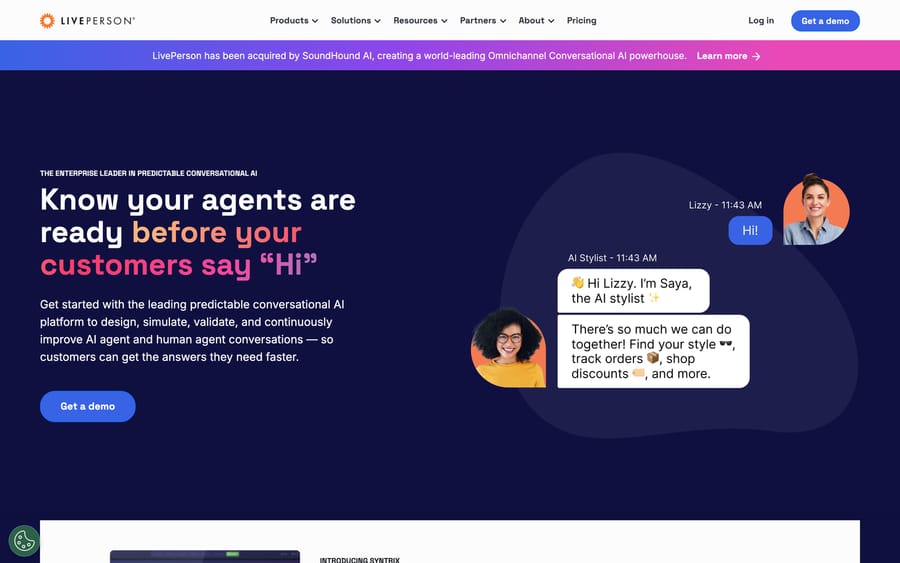
LivePerson was founded in 1995 by Robert LoCascio and went public on Nasdaq in 2000, making it one of the oldest names in what is now called conversational AI. It built its business on live chat, then messaging, then AI-assisted and AI-automated conversations, all sold to large enterprises: HSBC, PNC, Burberry, Bankwest, The RealReal, and Zurich Insurance are among its publicly referenced customers. The platform reports handling more than one billion customer messages a month across its install base.
The acquisition is the fact that matters most right now. SoundHound AI, a voice AI company, announced a definitive agreement to acquire LivePerson on April 21, 2026, and closed the deal on September 4, 2026, at an equity value of $43 million and a total enterprise value of roughly $250 million once LivePerson's debt is factored in. That is a steep discount to LivePerson's earlier market value, and it tells you something concrete: LivePerson had scale (one billion monthly messages, a Fortune 500 customer list) but had struggled financially enough to sell at that price. SoundHound's stated rationale is combining its own voice and agentic AI with LivePerson's enterprise messaging infrastructure into one company. If you are evaluating LivePerson today, you are really evaluating a newly combined SoundHound-LivePerson product roadmap. The standalone company its older case studies were written about no longer exists on its own.
How LivePerson's AI works
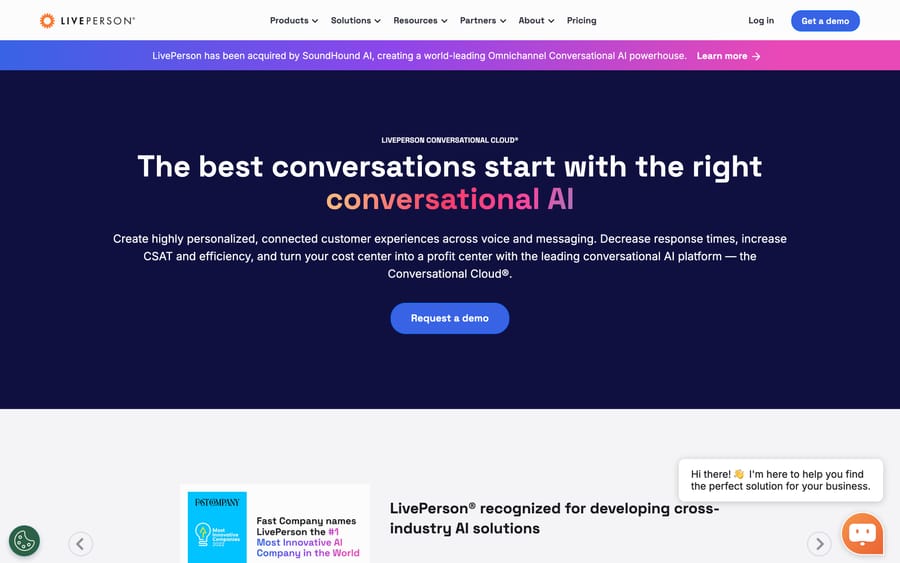
The core platform is Conversational Cloud, which routes and manages conversations across messaging, chat, and voice, and lets a business mix fully automated AI responses with human agents on the same thread. Several named components sit on top of it:
- Conversation Builder: a no-code interface for constructing automated bot flows and intent-handling logic.
- Agent Workspace: the unified interface human agents use, including a mode where they review, edit, and approve AI-drafted responses before sending instead of letting the AI reply unsupervised.
- Conversational Intelligence & Insights: analytics that mine historical conversation data for intent patterns and performance metrics, used to tune both bots and human agents.
- Syntrix: a testing tool that simulates large numbers of customer interactions against an AI agent before it goes live, intended to catch failure modes before a real customer does.
- Generative AI orchestration: features for blending generative responses with the platform's older rules-based bot logic, plus an integration hub connecting to external CRM, marketing, and data systems.
The mechanism worth understanding is the "review before send" pattern in Agent Workspace. Rather than an AI agent replying to a customer directly and unsupervised, LivePerson's default enterprise pattern routes a drafted AI response to a human first for approval on at least some conversation types. That is a materially different risk posture from a self-serve chatbot vendor that ships autonomous replies by default, and it is why LivePerson's sales conversation is with a compliance-conscious enterprise buyer rather than a 20-person support team that wants automation live this week.
Key features
- Omnichannel routing across chat, messaging (SMS, WhatsApp), and voice, unified in Conversational Cloud.
- Conversation Builder for constructing automated bot flows without code.
- Agent Workspace with an AI-drafts-human-approves review mode for sensitive conversation types.
- Syntrix for pre-launch testing: simulating volume against an AI agent before it handles real customers.
- Conversational Intelligence & Insights analytics on intent, resolution, and agent performance.
- An integration hub connecting to external CRM and data systems.
- Vendor-reported outcomes across its customer base: up to 90% automation on suitable intents, and reported reductions in operating cost and agent training time. These are vendor-published ranges. No independent audit backs them for any specific deployment.
What G2 and Trustpilot say, and why they disagree
LivePerson holds a 4.3 out of 5 rating across 391 reviews on G2, a business-software review site where the reviewer is typically the person who bought or administers the tool. Recurring G2 praise covers chat speed, reliability, and enterprise-scale conversational workflows; recurring complaints cover opaque pricing, slow implementation compared to lighter tools like Zendesk or Intercom, and difficulty customizing analytics dashboards.
On Trustpilot, a site whose reviewers skew toward end consumers and complaint-driven visits, LivePerson sits at 1.3 out of 5 across 122 reviews, checked 2026-09-17. Three attributed reviews there:
"There are better, less expensive options. Automatic reports would often break." Attributed to Jessica Prorock, Trustpilot, December 2024.
"I wouldn't trust a company with my customers when they can't take care of their own." Attributed to Andrew Robertson, Trustpilot, August 2023.
"Liveperson are fantastic at chasing invoices, and that's about it." Attributed to Rob, Trustpilot, April 2022.
The gap between the two scores is itself informative: Trustpilot reviews for an enterprise B2B platform tend to skew toward billing disputes and account-management frustration. G2's audience is closer to evaluating the product's actual chat and AI functionality. Read both, but weight G2 more heavily if the question is "does the product work," and weight the Trustpilot pattern (specifically the invoicing and support complaints) if the question is "what is it like to be a LivePerson customer commercially."
LivePerson pricing (researched)
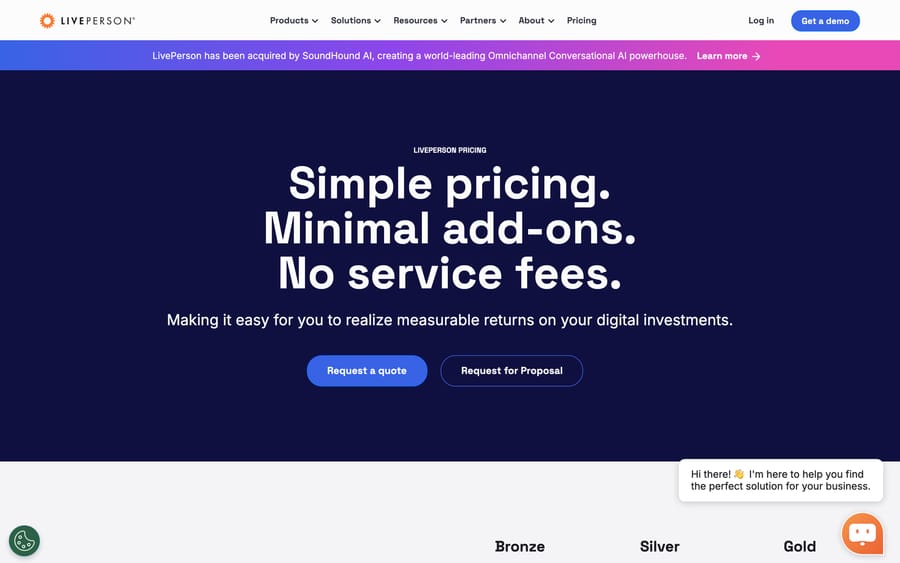
LivePerson does not publish dollar figures. Its pricing page names three tiers, Bronze, Silver, and Gold, distinguished by support level and feature depth (Bronze covers agent-efficiency basics; Gold adds advanced analytics and generative AI), but every tier ends in "request a quote" or a request-for-proposal form. The page does disclose one concrete add-on cost: proactive SMS messaging is billed at the SMS provider's list price plus a 15% handling fee, with WhatsApp following Meta's published rate card.
For an actual number, the best source we found is Vendr's aggregated buyer data: the average annual contract for LivePerson is about $60,945, with deals reaching as high as $110,000, based on real negotiated purchases Vendr has brokered or tracked. Vendr also states its customers typically negotiate roughly $11,000 off the initial quote, which tells you there's real room to negotiate before signing. A sales-only quote process gives LivePerson an incentive to open high and anchor on volume rather than publish one number every buyer sees. A few other pricing-aggregator sites cite per-seat figures (roughly $30 to $50 per user per month depending on company size) or a $599 monthly starting price, but none of those numbers traced back to a primary source we could verify. Treat them as unconfirmed estimates. We checked AWS Marketplace for a public listing; there is none.
What drives the price
- Message and conversation volume. LivePerson's core unit has historically been conversation or message volume, so a bank running millions of monthly chats prices very differently from a 50-person retailer.
- Which tier and add-ons. Gold's advanced analytics and generative AI features cost more than Bronze's baseline agent tools, and proactive SMS/WhatsApp messaging is billed separately.
- Contract length. Vendr's data suggests multi-year commitments unlock better per-unit rates, standard practice in enterprise software procurement.
- Integration and implementation scope. Third-party estimates put implementation costs from around $5,000 for a small deployment to $50,000 or more for a large enterprise rollout, on top of the subscription.
Pros and cons
Pros
- Genuine enterprise scale: one billion-plus monthly messages processed, three decades of operating history, Fortune 500-caliber customers.
- The AI-drafts, human-approves pattern in Agent Workspace suits regulated or risk-averse enterprises that don't want a bot replying unsupervised.
- Syntrix's pre-launch simulation testing is a real answer to "how do we know this AI agent won't say something wrong to a live customer."
- Now backed by SoundHound's voice AI technology post-acquisition, which could deepen the platform's voice capabilities over time.
Cons
- No published pricing; G2 reviewers themselves list opaque pricing as a recurring complaint, and the real numbers (average contract near $61,000/year) only surface through third-party procurement data.
- Slower implementation than lighter, self-serve competitors, according to G2 reviewers directly comparing it to Zendesk and Intercom.
- The company was acquired at a steep discount to its earlier valuation, which raises fair questions about roadmap continuity and long-term support investment during the integration with SoundHound.
- Trustpilot's pattern of billing and account-management complaints, even accounting for that audience's skew, is a signal worth asking a reference customer about directly.
Who LivePerson is best for
LivePerson fits a large enterprise, likely regulated (financial services, insurance, telecom) or operating at genuine one-billion-message-a-month scale, that wants AI drafting responses with a human approval step built in rather than an autonomous bot, and that has the procurement muscle to negotiate a custom contract down from an opening quote. If your compliance team needs to see every AI response before it reaches a customer and your conversation volume justifies a six-figure annual platform, LivePerson's Conversational Cloud is built for exactly that.
It's the wrong choice if you want to see a price before a sales call, if your team already lives inside a help desk like Zendesk or Freshdesk and just wants tickets automated inside it, or if the mid-acquisition uncertainty about product direction is a risk you'd rather not carry into a multi-year contract right now.
LivePerson vs alternatives
| LivePerson | Kore.ai | Macha | |
|---|---|---|---|
| Model | Enterprise conversational AI: messaging, chat, voice, human-in-the-loop AI | Enterprise conversational and agentic AI platform | AI agent layer on your existing help desk |
| Best for | Large, regulated enterprises at high message volume | Enterprise teams building custom conversational and voice agents | Support teams on Zendesk, Freshdesk, Gorgias or Front |
| Ownership | Subsidiary of SoundHound AI since September 2026 | Independent | Independent |
| Pricing | Not published; Vendr reports ~$60,945/yr average, up to $110K | Not published; enterprise sales-led | From $299/mo for 750 tickets (~$0.40/ticket), published |
| Self-serve trial | No | No | Yes, $50 free usage, no credit card |
| Setup | Sales-led, longer implementation per G2 reviewers | Sales-led, developer-heavy build | Built, tested and monitored by the Macha team |
| Replaces your help desk? | No, it's a standalone conversational platform | No, it's a standalone platform | No, it deliberately augments your help desk |
LivePerson and Kore.ai both sell broad enterprise conversational AI platforms instead of a layer on top of a help desk you already run. Both earn revenue on negotiated annual contracts, not transparent published pricing. Our Kore.ai guide covers that comparison in more depth, including where Kore.ai's platform differs in its build model.
Macha solves a narrower, more specific problem. It sits on top of Zendesk, Freshdesk, Gorgias, or Front and drafts or resolves the tickets your support team already gets, without asking you to replace your help desk with a new conversational platform. Macha fits a team whose actual pain is a support inbox that has grown faster than headcount, not a company deciding whether to modernize its entire enterprise customer-engagement stack. It's priced transparently from $299/month for 750 tickets, about $0.40 a ticket at every tier, with $50 of free usage and no credit card to start. See Macha's pricing for the full table.
How we researched this
We read LivePerson's homepage, /pricing/, and /products/conversational-cloud/ pages directly. The SoundHound AI acquisition timeline and deal value are confirmed against SEC filings (8-K, 424B3) and press coverage surfaced in search, checked 2026-09-17, since this is too consequential a fact to take from a single secondary source. G2's own review pages blocked direct fetches, so the 4.3/5, 391-review figure comes from a G2 search-result snippet; Trustpilot's page loaded directly and its named reviews are quoted as shown. We could not trace the per-seat and $599/month figures some pricing-aggregator sites cite back to a primary source. They're flagged as unverified here, not used as fact.
FAQ
What is LivePerson? LivePerson is an enterprise conversational AI platform for chat, messaging, and voice, founded in 1995, that blends AI-automated responses with human agents. It became a subsidiary of SoundHound AI when that acquisition closed on September 4, 2026.
Is LivePerson still an independent company? No. SoundHound AI acquired LivePerson in a deal that closed September 4, 2026, at roughly $250 million in total enterprise value.
How much does LivePerson cost? LivePerson doesn't publish pricing; its Bronze, Silver, and Gold tiers all end in a custom quote. Vendr's aggregated real-deal data puts the average annual contract at about $60,945, with deals reaching $110,000.
Does LivePerson offer a free trial? No. There's no self-serve signup; every plan requires a sales conversation.
What do LivePerson reviews say? G2 shows 4.3/5 across 391 reviews, with reviewers praising chat reliability and enterprise scale but flagging opaque pricing and slow implementation. Trustpilot shows a much lower 1.3/5 across 122 reviews, skewed toward billing and account-management complaints rather than product functionality.
What is Syntrix? Syntrix is LivePerson's pre-launch testing tool. It simulates large volumes of customer interactions against an AI agent to catch failure modes before the agent handles real customers.
What are good alternatives to LivePerson? Kore.ai is a comparable enterprise conversational AI platform with a similarly custom sales process. For a team that wants to automate tickets inside a help desk it already runs, rather than adopt a new enterprise conversational platform, Macha is a different category of tool.
Who are LivePerson's customers? Publicly referenced customers include HSBC, PNC, Burberry, Bankwest, The RealReal, and Zurich Insurance, concentrated in financial services, retail, and insurance.
Ready to automate your support inbox instead of adopting a new enterprise platform? Start a Macha trial with $50 of free usage and no credit card, or see Macha's pricing.
Sources: liveperson.com, liveperson.com/pricing, liveperson.com/products/conversational-cloud, SEC EDGAR: SoundHound AI 8-K, The Globe and Mail: SoundHound AI Completes LivePerson Acquisition, Vendr: LivePerson buyer guide, and Trustpilot (trustpilot.com/review/liveperson.com, fetched directly).
Resolve tickets automatically with AI agents
Macha's AI agents work on top of the help desk you already use — no code.