Intercom
 Shopify
 Stripe
 Slack
Slack Notion
 Google Workspace
 Confluence

Kustomer AI Explained: What It Automates and Where It Stops (2026)


Kustomer is a CRM-style customer service platform, and its AI is built into the product as four named systems (Concierge, Envoy, Architect, and Data Explorer) handling everything from resolving a routine request end to end to helping a human agent through a complex one. This guide covers what each of those does, how they fit together, what Kustomer's AI actually costs (the short answer: nobody outside a sales call knows a number), where the automation stops, and where a separate AI agent layer can extend what Kustomer's own AI does inside the platform.

We checked Kustomer's own site directly for this guide. If you already use Kustomer or you're evaluating it as your CRM, this answers a narrower question than "what is Kustomer": specifically what its AI does and doesn't do, since vendor pages tend to describe outcomes like "loyalty, retention, and growth" instead of mechanics. For the broader product picture, see our general Kustomer guide and Kustomer pricing breakdown.
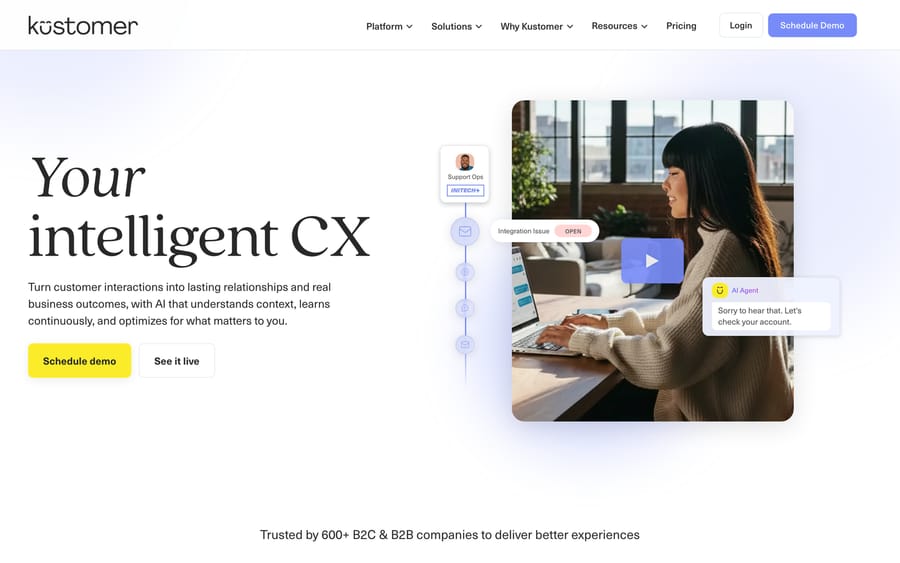
A brief note on who owns Kustomer
Kustomer was founded in 2015 by Brad Birnbaum and Jeremy Suriel. Meta (then still closely tied to Facebook's brand) announced its acquisition of Kustomer in 2020, and the deal reportedly closed in February 2022 at a value of roughly $1 billion after EU regulatory clearance. That ownership didn't last: Meta spun Kustomer back out to independence in May 2023, reportedly at a valuation of around $250 million, with a group of venture firms taking a stake, Meta retaining a minority position, and founder Brad Birnbaum staying on as CEO. We're hedging these figures because our direct fetches of the primary coverage returned access errors, so treat them as reported rather than vendor-confirmed. The practical takeaway for a buyer: Kustomer is once again an independently operated, venture-backed company. That matters if you were holding off evaluating it during the acquisition period.
What Kustomer's AI actually does
Kustomer's AI isn't one feature. It's four, built to hand off to each other instead of competing for the same job.
Concierge is the fully autonomous layer. It's built to resolve requests end to end across channels using the full customer context Kustomer already holds: order history, prior conversations, CRM fields. The vendor frames its goal as "loyalty, retention, and growth" outcomes, a broader target than pure ticket deflection.
Envoy is the human-assist layer. Where Concierge tries to close the loop without an agent, Envoy sits alongside a human agent and surfaces "context, intelligence, and tools" mid-conversation, the same customer data Concierge uses, but presented to a person making the call instead of an AI making it.
Architect is the builder: the interface for building, deploying, and iterating on the automated experiences Concierge and Envoy run.
Data Explorer is described around "goal-oriented optimization": you set a business goal, and the AI actions across the platform orient toward it. That's a different framing than most vendors in this category use. Instead of tuning individual automations, you're meant to set an outcome and let the system route effort toward it. In practice that likely means adjusting weighting or thresholds across Concierge and Envoy so both push toward the same measured target, whether that's average handle time, CSAT, or a retention metric, rather than each system being tuned independently by whoever configured it.
The mechanism underneath all four is the same idea that runs through most CRM-native AI: broad access to structured customer data (not just the current conversation) is what lets an automated response go further than a website chatbot's FAQ answer. Concierge can act on order history and account fields directly, because that data already lives in the same platform as the AI running against it.
Setting up Kustomer's AI
Concierge, Envoy, and Architect are core Kustomer features, so setup happens inside the same admin console you'd use for any other Kustomer configuration: connect your data sources, define the workflows Architect should build, and decide which conversation types route to Concierge versus straight to a human with Envoy support. Kustomer doesn't publish a self-serve trial or sandbox for testing this incrementally on the pages we could fetch, which lines up with its sales-assisted, quote-based buying process generally. For a team migrating from a simpler help desk, that means the AI configuration work happens as part of the same onboarding project as the CRM migration itself, not as a separate, later step you can defer. Budget the time accordingly: mapping which conversation types Concierge should own, versus which stay with Envoy-assisted humans, is a judgment call specific to your ticket mix, and nobody outside your own team can make it for you sight unseen.
What Kustomer's AI costs
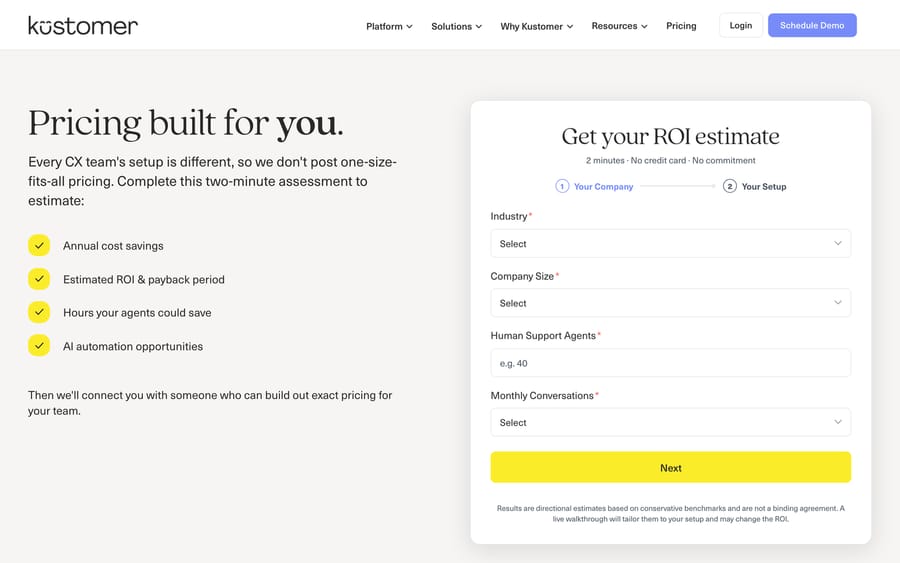
Kustomer's pricing page states plainly: "Pricing built for you. Every CX team's setup is different, so we don't post one-size-fits-all pricing." Instead of tiers, a prospective buyer completes a two-minute assessment and gets a personalized estimate covering annual cost savings, projected ROI and payback period, agent hours saved, and specific AI automation opportunities for their setup. There's no published number to cite, and no evidence from what we could fetch that Concierge, Envoy, Architect, or Data Explorer sit behind a separate paywall from the base platform. The two add-ons named on the pricing page are a HIPAA-enabled subscription and implementation services, both priced individually and kept off the headline number.
The practical read: if you want a dollar figure before talking to sales, Kustomer isn't going to give you one. That's a deliberate choice. Anchoring the sales conversation on a personalized ROI estimate, hours saved, payback period, projected savings, means the first number a prospect sees is a benefit, not a cost, which is a stronger negotiating position for Kustomer than a published price list would be. A CRM-and-AI platform bundled around your specific data volume and automation footprint is also genuinely harder to put a single sticker price on than a flat per-seat SaaS tool, so the incentive and the practical difficulty point the same direction.
Where Kustomer's AI stops
Everything Concierge, Envoy, and Architect do happens inside Kustomer's own CRM and conversation data. That's the platform's strength (broad, structured customer context feeding every automated response) and also its boundary: none of the four systems described on Kustomer's own site are framed as reaching outside Kustomer into a completely separate system that isn't already connected as a data source. If your team runs additional tools, a separate order management platform, a Slack-based escalation process, an internal wiki that isn't synced into Kustomer, those stay outside what Concierge and Envoy can act on until someone builds that connection.
The other boundary is configuration effort. Architect exists because building "customer experiences that deliver on your business goals" isn't a one-click toggle. Someone on your team, or someone from Kustomer's implementation service, has to define what a resolved Concierge conversation looks like and which conversation types get routed where. That's a normal cost of CRM-native automation generally. It's still a materially different lift than installing a chat widget.
Who Kustomer's AI suits
Kustomer's AI fits a team already running (or seriously evaluating) Kustomer as its core CRM and support platform, where the value of the AI comes specifically from acting on the same customer record the CRM already holds. It's a poor fit as a reason to switch platforms on its own. If you're on a different help desk and shopping for AI features specifically, Kustomer's AI isn't something you can bolt onto Zendesk or Freshdesk. It only exists inside Kustomer itself, which means the AI question and the "should we migrate our whole CRM" question are really the same question, whatever the marketing framing suggests. A team with years of workflows and integrations built around an existing help desk should weigh that migration cost honestly before treating Kustomer's AI as the deciding factor. See our Kustomer alternatives comparison if you're weighing the whole platform, beyond just the AI question.
Where an AI agent layer fits on top
Kustomer's AI is scoped to what happens inside Kustomer. For a team that wants AI agents acting across systems Kustomer doesn't natively reach, or that runs a different help desk entirely, an AI agent layer like Macha is a different kind of tool, built to sit inside a help desk and connect out to order data, subscriptions, and other backend systems through custom connectors, with agents built in plain English instead of through a CRM's own builder interface. Macha isn't a Kustomer alternative; it's not a CRM at all. For a Kustomer customer, the honest comparison is architectural, not competitive. Kustomer's AI works from data already inside Kustomer, while a layer like Macha reaches into whatever systems your agents need regardless of which help desk sits underneath. See how Macha's agents work and current pricing.
FAQ
What is Kustomer AI? The collective name for four built-in AI systems inside the Kustomer CRM: Concierge (autonomous resolution), Envoy (human-agent assist), Architect (the builder for both), and Data Explorer (goal-oriented optimization across the platform).
How much does Kustomer AI cost? Kustomer doesn't publish pricing for its AI or its base platform. It uses a two-minute assessment to generate a personalized quote and ROI estimate instead of published tiers.
Is Kustomer's AI included or an add-on? Based on what's published, Concierge, Envoy, Architect, and Data Explorer all appear to be part of the core platform rather than a separate paid tier, though Kustomer doesn't state this as an explicit guarantee on the pages we could access.
Is Kustomer still owned by Meta? No. Meta acquired Kustomer in a deal that reportedly closed in 2022, then spun it back out to independence in May 2023. Kustomer is again an independently operated company, with Meta reportedly holding a minority stake.
What's the difference between Concierge and Envoy? Concierge resolves a request end to end without a human. Envoy assists a human agent who's still handling the conversation, surfacing the same underlying customer context to help them respond.
Can Kustomer's AI connect to systems outside Kustomer? Only through whatever data sources and integrations you've connected into Kustomer. The AI acts on data already inside the platform; it isn't described as reaching into an unconnected external system on its own.
Are there good alternatives to Kustomer? See our best Kustomer alternatives guide for platform-level comparisons. If what you actually want is an AI agent layer to run across a help desk you already use, that's a different category of tool from Kustomer entirely.
Does using Kustomer's AI require migrating our whole support stack? Effectively, yes. Concierge, Envoy, and Architect all run on data inside Kustomer's own CRM, so getting the AI means adopting Kustomer as your customer service platform, not adding a plugin to your current one.
Sources: Kustomer homepage, Kustomer pricing.
Automate your support workflows
Macha's agents run multi-step workflows across the tools you already connect.