Intercom
 Shopify
 Stripe
 Slack
Slack Notion
 Google Workspace
 Confluence

Leena AI: The Complete Guide (2026)


Leena AI sells AI "colleagues" that sit inside Slack, Teams, or a browser and answer the HR and IT questions employees would otherwise file as tickets. This guide covers what it actually automates, how its pricing works, what real users say after buying it, and how it compares to Moveworks and Aisera if you're shortlisting enterprise employee-support AI.

We build AI agents for customer service ourselves, so we're comparing Leena AI the way a practitioner would: against what it actually ships in production.
Leena AI is a New York-headquartered company, founded in 2018 out of Y Combinator's Summer 2018 batch by Mayank Goyal, Adit Jain, and Anand Kumar Prajapati. It has raised more than $40 million from Bessemer Venture Partners, Greycroft, and angel investor Elad Gil, and now reports more than 500 enterprise customers and 20 million employees on its platform. It sells to large enterprises, not small support teams: named customers on its site include Coca-Cola, Nestlé, Abbott, H&M, Panasonic, Sony, Puma, Vodafone, and Airbnb.
What is Leena AI?
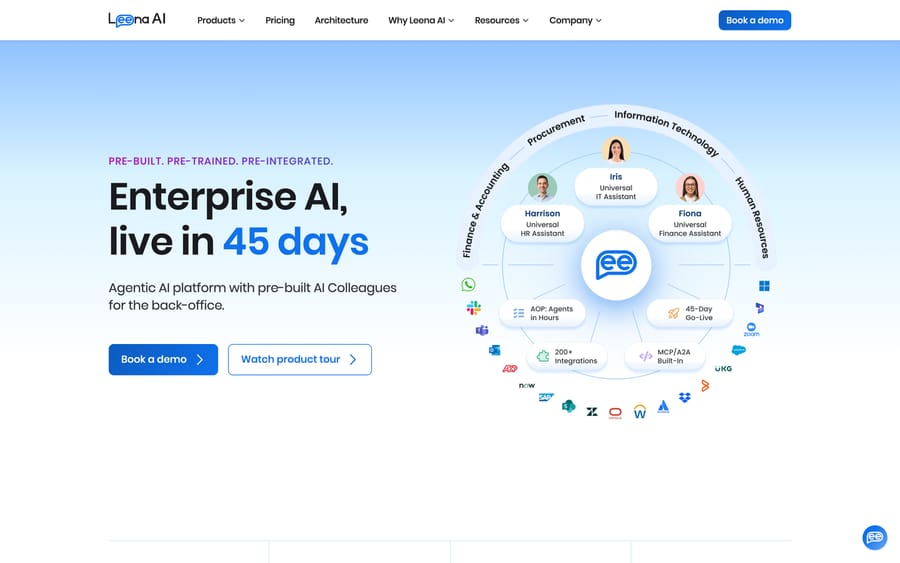
Leena AI is an "agentic AI platform" built around pre-packaged AI colleagues for enterprise back-office functions, not a single general-purpose bot. The three it leads with are Harrison (HR), Iris (IT), and Fiona (finance), each pre-trained on the workflows of that function so a buyer isn't starting from a blank agent. It connects to more than 200 enterprise systems, including Workday, SAP, Oracle, Salesforce, and ServiceNow, and it's built to work inside the channels employees already use: Slack, Microsoft Teams, WhatsApp, and email.
The pitch is speed to value. Leena AI's homepage headline is "Enterprise AI, live in 45 days." That number does real work in the sales pitch: it's the argument for buying a pre-built colleague instead of configuring a general platform like Kore.ai from scratch, where a comparable HR deployment can take months of policy-encoding work. Whether 45 days holds for a given enterprise depends on how many source systems get connected and how much custom policy logic HR wants encoded, and Leena AI doesn't publish a breakdown of what pushes that number up.
How Leena AI's technology works
Leena AI's architecture has three layers: the AI colleague itself (the conversational front end), a Knowledge Studio that ingests documents and policies from systems like SharePoint and Confluence, and what it calls Agent Operating Protocols (AOPs). AOPs let an HR or IT team describe a process in plain English and have Leena AI turn it into an automated workflow, so a policy change doesn't require a developer to rewrite logic.
For IT specifically, the platform does ticket triage and routing before it does resolution. On its IT service desk page, Leena AI claims "near perfect precision" in categorizing tickets by analyzing an employee's query, intent, role, team, and department, so misrouted requests don't sit in the wrong queue. Beyond routing, it automates the genuinely repetitive slice of IT work: password resets, account unlocks, access provisioning. Judgment-heavy tickets still go to a human agent, who gets a federated search across the company's connected knowledge bases plus AI-drafted answers pulled from past resolutions.
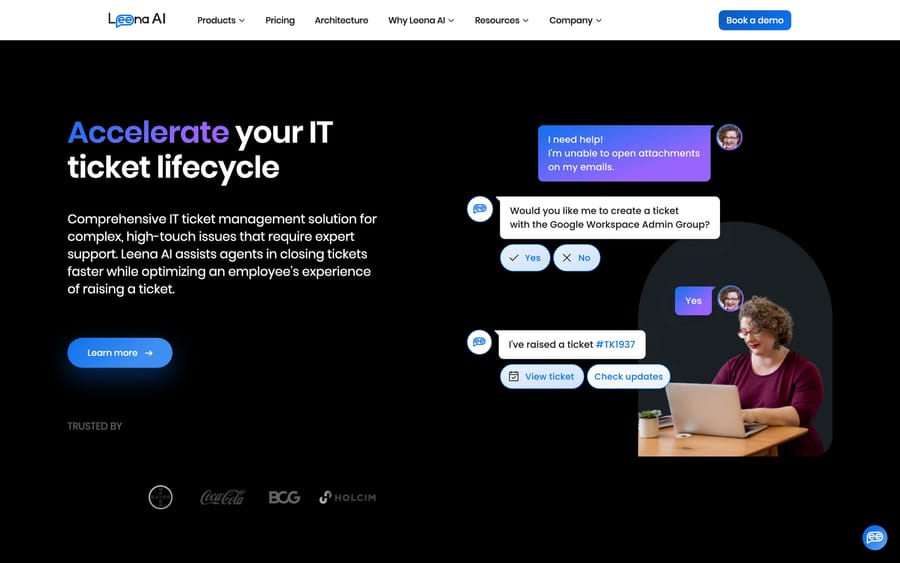
Leena AI also advertises MCP and A2A (agent-to-agent) interoperability out of the box, so a Leena AI colleague can hand off to or call another vendor's agent instead of forcing a customer to replace every existing automation at once. That's a real design choice, not a checkbox feature: a platform that wants to be the only agent in your stack has an incentive to make integration with rivals painful, and Leena AI is explicitly positioning against that by building interoperability in.
Key features
- Three pre-built AI colleagues for HR, IT, and finance, each pre-trained on the workflows of that department.
- Knowledge Studio, which indexes existing systems (SharePoint, Confluence, ServiceNow, an LMS) so the AI can answer from policy documents without a team re-authoring content into a new knowledge base.
- 200+ pre-built integrations, including Workday, SAP, Oracle, Salesforce, ADP, and UKG.
- Agent Operating Protocols (AOPs), letting a business team describe a process in plain English instead of filing an engineering ticket to encode it.
- Voice support and 100+ languages, aimed at global workforces.
- MCP/A2A interoperability, so Leena AI's agents can call or hand off to agents built on other platforms.
Leena AI pricing
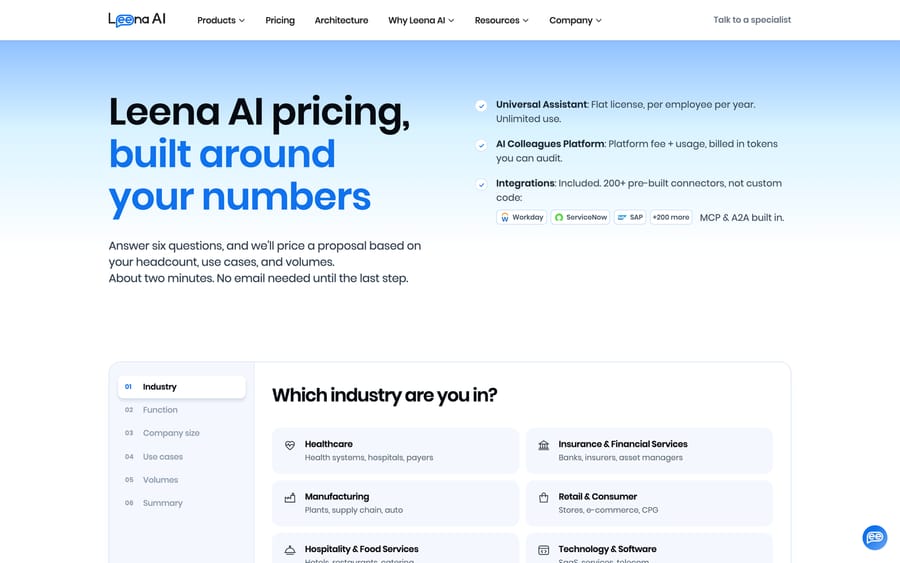
Leena AI does not publish prices, and its own pricing page is candid about why: "no two enterprises buy the same thing. Your price reflects your headcount, your workforce mix, and the use cases you deploy." In place of a price list, the site runs a six-question intake (industry, function, company size, use cases, volumes) that generates a custom proposal within one business day.
It does publish the shape of its two pricing models, which is more structural clarity than most enterprise AI vendors give before a sales call:
- Universal Assistant: a flat license priced per employee per year, with unlimited use. This is the model for a single deployed assistant covering a function like HR.
- AI Colleagues Platform: an annual platform fee plus usage billed in tokens the vendor says is auditable, meaning a buyer can see what's actually being charged for instead of trusting an opaque "resolution" count.
- Integrations are included in both models. The 200+ connectors aren't a paid add-on.
We checked the vendor's AWS Marketplace and Google Cloud Marketplace listings and found no public Leena AI listing with list pricing on either as of this writing, so per-employee or per-token figures aren't independently verifiable. Treat the vendor's own framing as the best available signal, not a firm quote: not publishing a number keeps every deal a private negotiation, which favors whichever side already knows what similar customers paid, and that's the seller. Macha takes the opposite approach and publishes its pricing tiers outright.
Pros and cons
Pros:
- Fast to a working deployment relative to building a custom bot, per the vendor's "45 days" claim and case-study language from customers like CHRISTUS Health, who described their go-live as "seamless."
- Pre-built for HR/IT/finance specifically, so buyers aren't starting from a blank agent and writing every policy answer themselves.
- Reviewers on Software Advice consistently cite ease of implementation and responsive vendor support across pharmaceutical, financial services, and building-materials companies.
- Auditable, token-based billing on the AI Colleagues Platform tier is more transparent than a flat "resolution" metric that hides what's actually being counted, which is exactly the incentive problem a resolution-based vendor has no reason to fix on its own.
Cons:
- No published pricing at all. Every deal requires a sales conversation, which costs real evaluation time for a buyer trying to compare three or four vendors quickly.
- Software Advice reviewers also note that customization takes considerable time and that the UI could be more refined, and some want more out-of-the-box integrations beyond the 200+ already offered.
- Built for large enterprises specifically. A 50-person company isn't the target customer, and the six-question pricing flow itself assumes headcount and use-case scale a small team won't have.
- Independent third-party review volume is thin: Software Advice shows 13 reviews, and we couldn't verify a G2 or Capterra rating (both blocked automated access), so buyers should ask Leena AI directly for reference customers close to their own size and industry.
Who Leena AI is best for
Leena AI fits a large enterprise at Coca-Cola or CHRISTUS Health scale that wants HR and IT self-service inside Slack or Teams without building an agent from zero. It particularly suits organizations already running Workday, ServiceNow, or SAP, since the value proposition leans on those 200+ pre-built connectors doing the integration work a smaller team would otherwise pay a systems integrator to build. If your actual problem is customer-facing support tickets, Leena AI isn't built for that. It's an internal, back-office tool.
Leena AI vs alternatives
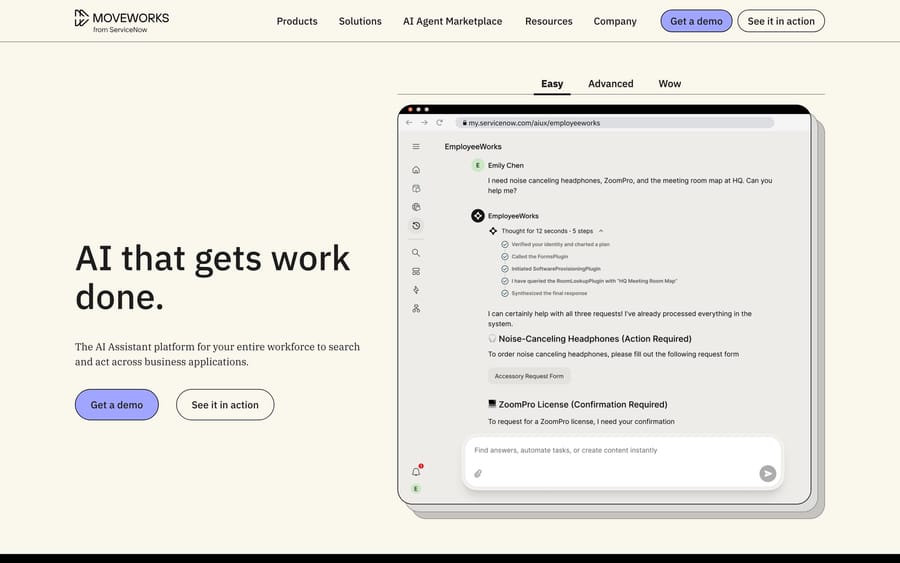
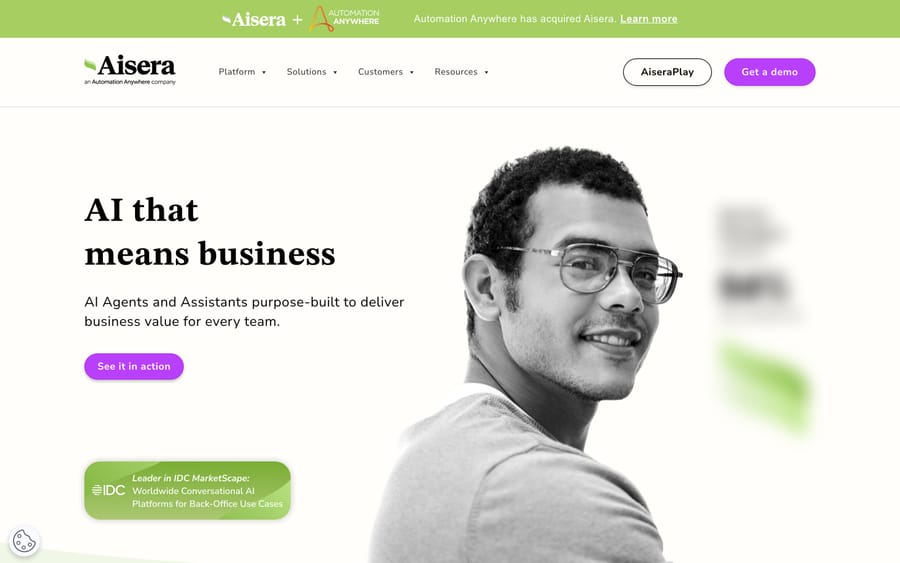
Leena AI competes most directly with Moveworks (now part of ServiceNow) and Aisera (now part of Automation Anywhere), both enterprise employee-support AI platforms with similar pre-built-agent positioning. Macha sits in a different category: it's a support-ticket AI agent layer for a team's existing customer-facing help desk, not an internal HR/IT tool. Treat this comparison as "which employee-support platform," not "which of these three do the same job."
| Leena AI | Moveworks | Macha | |
|---|---|---|---|
| Model | Pre-built AI colleagues for HR/IT/finance, deployed via Slack/Teams | AI assistant platform for the whole workforce, now part of ServiceNow | AI agent layer on your existing customer-facing help desk |
| Best for | Large enterprises automating internal HR/IT tickets | Enterprises already invested in the ServiceNow ecosystem | Support teams on Zendesk, Freshdesk, Gorgias or Front |
| Pricing | Not published; per-employee or platform-fee-plus-token, quote only | Not published; enterprise sales only | From $299/mo for 750 tickets (~$0.40/ticket), published |
| Setup | Vendor-led, ~45 days claimed | Vendor-led enterprise onboarding | Built, tested and monitored by the Macha team |
| Trial | None: demo and custom quote | None: demo only | $50 free usage |
Macha isn't a Leena AI substitute if the job is internal HR or IT deflection; that's simply not a use case Macha builds for. But if the real problem is customer support tickets piling up in Zendesk or Freshdesk, and "employee AI platforms" got floated as an option because that's the AI vendor category someone had heard of, Macha's AI agent layer fits teams solving that specific problem, because it's built for the help desk your support team already runs, not for internal employee questions.
How we researched this
This guide is based on Leena AI's own homepage, pricing page, and IT service desk page (fetched 2026-09-18), its Y Combinator company profile for founding and funding details, and Software Advice's published review aggregate (4.5/5 across 13 reviews, checked 2026-09-18) for third-party sentiment. G2, Capterra, TrustRadius, and Gartner Peer Insights all blocked automated access during research, so we couldn't independently verify a G2 star rating or pull additional attributed quotes from those platforms. Software Advice was the review source we could actually reach.
FAQ
What is Leena AI used for? Leena AI automates HR, IT, and finance support inside the tools employees already use (Slack, Teams, WhatsApp, email), answering policy questions and resolving tickets like password resets or benefits queries without a human agent.
How much does Leena AI cost? Leena AI doesn't publish pricing. It offers two models: a flat per-employee annual license with unlimited use, or an annual platform fee plus token-based usage. Get a quote through its six-question pricing flow or a sales call.
Is Leena AI the same as Leena AI's IT service desk? IT service desk is one of three product lines (alongside HR and finance), each built around a dedicated AI colleague: Iris for IT, Harrison for HR, Fiona for finance, all on the same underlying platform.
Who founded Leena AI and when? Leena AI was founded in 2018 by Mayank Goyal, Adit Jain, and Anand Kumar Prajapati, as part of Y Combinator's Summer 2018 batch. It's headquartered in New York.
What are the best Leena AI alternatives? Moveworks (now part of ServiceNow) and Aisera (now part of Automation Anywhere) are the closest direct competitors for enterprise employee-support AI. If the actual need is customer support automation rather than internal HR/IT, an AI agent layer like Macha fits teams solving that problem better than any employee-support platform would.
Does Leena AI replace ServiceNow or Workday? No. Leena AI integrates with those systems instead of replacing them. It's a conversational front end and automation layer that reads and writes to the HR/IT/finance systems a company already runs.
Is there a free trial for Leena AI? No self-serve free trial. Leena AI sells through demos and custom enterprise quotes.
How long does Leena AI take to set up? Leena AI advertises a 45-day go-live. Actual timelines depend on how many source systems need connecting and how much custom policy logic a team wants automated, which the vendor doesn't break down publicly.
Whichever employee-support platform you land on, get a concrete number for your own ticket or query volume before signing anything priced on a black-box "resolution" metric. And if what you're actually solving is a customer support queue rather than an internal HR/IT one, see how Macha's agents work on your existing help desk.
Sources:
- https://leena.ai
- https://leena.ai/pricing
- https://leena.ai/it-service-desk
- https://leena.ai/customers
- https://www.ycombinator.com/companies/leena-ai
- https://www.softwareadvice.com/hr/leena-ai-profile/
- https://www.moveworks.com
- https://aisera.com
Resolve tickets automatically with AI agents
Macha's AI agents work on top of the help desk you already use — no code.