Intercom
 Shopify
 Stripe
 Slack
Slack Notion
 Google Workspace
 Confluence

Octocom: The Complete Guide (2026)


Octocom sells an AI agent built specifically for ecommerce support: order changes, shopping questions, and social replies, wired into the platforms a store already runs on, with phone support and help-desk sync available as add-ons. This guide covers what that agent actually does, how Octocom's flat-band pricing works, what each tier leaves out, and where it lines up against the alternatives.

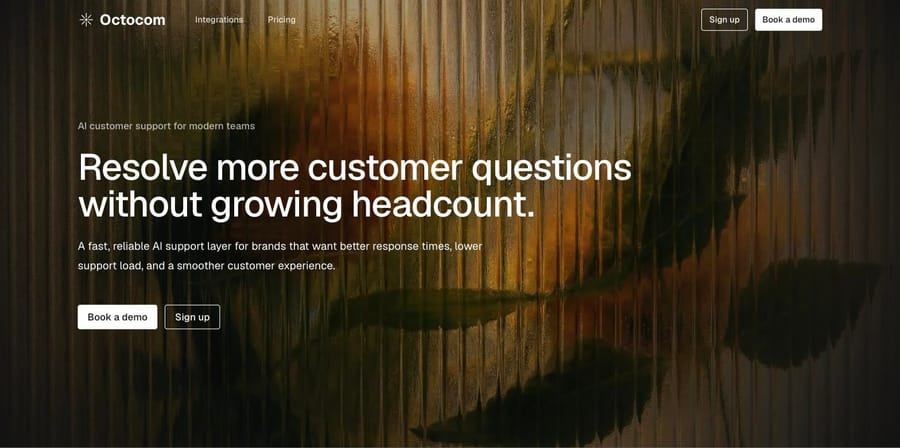
We checked Octocom's pricing page directly, including three of its FAQ accordions, since an earlier automated fetch of the same page missed the free-trial button and the overage policy entirely.
What Octocom is
Octocom builds an AI agent for ecommerce and DTC brands, positioned as a way to "resolve more customer questions without growing headcount." Its marketing names four roles for that agent: a Customer Service Agent for order modifications and policy questions, a Shopping Consultant that recommends products from the store's catalog, a Voice Agent for phone support, and a Social Media Agent that replies to comments and DMs. Octocom claims 1,000+ companies use the platform, with named customers including Bauhaus, CertaPet, Coffee Friend, FloraQueen, NOVOS Labs, Telia, and The Athlete's Foot; treat the 1,000+ figure as a vendor-reported scale claim with no independent audit behind it.
The real differentiator against a general-purpose AI chatbot is depth of ecommerce plumbing. Octocom natively integrates with Shopify, WooCommerce, PrestaShop, Magento 2, and BigCommerce for live order and catalog data, plus payments, returns, and subscription tools including Stripe, PayPal, AfterShip, Loop Returns, ShipStation, and Recharge. That breadth is the mechanism worth understanding: an agent that can only read a Shopify order is limited to answering, while one that also connects to Loop Returns and Recharge can process a return or pause a subscription without a human touching it.
How Octocom's AI works
Octocom describes its core agent plainly: "an AI agent that handles inbound customer conversations end-to-end and only escalates when it can't help." Underneath that framing sit two guardrail mechanisms the company names specifically, past what most marketing copy bothers to state. Hallucination mitigation keeps replies grounded in a store's approved sources and has the agent refuse to answer when it isn't confident, instead of guessing. Jailbreak prevention defends against prompt injection and adversarial attempts to bypass the rules a merchant sets. Both sit alongside multi-step workflows, which chain several actions and decisions together to resolve a request (a swap that requires checking stock, then processing the exchange, then confirming by email) without a human in the loop, and conditional workflow variants, which branch that logic based on customer attributes or order data so a VIP customer or a delayed order gets a different path than the default.
Channel coverage is broader than most competitors out of the box: website chat, email, contact forms, Facebook Messenger, Instagram DMs, and public Instagram/Facebook comment replies are all included on every plan. Two channels are priced separately: SMS and phone support (the Voice Agent) are listed as add-ons, not bundled into Basic or Advanced, and syncing two-way with a third-party help desk like Zendesk, Gorgias, or Intercom is also an add-on rather than a core feature. Worth planning around if the homepage's four-agent pitch led you to assume all four are included at every tier.
Key features
- Customer Service Agent: handles order modifications, cancellations, and policy questions end-to-end, escalating only when it can't resolve the request.
- Shopping Consultant: recommends products using store catalog data for pre-sale conversations.
- Multi-step and conditional workflows: chains actions across a request and branches logic on customer or order attributes (Advanced: unlimited; Basic: limited).
- Hallucination mitigation and jailbreak prevention: guardrails that keep replies grounded in approved sources and defend against prompt injection.
- Voice Agent and SMS: phone support and text messaging, sold as add-ons rather than bundled into the base tiers.
- Ecommerce integrations: Shopify, WooCommerce, PrestaShop, Magento 2, BigCommerce, plus custom product feeds and order APIs for anything else.
- Third-party help desk sync: two-way sync with Zendesk, Gorgias, and Intercom, sold as an add-on.
Octocom pricing (researched)
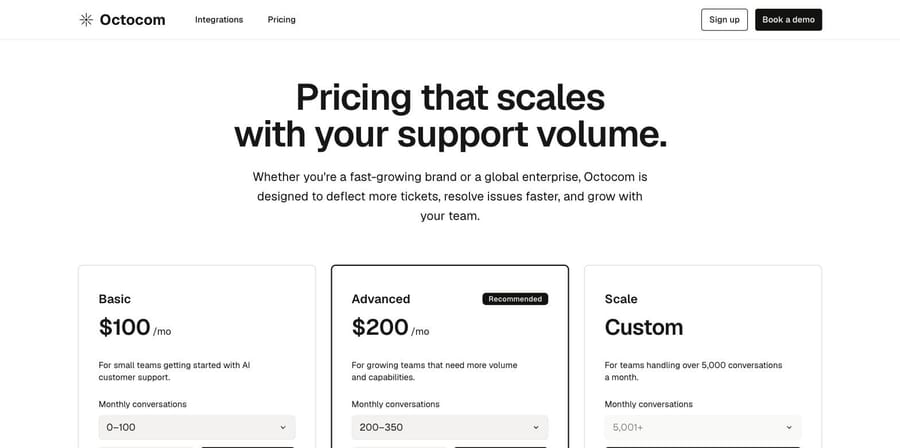
Octocom prices in three volume bands, and each is a flat monthly fee across a surprisingly wide conversation range rather than a per-unit rate:
| Plan | Price | Conversations/mo | AI agents | Seats | Stores | Support response |
|---|---|---|---|---|---|---|
| Basic | $100/mo flat | 0-199 | 1 | Up to 3 | 1 | 2 business days |
| Advanced | $200/mo flat | 200-5,000 | Up to 5 | Up to 10 | Up to 3 | 1 business day |
| Scale | Custom, decreasing per-conversation rate | 5,001+ | Unlimited | Unlimited | Unlimited | 4 hours |
That Advanced band is worth pausing on: $200/month covers anywhere from 200 to 5,000 conversations, a 25x range under one flat number, before Scale's custom, volume-declining rate takes over. The incentive behind flat bands instead of a strict per-conversation meter is worth naming: Octocom only earns more from you when you cross into the next band, not with every extra ticket, which is friendlier to a growing store than a meter that ticks up on day one of a busy month. Every plan, confirmed directly in Octocom's pricing FAQ, includes a 14-day free trial with no credit card required, and you can switch plans or cancel anytime from the dashboard. Going over a tier's monthly conversation limit doesn't cut the bot off either: extra conversations bill at the next tier's per-conversation rate, and Octocom says it warns you as you approach the limit. Scale pricing itself is usage-declining, meaning the effective per-conversation cost generally drops as volume grows, with the final number also shaped by any custom security, support, SLA, or procurement requirements.
Add-ons worth budgeting separately: the Voice Agent (phone support), SMS, third-party help desk sync (Zendesk/Gorgias/Intercom), Trustpilot and Google review-response automation, custom third-party integrations, session replay, and custom implementation support. None of these carry published prices; they're a sales conversation.
Pros and cons
Pros
- Purpose-built for ecommerce, with native Shopify, WooCommerce, BigCommerce, Magento 2, and PrestaShop integrations rather than a generic connector list.
- Named guardrails (hallucination mitigation, jailbreak prevention) instead of a bare "our AI is safe" claim.
- A genuinely wide flat-price band on Advanced ($200/month from 200 to 5,000 conversations) makes cost predictable through a lot of growth.
- A real 14-day free trial with no credit card, so you can test the agent against live traffic before paying.
Cons
- Voice, SMS, and help-desk sync (Zendesk/Gorgias/Intercom) are all separate add-ons with no published pricing, so the advertised $100-$200 tiers understate the real cost for a team that wants those.
- Overage billing at "the next tier's per-conversation rate" isn't itself a published number, so a busy month's bill is hard to estimate in advance.
- No detail is published on how the agent's confidence threshold is tuned, so evaluating reliability requires your own testing rather than the marketing pages.
- No founding date, funding, or company-history information is published, making the vendor's track record harder to verify than with more established competitors.
Who Octocom is best for
Octocom fits teams running ecommerce or DTC brands on Shopify, WooCommerce, BigCommerce, Magento, or PrestaShop that want an AI agent covering chat, email, contact forms, and social comments out of the box, with room to add phone and SMS later. If your support volume is genuinely ecommerce-shaped (order status, returns, subscription changes, product recommendations) and you already use tools like Loop Returns, Recharge, or ShipStation that Octocom connects to natively, the integration depth does real work, and the wide Advanced band means you won't outgrow pricing quickly.
It's a weaker fit for a team that needs phone support or two-way help desk sync from day one without budgeting for add-ons, or a business whose support questions are mostly account or B2B in nature rather than order- and catalog-shaped.
Octocom vs alternatives
| Octocom | Yuma AI | Macha | |
|---|---|---|---|
| Model | Ecommerce AI agent with guardrailed workflows | Ecommerce AI agent for support automation | AI agent layer on top of your existing help desk |
| Best for | DTC/ecommerce brands wanting broad channel coverage with optional voice/SMS | Ecommerce brands wanting AI ticket automation | Teams on Zendesk, Freshdesk, Gorgias, or Front |
| Pricing | $100-$200/mo flat tiers by conversation band, custom above 5,000 | Not fully published; sales-led | One plan by ticket volume, from $299/month for 750 tickets (about about $0.40 per ticket a ticket) |
| Voice/SMS | Add-on | Not a core feature | Not a core feature |
| Help desk sync | Add-on (Zendesk, Gorgias, Intercom) | Native | Is the help desk layer itself |
| Free trial | 14 days, no credit card | Limited | $50 of free usage (about 125 tickets), no credit card, no time limit |
| Replaces your help desk? | No, integrates with it | No | No, deliberately augments it |
Octocom and Yuma both start from the same premise, an AI agent that understands ecommerce orders and policies, and the choice between them usually comes down to channel coverage and how much you want bundled versus added on. If your support work already runs inside a help desk and the gap isn't ecommerce-specific plumbing but agents built to your own instructions, Macha is the more direct fit: it runs on top of the help desk you already use, priced on ticket volume with a published pricing page instead of a conversation-band tier plus add-ons.
FAQ
What is Octocom? Octocom is an AI customer support platform built for ecommerce and DTC brands, marketed around four agent roles: a Customer Service Agent, a Shopping Consultant, a Voice Agent, and a Social Media Agent.
How much does Octocom cost? Basic is a flat $100/month for 0-199 conversations, Advanced is a flat $200/month for 200-5,000 conversations, and Scale is custom-priced with a per-conversation rate that generally decreases with volume above that. Voice, SMS, and help-desk sync are separate add-ons.
Does Octocom offer a free trial? Yes. Every plan includes a 14-day free trial with no credit card required, and you can switch plans or cancel anytime from the dashboard.
What happens if a store exceeds its conversation limit? It isn't cut off. Extra conversations bill at the next tier's per-conversation rate, and Octocom says it warns accounts as they approach their limit.
How does Octocom's AI stay accurate and avoid making things up? Through two named guardrails: hallucination mitigation, which grounds replies in a store's approved sources and has the agent decline to answer when it's unsure, and jailbreak prevention, which defends against prompt injection and adversarial attempts to bypass the rules a merchant sets.
Is phone or SMS support included in Octocom's base price? No. The Voice Agent (phone) and SMS are both listed as add-ons on top of the Basic and Advanced plans, with pricing handled through sales.
What platforms does Octocom integrate with? Natively: Shopify, WooCommerce, PrestaShop, Magento 2, and BigCommerce for ecommerce; Stripe, PayPal, Braintree, and Adyen for payments; AfterShip, Loop Returns, ShipStation, and Narvar for returns and shipping; and Recharge, Skio, and Bold for subscriptions. Zendesk, Gorgias, and Intercom sync is available as an add-on.
What are good alternatives to Octocom? Yuma AI is the closest comparison for an ecommerce-specific AI agent. For teams that want AI agents acting inside an existing help desk's ticket queue with published, ticket-based pricing, Macha is a lighter-weight alternative.
Sources: Octocom homepage, Octocom pricing.
Resolve tickets automatically with AI agents
Macha's AI agents work on top of the help desk you already use — no code.