Intercom
 Shopify
 Stripe
 Slack
Slack Notion
 Google Workspace
 Confluence

Omilia: The Complete Guide (2026)


Omilia builds a fully proprietary voice AI stack, no borrowed speech-to-text, no borrowed text-to-speech, for banks, insurers, and large retail chains that need a phone system handling over a million calls a day without a third-party API in the critical path. This guide covers what Omilia's platform actually does, how its outcome-based pricing works, what its funding and customer scale actually look like, and where it fits next to Parloa and a help-desk-native alternative.

We build AI agents for customer service that sit inside a help desk's ticket queue, worlds away from a phone network, so this guide reads Omilia as a specialist in a category we don't compete in.
What is Omilia
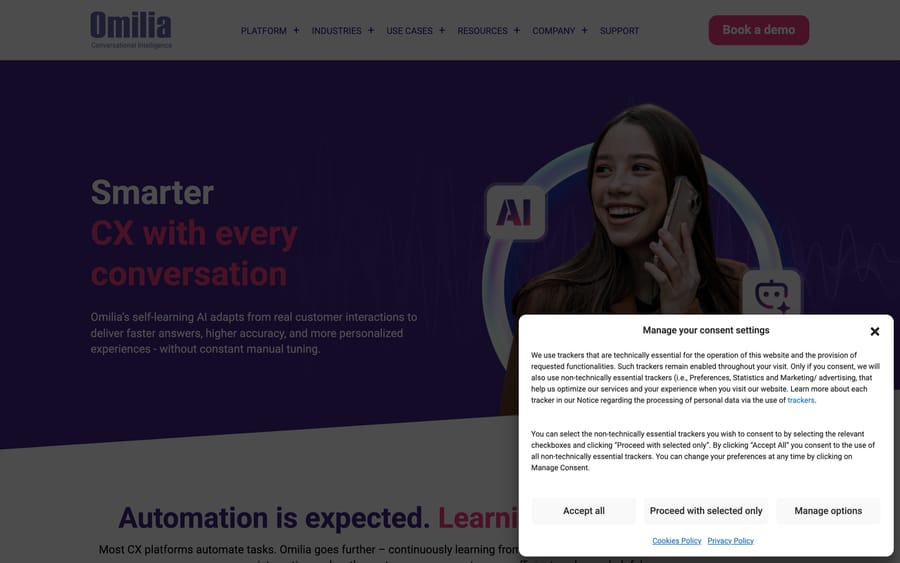
Omilia was founded in Athens, Greece, and now also operates out of New York, building what it calls the Omilia Cloud Platform (OCP) for enterprise conversational AI. The company secured $67 million in Series B funding on August 6, 2026, led by Expedition Growth Capital, with its own announcement stating annual recurring revenue had passed $60 million and had grown more than 10x since its Series A without an additional equity raise in between. That's a genuinely strong capital-efficiency story for a company this deep into hardware-adjacent infrastructure, building its own speech models from the ground up.
Omilia says it runs some of the largest agentic voice deployments in production today, including handling over 1 million calls daily for a Tier 1 US bank and 600,000-plus daily calls for a major insurance company, figures that are vendor-reported and worth treating as a scale claim, unaudited. Its published customer list includes Capital One, Discover, RBC, Taco Bell, Nissan, Allstate, DWP, and PSEG, concentrated in finance, insurance, government, and quick-service restaurants: industries where a dropped or mishandled call has a real cost.
How Omilia's AI works
Omilia's core pitch is architectural: its speech pipeline is fully native, proprietary ASR (speech recognition), a proprietary dialog manager, and its own Lexis text-to-speech engine, with no third-party speech-to-text or text-to-speech API anywhere in the chain. That matters for two concrete reasons. First, latency: chaining several third-party APIs together adds round-trip time that a single vertically integrated stack doesn't carry. Second, data residency: utterance audio never leaves Omilia's certified environment, which the company positions as a requirement for PCI Level 1 and FedRAMP compliance in regulated industries.
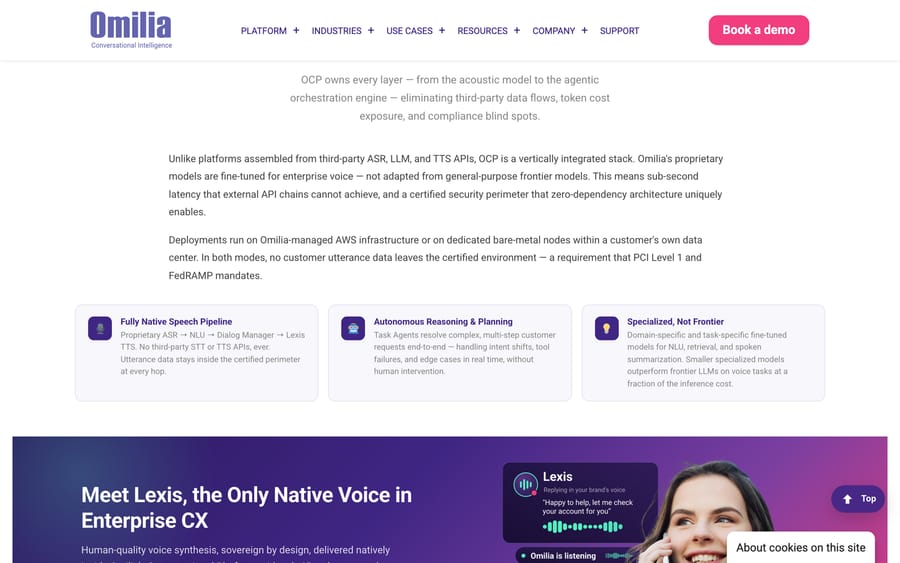
Task Agents are Omilia's term for the autonomous side of the platform: agents that resolve complex, multi-step requests end to end, including handling intent shifts and tool failures in real time without a human stepping in. The company also argues that smaller, task-specific models beat general-purpose frontier LLMs on voice tasks specifically, at a fraction of the inference cost, a claim that lines up with the broader industry pattern of narrow, fine-tuned models outperforming large general models on bounded tasks.
Key features
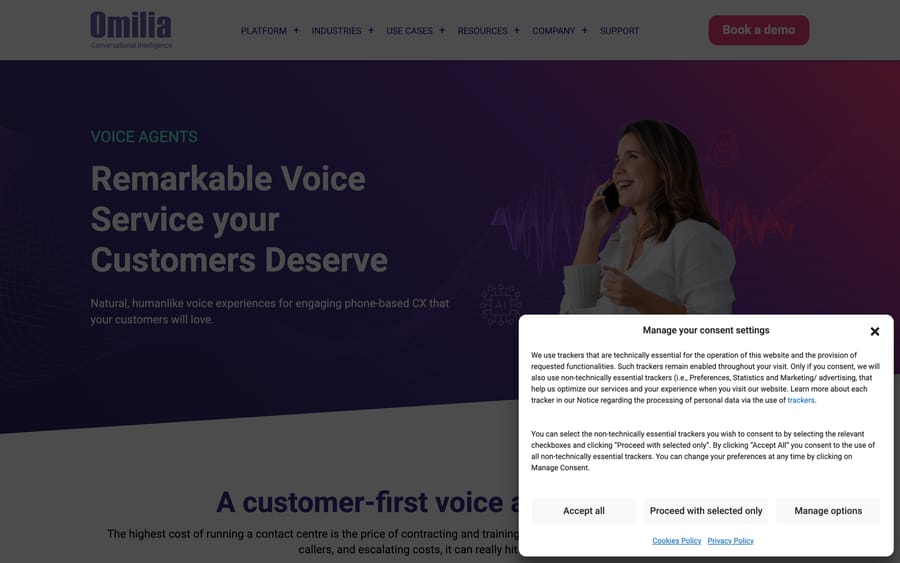
- Voice Agents: natural-language phone automation the company reports completes over 90% of tasks without escalation.
- Chat Agents: the same conversational engine applied to digital messaging channels.
- TalkGuard: anti-fraud protection and voice biometrics authentication built into the call flow.
- CSR CoPilot: real-time assistance for human agents handling calls the AI hands off.
- Workforce AI: automated quality management and call analysis across the contact center.
- Drive-Thru Voice AI: a purpose-built product for quick-service restaurant ordering.
- Self-learning engine: offline learning that discovers new resolution patterns from live interaction data instead of requiring constant manual rule updates.
Omilia pricing
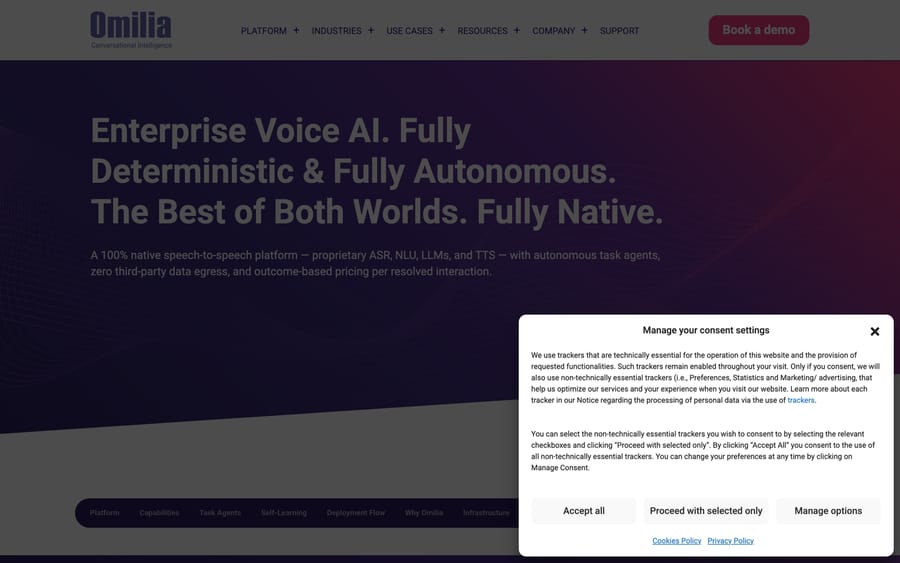
Omilia doesn't publish a rate card, and no independent contract-value data (Vendr, AWS Marketplace, or similar) exists for the company at the time of writing, unlike several of its more heavily benchmarked peers. What Omilia's own site does state clearly is the pricing mechanism: one price per resolved interaction, regardless of how many agentic steps it took to get there. The company frames this explicitly against token-metered billing, positioning "zero token cost pass-through" as removing the risk of a compute overage charge when a call takes an unexpectedly long reasoning path.
That mechanism is worth naming for what it rewards. A vendor billing by the token or by compute time earns more when a model takes longer or loops more to reach an answer, an incentive that quietly punishes efficiency. Omilia's per-resolved-interaction model instead ties revenue to the outcome a customer actually wanted, so a call resolved in three reasoning steps costs the buyer the same as one resolved in fifteen. The trade-off is that "resolved" is Omilia's own definition to negotiate at contract time, and with no public number or third-party benchmark available, a prospective buyer has to get that definition and the resulting price in writing before assuming the incentive works entirely in their favor.
Real users on Omilia
This is the one section of this guide where the honest answer is: we couldn't independently verify it. A secondary search pass surfaced a Gartner Peer Insights rating of 4.7 out of 5 from 67 reviews, and Omilia says it was named the only Customers' Choice vendor in Gartner's 2024 Peer Insights Voice of the Customer report for Enterprise Conversational AI Platforms. But direct fetches to Gartner, G2, TrustRadius, and Capterra all returned access errors for this vendor, and no individually attributed reviewer quote could be confirmed firsthand. This guide states plainly instead: treat the 4.7/5 figure as reported until you can pull the live page yourself and verify it.
Omilia has also been named a Leader in Forrester's Wave for Conversational AI Platforms (Q2 2026) and a Visionary in Gartner's 2026 Magic Quadrant for Conversational AI Platforms, both of which reflect analyst evaluation more than user sentiment.
Pros and cons
Pros
- Fully native speech stack removes third-party API dependencies from the latency and compliance path.
- Outcome-based pricing aligns cost with resolved interactions instead of compute consumed.
- Strong, capital-efficient growth story (10x ARR since Series A, $60M+ ARR) suggests real enterprise traction behind the funding headline.
- Deep regulated-industry credentials: PCI Level 1, FedRAMP-aligned deployment, and built-in fraud/biometrics via TalkGuard.
Cons
- No public pricing and no third-party contract-value data available, which makes early budgeting difficult.
- Independent, individually attributed review quotes couldn't be verified for this guide; treat aggregate ratings as reported and unconfirmed.
- Performance figures (97% intent accuracy, sub-1-second latency, 90%+ task completion) are vendor-reported comparisons against industry averages, still awaiting independent benchmarking.
- Built for voice-first, high-volume enterprise contact centers; overkill for a team whose support problem lives in email and chat tickets.
Who Omilia is best for
Omilia suits you if you run a large, regulated enterprise, a bank, insurer, or national retail or restaurant chain, with genuinely high call volumes and a compliance function that cares about where voice data physically goes. If your contact center already handles millions of calls a month and a dropped or mishandled one carries real financial or regulatory risk, Omilia's architecture argument is a serious one to evaluate.
It's a poor match for a team without that call volume or that compliance burden, and it has nothing to offer a support team whose actual bottleneck is a Zendesk or Freshdesk ticket queue instead of a phone line.
Omilia vs alternatives
| Omilia | Parloa | Macha | |
|---|---|---|---|
| Model | Fully native voice AI stack, outcome-based pricing | Voice AI agent platform for contact centers | AI agent layer on your existing help desk |
| Best for | Large regulated enterprises with high call volumes | Enterprise contact centers automating voice | Teams on Zendesk, Freshdesk, Gorgias, or Front automating ticket volume |
| Pricing | Not published; per resolved interaction, no token pass-through | Not published; enterprise quote | From $299/mo for 750 tickets (about $0.40/ticket), published |
| Stack | Proprietary ASR, NLU, and TTS end to end | Built on a mix of underlying models | Sits on top of the help desk's own data |
| Channel | Voice-first, plus chat | Voice-first | Email, chat, and messaging tickets |
See our Parloa guide for the deeper look at that comparison. Omilia and Parloa are both solving the same enterprise voice problem for a similar buyer; the real differentiator between them is architectural: a native stack versus an assembled one, more than which one is more "AI." Macha isn't a candidate for either use case: it has nothing to say about a ringing phone. If a support team's real bottleneck is its ticket queue, Macha is a faster and far cheaper place to start. See pricing for the current numbers.
How we researched this: we checked Omilia's own homepage and product pages directly on 2026-09-17, working around the site's bot protection with a standard browser identity. Funding and ARR figures came from Omilia's own newsroom announcement. No independent pricing benchmark exists for this vendor; its outcome-based model is stated on its own site but not attached to a number. Review-site access was blocked across the board, so the Gartner Peer Insights figure is reported, not independently confirmed.
FAQ
What is Omilia? Omilia is an enterprise voice AI company that builds a fully proprietary speech stack (ASR, NLU, and TTS) for large, regulated contact centers in banking, insurance, retail, and quick-service restaurants.
How much does Omilia cost? Omilia doesn't publish pricing. It charges one price per resolved interaction regardless of how many reasoning steps an agent takes, with no separate token or compute charge, but the actual rate is negotiated per enterprise contract.
Is Omilia's technology different from platforms built on third-party APIs? Yes, by its own account. Omilia builds its ASR, dialog management, and TTS (branded Lexis) natively rather than assembling them from third-party vendors, which it argues lowers latency and keeps utterance data inside a certified compliance perimeter.
How big is Omilia? The company reported annual recurring revenue past $60 million and more than 10x ARR growth since its Series A as of its $67 million Series B in August 2026, alongside deployments handling over 1 million calls a day for at least one large bank customer.
Is Omilia good, based on reviews? A secondary source reports a Gartner Peer Insights rating of 4.7 out of 5 from 67 reviews, but this guide could not independently verify that figure or pull an attributed reviewer quote, since Gartner, G2, TrustRadius, and Capterra all blocked automated access.
What are good Omilia alternatives? Parloa is the closest direct comparison for enterprise voice AI. For a support team whose real bottleneck is email and chat ticket volume rather than phone calls, Macha is a different kind of tool built for that job.
Does Omilia work outside of voice? Yes, Chat Agents apply the same underlying conversational engine to digital messaging channels, though voice remains the company's primary focus and differentiator.
Omilia is a serious option for a regulated enterprise with real call volume to automate. If your bottleneck is actually the ticket queue in Zendesk or Freshdesk, start a Macha trial or check /pricing.
Sources: Omilia homepage, Omilia, Enterprise Voice AI, Omilia, Voice Agents, Omilia newsroom, $67M Series B announcement, Parloa homepage, Macha's Parloa guide.
Resolve tickets automatically with AI agents
Macha's AI agents work on top of the help desk you already use — no code.