Intercom
 Shopify
 Stripe
 Slack
Slack Notion
 Google Workspace
 Confluence

Pypestream: The Complete Guide (2026)


Pypestream builds voice and chat AI agents for enterprise customer service, and its pitch is specifically about finishing transactions, filing claims, resolving disputes, completing payments, not just answering questions. This guide covers what the platform does, what a deal likely costs (Pypestream publishes nothing and no third-party pricing source could be found either), the real customer evidence available, and how it compares to Kore.ai.

We build AI agents for customer service ourselves, at a much smaller scale than Pypestream's enterprise deployments, so treat this as an outside comparison.
What is Pypestream?
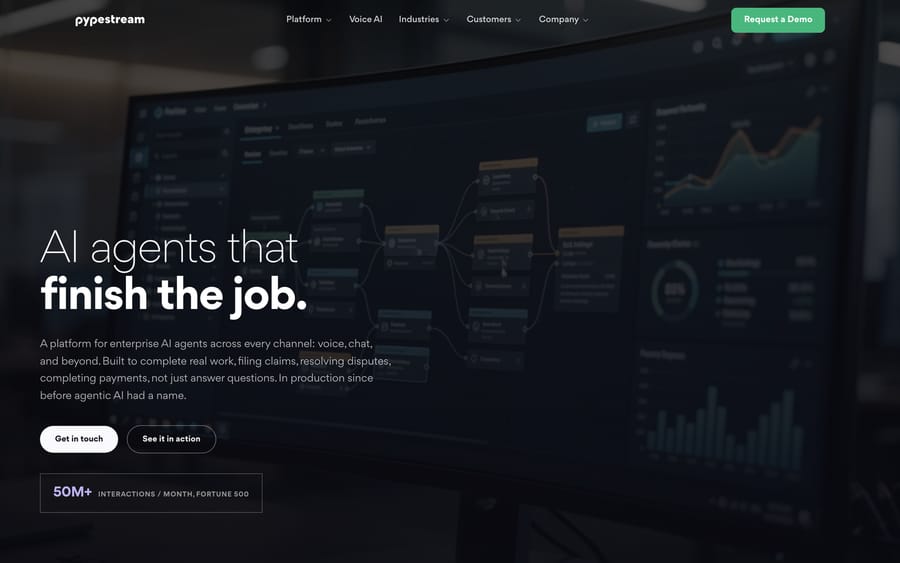
Pypestream is an enterprise AI agent platform, founded in 2015 and currently at Series B stage, that builds voice and chat agents trained on a company's own systems and workflows. The company's own framing leans on tenure: it says it has been "in production since before agentic AI had a name," and its site lists 11-plus years in production, 100 million-plus consumers helped, and more than 3,000 AI agents deployed across 34-plus countries.
The company sells into insurance, health insurance, telecom, travel, media, and retail, and its named, verifiable customers include Sling TV, TriWest Healthcare Alliance, and WR Berkley, alongside several case studies published under anonymized names like "National Wireless Carrier" and "National P&C Carrier."
How Pypestream's AI works
Pypestream's platform spans four pieces shown together on its product page: an AI Agent Builder, Voice AI, Chat Agents, and Analytics. The company's own distinction from a typical chatbot is completion: an agent is meant to look up a policy, pull a real-time quote from a backend system like Guidewire or Duck Creek, collect a document with OCR extraction, and close out the interaction, instead of routing the customer to a human once the conversation gets specific.
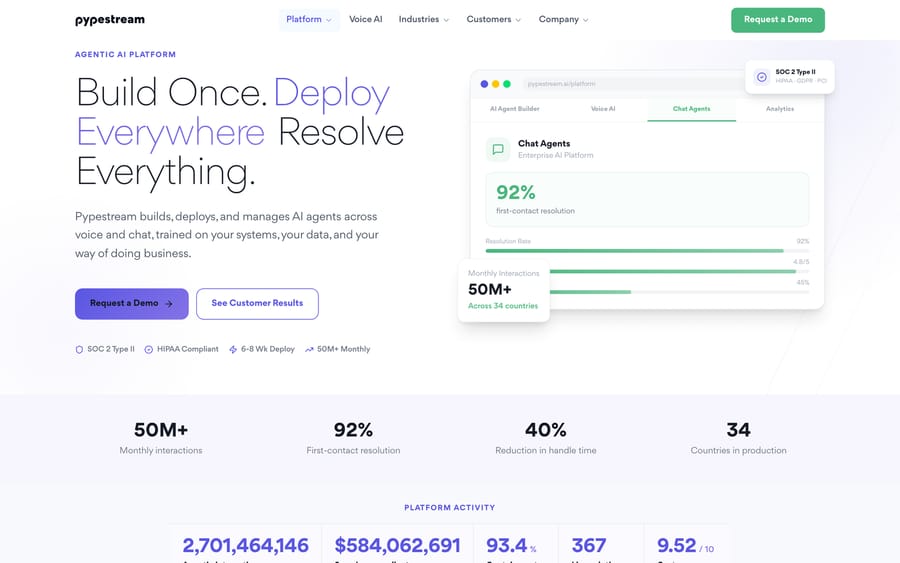
A live counter on that page (continuously updating, by its own description) showed over 2.7 billion cumulative agentic interactions and more than $580 million saved across clients at the time we checked it, alongside a reported 93-95% containment rate (resolved without a human) across roughly 367 live deployments. Treat the exact figures as a snapshot, since the counter moves in real time, but the order of magnitude, billions of interactions and hundreds of millions in reported savings across a multi-year customer base, is the useful signal.
When an agent does reach its limit, Pypestream's Human-in-the-Loop handoff carries the full conversation transcript, customer intent, sentiment, and history to the live agent, with an average handoff time the company puts at 0.4 seconds, so a customer doesn't have to re-explain the issue.
Key features
- AI Agent Builder for designing agents trained on a company's own SOPs, systems, and data.
- Voice AI with sub-second response times, positioned as natural-sounding, and HIPAA-compliant.
- Chat Agents across web, mobile, WhatsApp, and SMS with consistent context across channels.
- Human-in-the-Loop escalation that transfers full conversation history and AI-suggested responses when an agent hits its limit.
- Analytics built around the same production metrics the company publishes externally: resolution rate, containment, and cost impact.
- Compliance certifications: SOC 2 Type II, HIPAA, GDPR, and PCI.
Pypestream pricing
Pypestream does not publish pricing anywhere on its site. Every path leads to "Request a Demo."
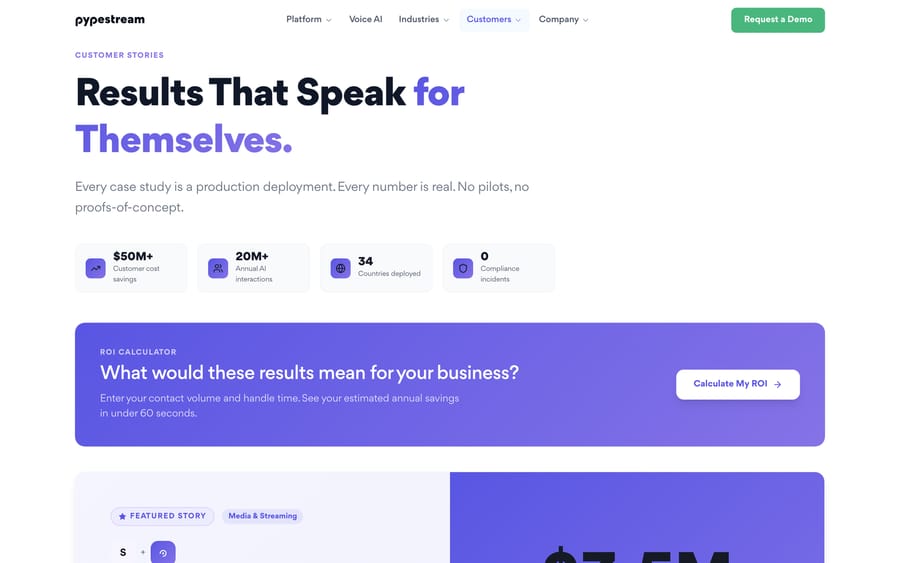
We checked before writing "not published." Vendr's listing for Pypestream carries no contract-value data, and no AWS, Azure, or Google Cloud Marketplace listing exists for the company either. That's a genuine gap, not a step we skipped. The site does offer an ROI calculator that estimates savings from a buyer's own contact volume and handle time, a sales tool, not a pricing page, but it does at least frame the conversation around measurable numbers before the first call. Building a calculator that always shows savings is itself a sales incentive worth naming: it invites a buyer to imagine a return before a single dollar figure has been discussed.
Real customer evidence, since third-party reviews were out of reach
Pypestream links its own G2 profile directly from its homepage, and we tried to pull a rating from it; G2 blocked the request on every attempt, including through a headless browser, and this session's search budget was exhausted before a cached fallback could be tried. What we could verify instead were Pypestream's own published case studies, which are unusually specific for vendor marketing.
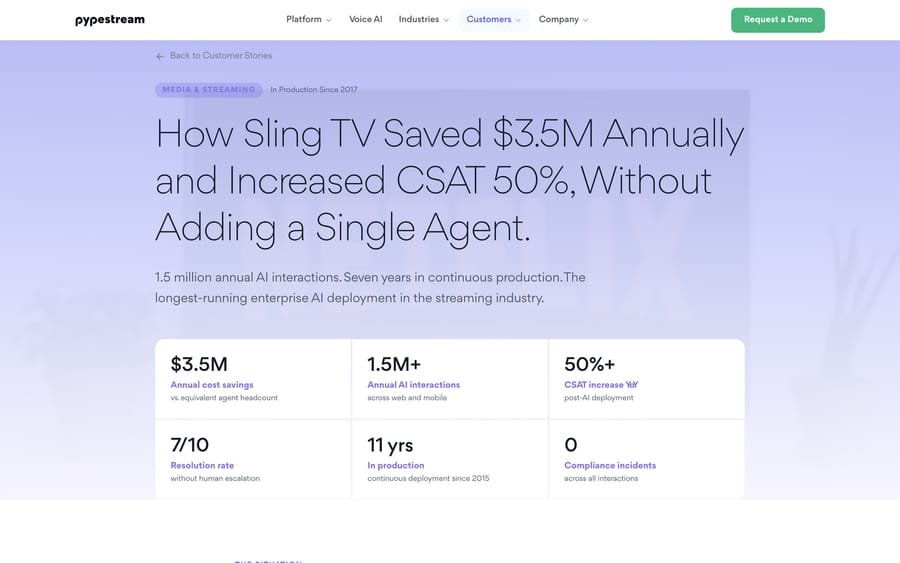
Sling TV's case study, attributed to Seth Van Sickel, SVP, reports $3.5 million in annual cost savings, 1.5 million-plus annual AI interactions, a 50%-plus year-over-year CSAT increase, and 11 years of continuous production since 2015, with zero compliance incidents. TriWest Healthcare Alliance reports a 92% member-inquiry automation rate and zero HIPAA incidents across 3.8 million member interactions. WR Berkley and several anonymized insurance and telecom deployments report similarly specific numbers, including one national P&C carrier whose case study claims a first-notice-of-loss CSAT improvement from 2.3 to 4.8 in six months. These are vendor-published case studies with named executives in some instances, and we're labeling them as such, so read the specific figures as Pypestream's strongest documented examples.
Pros and cons
Pros
- Genuine longevity: 11-plus years of continuous production deployments, including a named customer (Sling TV) running since 2015.
- Unusually specific, named case-study data: dollar savings, CSAT scores, compliance-incident counts, instead of vague marketing claims.
- A real architectural distinction: built for completing transactions (claims, payments, disputes), not just answering FAQs.
- Fast, structured Human-in-the-Loop handoff with a stated 0.4-second average transfer time and full context preserved.
Cons
- Zero pricing transparency, and unlike some vendors in this category, no Vendr estimate or marketplace listing fills the gap.
- No accessible third-party review data (G2 blocked every attempt) at the time of this research.
- The live "Platform Activity" counter's headline numbers shift in real time, which makes citing a precise figure from the site inherently a moving target.
- Enterprise-only sales motion with no self-serve option, so evaluating it requires a real sales process.
Who Pypestream is best for
Pypestream fits large enterprises, particularly in insurance, health insurance, telecom, and media, that need AI agents to complete real transactional work: claims, billing, disputes, payments, and that value a vendor with over a decade of production history to point to. If your evaluation criteria include "has this actually run in production for years, not just a pilot," Pypestream's case-study library is built specifically to answer that question.
It's the wrong fit if you want any visibility into cost before a sales conversation, since there's no published number and no third-party pricing source to check it against. It's also the wrong tool if your actual bottleneck is a support team's ticket backlog. That's a help-desk automation problem, priced and built differently.
Pypestream vs alternatives
| Pypestream | Kore.ai | Macha | |
|---|---|---|---|
| Model | Voice and chat AI agents built to complete transactions (claims, payments, disputes) | Enterprise agentic AI platform (Artemis) across CX and employee experience | AI agent layer on your existing help desk |
| Best for | Insurance, health insurance, telecom, and media enterprises with regulated workflows | Enterprises wanting one platform across customer and employee AI use cases | Support teams on Zendesk, Freshdesk, Front, or Gorgias |
| Pricing | Not published; no marketplace or Vendr listing found | Not published; enterprise sales | From $299/mo for 750 tickets (~$0.40/ticket), published |
| Reviews | Not accessible at time of research | See our Kore.ai guide for details | N/A (new category on G2) |
| Self-serve trial | No | No | $50 of free usage, no credit card |
| Setup | 6-8 week deployment with Pypestream's team | Enterprise deployment with Kore.ai's team | Built, tested and monitored by the Macha team |
| Replaces your help desk? | Not applicable; not a help desk product | Not applicable; not a help desk product | No, it deliberately augments it |
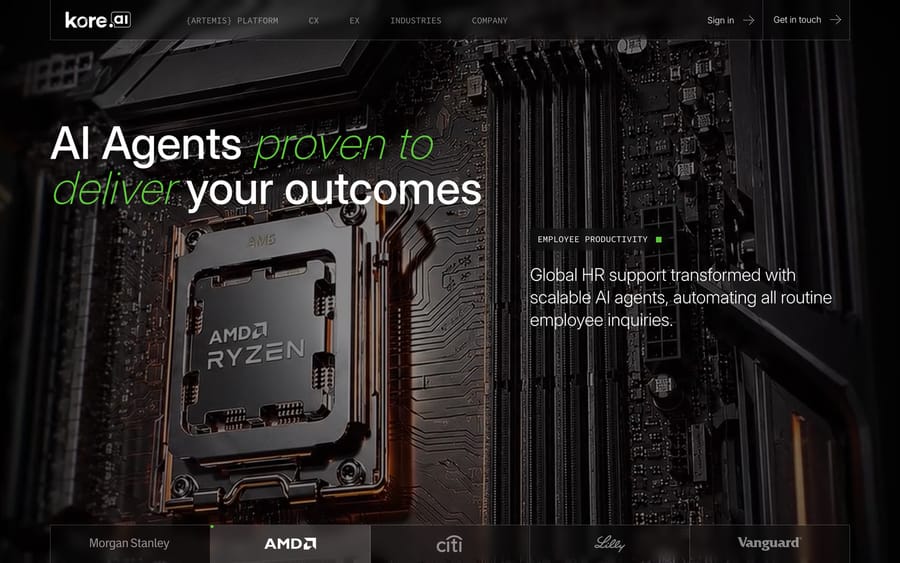
Kore.ai is the closer comparison for enterprise scope: both sell a broad agentic AI platform instead of a single point tool, and both name major enterprise customers (Morgan Stanley, AMD, Citi, and Lilly appear on Kore.ai's site) instead of publishing pricing. The practical difference is breadth: Kore.ai explicitly spans customer experience and employee experience use cases under one platform, while Pypestream stays focused on customer-facing voice and chat specifically. If your buying committee includes an HR or IT stakeholder as well as customer service, that difference is worth raising early in a bake-off.
Neither vendor touches a support team's ticket backlog, which is a different problem. If your bottleneck is email and chat tickets, Macha runs as an agent layer on top of the help desk you already use, priced per ticket instead of per enterprise contract.
How we researched this
pypestream.ai renders entirely client-side, so a plain fetch returns only a page title with no body content; every claim here comes from a JavaScript-rendered capture of the live site (home, /product, /company, /customers, and the Sling TV case study), taken 2026-09-17. The Platform Activity counters update continuously by the page's own description, so we're reporting them as an as-of snapshot. We attempted Pypestream's own linked G2 profile and Vendr for pricing and review data; G2 returned a 403 on every attempt, including through a headless browser, and Vendr shows no pricing for Pypestream. This session's WebSearch budget was used up before a cached-search fallback could be tried, so this guide relies on Pypestream's own named case studies for customer evidence, and we've labeled that limitation directly instead of filling the gap with a guess. Kore.ai's homepage was fetched directly.
FAQ
What is Pypestream? An enterprise AI agent platform, founded in 2015, that builds voice and chat agents designed to complete transactions like claims filing, dispute resolution, and payments, not just answer questions.
How much does Pypestream cost? Pricing isn't published, and no marketplace listing or Vendr estimate is available either, which is unusual even for enterprise AI. Expect a sales-led evaluation built around an ROI calculator instead of a price list.
Is Pypestream good, based on reviews? We couldn't access G2 for a rating during this research, and no cached search fallback was available. What's verifiable is Pypestream's own published case studies, including a named Sling TV executive reporting $3.5 million in annual savings and 11 years of continuous production.
Does Pypestream offer a free trial? No self-serve trial is listed. Every path on the site leads to requesting a demo.
How long has Pypestream been in production? The company says over 11 years, with its Sling TV deployment specifically running continuously since 2015.
What are good alternatives to Pypestream? Kore.ai is the closer comparison for enterprises wanting one platform across both customer and employee AI use cases. Neither is a fit for a support team's ticket backlog, which is a help-desk automation problem instead.
Who are Pypestream's named customers? Sling TV, TriWest Healthcare Alliance, and WR Berkley are named directly, alongside several anonymized case studies in telecom, insurance, and retail.
If your actual bottleneck is a support team's ticket queue, see how Macha's pricing works or start a trial.
Sources: Pypestream, Pypestream - Product, Pypestream - Company, Pypestream - Customers, Pypestream - Sling TV case study, Vendr - Pypestream listing, Kore.ai, G2 - Pypestream reviews (blocks automated fetches).
Resolve tickets automatically with AI agents
Macha's AI agents work on top of the help desk you already use — no code.