Intercom
 Shopify
 Stripe
 Slack
Slack Notion
 Google Workspace
 Confluence

Rasa AI: The Complete Guide (2026)


Rasa is an open, developer-first platform for building enterprise conversational AI agents, combining large language models with deterministic business logic through a framework it calls CALM. This guide covers what it actually does, its real pricing tiers, company background, and where it fits next to a fully managed alternative.

We build AI agents for customer service ourselves, so we read Rasa the way a technical evaluator would: what you actually get on the free tier, what changes once you need Enterprise, and where the open-framework pitch genuinely differs from a closed platform.
What is Rasa?
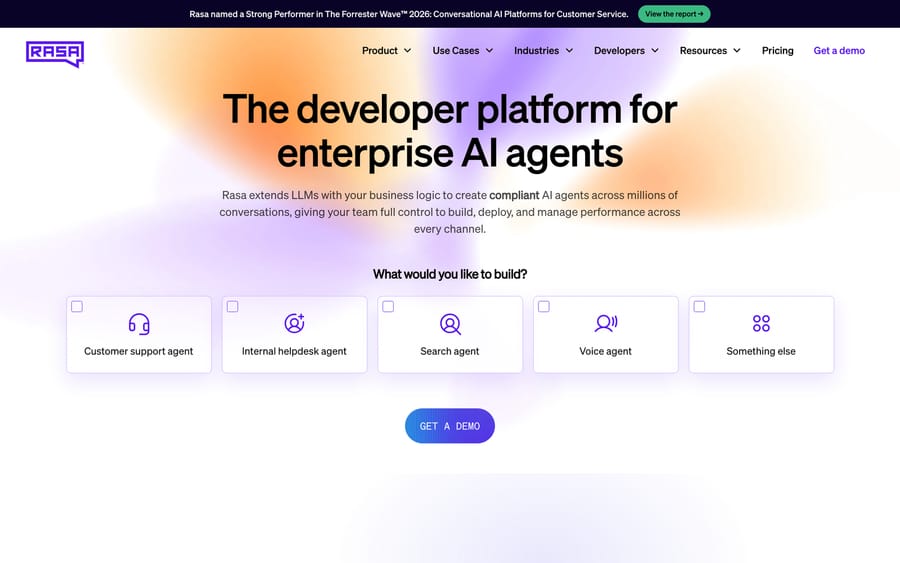
Rasa was founded in 2016 and is headquartered in Berlin, with a San Francisco office, built on the open-source NLU and dialog-management work the founding team started that year. Alan Nichol, co-founder, remains CTO; current leadership includes CEO Melissa Gordon, Chief Product Officer Björn Minkmar, and Chief Revenue Officer Vikas Bhambri. Investors named on Rasa's own site include Andreessen Horowitz, PayPal Ventures, Accel, Basis Set Ventures, Salisbury Ventures, and Mango Capital, though Rasa doesn't disclose a specific funding total or round amounts publicly.
Rasa positions itself squarely at technical teams in regulated industries, finance, healthcare, insurance, telecom, and government, where "full access to prompts, policies, and codebase" and on-premises or offline deployment options matter as much as the conversational AI itself. Named customers include Autodesk, BNP Paribas Fortis, Groupe IMA, Swisscom, and Providence Health, alongside Orange, Albert Heijn, and N26 referenced elsewhere on Rasa's site. Rasa was named a Strong Performer in Forrester's 2026 Wave for Conversational AI Platforms for Customer Service, per Rasa's own citation of the report.
How Rasa's AI works
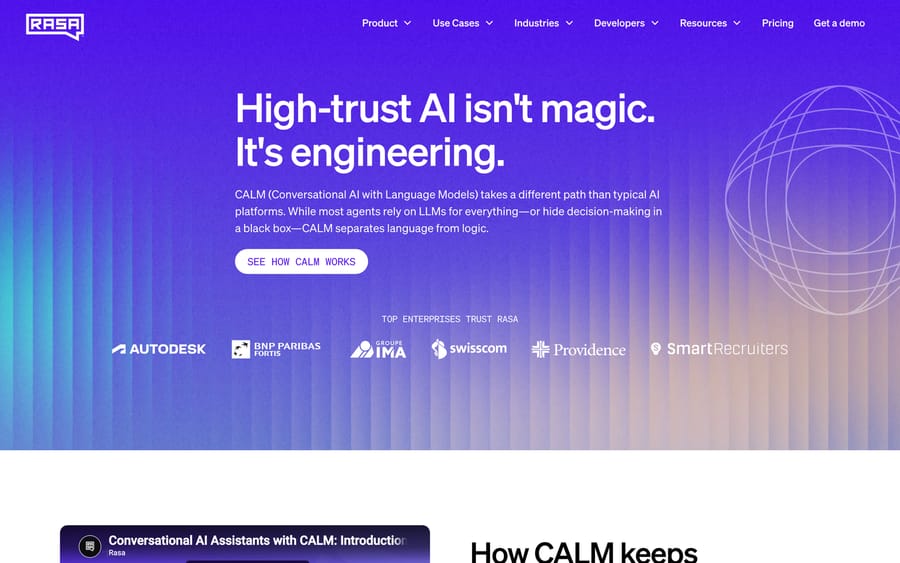
The core technical argument is CALM (Conversational AI with Language Models), and it's a genuine architectural choice, not just a marketing label. Rasa's own framing: most conversational AI platforms either rely on an LLM for everything, improvising every response, or hide their decision logic in an opaque "composite" system nobody can fully audit. CALM instead separates language understanding (handled by an LLM) from business logic (handled by deterministic, developer-defined flows), so an agent can hold a natural conversation while still guaranteeing it never skips a required compliance step or promises something the business logic doesn't allow.
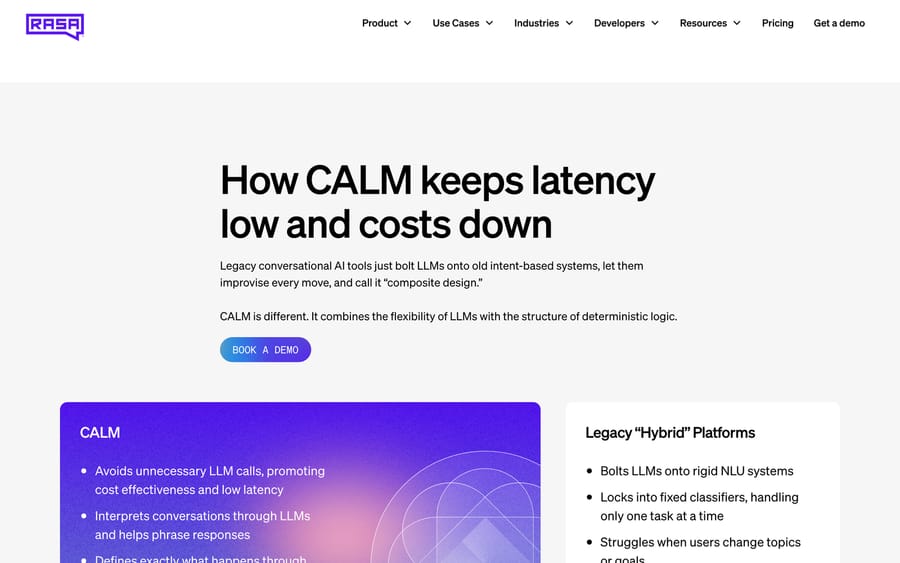
That comparison matters concretely for cost and reliability: a legacy hybrid platform calls the LLM constantly and locks into fixed classifiers that handle one task at a time, struggling when a user changes topics mid-conversation. CALM avoids unnecessary LLM calls specifically to keep latency and cost down, while still letting the LLM interpret free-form language and help phrase responses. Rasa reports, in its own figures that we could not independently audit, a 50% cost reduction across more than 50 enterprise deployments and a 59% goal-completion rate per conversation using this approach.
Key features
- CALM framework: separates LLM-driven language understanding from deterministic business logic.
- Open framework: full access to prompts, policies, and the underlying codebase, with no vendor lock-in.
- Multi-agent orchestration: coordinates domain-specific agents while maintaining conversational state.
- Voice/IVR support: real-time speech processing with turn-taking and barge-in handling.
- Flexible deployment: on-premises, private cloud, or fully offline environments, a genuine differentiator for regulated industries.
- Real-time observability: built-in monitoring, evaluation, and performance tracking.
Rasa pricing
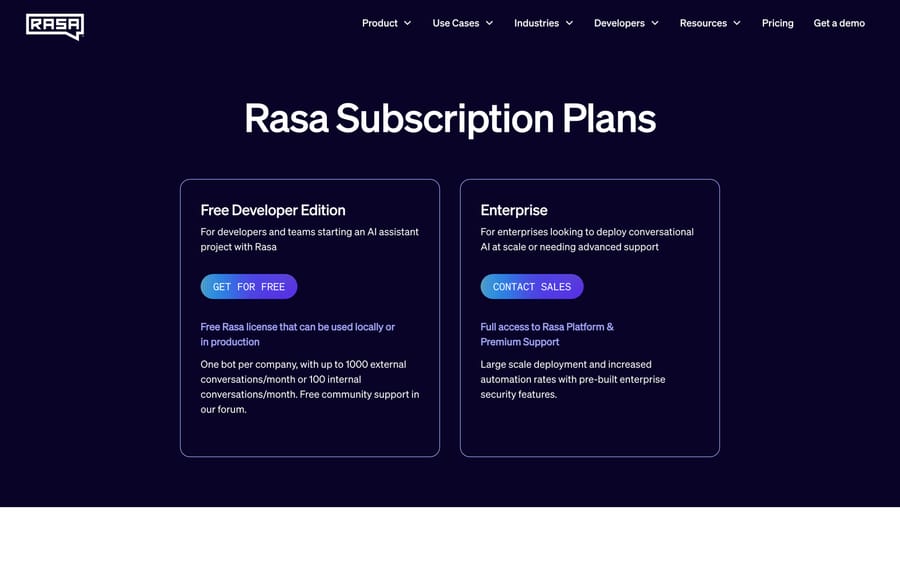
Rasa publishes a genuinely usable free tier: the Free Developer Edition gives one bot per company, up to 1,000 external conversations a month (or 100 internal conversations), usable locally or in production, with community forum support. That's a real production allowance, well beyond a sandbox, which is unusual in this category.
Beyond that, Enterprise is custom-quoted, requiring a sales conversation, and adds full platform access, premium support with 24/7/365 response times, a dedicated Customer Success Manager and engineer, and self-managed or managed deployment options. One inconsistency worth flagging: an earlier pass at Rasa's pricing surfaced a distinct "Business" tier (bundling Rasa Pro with a no-code Rasa Studio interface) that didn't appear on the two-tier version we screenshotted directly, so Rasa's tier structure may be in flux, or gated behind a toggle we didn't trigger. Either way, there's no published number for anything beyond the free tier, so budget for a sales conversation once the 1,000-conversation ceiling is a real constraint. Giving away a genuinely usable free tier is its own incentive: a developer who builds a working bot on Rasa's own infrastructure and workflow is the easiest possible lead for the Enterprise sales team once that bot needs to scale past what the free tier allows.
Pros and cons
Pros
- A genuinely usable free production tier (1,000 conversations/month), not just a trial.
- Full framework transparency: prompts, policies, and codebase are yours to inspect and modify, with no vendor lock-in.
- On-premises and fully offline deployment options, a real requirement for some regulated industries.
- CALM's separation of language from logic is a defensible architectural answer to LLM hallucination risk in a business-critical flow.
Cons
- No published pricing beyond the free tier; Enterprise requires a full sales cycle.
- The framework's flexibility comes with real technical setup: it's a developer platform first, with a point-and-click builder as an add-on rather than the default experience.
- We could not find independent, third-party review data (G2 and Gartner Peer Insights both blocked automated access); the only satisfaction figures available are Rasa's own.
- Apparent inconsistency in the current tier structure (a "Business" tier we found in one pass, absent from another) makes it harder to compare pricing cleanly.
What actual users say
We could not independently verify user sentiment for this guide: both G2 and Gartner Peer Insights blocked our direct research access, and a specific product review page we attempted on Capterra resolved to an unrelated product instead of Rasa's own listing. What's available is Rasa's own citation of a 4.4-star customer satisfaction figure on its homepage, alongside the Forrester Wave 2026 recognition and the 50%-cost-reduction, 59%-goal-completion statistics discussed above, all vendor-reported figures we could not independently source.
How we researched this: we checked Rasa's homepage, pricing, platform, and CALM pages directly on 2026-09-17, plus rasa.com/about for company background. G2 and Gartner Peer Insights both returned blocked responses to a direct fetch, and this session's WebSearch budget was used up before an independent review source could be found, so third-party review data is a genuine gap in this guide. We're disclosing that gap instead of filling it with a number we couldn't verify.
Who Rasa is best for
Rasa fits engineering teams at regulated enterprises, finance, healthcare, insurance, telecom, government, that need full control over prompts and decision logic, potentially on-premises or fully offline, and that have the technical capacity to build on an open framework rather than configure a closed platform. The free tier's real 1,000-conversation production allowance also makes it a reasonable starting point for a technical team validating an approach before an Enterprise conversation.
Rasa fits teams with engineering capacity more than it fits a non-technical team wanting a managed, point-and-click agent with someone else handling the infrastructure. Rasa's core pitch, full framework access and deployment flexibility, is precisely the thing a team without engineering resources doesn't need and would pay an ongoing setup cost to use well.
Rasa vs alternatives
| Rasa | Kore.ai | Macha | |
|---|---|---|---|
| Model | Open, developer-first conversational AI framework | Enterprise agentic AI platform for CX and EX | AI agent layer on your existing help desk |
| Best for | Engineering teams needing full framework control, on-prem/offline options | Enterprise contact centers wanting a managed platform | Teams on Zendesk, Freshdesk, Gorgias, or Front |
| Pricing | Free (1,000 conversations/mo); Enterprise custom | Not independently verified here; see the Kore.ai guide | From $299/mo for 750 tickets (~$0.40/ticket), published |
| Setup | Developer-built on an open framework | Sales-led, enterprise onboarding | Built, tested, and monitored by the Macha team |
| Trial | Free tier, real production allowance | Demo-gated | $50 free usage |
| Replaces your help desk? | No, it's a framework for building agents, not a ticketing system | No, layers onto existing CX/EX systems | No, deliberately augments it |
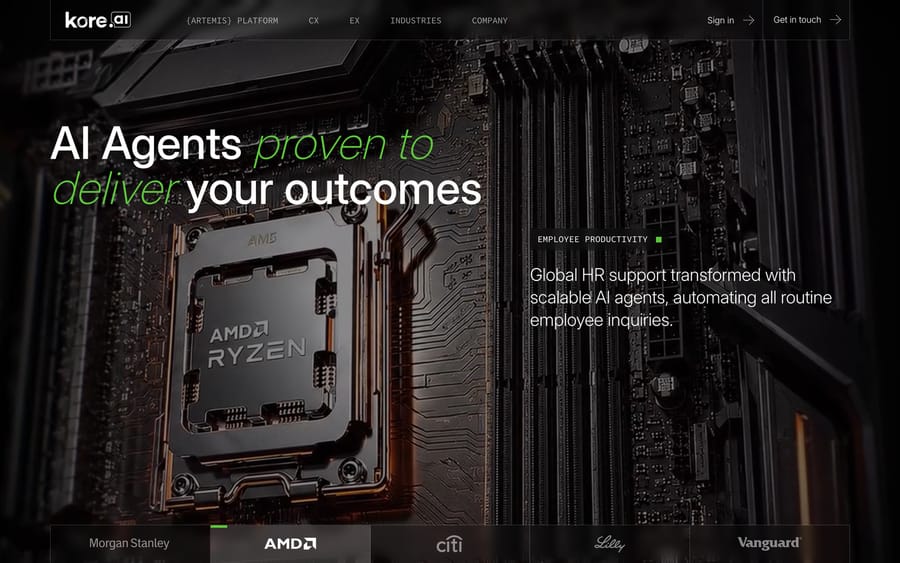
Rasa and Kore.ai sit at genuinely different points on the build-versus-buy spectrum: Rasa gives a technical team a framework to build and fully control, while Kore.ai sells a more managed enterprise platform through a sales-led process. The choice between them usually comes down to whether an organization has (or wants) the engineering capacity to own its conversational AI stack directly.
Macha sits outside this comparison entirely: instead of a framework for building a conversational AI agent from scratch, it's an AI agent layer that runs on top of a help desk a team already uses (Zendesk, Freshdesk, Gorgias, or Front), with the Macha team building, testing, and monitoring the agents rather than a developer team building on an open framework. A team that wants to own its own conversational AI stack fits Rasa; a team that wants a working agent on its existing help desk without a build project fits Macha. See Macha's pricing or start with $50 of free usage against real tickets.
FAQ
What is Rasa? Rasa is an open, developer-first platform for building enterprise conversational AI agents, founded in 2016, built around its CALM framework that separates LLM-driven language understanding from deterministic business logic.
How much does Rasa cost? The Free Developer Edition allows one bot per company with up to 1,000 external conversations a month, usable in production, at no cost. Enterprise pricing is custom and requires a sales conversation, adding full platform access and premium support.
Is Rasa open source? Rasa is built on open-source foundations, and its framework gives full access to prompts, policies, and the underlying codebase, with no vendor lock-in, though its paid tiers are commercial products layered on top.
What is CALM? CALM (Conversational AI with Language Models) is Rasa's architecture for separating language understanding (handled by an LLM) from business logic (handled by deterministic flows), aimed at keeping an agent reliable and auditable rather than fully improvised.
What do real users say about Rasa? We could not find independent third-party review data for this guide; G2 and Gartner Peer Insights both blocked direct research access. Rasa's own site cites a 4.4-star customer satisfaction figure and a Forrester Wave 2026 Strong Performer recognition.
Who is Rasa best for? Engineering teams at regulated enterprises (finance, healthcare, insurance, telecom, government) that need full control over their conversational AI stack, potentially with on-premises or offline deployment requirements.
Is Macha an alternative to Rasa? Not directly. Rasa is an open framework for building conversational AI agents from scratch; Macha is an AI agent layer that runs on top of a help desk a team already uses (Zendesk, Freshdesk, Gorgias, or Front), built and managed by the Macha team. A team that wants to own its stack fits Rasa; a team that wants a working agent without a build project fits Macha.
Sources: Rasa, Rasa pricing, Rasa Platform, Rasa CALM, Rasa about. G2 and Gartner Peer Insights both blocked our direct research access.
Resolve tickets automatically with AI agents
Macha's AI agents work on top of the help desk you already use — no code.