Intercom
 Shopify
 Stripe
 Slack
Slack Notion
 Google Workspace
 Confluence

Replicant AI: The Complete Guide (2026)


Replicant builds AI voice agents by cloning a contact center's own best conversations instead of starting from a blank script, and DoorDash's public case study reports it automating more than 350,000 calls a day at an 87% resolution rate. This guide covers what Replicant actually does, real G2 and Capterra reviews including a pricing complaint worth reading before a sales call, what it costs based on the little Replicant will say publicly, and how it compares to PolyAI and Macha for teams evaluating voice AI against a lighter, help-desk-native option.

Replicant's whole pitch is in its name: it markets itself as "AI that replicates your best agents on their best day," building new agents from a company's own transcripts instead of a generic template.
What is Replicant?
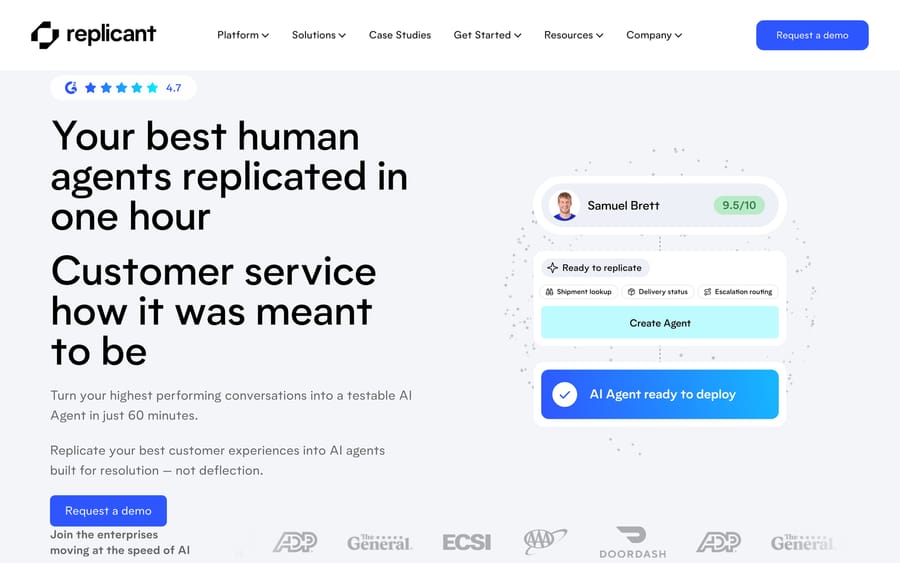
Replicant is a conversational AI platform for contact centers that turns "your highest performing conversations into a testable AI Agent in just 60 minutes," built from a company's own conversation data starting point. It sells three core capabilities: Conversation Automation (resolving requests without adding agents), Conversation Intelligence (analytics across every conversation, automated and human-handled alike), and multi-channel support across voice, chat, and SMS. The company reports being "proven across 1B+ minutes at the world's most trusted brands," with named customers including DoorDash, AAA, ADP, and ECSI visible on its site.
A specific design choice differentiates Replicant from a pure-LLM competitor: it combines deterministic reasoning for business rules with generative AI for the conversational parts, so a policy like "never approve a refund over $200 without a human" is enforced by code, not by hoping the model follows an instruction. That's paired with automatic PII redaction, redundant failover systems, and SOC 2, HIPAA, PCI DSS, and GDPR compliance, aimed at handling regulated, high-stakes calls: payments, healthcare, insurance, on top of low-risk FAQ traffic.
Real results: the DoorDash case study
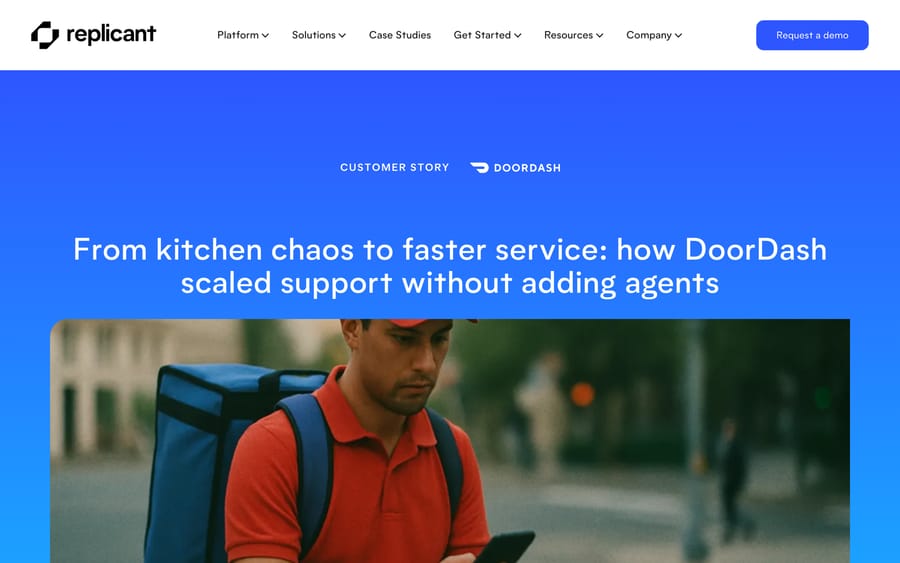
DoorDash's published case study is specific enough to be worth reading directly instead of summarizing from a homepage stat. It reports 350,000-plus calls automated per day at an 87% resolution rate with 0-minute hold times, deployed in six weeks from kick-off to launch. During a tax-season campaign, Replicant reportedly handled nearly 800,000 calls in eight days and saved more than 2.5 million agent minutes, letting DoorDash avoid hiring seasonal agents during a predictable volume spike. Within the first six weeks of the initial deployment, DoorDash reports over 35,000 food orders placed daily through the automated flow, alongside falling escalations and rising customer satisfaction.
That's a genuinely detailed, checkable case study rather than a vague testimonial, and it's the kind of evidence worth asking Replicant to reproduce for your own volume during a sales conversation.
How Replicant's AI works
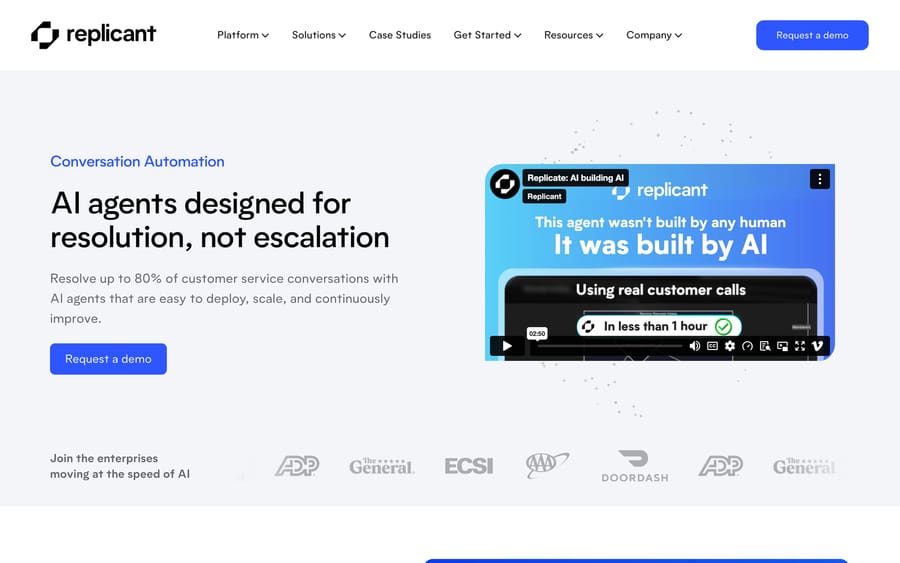
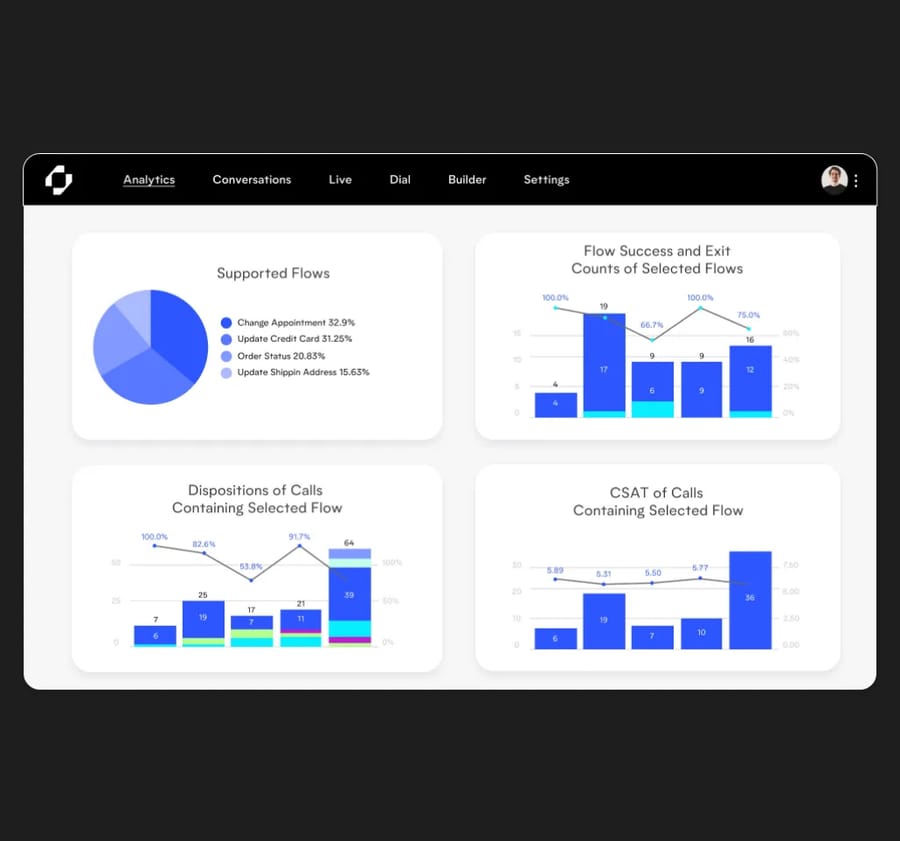
Replicant's build process starts from a company's actual historical conversations instead of a blank canvas, which is the mechanism behind its "one hour" claim: the platform mines what a company's best human agents already do well and turns that pattern into a testable agent, skipping the usual cycle of writing conversation flows from scratch and iterating through trial and error. Replicant states this approach can resolve up to 80% of customer service conversations. The deterministic-reasoning layer sits underneath the generative model specifically for business rules and compliance boundaries, a distinction worth understanding because it's the opposite failure mode from a pure-LLM agent that might "helpfully" improvise around a policy it wasn't supposed to touch.
Key features
- Conversation-data-driven agent building: new agents are built from a company's own best conversations, tested before launch, instead of generic scripts.
- Deterministic reasoning for business rules, layered under generative AI for the conversational parts.
- Conversation Intelligence: analytics across every interaction, automated or human, for coaching and process insight.
- Multi-channel: voice, chat, and SMS from one platform.
- Compliance and reliability: SOC 2, HIPAA, PCI DSS, GDPR, automatic PII redaction, and redundant failover systems built for regulated, high-volume traffic.
Replicant pricing
Replicant doesn't publish pricing. We checked replicant.com/pricing directly: the page describes "straightforward, pay-as-you-go" billing with contract terms that are month-to-month or multi-year, an "agreed-upon business outcome for performance evaluation," in-depth ROI analysis to project annual savings, and a dedicated implementation team. Every path leads to a "Request Pricing" form; no rate card exists.
The incentive worth naming is right there in the pricing page's own language: an "agreed-upon business outcome for performance evaluation" means Replicant is willing to structure at least part of a contract around results, which is a meaningfully different posture from a flat per-seat SaaS price. That can work in a buyer's favor if the outcome metric is well specified, and against them if it isn't, so get the exact definition of the agreed outcome in writing before signing.
Real reviewers back up that pricing is a genuine friction point. A verified G2 reviewer wrote: "Product offering is expensive. We wish the different components of pricing i.e. fixed and variable is adjusted based on the utilization of platform capabilities." Treat any Replicant quote as a starting point for negotiation, not a fixed rate, and push for the ROI analysis the pricing page promises before committing.
What actual users say
Replicant holds 4.7 out of 5 on G2 (a search-engine summary reported 45 reviews; we couldn't independently verify the exact count since G2 returned a 403 to direct access) and 4.9 out of 5 on Capterra from 21 reviews, checked directly on 2026-09-17.
Capterra reviewers are specific and largely positive. Connor S., a Marketing and Operations Lead in retail, wrote that "Replicant Voice has created an entirely new way to interact with our customers using voice AI," citing a 50% reduction in hold times. Hetal S., VP of Product & Operations at a consumer services company with 1,001-5,000 employees, reported "very impressed with the bot's accuracy, its ability to deal with restaurant background noise, and how it's able to navigate IVRs," with 65% of phone orders handled at human-matching success rates. Rob D., a contact center applications manager in insurance, praised the vendor relationship directly: "The team at Replicant is such outstanding partners for a vendor," reporting five use cases live within two months.
The pricing complaint quoted above is the clearest recurring negative signal across both platforms: strong marks on capability and partnership, consistent friction on cost predictability.
Pros and cons
Pros
- Genuinely detailed, checkable case studies (DoorDash's 350,000+ daily calls at 87% resolution) rather than vague testimonials.
- Deterministic reasoning under the generative layer, a real safeguard for business rules an LLM shouldn't be trusted to improvise around.
- Strong, specific reviews on both G2 (4.7/5) and Capterra (4.9/5, 21 reviews), with named reviewers citing concrete results.
- Willingness to structure pricing around agreed business outcomes, which can align incentives well if the metric is specified carefully.
Cons
- Zero published pricing; every evaluation starts with a "Request Pricing" form and a sales cycle.
- The most consistent complaint across review platforms is cost unpredictability from the mixed fixed-plus-variable pricing structure.
- Built for contact centers with real call volume and compliance requirements. A small team without regulated, high-stakes calls gets less benefit from the deterministic-reasoning layer than a larger, riskier deployment would.
- No self-serve trial; the "one hour" build claim is a sales-process anecdote, not something you can test yourself before talking to Replicant.
Who Replicant is best for
Replicant fits teams at a mid-size to large contact center with real call volume, existing conversation transcripts to build from, and at least some regulated or high-stakes call types (payments, insurance, healthcare) where deterministic business rules matter. DoorDash's case study, hundreds of thousands of calls a day with a hard compliance and satisfaction bar, is the shape of deployment Replicant is built to win.
It's the wrong choice for a team that wants to see a price before a sales conversation, or one running mostly low-volume, low-stakes conversations where an LLM-only competitor's simpler pricing might be easier to reason about. A 15-person support team fielding a few hundred tickets a month gets little from a platform built and priced around outcome-based enterprise contracts.
Replicant vs alternatives
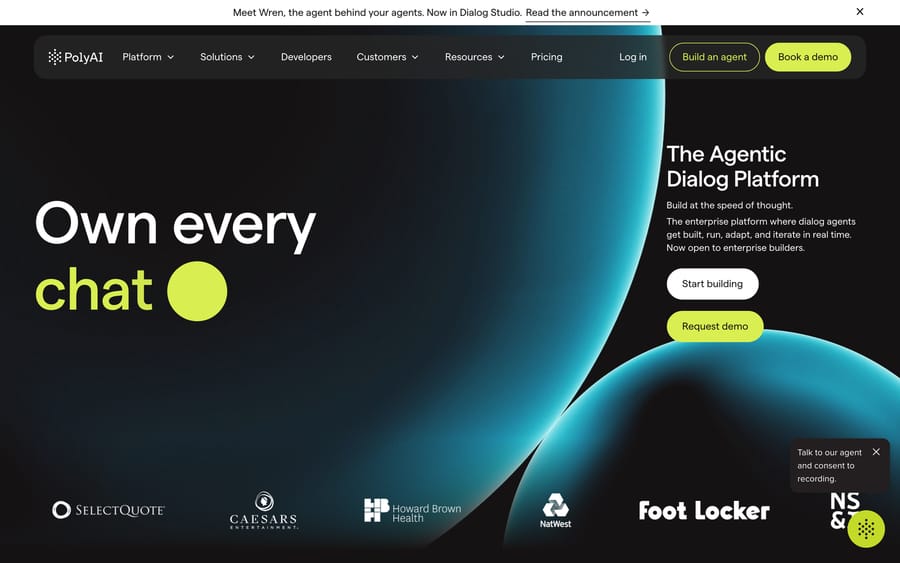
The closest comparison is PolyAI, another enterprise voice AI platform serving regulated, high-volume industries. PolyAI's pricing model is per-minute for ongoing voice-agent use, described as including "proactive performance improvements, maintenance and 24/7 support," but like Replicant, it doesn't publish an actual rate; every quote goes through a demo request.
| Replicant | PolyAI | Macha | |
|---|---|---|---|
| Model | Voice, chat, and SMS AI built from real conversation data | Enterprise voice AI ("Agentic Dialog Platform") | AI agent layer on your existing help desk |
| Pricing | Unpublished, outcome-based option available | Unpublished, per-minute | From $299/mo for 750 tickets (~$0.40/ticket), published |
| Rule enforcement | Deterministic reasoning layer under generative AI | Not independently verified for this guide | Standard controls; scoped per agent |
| Self-serve trial | No | No | $50 free usage |
| Real-user rating | 4.7/5 (G2), 4.9/5 from 21 reviews (Capterra) | Not independently verified for this guide | N/A (newer platform) |
| Replaces your help desk? | No, voice, chat, and SMS for contact centers | No, voice-first for contact centers | No, sits on top of Zendesk, Freshdesk, Gorgias, or Front |
Replicant and PolyAI both compete for the same enterprise contact-center buyer, one with real call volume and a compliance bar to clear. Neither reaches a support team's ticket queue inside a help desk; that's where Macha fits instead, published per-ticket pricing and a self-serve trial as an AI agent layer inside Zendesk, Freshdesk, Gorgias, or Front. For more on how voice-first contact-center AI compares to ticket-based agents, see our guide to AI agents for customer service, and for another enterprise voice AI comparison, see our guide to Parloa.
How we researched this
We fetched Replicant's homepage, pricing page, platform page, and DoorDash case study directly on 2026-09-17, using its sitemap to find real case-study URLs. G2's reviews page returned a 403 to direct access, so its rating and the pricing complaint quoted here come from a search-engine summary of that page; Capterra's review page was fetched directly and its quotes verified there. PolyAI's homepage and pricing page were fetched directly for the comparison. We could not verify Replicant's actual contract pricing at any scale.
FAQ
What is Replicant? Replicant is a conversational AI platform for contact centers that builds voice, chat, and SMS agents from a company's own best conversations, combining generative AI with a deterministic reasoning layer for business rules.
How much does Replicant cost? Replicant doesn't publish pricing. Its pricing page describes pay-as-you-go billing with month-to-month or multi-year contracts and an option to structure part of the deal around an agreed business outcome. Get a specific quote and a written definition of any outcome metric before signing.
What results does Replicant report for real customers? DoorDash's public case study reports 350,000+ calls automated per day at an 87% resolution rate, deployed in six weeks, with nearly 800,000 calls handled in eight days during a tax-season campaign.
What do real users say about Replicant? Replicant holds 4.7/5 on G2 and 4.9/5 from 21 reviews on Capterra (checked 2026-09-17). Reviewers praise accuracy, IVR navigation, and the vendor relationship; the clearest recurring complaint is that fixed-plus-variable pricing is hard to predict.
Is there a free trial? No self-serve trial is published. Replicant's "agent in one hour" claim describes the build process during an active sales engagement, not a product you can try yourself first.
What compliance certifications does Replicant have? SOC 2, HIPAA, PCI DSS, and GDPR, plus automatic PII redaction and redundant failover systems, aimed at regulated call types like payments, insurance, and healthcare.
How does Replicant compare to PolyAI? Both are enterprise voice AI platforms with unpublished pricing serving similar regulated, high-volume industries. Replicant emphasizes building agents from a company's own conversation data with a deterministic rules layer; PolyAI bills per minute for ongoing voice-agent use. Compare both directly against your specific call volume and use case.
Does Replicant replace a help desk? No. Replicant handles voice, chat, and SMS for contact centers. It has no general-purpose ticket queue, so a team running support through a help desk needs a different, lighter tool alongside it.
Ready to automate the ticket queue with published, per-ticket pricing instead of an outcome-based enterprise contract? See how Macha's pricing works or start a trial on top of the help desk you already run.
Sources: Replicant, Replicant pricing, Replicant Conversation Automation, Replicant DoorDash case study, Capterra: Replicant reviews, PolyAI, PolyAI pricing.
Resolve tickets automatically with AI agents
Macha's AI agents work on top of the help desk you already use — no code.