Intercom
 Shopify
 Stripe
 Slack
Slack Notion
 Google Workspace
 Confluence

Serval: The Complete Guide (2026)


Serval builds AI agents that handle enterprise IT and operations requests, with one agent that builds automations from natural language and a second that actually resolves employee tickets using them. This guide covers what it does, its real funding and customer results, and how it compares to Atomicwork and Moveworks if you're evaluating AI-native service management platforms.

We build AI agents for customer service ourselves, so we checked Serval's own customer quotes against its case-study pages, and we found a genuine inconsistency in its published numbers worth flagging instead of smoothing over.
What is Serval?
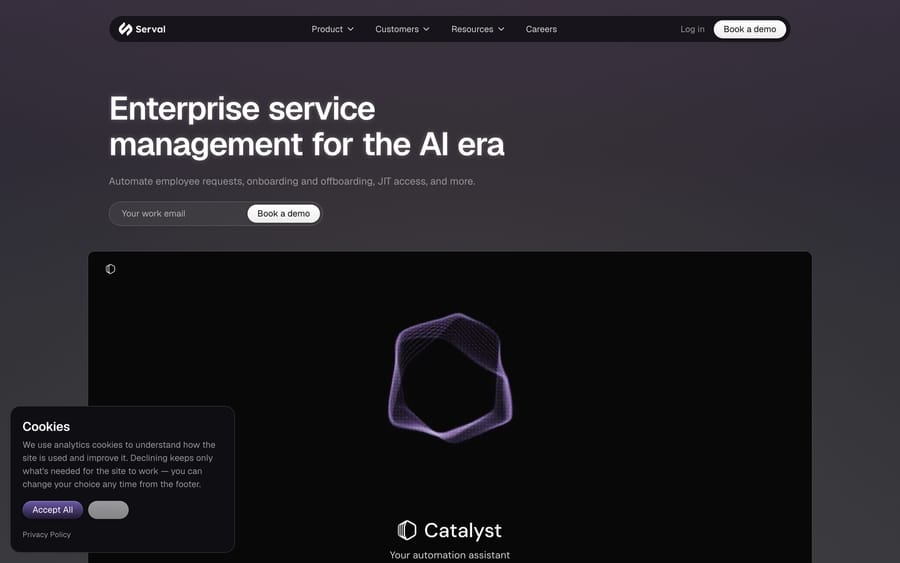
Serval calls itself "enterprise service management for the AI era," automating employee requests, onboarding and offboarding, just-in-time access, and repetitive cross-functional work spanning IT, HR, security, legal, finance, and go-to-market operations. It raised a $47 million Series A in October 2025, led by Redpoint Ventures with First Round, General Catalyst, and Box Group participating, and is led by CEO Jake Stauch. Its customer list, named directly on its own site, includes Notion, Ramp, GitHub, Vercel, GitLab, Brex, Perplexity, and SeatGeek among 20-plus others, which is an unusually strong logo roster for a company at this funding stage.
Stauch's stated strategy captures the product's philosophy: "We want to make it easier to automate something forever than do it manually once." That's the core bet Serval is making against ServiceNow and other legacy ITSM tools: a human resolves a ticket once, and the agent should learn that resolution and handle every future instance of it on its own.
How Serval's AI works
Serval runs a two-agent architecture. Catalyst is the admin-facing agent that "builds code-based workflows from natural language prompts," meaning an IT admin describes a process in plain English and Catalyst turns it into an executable, deterministic workflow, fixed code instead of a loose set of instructions an LLM re-interprets every time. The help desk agent is what employees actually talk to: it "reasons over employee requests and resolves them using the tools that admins have published" through Catalyst.
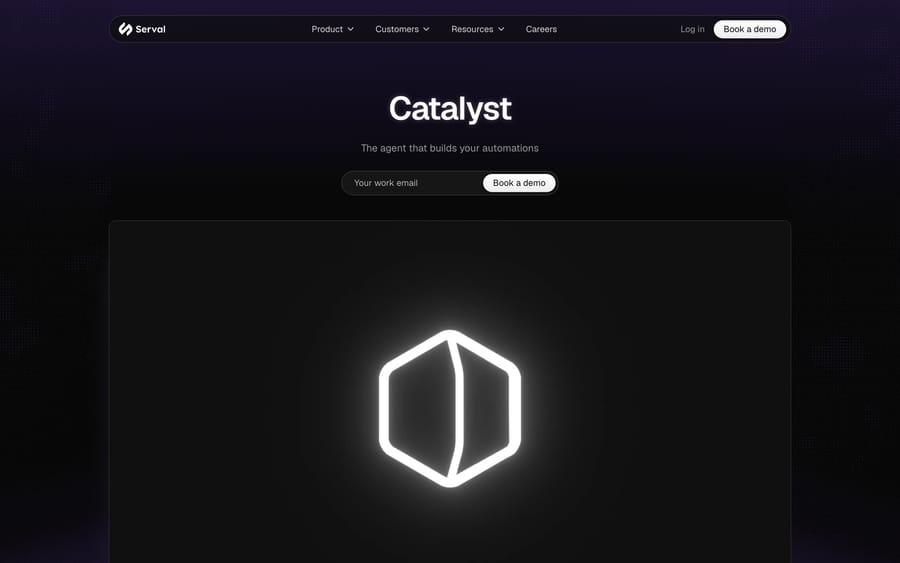
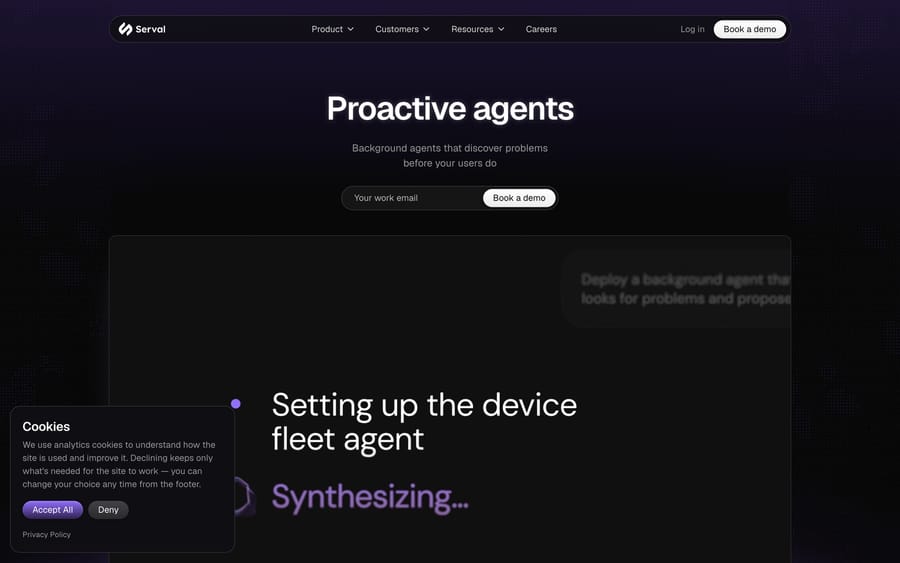
That split matters because it separates two different jobs that a lot of competing platforms blur together: building the automation and running it. An admin using Catalyst doesn't have to be a developer, and the resulting workflow is deterministic once published, which is a meaningfully different reliability guarantee than an agent re-reasoning from scratch on every similar ticket. Serval also runs Proactive agents, described as "background agents that discover problems before your users do," which scan for issues (the marketing copy names a device fleet setup scenario) and propose fixes without waiting for someone to file a ticket first.
Key features
- Catalyst agent: builds deterministic, code-based workflows from natural-language admin prompts.
- Help desk agent: resolves employee requests directly using the tools and workflows Catalyst has published.
- Proactive agents: background agents that surface and propose fixes for problems before an employee reports them.
- Cross-functional coverage: IT (password resets, access), HR (onboarding, benefits), security (privileged access), legal (contract review), finance (policy questions, license management), and GTM operations.
- Enterprise integrations: connects to systems like ServiceNow, Microsoft Entra, and Workday, without requiring a full migration off them.
- Omnichannel support: Slack, Teams, email, and web portal, per third-party review coverage of the product.
Serval pricing
Serval does not publish pricing. Its pricing page routes every visitor to "Get a quote" or "Book a demo," with no tiers, seat counts, or usage-based numbers shown publicly. A third-party review site describes this as a "demo-gated pricing model" with custom contracts, which is consistent with what we found directly on Serval's own site.
The incentive worth naming: a fully custom-quote model with strong, named enterprise logos (Notion, Ramp, GitHub) lets Serval price each deal against that specific company's willingness to pay, with no public number for a competitor to undercut. That's a reasonable strategy at the enterprise stage, but it also means a buyer gets no anchor point before a sales conversation starts.
Pros and cons
Pros:
- Customer quotes are specific and attributed rather than generic praise: SeatGeek's Elisa Folden reports going "from 0 to 40% automation within three weeks," and Perplexity's Vernon Man reports completing "over 50% of incoming requests automatically."
- The Catalyst/help-desk-agent split is a genuine architectural choice, separating workflow-building from workflow-execution instead of asking one agent to do both.
- Strong, verifiable customer roster for a company that only raised its Series A in October 2025: Notion, Ramp, GitHub, Vercel, and GitLab are named directly on Serval's own site.
- GitLab's CIO is quoted making an unusually direct claim, choosing to "move IT fully onto Serval" and drop its legacy ITSM, a stronger commitment signal than a typical pilot testimonial.
Cons:
- No published pricing at all, no starting figure of any kind, which is a real cost in evaluation time for a team trying to shortlist multiple vendors quickly.
- Serval's own numbers for SeatGeek don't fully agree with each other: the homepage quote cites 40% automation within three weeks (projecting 70% soon), while the dedicated SeatGeek case-study page cites 50% automation from 7,000 manual tickets within 60 days. Both could be true at different points in the rollout, but the inconsistency itself is worth noticing before repeating either number as a fixed benchmark.
- We could not verify an independent third-party rating: G2 and TrustRadius both blocked automated access, and the one third-party review we found came from a competing ITSM vendor's own site, which we're excluding entirely given an apparent factual error in it.
- Enterprise-only positioning: the customer list and $47M raise both point to a product built for well-resourced IT teams at funded tech companies. A small business support desk is a mismatch.
Who Serval is best for
Serval fits teams at a mid-market-to-enterprise IT or operations org, likely at a funded tech company already comfortable evaluating AI-native tools, that wants a single platform automating requests across IT, HR, security, legal, and finance instead of stitching together department-specific point tools. Its own customer roster (Notion, Ramp, GitHub, Perplexity) signals the kind of company it's built and priced for. A small support team without dedicated IT headcount to run Catalyst's workflow builder is a weaker fit; the deterministic-workflow model assumes someone owns building and maintaining those workflows over time.
Serval vs alternatives
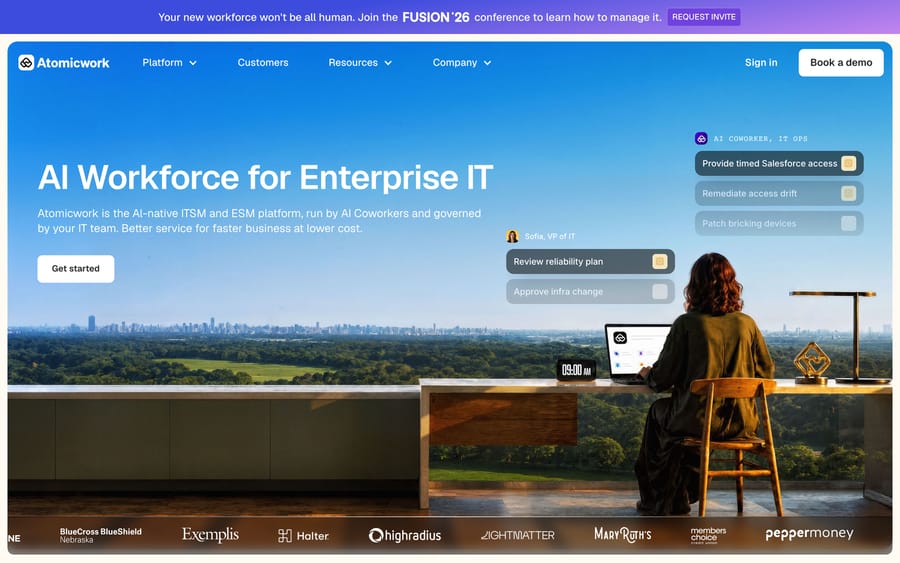
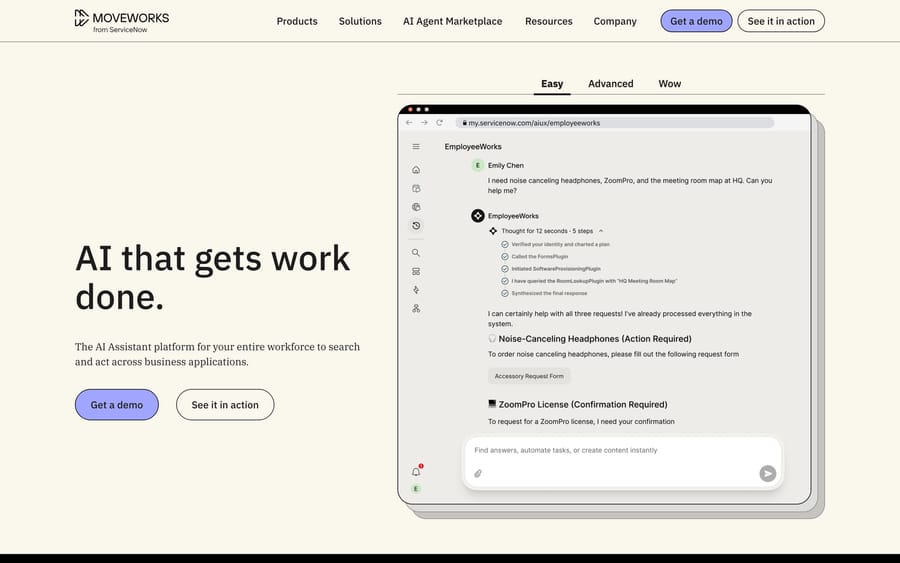
Atomicwork is the closest direct comparison: both are AI-native ITSM platforms explicitly positioned against legacy ServiceNow-style deployments, both published in 2025-vintage funding rounds, and both split automation-building from automation-running in similar ways. Moveworks, now part of ServiceNow itself, is a second comparison point, though it's a much older, more established platform. Macha is a different category: an AI agent layer for customer-facing support tickets, distinct from an internal enterprise service management platform.
| Serval | Atomicwork | Macha | |
|---|---|---|---|
| Model | Two-agent system: Catalyst builds workflows, help desk agent resolves requests | Role-based AI Coworkers for IT/ESM | AI agent layer on your existing customer-facing help desk |
| Best for | Funded, mid-market-to-enterprise IT/ops teams (Notion, Ramp, GitHub scale) | Enterprises replacing or augmenting ServiceNow-style ITSM | Support teams on Zendesk, Freshdesk, Gorgias or Front |
| Pricing | Not published; demo-gated custom quote | Published: from $25,000/yr, or $1-3 per outcome | From $299/mo for 750 tickets (~$0.40/ticket), published |
| Setup | Vendor-led; SeatGeek reports early automation within 3 weeks | Vendor-led implementation | Built, tested and monitored by the Macha team |
| Trial | None; demo only | Demo only, no public trial | $50 free usage |
Macha fits a support team whose actual bottleneck is customer-facing tickets, not internal IT or HR requests. Macha's AI agent layer and its published pricing are worth comparing directly if that's the real problem, since neither Serval nor Atomicwork addresses external customer support.
How we researched this
This guide is based on Serval's own homepage, product pages, and per-customer case-study pages (all fetched via serval.com and its sitemap on 2026-09-18), TechCrunch's own reporting on its Series A, and one third-party review site for pricing-model confirmation. We flagged, rather than hid, a discrepancy between two of Serval's own published numbers for the same customer. A Forbes article about the company returned a 403 and could not be used; a review of Serval published by a competing ITSM vendor's site contained a claim we couldn't verify and excluded rather than repeated.
FAQ
What is Serval used for? Serval automates enterprise IT, HR, security, legal, finance, and operations requests using two AI agents: Catalyst, which builds automations from natural language, and a help desk agent, which resolves employee requests using those automations.
How much does Serval cost? Serval doesn't publish pricing. It uses a demo-gated, custom-quote model with no public tiers or starting number.
Who funds Serval and how much has it raised? Serval raised a $47 million Series A in October 2025, led by Redpoint Ventures with First Round, General Catalyst, and Box Group participating. CEO Jake Stauch leads the company.
Which companies use Serval? Named customers on Serval's own site include Notion, Ramp, GitHub, Vercel, GitLab, Brex, Perplexity, SeatGeek, and Mercor, among 20-plus others.
What are the best Serval alternatives? Atomicwork is the closest direct comparison, also AI-native and positioned against legacy ServiceNow-style ITSM. Moveworks (now part of ServiceNow) is a second, more established alternative. If the real need is customer-facing support rather than internal IT, an AI agent layer like Macha fits that job better than any ITSM platform.
Is there a free trial for Serval? No public self-serve trial. Serval sells through demos and custom quotes.
Does Serval replace ServiceNow? Serval positions itself as an alternative, and GitLab's CIO is quoted describing a full move off legacy ITSM onto Serval. Whether that fits a given company depends on how deeply that company has already invested in ServiceNow's ecosystem.
How fast does Serval deploy? Results vary by customer. SeatGeek reported 40% automation within three weeks on its homepage quote and 50% automation from 7,000 manual tickets within 60 days on its dedicated case study; both figures come directly from Serval's own site.
Whichever enterprise service management platform you're comparing, ask for a customer reference close to your own size, since a strong logo list doesn't guarantee your deployment moves at the same speed. And if the tickets piling up are customer-facing rather than internal IT, see how Macha's agents work on your existing help desk.
Sources:
- https://www.serval.com
- https://www.serval.com/product/catalyst
- https://www.serval.com/product/proactive-agents
- https://www.serval.com/customers/seatgeek.md
- https://techcrunch.com/2025/10/21/serval-raises-47-million-to-bring-ai-agent-to-it-service-management/
- https://www.siit.io/tools/trending/serval-ai-review
- https://www.atomicwork.com
- https://www.moveworks.com
Resolve tickets automatically with AI agents
Macha's AI agents work on top of the help desk you already use — no code.