Intercom
 Shopify
 Stripe
 Slack
Slack Notion
 Google Workspace
 Confluence

ServiceNow AI Agents: The Complete Guide (2026)


ServiceNow AI Agents is the agentic AI layer built into the ServiceNow platform, covering IT service management, customer service management, and HR service delivery with autonomous and AI-assisted workflows. This guide covers what it actually does, its real (quote-only) pricing after the April 2026 tier overhaul, honest G2 ratings, and where it fits next to a lighter, help-desk-native alternative.

We build AI agents for customer service ourselves, so we read ServiceNow the way a buyer comparing platforms would: what the 2026 pricing changes actually mean, what's confirmed versus estimated, and what's said about the product once the sales deck closes. One thing to flag up front: ServiceNow's own site blocked every attempt we made to fetch or screenshot it directly, across the marketing site, investor relations, and community pages, so several claims below are triangulated from independent secondary sources instead of ServiceNow's own pages, and that's disclosed at each point it matters.
What is ServiceNow AI Agents?
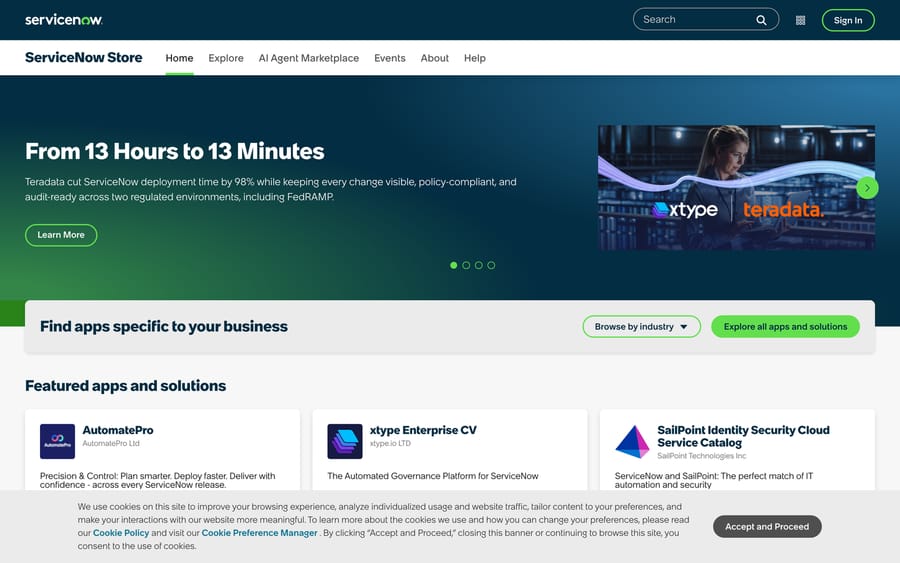
ServiceNow AI Agents is the umbrella name for agentic AI capabilities built directly into the Now Platform, ServiceNow's enterprise workflow product spanning IT service management (ITSM), customer service management (CSM), and HR service delivery (HRSD). It's positioned as native automation, not a bolt-on chatbot, across the same workflows a large enterprise already runs its IT tickets, customer cases, and employee requests through. ServiceNow's own AI Agent Marketplace, visible on the ServiceNow Store, lists third-party and partner-built agents alongside ServiceNow's own, similar in shape to an app marketplace for pre-built automation.
Independent sources describe the core AI capabilities as: an AI Agent Orchestrator that coordinates multiple agents and routes work between them, an AI Agent Studio for building and configuring agents, an AI Agent Fabric connecting agents across the platform's different products, and an AI Control Tower for governance and oversight. Now Assist is ServiceNow's generative AI brand layered across ITSM, CSM, and HRSD specifically, covering case summarization, resolution-note generation, AI search, and code generation from plain-language prompts.
How ServiceNow's AI works
The mechanism worth understanding is the split between two different things ServiceNow sells under the AI umbrella: Now Assist (generative AI features bundled into the platform, summarizing cases and drafting responses) and AI Agents proper (autonomous agents that complete multi-step processes without a human driving each step). This is a meaningful distinction for a buyer, because the tier a business lands on determines which one it actually gets.
As of the April 2026 repackaging, ServiceNow replaced its older ITSM tier structure with three AI-native tiers: Foundation (core incident, request, and asset management with Now Assist bundled in), Advanced (adds change and problem management plus process mining), and Prime (the only tier with fully autonomous AI agents and the highest AI consumption allocation). Critically, only Prime includes building custom AI skills and agents; a business on Foundation or Advanced gets generative assistance inside existing workflows but can't construct its own autonomous agents on the platform. That's a real gate to understand before assuming "ServiceNow AI Agents" means the same thing at every tier, and it's a normal incentive for a platform vendor: bundling the cheap-to-run generative writing features broadly while reserving the expensive-to-support autonomous-agent capability for the tier that also carries the highest margin.
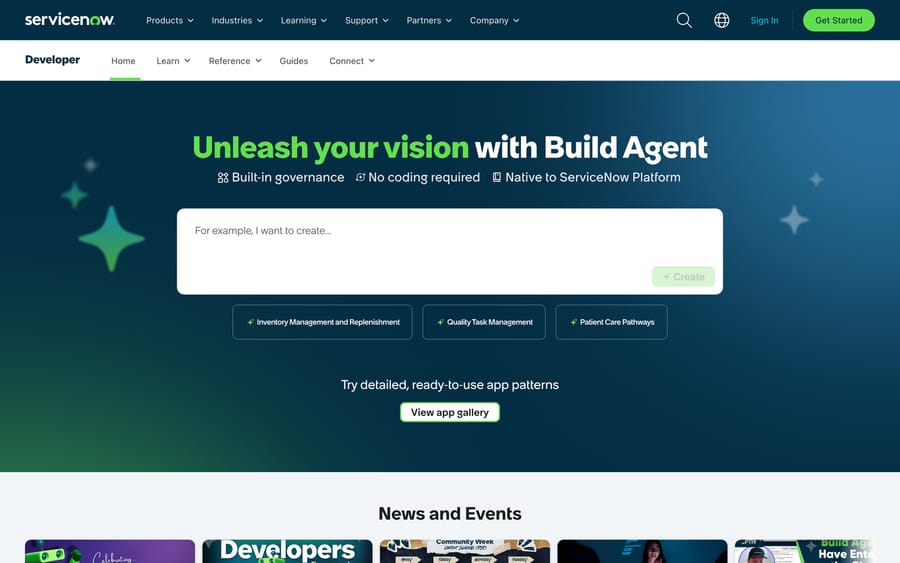
ServiceNow's own developer portal, reachable outside the marketing site's bot wall, shows the actual agent-building interface directly: a "Build Agent" tool that takes a plain-language description ("I want to create...") and scaffolds an agent with built-in governance and no coding required, alongside sample patterns like "Inventory Management and Replenishment" and "Patient Care Pathways."
Key features
- AI Agent Orchestrator: coordinates and routes work across multiple agents.
- AI Agent Studio: the agent-building and configuration environment (Prime tier only for custom agents).
- AI Agent Fabric: connects agents across ServiceNow's different product lines.
- AI Control Tower: governance, oversight, and monitoring for deployed agents.
- Now Assist: generative AI for case summarization, resolution notes, AI search, and prompt-based code generation, bundled into every ITSM tier.
- AI Agent Marketplace: pre-built, partner and third-party agents available through the ServiceNow Store.
ServiceNow AI Agents pricing
ServiceNow does not publish a price list anywhere on its site; every tier, for every product, is sized through a sales conversation. Several independent sources synthesizing ServiceNow's public tier changes estimate Foundation at roughly $70-100 per user, scaling up to $160-200+ per user for Prime, before any AI consumption is added on top. Treat these as third-party estimates. ServiceNow itself has not confirmed a number.
The consumption layer adds real complexity to budgeting: Now Assist's generative features run against consumption-based "Assist" pools instead of a flat per-user add-on, so a team with heavy AI usage can trigger per-unit overage charges beyond its base license, on top of the per-user tier price. Combined with only Prime unlocking custom AI agent building, the practical result is that a business evaluating "ServiceNow AI Agents" specifically, beyond Now Assist's generative-writing features, should expect a Prime-tier quote plus a genuinely variable AI consumption line. There's no single flat number to budget against.
Pros and cons
Pros
- Deep native integration across ITSM, CSM, and HRSD inside a platform many large enterprises already run.
- AI Agent Orchestrator and Fabric let multiple agents coordinate across different workflows instead of operating as isolated point bots.
- A marketplace of pre-built partner agents reduces some build-from-scratch effort.
- Reviewers report fast, natural-language ticket creation that scales across large support volumes.
Cons
- No published pricing anywhere; every quote requires a sales cycle, and third-party estimates put Prime (the only tier with real autonomous agents) at $160-200+ per user before consumption.
- Consumption-based "Assist" pools mean AI costs can vary and overrun a budgeted per-user price.
- Reviewers describe the platform as complex, with advanced configuration often requiring technical expertise or outside consultants.
- Some reviews cite inaccuracy and limited AI capability in specific configurations, alongside a request for a more intuitive setup process.
What actual users say
G2 lists ServiceNow AI Agents at 4.3 out of 5, and the broader "ServiceNow Autonomous CRM" listing (which bundles CSM's AI capabilities) separately shows 4.3 out of 5 from 1,185 reviews, giving a reasonably large sample to weigh against. We could not fetch either G2 page directly (G2 returned an access-restriction page to our automated request), so what follows is cited from search-indexed snippets of G2's own listings. We did not read those pages ourselves.
Reviewers consistently praise the automation of repetitive tasks and integration with existing ServiceNow workflows, with one describing fast, natural-language ticket creation that "scales well across large support volumes." On the harder edges, reviewers describe the platform as feeling "overwhelming due to its complexity," with advanced feature setup often requiring technical expertise, external consultants, or additional cost, and some specifically flag inaccuracy and limited AI capability as recurring frustrations. One reviewer suggested making the configuration process more intuitive would help teams adopt and scale AI agents faster.
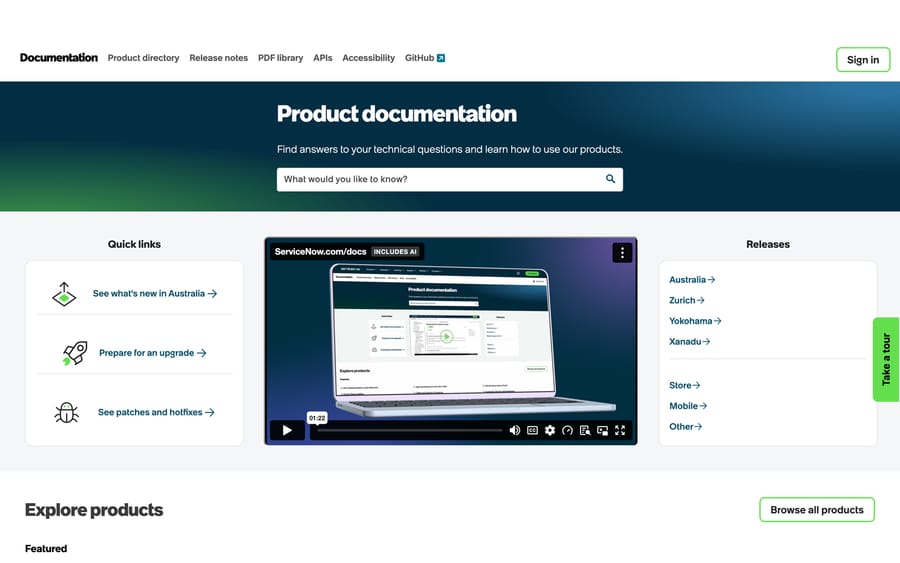
How we researched this: we checked ServiceNow's main marketing domain and investors.servicenow.com directly, and both blocked every fetch and screenshot attempt, so pricing details here are triangulated across several independent sources (eesel AI, Quackback, Crossfuze, Allied ESM) instead of read from ServiceNow directly. Two subdomains outside that wall, the ServiceNow Store and developer.servicenow.com, were reachable and are screenshotted directly in this guide, along with docs.servicenow.com, shown above. Reviews are cited secondhand from G2 search snippets after G2 itself also blocked a direct fetch.
Who ServiceNow AI Agents is best for
ServiceNow AI Agents fits teams at large enterprises already running ServiceNow for ITSM, CSM, or HRSD that want AI agents built natively into those same workflows, with a Prime-tier budget and the internal (or consultant) technical capacity reviewers say advanced configuration requires. It fits IT and enterprise service teams specifically where the value comes from coordinating agents across multiple ServiceNow modules at once, well beyond a single support queue.
It's a weaker fit for a team that isn't already on the ServiceNow platform, or one whose entire support operation lives in a lighter help desk instead of an enterprise service-management suite. Buying ServiceNow specifically to get AI agents, without an existing ITSM/CSM footprint to attach them to, is adopting a large enterprise platform for a feature that only fully activates on its most expensive tier.
ServiceNow AI Agents vs alternatives
| ServiceNow AI Agents | Salesforce Agentforce | Macha | |
|---|---|---|---|
| Model | Native AI agents across ITSM/CSM/HRSD on the Now Platform | AI agent platform across the Salesforce CRM suite | AI agent layer on your existing help desk |
| Best for | Large enterprises already on ServiceNow | Large enterprises already on Salesforce | Teams on Zendesk, Freshdesk, Gorgias, or Front |
| Pricing | Not published; ~$70-200+/user by tier (third-party estimate) plus AI consumption | See the Agentforce guide | From $299/mo for 750 tickets (~$0.40/ticket), published |
| Setup | Enterprise sales cycle; custom agents require the top tier | Enterprise sales cycle | Built, tested, and monitored by the Macha team |
| Trial | Demo-gated | Demo-gated | $50 free usage |
| Replaces your help desk? | No, extends an existing ServiceNow deployment | No, extends an existing Salesforce deployment | No, deliberately augments it |
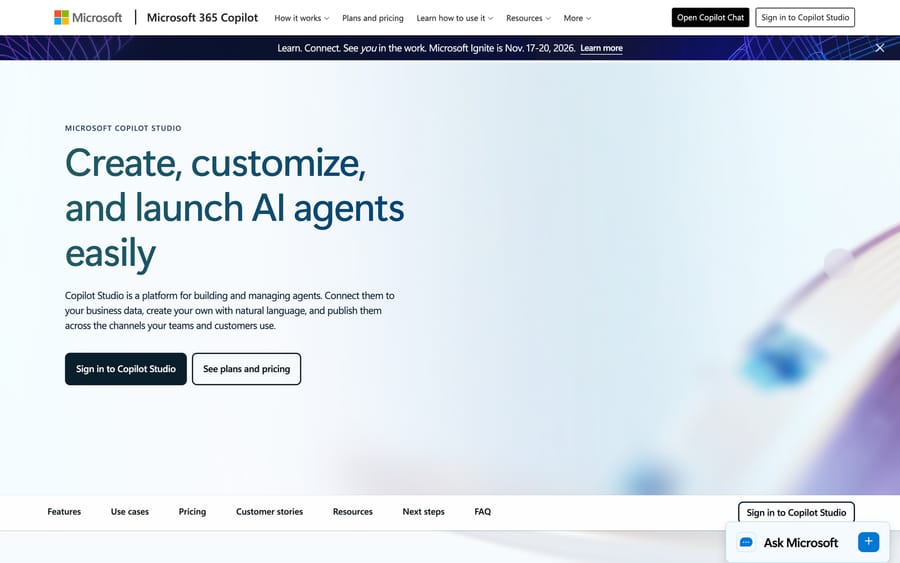
ServiceNow and Salesforce's Agentforce sit in the same category: both are AI agent layers built into a large enterprise platform a business already runs, priced and sold the same way (custom, tiered, sales-led), and both gate real autonomous-agent building behind a higher tier. The practical choice between them is usually already made by which platform, ServiceNow or Salesforce, the business runs its core workflows on. The AI layer itself rarely swings that decision.
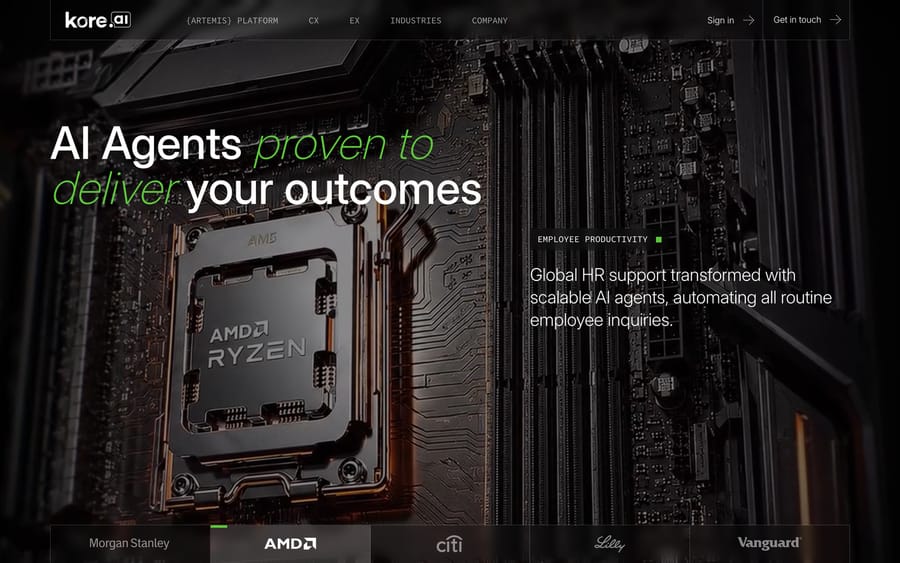
Kore.ai is a useful third comparison: it's a dedicated enterprise agent orchestration platform built independent of any single ITSM or CRM suite, which suits a business evaluating agent platforms on their own terms, separate from its ServiceNow or Salesforce footprint.
Macha is a different shape of tool entirely: instead of a native AI layer inside a large enterprise platform, it's an AI agent layer that runs on top of a help desk a team already uses (Zendesk, Freshdesk, Gorgias, or Front). A large enterprise already committed to ServiceNow or Salesforce gets more value activating the AI layer built into that platform; a team whose support operation lives in a lighter help desk gets a faster path to a working agent through Macha, without adopting an enterprise service-management suite to get there. See Macha's pricing or start with $50 of free usage against real tickets.
FAQ
What is ServiceNow AI Agents? ServiceNow AI Agents is the agentic AI layer built into the Now Platform, covering IT service management, customer service management, and HR service delivery, including an AI Agent Orchestrator, AI Agent Studio, AI Agent Fabric, and the Now Assist generative AI brand.
How much does ServiceNow AI Agents cost? ServiceNow doesn't publish pricing. Third-party estimates put its April 2026 tiers at roughly $70-100/user for Foundation up to $160-200+/user for Prime, before AI consumption, which is billed through separate, usage-based "Assist" pools. Only Prime includes building custom autonomous agents.
What changed in ServiceNow's pricing in April 2026? ServiceNow replaced its older ITSM tiers with three AI-native ones: Foundation, Advanced, and Prime, with Now Assist generative AI bundled into every tier and full autonomous agent-building reserved for Prime only.
What do real users say about ServiceNow AI Agents? G2 shows 4.3 out of 5 for ServiceNow AI Agents specifically, and 4.3 out of 5 from 1,185 reviews for the broader ServiceNow Autonomous CRM listing. Reviewers praise fast automation and integration; recurring complaints cite platform complexity, setup requiring outside consultants, and occasional inaccuracy.
Does ServiceNow AI Agents replace a help desk like Zendesk? No. It extends an existing ServiceNow ITSM, CSM, or HRSD deployment. It isn't a standalone help desk on its own.
Is Macha an alternative to ServiceNow AI Agents? Not directly. ServiceNow AI Agents is a native AI layer inside a large enterprise platform; Macha is an AI agent layer that runs on top of a help desk a team already uses (Zendesk, Freshdesk, Gorgias, or Front). A large enterprise already on ServiceNow gets more value from its native AI layer; a team on a lighter help desk gets a faster path to a working agent through Macha.
Sources: ServiceNow's own site (servicenow.com) blocked our direct research access; the following corroborating sources were used instead: eesel AI's ServiceNow AI pricing guide, the ServiceNow Store (reachable directly), and G2's listings for ServiceNow AI Agents and ServiceNow Autonomous CRM (cited secondhand; G2 itself also blocked a direct fetch).
Resolve tickets automatically with AI agents
Macha's AI agents work on top of the help desk you already use — no code.