Shopify
 Stripe
 Slack
Slack Notion
 Google Workspace
 Confluence

Siena AI: The Complete Guide (2026)


Siena AI is an AI customer experience platform built for consumer brands and ecommerce merchants, covering support, shopping recommendations, social media replies, and conversation quality scoring under one system. This guide covers what Siena actually does, how its AI personas and "CORE" reasoning engine work, what it costs (Siena is one of the few vendors in this category that actually publishes a number), and how it compares to help-desk-native alternatives.

We build AI agents for customer service ourselves, so we read Siena's claims the way a buyer evaluating both products would: what's a real mechanism, what's a case-study number, and what's marketing.
What is Siena AI?
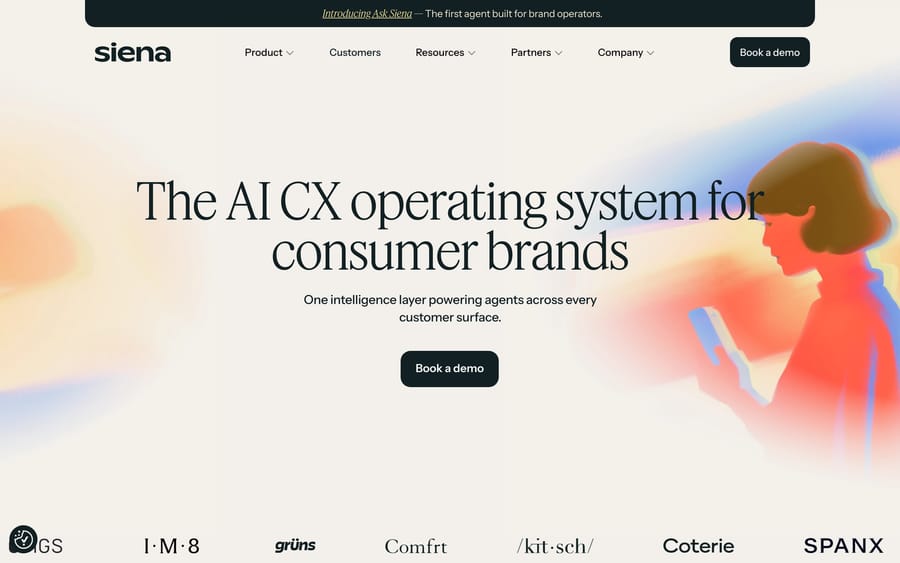
Siena AI was founded in 2023 by Andrei Negrau and Lisa Popovici and raised a $4.7 million seed round that November, backed by Sierra Ventures, Pari Passu Ventures, Spacestation Investments, Village Global, The Council, and OpenSky Ventures. The company's pitch from day one has been "empathic" AI: agents built specifically for direct-to-consumer brands, where tone and brand voice matter as much as resolving the ticket.
Siena targets ecommerce and consumer brands specifically; it doesn't chase enterprise support in general. Named customers include Spanx, Coterie, HexClad, Prose, Everyday Dose, and Kitsch, and published case studies cite Simple Modern reaching 98% customer satisfaction and True Sea Moss automating 80% of interactions. Those are vendor-published, customer-specific figures, not an independently audited average across all Siena customers, so treat them as evidence of what's achievable rather than a number you should expect on day one.
How Siena AI's AI works
Siena's core technical claim is its CORE engine, described as a cognitive reasoning system that determines the right resolution path for a customer issue rather than just retrieving the closest-matching help article. In practice this means a single conversation can touch multiple systems at once: looking up an order, checking a return policy, and issuing a replacement, without a human stitching those steps together manually.
The platform is organized around distinct agents, each scoped to one job:
- Customer Service Agent handles support inquiries across email, chat, and messaging, in over 100 languages.
- Shopping Agent makes product recommendations and drives sales conversations, blurring the line between support and merchandising.
- Social Agent manages replies and engagement on social channels and comments.
- QA Agent automatically scores conversations for quality, a function usually left to a human QA team.
- Topics Explorer surfaces recurring themes across conversations for voice-of-customer analysis.
- Ask Siena and Copilot give human agents brand-voice-consistent draft replies and translations when a conversation needs a person.
The mechanism worth understanding is AI personas: Siena lets a brand define distinct voices for different channels, so a social media reply can sound casual and on-brand while an email about a billing dispute stays formal. The platform bills itself as "platform agnostic," meaning it's built to sit on top of whatever help desk a brand already runs.
Where it connects
Siena integrates with Gorgias and Gladly, among other help desks, with the Gorgias integration installed by connecting your Gorgias subdomain from Siena's dashboard, which then auto-creates an HTTP integration and a dedicated agent. Automated replies get tagged "handled-by-siena" inside Gorgias so a team can audit what the AI actually sent versus what a human wrote. That tagging detail matters more than it sounds: it's the difference between trusting a vendor's dashboard number and being able to check the work in the help desk your team actually reads.
Key features
- CORE engine: cognitive reasoning across multiple systems (orders, policies, inventory) inside a single conversation.
- Customer Service, Shopping, and Social agents: purpose-built agents for support, sales, and social replies rather than one generic bot.
- AI personas: distinct, brand-defined voices per channel, so a casual social reply and a formal billing email don't sound like the same account.
- QA Agent and Topics Explorer: automated conversation scoring and voice-of-customer theme surfacing.
- Subscription management: automated skip, pause, and swap handling for subscription-model brands.
- Copilot: draft replies and translations for human agents on complex tickets.
- 100+ language support across text-based channels.
Siena AI pricing (published)
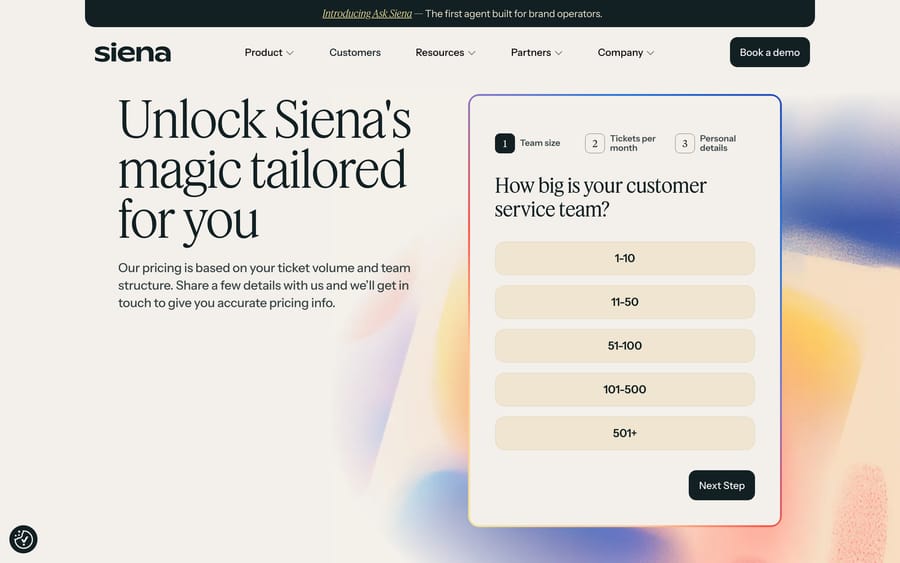
Siena is unusual in this category: it actually publishes a starting price, though the pricing page itself opens with a short quiz (team size, tickets per month, then your details) before quoting a number back to you rather than showing a static price list.
We checked the page directly: scroll past the quiz to the "How does pricing work?" section, and the structure is stated plainly as fixed marketing copy, not a quiz output. The platform charges a $750/month platform fee, which includes the core AI engine and an unlimited sandbox environment for testing, plus $0.90 per ticket automated on top. Support and implementation, described as expert onboarding with dedicated Slack access, is included in that fee rather than sold separately.
The page is explicit that the final number gets customized: "Our pricing is based on your ticket volume and team structure. Share a few details with us and we'll get in touch to give you accurate pricing info." So the $750 + $0.90/ticket structure is real and published, but your actual monthly bill depends on volume you won't know until you talk to the Siena team. There's no free trial or self-serve signup listed on the pricing page.
Worth doing the arithmetic: at 1,000 automated tickets a month, the published structure works out to $750 + $900 = $1,650, or about $1.65 per ticket blended. At 5,000 tickets, it's $750 + $4,500 = $5,250, or about $1.05 per ticket blended, since the flat platform fee dilutes as volume grows. That structure carries a built-in incentive: the $750 is sunk the moment you sign, so every additional automated ticket is closer to pure margin for Siena, which is worth remembering if a sales rep is encouraging you to automate scenarios you wouldn't otherwise choose to hand to AI. A small brand automating a few hundred tickets a month pays a much higher blended rate than a brand automating thousands.
Pros and cons
Pros
- Actually publishes a starting price, unusual for AI CX platforms at this scope.
- Purpose-built for ecommerce workflows: shopping, subscriptions, and social replies, in one system.
- AI personas give real brand-voice control per channel.
- QA Agent and Topics Explorer add value beyond ticket automation, replacing tasks a human QA analyst would otherwise do.
- Transparent tagging in Gorgias lets a team audit AI-sent replies against human ones.
Cons
- No free trial or self-serve signup; you talk to sales before testing anything.
- The $750 platform fee is a fixed cost that hits small-volume brands hardest on a blended per-ticket basis.
- Built specifically for consumer/ecommerce brands, so a B2B or non-retail support team is a weaker fit.
- Case-study automation and CSAT numbers are vendor-published and specific to each brand's setup.
Who Siena AI is best for
Siena AI suits teams at a direct-to-consumer or ecommerce brand already running Gorgias or Gladly that want one AI system covering support, shopping recommendations, and social replies with a consistent, on-brand voice across all three. The subscription management and QA scoring features specifically target the operational pain of a growing DTC brand: skip/pause/swap requests, and checking whether AI-sent replies actually sound like the brand.
It's the wrong choice if you run a B2B support team, sit outside ecommerce, or want to test a tool before signing anything: Siena's pricing page collects your details for a callback instead of a signup button.
Siena AI vs alternatives
| Siena AI | Gorgias AI Agent | Macha | |
|---|---|---|---|
| Model | AI CX platform for ecommerce/DTC brands | Native AI agent inside Gorgias | AI agent layer on your existing help desk |
| Best for | Ecommerce/DTC brands wanting support + shopping + social in one system | Teams fully committed to Gorgias | Teams on Zendesk, Freshdesk, Gorgias, or Front |
| Channels | Email, chat, social, in 100+ languages | Inside Gorgias only | Inside your help desk (chat + email tickets) |
| Pricing | $750/mo platform fee + $0.90/ticket automated, published | Bundled into Gorgias plans | From $299/month for 750 tickets (about $0.40 per ticket), published |
| Self-serve trial | No | Depends on Gorgias plan | Yes, $50 of free usage (about 125 tickets), no credit card, no time limit |
| Setup | Sales-led onboarding with dedicated Slack support | Native, minimal setup on Gorgias | setup and monitoring by the Macha team, included on every plan |
| Replaces your help desk? | No, but is a broad standalone layer across channels | No, it's a Gorgias feature | No, built to run on top of it |
Siena's pricing structure is closer to Macha's than most vendors in this category: both charge per ticket, both publish a number, and neither hides behind a mandatory sales call to see a starting figure. The difference is scope and platform choice. Macha runs on top of whichever help desk your team already uses, including Zendesk and Front, and doesn't carry a fixed monthly platform fee before the per-ticket charge starts. If your brand's whole operation already centers on shopping and social replies alongside support, Siena's combined scope may be worth its price. If you mainly need agents answering tickets inside the help desk you already run, compare the blended cost at your real volume against Macha's pricing before choosing.
FAQ
What is Siena AI? Siena AI is an AI customer experience platform, founded in 2023, built for ecommerce and direct-to-consumer brands, covering support, shopping recommendations, social media replies, and conversation quality scoring.
How much does Siena AI cost? Siena publishes a starting structure: a $750/month platform fee (core AI engine plus an unlimited sandbox) plus $0.90 per ticket automated. The final number is customized by ticket volume and team structure.
Does Siena AI have a free trial? No. There's no self-serve trial or signup listed; the pricing page collects your details for a custom quote.
What is Siena AI's CORE engine? CORE is Siena's cognitive reasoning system. It determines the right resolution path across multiple systems (orders, policies, inventory) within a single conversation, going beyond a simple help-article match.
What help desks does Siena AI integrate with? Siena integrates with Gorgias and Gladly, among others, and describes itself as platform agnostic. The Gorgias integration connects via your Gorgias subdomain and tags automated replies "handled-by-siena" for auditing.
Who uses Siena AI? Publicly named customers include Spanx, Coterie, HexClad, Prose, Everyday Dose, and Kitsch. Case studies cite Simple Modern at 98% customer satisfaction and True Sea Moss automating 80% of interactions.
How much funding has Siena AI raised? $4.7 million in a seed round announced November 2023, backed by Sierra Ventures, Pari Passu Ventures, Spacestation Investments, Village Global, The Council, and OpenSky Ventures.
What are good alternatives to Siena AI? For a brand fully committed to one help desk, that help desk's own native AI agent (such as Gorgias's) is a lighter-weight option. For a team that wants published, per-ticket pricing without a fixed platform fee, Macha is a comparable alternative that runs on top of the help desk you already use.
Does Siena AI work outside ecommerce? It can, but its features (Shopping Agent, subscription management, Social Agent) are built around retail and DTC workflows, so a non-ecommerce support team will pay for capability it won't use.
Sources: Siena AI homepage, Siena AI pricing, TechCrunch — Siena AI raises $4.7M, Siena AI on Gorgias docs.
Resolve tickets automatically with AI agents
Macha's AI agents work on top of the help desk you already use — no code.