Intercom
 Shopify
 Stripe
 Slack
Slack Notion
 Google Workspace
 Confluence

Smith.ai: The Complete Guide (2026)


Smith.ai sells three different ways to answer a phone call, an AI-only receptionist, a hybrid of AI and live humans, and an all-human virtual receptionist team, and prices each one differently by the call. This guide covers what each tier actually does, what it costs down to the per-call and overage rate, what real users say on Trustpilot, and how it compares to Ruby Receptionist and Macha for teams deciding how to handle inbound calls and tickets.

Smith.ai has been doing this for over a decade, which shows up in how specific its product is. It isn't a general voice AI platform you configure from scratch. It's an answering service that happens to run AI first and drop to a trained human the moment a call gets complicated, built heavily around law firm intake.
What is Smith.ai?
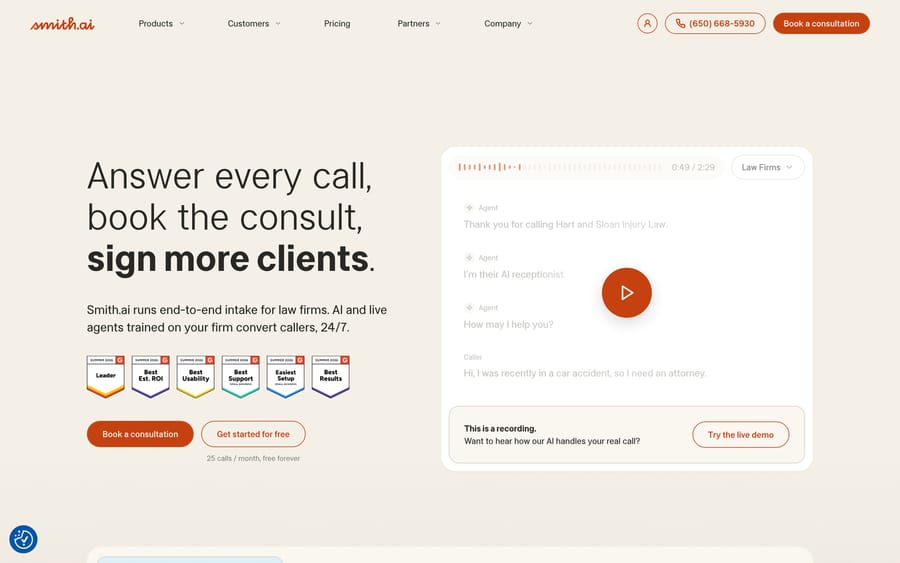
Smith.ai provides call-answering and intake services for businesses, built around the pairing of an AI receptionist with a network of live human agents who take over when a call needs judgment a script can't handle. The company states it has handled more than 25 million calls over 11-plus years and that more than 5,000 law firms use it, backed by a network of over 500 North American live agents trained specifically on legal intake. Named customers on its site include Heartland Law Group, O'Connor Cadiz Accident & Injury Law, and Porcello Law Offices.
Law is clearly the center of gravity: Smith.ai has dedicated intake flows for personal injury, family law, criminal defense, estate planning, immigration, and employment law. It also serves home services, marketing agencies, and other small and mid-sized businesses that need a phone answered professionally around the clock, but the legal-intake specialization is where the product depth is.
The pitch on the homepage is direct about what each layer is for: "AI handles the routine, live agents handle the complex." That's the mechanism worth understanding before anything else, because it changes what you're actually buying at each price point.
How Smith.ai's AI and human agents work together
Smith.ai runs three distinct staffing models rather than one AI product with add-ons:
- AI-first: the AI receptionist answers, qualifies, and books first, with human backup available for calls the AI can't resolve.
- Hybrid: a blend where AI and live human agents split the work more evenly, aimed at teams that want AI efficiency but a lower bar for handing off to a person.
- Human-first (Virtual Receptionist): a live, trained human answers every call from the start; AI works behind the scenes on call summaries and CRM updates instead of the caller-facing conversation.
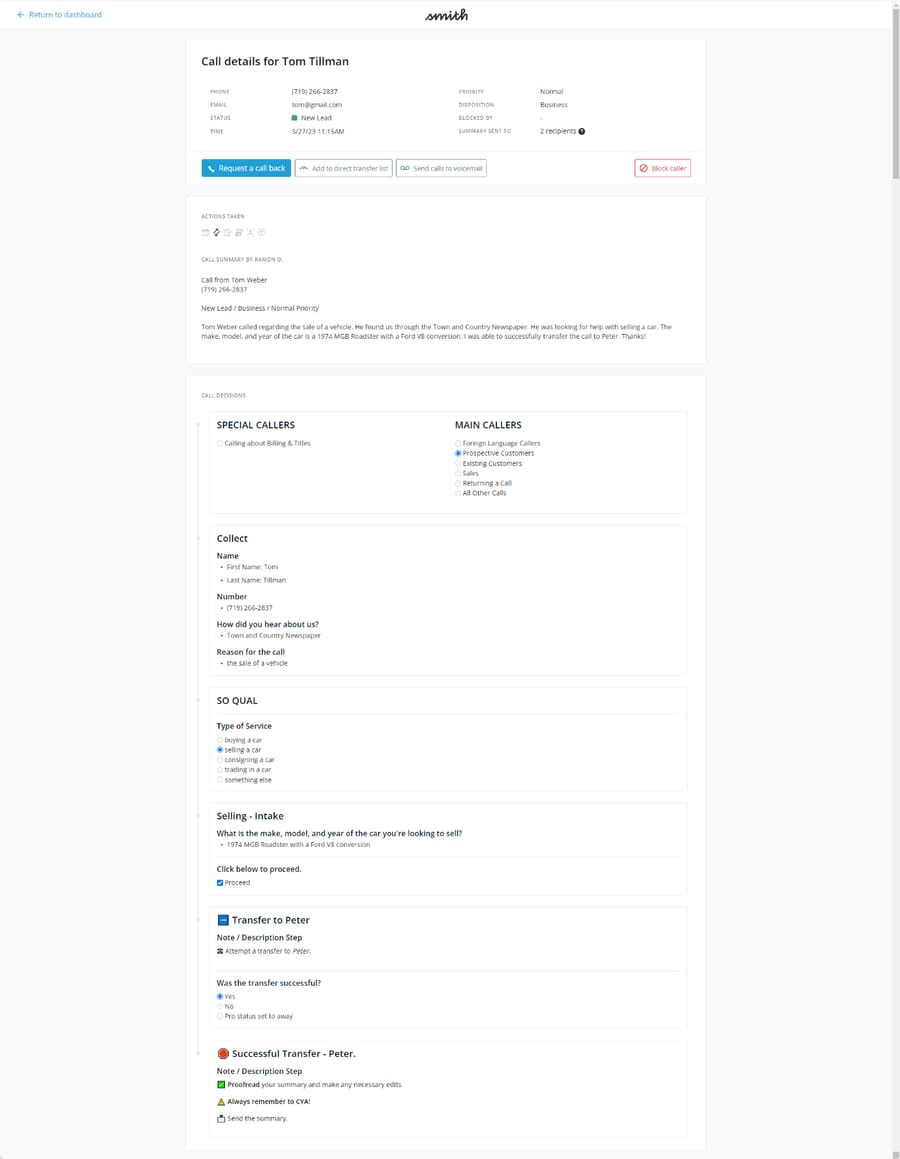
The AI layer handles the parts of a call that are genuinely repetitive: capturing name and contact details, asking qualifying questions specific to a firm's intake script, checking calendar availability, and completing intake forms. When a caller asks something outside the script, describes a sensitive situation, or simply sounds like they need a human, the call routes to a live agent from Smith.ai's network. Every plan includes CRM integration and bilingual support as standard. Call recording and transcription is included on the AI-first plans; on the human-answered plans it's a $0.25-per-call add-on.
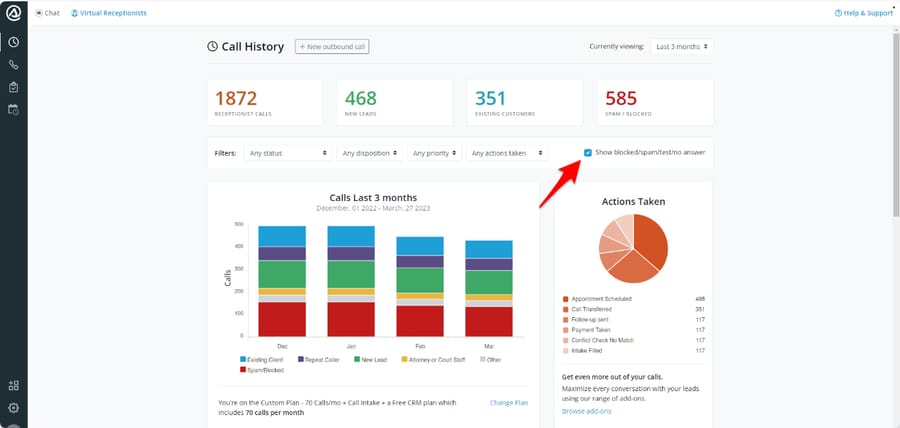
The dashboard is where this actually gets managed day to day. It shows call volume, new leads versus existing clients, and spam/blocked calls, filterable by status, disposition, and priority, with a downloadable CSV export.
Key features
- Three staffing tiers on one platform: AI-first, hybrid, and human-first, switchable as call volume or budget changes.
- Legal-intake specialization: dedicated scripts and live agents trained on personal injury, family law, criminal defense, estate planning, immigration, and employment law intake.
- Call recording, transcription, and CRM sync: CRM sync is standard on every tier; recording and transcription is included on the AI-first plans and is a $0.25-per-call add-on on the human-answered plans.
- Outbound calling, for callbacks and lead follow-up on top of inbound answering.
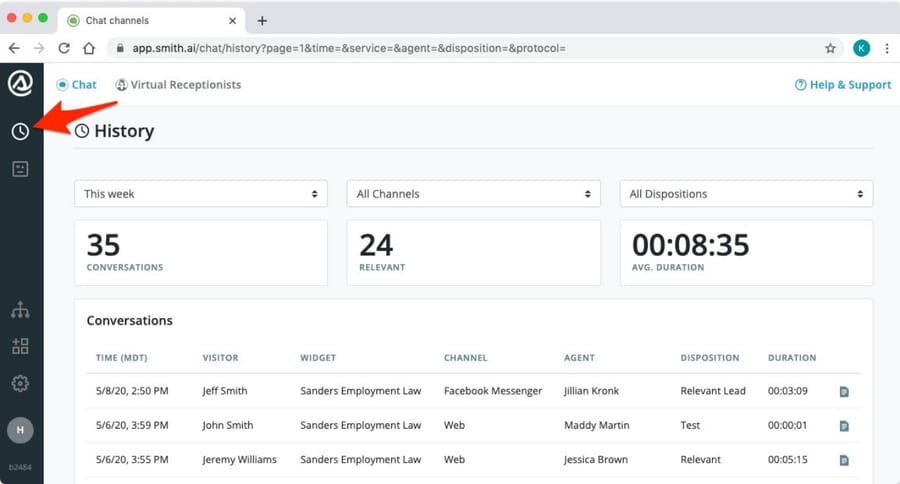
- A separate chat product with its own dashboard, tracking conversations, relevant leads, and average handling duration by channel (web, Facebook Messenger, and others).
- A 30-day money-back guarantee, and specifically a full refund of your first month's plan (up to $1,000) if you cancel in the first two weeks.
Smith.ai pricing
We checked smith.ai/pricing directly on 2026-09-17. The page separates AI-first and human-first pricing behind a toggle, and the two are structured differently.
Human-first (Virtual Receptionist) is sold as a flat monthly plan with an included call count and a per-call overage rate:
| Plan | Included calls | Monthly price | Per-call rate | Overage rate | Free transfer destinations |
|---|---|---|---|---|---|
| Starter | 30 | $300 | $10.00 | $11.50 | 1 |
| Basic | 90 | $810 | $9.00 | $10.50 | 2 |
| Pro | 300 | $2,100 | $7.00 | $8.50 | 10 |
| Enterprise | Custom | Custom | Negotiated | Negotiated | Custom |
Overage always costs more than the plan rate, which is a normal shape for a subscription, but it's worth modeling: a Starter customer who runs 45 calls in a month pays $300 plus 15 × $11.50, or $472.50, a blended $10.50/call rather than the advertised $10.00.
AI-first and hybrid pricing starts lower on the homepage: AI-first from $1.60/call and hybrid from $2.50/call, with a free-forever tier covering 25 calls a month at no cost. Smith.ai didn't publish a full AI-first tier table on the pricing page at the time we checked, unlike the human-first plans above, so treat the $1.60 figure as a starting rate only.
On top of any plan, add-ons run $0.25 to $1.50 per call, or $5 to $15 a month, covering things like appointment booking, additional CRM integrations, and SMS notifications. All plans bill month-to-month with no long-term contract, and a 12-month subscription earns a 10% discount.
The incentive worth naming: because overage always costs more than the plan rate, Smith.ai profits more from a customer who slightly under-buys their tier every month than one who sizes it correctly, which is exactly why modeling your real call volume against the tier boundaries (30, 90, 300) matters more here than the headline monthly price.
It's also worth converting these into the same unit as the rest of your support spend before you compare them to anything. A human answering a call costs $7 to $10 of somebody's time and expertise, which is why a receptionist service prices in single-digit dollars per conversation and only sells in blocks of tens or hundreds of calls. Text tickets sit two orders of magnitude below that: Macha's per-ticket rate works out at about $0.40 a ticket, once per thread however many messages it takes. That gap is not a verdict on either product — it's the actual reason nobody routes 2,000 emails a month through a receptionist service, and the reason a five-attorney firm's 200 intake calls are worth paying a person for. Price the channel, not the vendor.
What actual users say
Smith.ai's G2 pages returned a 403 to an automated fetch on 2026-09-17 (it actually has three separate G2 listings, split by AI Receptionist, Virtual Receptionist, and Live Chat, which fragments its review base across products). We checked Trustpilot instead: Smith.ai holds a 4.4 out of 5 rating from 371 reviews as of that date.
The long-tenure reviews are notable for a service business. Christopher McCann wrote: "I've been with Smith.ai for about 6 years now and I'm really impressed with them." Doug Newborn described real call volume: "They handle about 1,000 calls/month for me and work 24/7... Highly recommend."
Not every review is positive. Dean Roberts's one-star review reads: "Due to circumstances within the company, we have decided not to use that Smith.AI... Beware of the thieves do not trust this company," which reads like a billing dispute more than a service-quality complaint, but it's a sharp enough accusation that it's worth asking Smith.ai directly about cancellation and overage billing before signing up.
Pros and cons
Pros
- Genuine option to start AI-only and add live humans as volume or complexity grows, without switching vendors.
- Deep, specific legal-intake experience: 5,000+ law firms and agents trained on that vertical specifically.
- CRM sync included standard on every tier, and call recording and transcription included on the AI-first plans ($0.25 a call on the human-answered plans).
- Long visible customer tenure (multiple 5+ year Trustpilot reviews) for a phone-answering service.
- A genuinely free tier (25 calls/month) to test the AI-first product before paying anything.
Cons
- Human-first pricing punishes going even slightly over your tier: overage rates run 15–25% above the plan's per-call rate.
- AI-first pricing wasn't laid out in a full published tier table at the time we checked, only a starting rate.
- One sharp billing complaint on Trustpilot, against an otherwise strong review base, is worth asking about directly before signing a contract.
- It answers phone calls and web chat. It has no ticket queue and doesn't touch an existing help desk, so it solves the call channel, not the inbox.
Who Smith.ai is best for
Smith.ai fits teams at a law firm or professional-services business that need every call answered and every lead captured, and that value a live human safety net for calls that shouldn't be left to a script: a family law intake call, a personal injury claim, an upset client. The legal-intake specialization and the AI-plus-human blend are built for exactly that shape of business.
It's a weaker fit for a support team whose volume mostly arrives as email or chat tickets in an existing help desk rather than phone calls, or for a business trying to minimize cost per call at high volume, where the overage structure works against you. A 15-person e-commerce brand fielding Zendesk tickets gets little from a per-call phone answering service; a five-attorney firm fielding 200 intake calls a month is the target customer.
Smith.ai vs alternatives
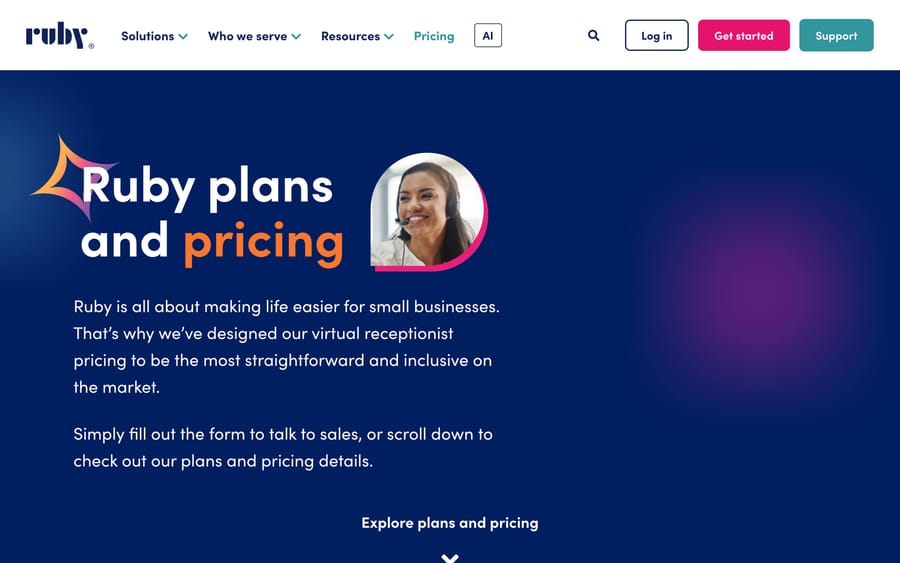
The closest direct comparison is Ruby, a virtual receptionist service with a similar human-plus-AI positioning for small businesses. Ruby bills by the minute rather than the call: plans run $250/month for 50 minutes, $395 for 100 minutes, $720 for 200 minutes, up to $1,725/month for 500 minutes, with live chat sold separately or bundled at a 20% discount. That's a meaningfully different mechanism from Smith.ai's per-call pricing: a Ruby customer pays more for a longer call, while a Smith.ai customer pays the same whether the call takes 30 seconds or 8 minutes, which rewards Smith.ai (and its live agents) for handling calls efficiently rather than keeping the caller on the line.
| Smith.ai | Ruby | Macha | |
|---|---|---|---|
| Model | AI-first, hybrid, or human-first receptionist | Human-first receptionist with optional AI | AI agent layer on your existing help desk |
| Channel | Phone calls and web/social chat | Phone calls and web chat | Email, chat, and Copilot tickets inside the help desk |
| Billing unit | Per call | Per minute | Per ticket |
| Entry price | $1.60/call (AI-first) or $300/mo for 30 calls (human-first) | $250/mo for 50 minutes | From $299/mo for 750 tickets (~$0.40/ticket), published |
| Free tier | 25 calls/month, free forever | Not published | $50 free usage |
| Real-user rating | 4.4/5, 371 reviews (Trustpilot) | Not independently verified for this guide | N/A (newer platform) |
| Replaces your help desk? | No, phone and chat only | No, phone and chat only | No, sits on top of Zendesk, Freshdesk, Gorgias, or Front |
If phone intake is the job, Smith.ai and Ruby are the right category, and the honest choice between them comes down to whether your calls run long (favor Smith.ai's per-call model) or short (favor Ruby's per-minute model) at your typical volume. Neither touches the ticket queue sitting inside your help desk, which is where most support teams spend the bulk of their day. That's the gap Macha is built for: an AI agent layer that reads and answers inside Zendesk, Freshdesk, Gorgias, Front, HubSpot or Intercom instead of a separate phone-answering service you manage alongside it. For more on how phone-first AI compares to ticket-based agents, see our guide to AI agents for customer service. If you're looking further along the voice spectrum, Regal AI covers a phone-and-SMS platform built for outbound revenue teams, and Parloa covers the enterprise contact-center end — both sell you a platform to configure, where Smith.ai sells you the finished service with people in it.
How we researched this
We fetched Smith.ai's homepage and pricing page directly on 2026-09-17, including a second pass to separate the AI-first, hybrid, and human-first price points behind the page's tabs. Ruby's pricing came from a direct fetch of ruby.com/pricing the same day. G2 returned a 403 to automated access across all three of Smith.ai's product listings there, so real-user evidence comes from Trustpilot instead. Product screenshots are real dashboard captures pulled from Smith.ai's own public help center instead of marketing renders. We could not verify Smith.ai's full AI-first pricing table, since the page states only a starting rate for that tier.
FAQ
What is Smith.ai? Smith.ai is a call-answering and intake service that pairs an AI receptionist with a network of live human agents, sold in AI-first, hybrid, and fully human-first tiers, with deep specialization in law-firm intake.
How much does Smith.ai cost? Human-first (Virtual Receptionist) plans start at $300/month for 30 calls ($10/call), rising to $2,100/month for 300 calls ($7/call), with overage rates 15–25% above the plan rate. AI-first pricing starts from $1.60/call, with a free tier covering 25 calls a month.
Is there a free trial? Smith.ai offers a free-forever tier covering 25 calls a month on the AI-first product, plus a 30-day money-back guarantee, including a full refund of your first month (up to $1,000) if you cancel within two weeks.
Does Smith.ai only serve law firms? No, but law is clearly the specialization: Smith.ai reports more than 5,000 law firms as customers and trains its live-agent network specifically on legal intake. It also serves home services, marketing agencies, and other small businesses.
What do real users say about Smith.ai? Trustpilot shows a 4.4/5 rating from 371 reviews as of 2026-09-17. Long-tenure customers (several 5+ year reviewers) praise reliability and call handling; the sharpest complaint on record is a billing dispute, not a service-quality issue.
How does Smith.ai compare to Ruby? Both blend AI and live human receptionists for small businesses, but they bill differently: Smith.ai charges per call regardless of length, while Ruby charges per minute. A business with typically short calls does better under Smith.ai's model; one with longer calls does better under Ruby's.
Does Smith.ai replace a help desk? No. Smith.ai answers phone calls and web/social chat. It has no ticket queue or email inbox, so a team running most of its support through a help desk needs a different tool, or one layered on top of the help desk, alongside it.
What's included on every Smith.ai plan? CRM integration and bilingual support are included standard. Call recording and transcription is included on the AI-first plans and is a $0.25-per-call add-on on the human-answered plans; appointment booking, extra CRM connections, and SMS notifications are also paid add-ons, at $0.25–$1.50 per call or $5–$15 a month.
Ready to put AI to work on the ticket queue instead of the phone queue? See how Macha's pricing works or start a trial on top of the help desk you already run.
Sources: Smith.ai, Smith.ai pricing, Smith.ai call dashboard help article, Smith.ai chat dashboard help article, Trustpilot: Smith.ai reviews, Ruby pricing.
Resolve tickets automatically with AI agents
Macha's AI agents work on top of the help desk you already use — no code.