Intercom
 Shopify
 Stripe
 Slack
Slack Notion
 Google Workspace
 Confluence

Synthflow: The Complete Guide (2026)


Synthflow builds voice AI agents that make and take phone calls, and it just went through a pricing shift worth knowing about before you evaluate it: its old self-serve monthly plans are gone, replaced by sales-led enterprise contracts starting at $30,000 a year. This guide covers what the product actually does, what that pricing change means depending on your size, real G2 review data, and how it compares to Vapi, a more usage-transparent alternative.

We build AI agents for customer service ourselves, on the help-desk side of the industry, so treat this as an outside comparison from someone who works nearby.
What is Synthflow?
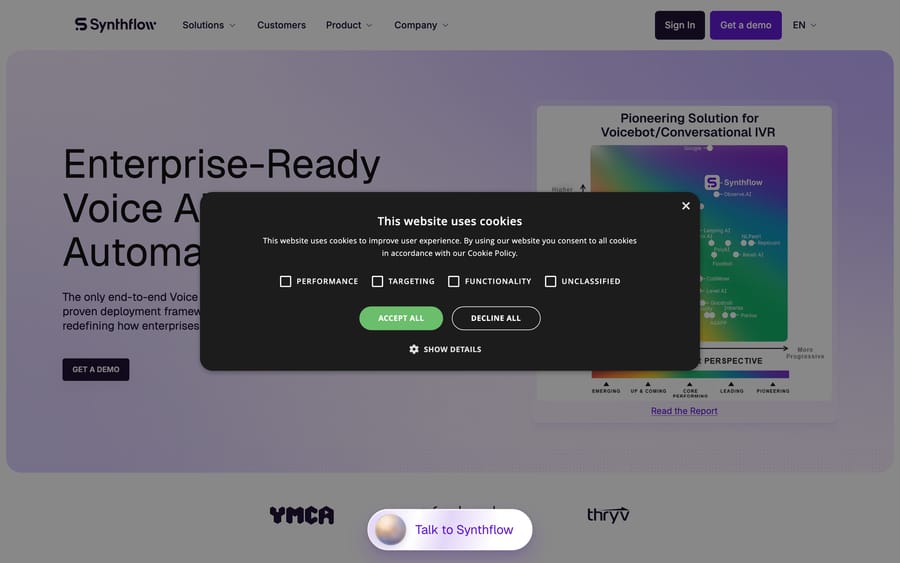
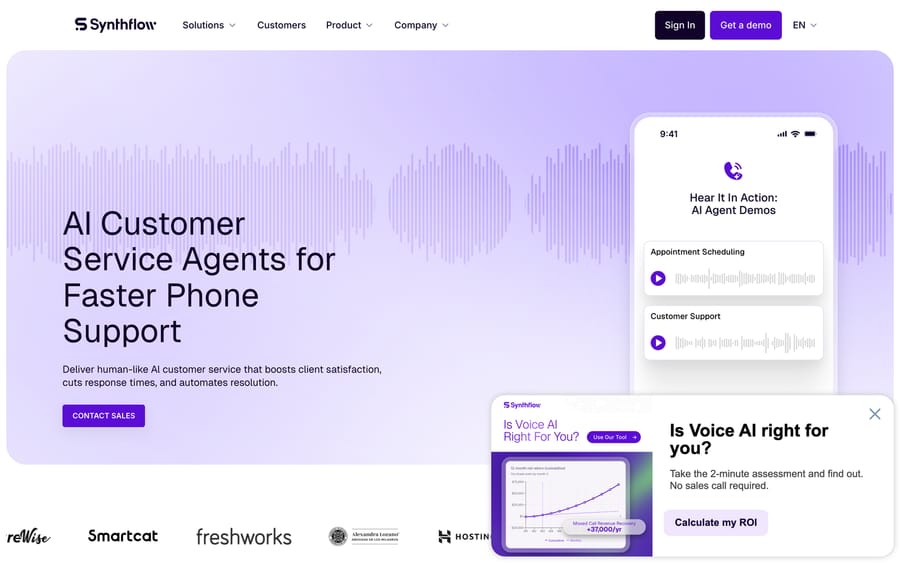
Synthflow is a voice AI platform for building agents that handle inbound and outbound phone calls: appointment scheduling, customer service, IVR replacement, and outbound outreach. It ships a visual flow builder, an in-house telephony network the company says runs at sub-100ms latency, 200+ integrations (Salesforce, HubSpot, Zapier among them), and compliance certifications including SOC 2, HIPAA, and PCI DSS. Named customers on its current site include Freshworks, Smartcat, the YMCA, and Hostinger.
The company's own positioning has moved distinctly upmarket. Its homepage now leads with "Enterprise-Ready Voice AI Automation," a clear step up from the small-business, no-code framing it used to run under (the sign-in link still points to fine-tuner.ai, a holdover from an earlier product name). That shift shows up most clearly in the pricing, which is the part worth reading carefully if you found Synthflow through an older review or a "best cheap voice AI" roundup.
How Synthflow's AI works
A Synthflow agent is built through a visual flow designer: you define call paths, connect data sources, and set escalation logic without writing code, then the platform routes the call through its own telephony stack. The company reports 99.99% uptime on that stack, plus a real-time monitoring and auto-QA layer that flags problem calls after the fact so a human doesn't have to listen to every one live.
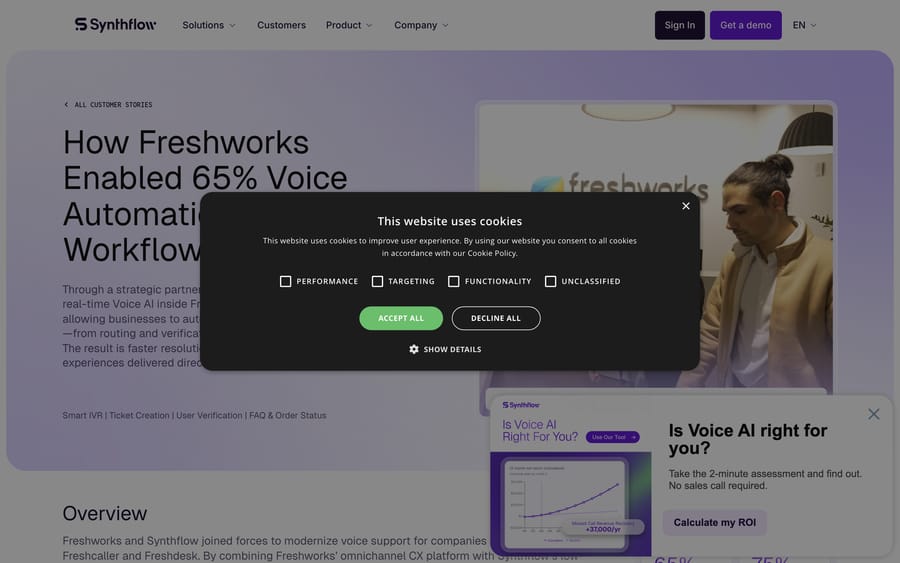
The clearest public result Synthflow publishes is its Freshworks partnership: Synthflow's voice AI runs inside Freshcaller and Freshdesk, handling smart IVR, ticket creation, user verification, and FAQ or order-status lookups. Freshworks reports 65% voice automation from the integration, per the case study on Synthflow's site.
Key features
- Visual Flow Designer for building call logic without code, including branching, handoffs, and fallback paths.
- In-house telephony network with sub-100ms latency and 99.99% uptime, according to the company, as an alternative to routing calls through a third-party carrier.
- 200+ integrations spanning CRMs (Salesforce, HubSpot), scheduling tools, and enterprise systems like Cisco and RingCentral.
- Real-Time Monitoring and Auto-QA that reviews calls for quality issues automatically, without manual spot-checks.
- Compliance certifications: SOC 2, HIPAA, PCI DSS, and GDPR, aimed squarely at the regulated, larger-company buyer the current site targets.
Synthflow pricing
This is the part that changed. Synthflow used to run four public monthly tiers: Starter at $29, Pro at $99, Growth at $449, and Agency at $899, aimed at solo operators and small agencies building their first voice agent. Those tiers are gone from the current site.
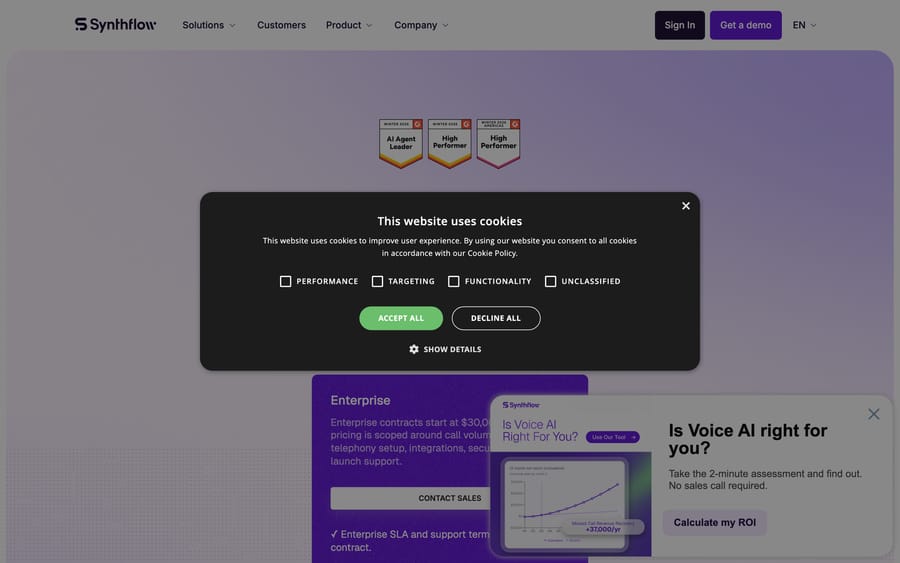
There's no self-serve way in. Neither the pricing page nor the billing docs describe a pay-as-you-go tier or a free trial today; the page's calls to action are "Contact Sales" and "Get a demo." Third-party write-ups described a pay-as-you-go tier as recently as June 2026, so check the date on any review that mentions one.
The incentive behind the shift
Retiring a $29 self-serve tier in favor of sales-led contracts with a $30,000 enterprise floor is a specific bet: that the company makes more money serving fewer, larger accounts with dedicated support than it did serving many small ones on thin monthly fees. It also means Synthflow no longer has to support the low-margin, high-churn end of its own funnel. The tension is that Synthflow's public review base hasn't caught up to that shift yet. G2 reports 92.8% of Synthflow's reviews come from the Small-Business segment, the exact customer the current pricing structure no longer serves with a cheap monthly plan. If you're reading G2 reviews from small-business users praising ease of setup, know that the plan they were describing may not be the one you'd be quoted today.
Reviews: what G2 actually shows
Synthflow holds a 4.5 out of 5 rating on G2 from just over 1,000 reviews, and a lower 4.1 out of 5 on Trustpilot from 215 reviews (checked September 19, 2026). On G2, ease of use is the most-mentioned positive theme (364 mentions), followed by setup ease and integration ease. One reviewer, in the small-business segment, wrote: "It is so easy!! I enter in the contacts info, give timelines of when to execute the phone call and it takes care of the rest." Another, describing it for SaaS founders specifically, praised the API's stability and low latency for keeping conversation flow natural.
The complaints cluster just as clearly: "expensive" is the top-mentioned con at 145 mentions, followed by cost limitations (97) and a real learning curve (59). Some reviewers also cite awkward phrasing, latency spikes, and difficulty handling interruptions or ambiguous requests. We couldn't pull individual reviewer company size or exact dates for these quotes since G2 blocked direct access on every attempt, including through a headless browser, so treat the star rating and theme counts as the reliable part and the specific quotes as directionally representative rather than a verified random sample.
Pros and cons
Pros
- A genuinely capable no-code voice builder with a large integration library (200+) and real enterprise compliance certifications.
- Strong G2 reputation: 4.5/5 from over 1,000 reviews, with ease of use and setup speed as the consistent, most-repeated praise.
- A real, named customer result (Freshworks, 65% voice automation) rather than only a vague case-study claim.
- Public, buyer-friendly metering rules: calls are billed per second with seconds pooled across calls, failed calls are free, and billing stops after a successful transfer.
Cons
- The self-serve monthly tiers that built its small-business review base are gone, and the Enterprise floor now starts at $30,000 a year.
- "Expensive" is the single most common G2 complaint, and that was true even before the pricing shift.
- No self-serve plan or free trial: every new customer starts with a sales conversation.
- No per-minute rate on Synthflow's pricing page; the last rate it published itself ($0.08 a minute) dates from August 2025.
Who Synthflow is best for
Synthflow now fits larger, more regulated organizations, the kind that need SOC 2 or HIPAA compliance, a dedicated telephony setup, and enough call volume to justify a five-figure annual contract with launch support included. If you're the kind of buyer running an RFP and comparing Synthflow against Uniphore or Cresta on a shortlist, it belongs there.
It's the wrong fit if you're a solo operator or small agency who found Synthflow through an old "$29/month voice AI" review: that tier is gone, and the only way in today is an Enterprise contract from $30,000 a year, far more than a small team's call volume justifies. Cost was already the most common G2 complaint before the change. It's also the wrong tool if your actual bottleneck is email and chat tickets. That's a help-desk automation problem.
Synthflow vs alternatives
| Synthflow | Vapi | Macha | |
|---|---|---|---|
| Model | No-code voice AI builder with in-house telephony | Developer-first voice AI platform, usage-based | AI agent layer on your existing help desk |
| Best for | Enterprises needing compliance and dedicated telephony | Builders and teams wanting transparent per-minute pricing | Support teams on Zendesk, Freshdesk, Front, or Gorgias |
| Entry pricing | Sales-led only; Enterprise from $30,000/yr | $29/mo Core plan plus published per-minute rates from $0.05/min hosting | From $299/mo for 750 tickets (~$0.40/ticket), published |
| Pricing transparency | Per-minute rate not on the vendor's own site; Enterprise scoped per deal | Full public calculator by model, voice, and transcriber provider | Published, one plan by ticket volume |
| Self-serve trial | No; demo and sales contact only | Yes, pay-as-you-go from the first minute | $50 of free usage, no credit card |
| Setup | No-code flow builder; Enterprise includes launch support | No-code and developer SDK options | Built, tested and monitored by the Macha team |
| Replaces your help desk? | Not applicable; not a help desk product | Not applicable; not a help desk product | No, it deliberately augments it |
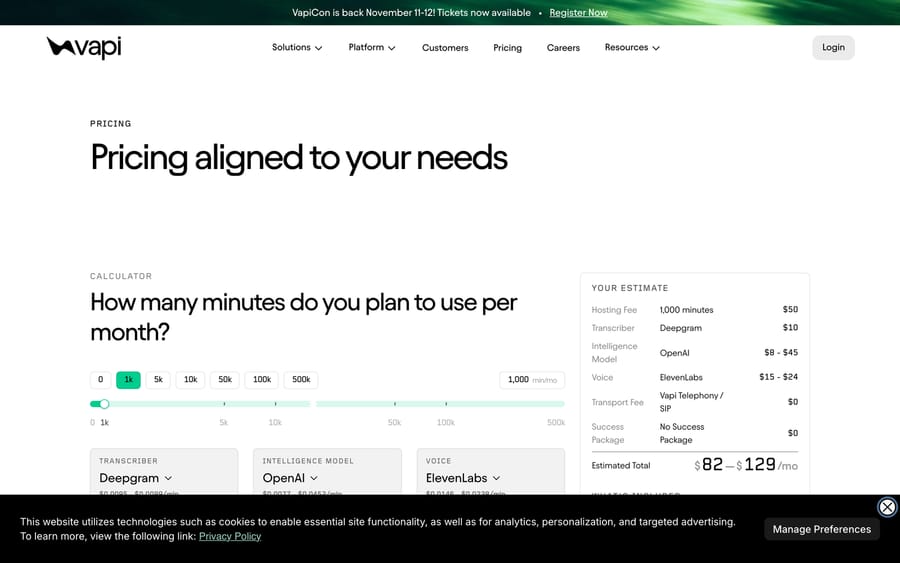
Vapi is the more directly comparable option for anyone Synthflow's pricing shift has priced out. It publishes an actual calculator, broken down by transcriber, model, and voice provider, so you can see your estimated monthly cost before you build anything, and it still has a $29/month self-serve Core plan alongside its usage-based pricing. The tradeoff is that Vapi leans more developer-first, so a no-code buyer used to Synthflow's flow designer may find Vapi's setup less guided.
Neither company solves a support team's actual ticket backlog, which is a different job. If your bottleneck is email and chat volume in Zendesk, Freshdesk, Front, or Gorgias rather than phone calls, Macha runs as an agent layer on top of that help desk instead, priced per ticket rather than per minute or per enterprise contract.
How we researched this
We checked synthflow.ai directly (home, /pricing, /ai-customer-service, /integrations, and the Freshworks case study) on 2026-09-17 for current product and pricing claims. We confirmed the retirement of the legacy $29 to $899 monthly tiers by comparing several third-party pricing trackers against Synthflow's own pricing page, which lists only Enterprise. A re-check on 2026-09-19 of the pricing page and Synthflow's billing docs found no pay-as-you-go tier or free trial; the docs describe sales-led pricing. G2's star rating, review count, and segment breakdown (92.8% Small-Business) came from a cached search result; G2 and Capterra both blocked direct access with a Cloudflare 403 on every attempt we made, including through a headless browser, so we couldn't independently verify individual reviewer dates or company sizes beyond the segment split G2 itself reports. Vapi's pricing was fetched directly from its own calculator.
FAQ
What is Synthflow? A voice AI platform for building phone-calling agents: appointment scheduling, customer service, IVR replacement, and outbound outreach, built through a no-code flow designer.
How much does Synthflow cost? Its old $29 to $899 monthly plans are retired, and there's no self-serve plan today. Pricing is sales-led: Enterprise contracts start at $30,000 a year, scoped by call volume, concurrency, telephony, integrations and support. Synthflow doesn't publish the per-minute rate inside those contracts; the last one it published was $0.08 a minute, in August 2025.
Does Synthflow have a free trial? Not today. Synthflow's pricing page offers a demo and a sales contact, and its billing docs describe sales-led pricing. Older reviews that mention a free trial or monthly plans describe terms from before that change.
Is Synthflow good, based on reviews? G2 shows 4.5 out of 5 from just over 1,000 reviews, and Trustpilot shows a lower 4.1 out of 5 from 215 reviews. The most common complaint on G2 is cost.
Why did Synthflow get rid of its cheap monthly plans? The company's public positioning has shifted toward larger, more regulated customers. Retiring low-margin self-serve tiers in favor of sales-led enterprise contracts is a common move once a vendor's highest-value customers are bigger accounts rather than solo operators.
What are good alternatives to Synthflow? Vapi is the closer comparison for anyone priced out by the enterprise shift: it publishes a public per-minute calculator and keeps a $29/month self-serve plan. Neither is a fit for a support team's email and chat backlog, which is a help-desk automation problem instead.
Who are Synthflow's named customers? Freshworks, Smartcat, the YMCA, and Hostinger appear on its current site; Freshworks specifically reports 65% voice automation from the integration.
If your actual bottleneck is a support team's ticket queue rather than phone call volume, see how Macha's pricing works or start a trial.
Sources: Synthflow, Synthflow pricing, Synthflow - AI customer service, Synthflow - integrations, Synthflow - Freshworks case study, Vapi pricing, G2 - Synthflow reviews (blocks automated fetches, cited via cached search result).
Resolve tickets automatically with AI agents
Macha's AI agents work on top of the help desk you already use — no code.