Intercom
 Shopify
 Stripe
 Slack
Slack Notion
 Google Workspace
 Confluence

Toma AI: The Complete Guide (2026)


Toma AI builds voice AI agents that answer the phone for car dealerships, and it has grown fast enough in that one vertical to raise a $17 million Series A led by a16z. This guide covers what the product actually does, real researched pricing (there's no price list, but one documented number exists), the truth about its reviews (the widely-cited "4.8/5" is not what it looks like), and how it compares to the alternatives, including where a help-desk AI agent layer like Macha fits a support team working tickets instead of dealership service calls.

We build AI agents for customer service ourselves, so this is written by people who have to evaluate platforms like this. We are not repeating a pitch deck.
What is Toma AI?
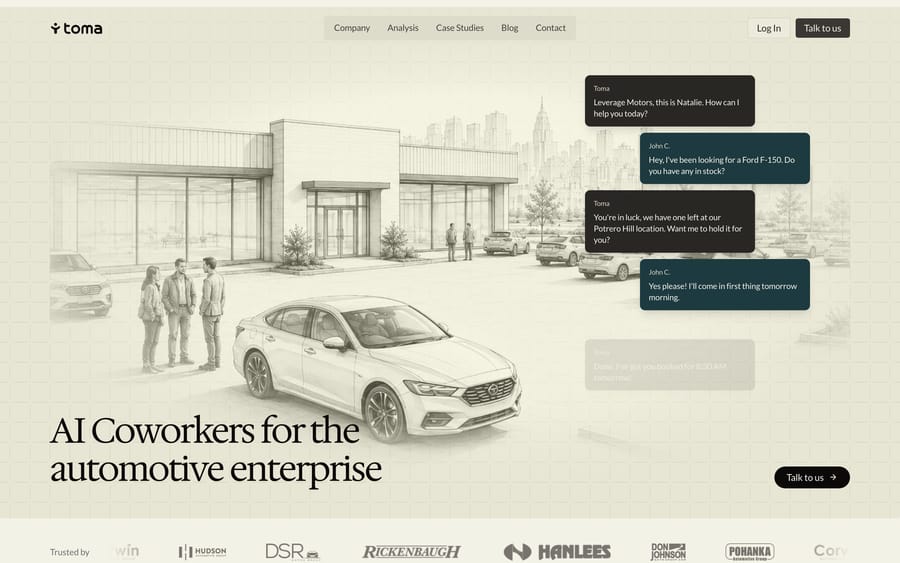
Toma is a Y Combinator company (Winter 2024 batch) founded by Monik Pamecha and Anthony Krivonos, building what it calls "AI coworkers" specifically for car dealerships: answering every call, working every lead, and booking every appointment. The company raised a $17 million Series A led by Andreessen Horowitz, with Y Combinator also participating, and per TechCrunch's June 2025 coverage, its AI voice agents were already deployed at more than 100 dealerships nationwide at that point. Toma's own site claims its agents have answered more than 1 million calls since launching in 2024.
The vertical focus is the whole strategy. Rather than building a horizontal voice AI platform and selling it into every industry, Toma builds specifically for automotive service departments, sales lines, and parts counters, learning from a dealership's own historical call data during onboarding and handing off complex calls to a human when the conversation goes outside what it's been trained to handle. That narrowness is a real advantage in a vertical with idiosyncratic terminology (RO numbers, loaner cars, recall campaigns) that a generalist voice AI vendor would need to learn from scratch.
How Toma's AI works
Toma's product is built around three jobs a dealership's phone line handles every day:
- Answering every call: service scheduling, parts inquiries, sales questions, and recall checks, handled by voice AI instead of routed to a human every time.
- Working every lead: following up on inbound leads that would otherwise sit in a CRM unanswered.
- Booking every appointment: scheduling service and sales appointments directly during the call instead of taking a message.
Underneath, Toma trains its agents on a dealership's own historical call recordings during onboarding, which is what lets it learn dealership-specific terminology and policies instead of shipping a generic script. When a call goes beyond what the AI has been trained to handle, it transfers to a human staff member instead of guessing. The company has also launched a feature called Toma IQ, which turns patterns from real dealership calls into dealer-approved AI policies, an attempt to keep the AI's behavior aligned with what a specific dealership's management actually wants, instead of a one-size-fits-all script.
Key features
- Inbound voice AI for service scheduling, parts inquiries, sales questions, and recall checks.
- Outbound lead follow-up for leads that would otherwise go unanswered.
- Direct appointment booking during the call instead of a callback.
- Onboarding that trains the AI on a dealership's own historical call data.
- Human handoff for calls outside the AI's trained scope.
- Toma IQ: converts patterns from real calls into dealer-approved AI policies.
- Deployed at 100+ dealerships as of mid-2025, per TechCrunch, with the vendor's own site claiming more than 1 million calls answered since 2024.
The "4.8/5" figure isn't a review score
Here's something worth flagging plainly: Toma has zero reviews on G2 and zero reviews on Capterra, confirmed by a direct read of Capterra's page ("Based on 0 user reviews"). A "4.8/5" rating that circulates in search results and comparison articles traces back to a single automotive-industry directory site's own editorial "Vetted Solution" score, based on that site's internal review framework, not aggregated customer ratings the way a G2 or Capterra score works. That distinction matters: an editorial rating from one reviewer or team is a different kind of evidence than hundreds of independent buyers scoring a product. If you're evaluating Toma, treat that 4.8 as one analyst's opinion, not a crowd-sourced verdict, and ask Toma directly for dealership references you can call.
Toma AI pricing (researched)
Toma doesn't publish pricing, and there's no pricing page on toma.com (the URL 404s). Every deal appears to go through a sales conversation, consistent with a B2B vertical SaaS product sold to dealership groups instead of self-served by an individual manager.
The one concrete number we could find, via a secondary source aggregating dealership AI pricing comparisons, describes a single documented example: a regional dealership group reportedly replaced an $180,000-a-year BDC (business development center) team with Toma at roughly $3,500 a month, or about $42,000 a year. Treat that as one example, not a general rate. It's a real, sourced data point, but a single case study is not a price list, and your dealership's actual quote will depend on call volume, number of locations, and which of Toma's capabilities you turn on. A sales-only quote process gives Toma an incentive to price each deal against what an in-house BDC team would otherwise cost a dealership, rather than publish one number every prospect sees.
What drives the price
- Call volume and number of locations, since a single-location dealership and a multi-rooftop dealer group have very different scale needs.
- Which capabilities you deploy: inbound answering alone is a narrower deployment than inbound plus outbound lead follow-up plus Toma IQ's policy tooling.
- Onboarding depth, since training the AI on a dealership's own historical calls is real setup work that likely scales with how much history and how many departments are involved.
- What it's replacing: the one documented example we found was priced against the cost of an in-house BDC team, suggesting Toma may price competitively against dealership staffing costs instead of a flat per-seat rate.
Pros and cons
Pros
- Deep vertical focus on automotive gives it dealership-specific terminology and workflow knowledge a horizontal voice AI vendor would need to build from scratch.
- Well-funded ($17M Series A led by a16z) with real deployment scale (100+ dealerships as of mid-2025, per TechCrunch).
- Onboarding trains on a dealership's own call history instead of shipping a generic script.
- Toma IQ's dealer-approved policy generation is a genuinely specific answer to "how do we keep the AI aligned with what we actually want."
Cons
- Zero reviews on G2 and Capterra, so there's no independent, aggregated customer evidence to check the vendor's claims against.
- The widely-cited "4.8/5" rating is one directory site's editorial score. It is easy to mistake for a customer review aggregate.
- No published pricing. The one documented number we found is a single case study. It is not a general rate.
- Built exclusively for automotive dealerships; there's no path to using this outside that vertical.
Who Toma AI is best for
Toma fits a car dealership or dealership group whose service and sales phone lines are understaffed relative to call volume, and that wants an AI trained on the specific vocabulary and workflows of automotive retail instead of a horizontal voice AI platform it would have to configure from scratch. If missed calls are costing you service appointments and sales leads, and you're comfortable with a sales-led custom quote, Toma's vertical depth is a real advantage.
Toma is the wrong choice if you run any business outside automotive retail, since the entire product is built around dealership-specific workflows, and it's worth a harder look before signing if the only evidence you have is that "4.8/5" figure, since it isn't the crowd-verified signal it appears to be.
Toma AI vs alternatives

| Toma AI | Parloa | Macha | |
|---|---|---|---|
| Model | Vertical voice AI for automotive dealership phone lines | Horizontal voice AI platform for contact centers | AI agent layer on your existing help desk |
| Best for | Car dealerships and dealership groups | Enterprise contact centers across industries | Support teams on Zendesk, Freshdesk, Gorgias or Front |
| Pricing | Not published; one documented example near $3,500/mo | Not published; enterprise sales-led | From $299/mo for 750 tickets (~$0.40/ticket), published |
| Self-serve trial | No | No | Yes, $50 free usage, no credit card |
| Setup | Sales-led; onboarding trains on dealership call history | Sales-led, enterprise implementation | Built, tested and monitored by the Macha team |
| Replaces your help desk? | No, it's a dealership phone system | No | No, it deliberately augments your help desk |
Toma AI and Parloa both automate voice conversations, but at very different scopes: Toma is built exclusively for one vertical's phone lines, while Parloa is a general contact-center voice AI platform. Our Parloa guide covers that broader platform in more depth, useful context on what a horizontal voice AI vendor looks like next to a vertical specialist like Toma.
Macha solves a different problem for a different channel entirely. It doesn't answer phones or work automotive leads; it drafts and resolves the tickets a support team already gets inside a help desk like Zendesk, Freshdesk, Gorgias, or Front. If your business runs a support inbox instead of a dealership phone line, Macha is priced transparently from $299/month for 750 tickets, about $0.40 a ticket at every tier, with $50 of free usage and no credit card to start. See Macha's pricing for the full table.
How we researched this
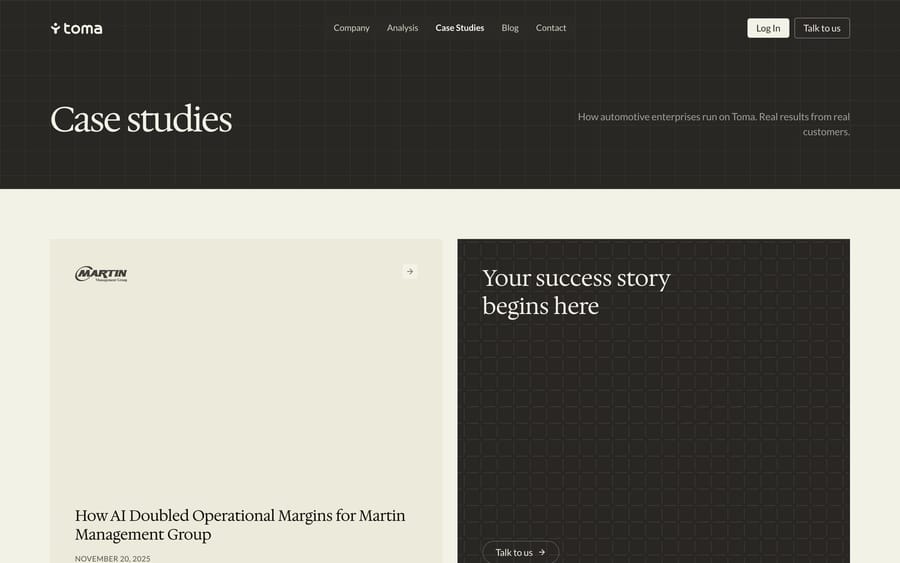
We checked Toma's homepage and /case-studies page directly; /pricing, /product, /about, and /careers all return 404. Funding and founder details are cross-checked between TechCrunch's June 2025 reporting and Y Combinator's own company listing; where the two sources named different secondary investors, we stated only what both agree on. The $3,500/month pricing example came from a secondary source aggregating dealership AI comparisons rather than from Toma directly, and is flagged as a single example instead of a general rate. G2 and Capterra review counts (both zero) are confirmed directly; the "4.8/5" figure's actual source (a single directory site's editorial score) was traced and is described accurately instead of repeated as a review aggregate.
FAQ
What is Toma AI? Toma builds voice AI agents specifically for car dealerships: answering service, sales, and parts calls, following up on leads, and booking appointments, with onboarding that trains the AI on a dealership's own historical call data.
How much does Toma AI cost? Toma doesn't publish pricing. One documented example found in research shows a dealership group paying roughly $3,500/month after replacing an $180,000-a-year BDC team, but treat that as a single case study rather than a general rate.
Is Toma AI's 4.8/5 rating real? It's real in the sense that a directory site gave it that score, but it's an editorial "Vetted Solution" rating from one site's internal framework, not an aggregate of customer reviews. G2 and Capterra both show zero reviews for Toma.
Who founded Toma AI? Monik Pamecha and Anthony Krivonos, in the Y Combinator Winter 2024 batch. The company raised a $17 million Series A led by Andreessen Horowitz.
Does Toma AI work outside the automotive industry? No. The entire product, including its onboarding and policy tooling, is built around automotive dealership call center workflows.
What are good alternatives to Toma AI? Parloa is a comparable voice AI platform, though built horizontally for enterprise contact centers instead of one vertical. For a support team whose real workload is a ticket queue instead of phone calls, Macha is a different category of tool.
How many dealerships use Toma AI? More than 100 dealerships, according to TechCrunch's June 2025 reporting; Toma's own site claims more than 1 million calls answered since its 2024 launch.
Ready to automate your support inbox instead of adding a new phone system? Start a Macha trial with $50 of free usage and no credit card, or see Macha's pricing.
Sources: toma.com, toma.com/case-studies, TechCrunch: Toma's AI voice agents have taken off at car dealerships, Y Combinator: Toma, Capterra (capterra.com/p/10031035/Toma, fetched directly).
Resolve tickets automatically with AI agents
Macha's AI agents work on top of the help desk you already use — no code.