Intercom
 Shopify
 Stripe
 Slack
Slack Notion
 Google Workspace
 Confluence

Verint: The Complete Guide (2026)


Verint is a customer experience automation vendor best known for call recording, workforce management and speech analytics, now repositioned around agentic AI bots under the brand Da Vinci. As of late 2025 it's also no longer a public company. This guide covers what Verint actually sells today, how its AI bots and IVA work, what the platform costs based on real published numbers (Verint doesn't quote a price on its own site), what reviewers say once they've used it, and where a lighter alternative fits if you don't need an enterprise contact center platform.

Macha builds AI agents for customer service that sit on top of a help desk teams already run, so we read guides like this one as a buyer would: what the platform does, what it costs, and who it's actually built for. We'll flag anywhere we couldn't verify a number.
What is Verint, and who owns it now?
Verint was spun out of Comverse Technology in 1994 and built its business on three legs: call and screen recording, workforce management (scheduling, forecasting, adherence), and speech and interaction analytics for large contact centers. It later added quality management and voice-of-customer tools through acquisitions like KANA ($514M, 2014) and Next IT ($30M, 2017), and it spun off its cyber-intelligence business as Cognyte in 2021, leaving a pure-play customer engagement company.
The thing that changes how you should read every other page on Verint's site: in August 2025, private equity firm Thoma Bravo agreed to take Verint private for roughly $2 billion, and the deal closed on November 26, 2025. Thoma Bravo already owned Calabrio, a workforce engagement competitor, and combined the two companies. By February 2026 the merged organization confirmed it would keep operating under the Verint name. Verint's own homepage now lists "Calabrio One" as part of its workforce engagement lineup, which is direct evidence the merger is live in the product, not just in a press release.
Two things follow. First, Verint no longer files public SEC quarterly numbers the way a NASDAQ-listed company does, which is part of why most of the pricing and revenue detail below comes from third-party sources instead of a 10-Q. Second, Verint and Calabrio are the same company now, so an RFP that lists both as separate options is comparing a vendor against itself.
The question that follows from that is the one neither company has answered publicly: Verint and Calabrio sold heavily overlapping workforce management suites, and a merged vendor does not maintain two of those forever. Verint's site currently lists Calabrio One alongside its own WEM lineup, which is what a company says while the decision is still being made. If you're signing a multi-year WEM contract in 2026, ask in writing which suite you are actually being sold, what the migration path looks like if it isn't the one you sign, and who pays for it. That is a reasonable question and the answer is not on any public page.
Verint also acquired Cogito, a real-time agent-coaching AI vendor, for about $61.4 million in October 2024, before the Thoma Bravo deal closed. Cogito's technology, which analyzed roughly 200 acoustic and linguistic signals in a live call, became the base for Verint's real-time coaching bots, covered below.
How Verint's AI works: Da Vinci and the bot model
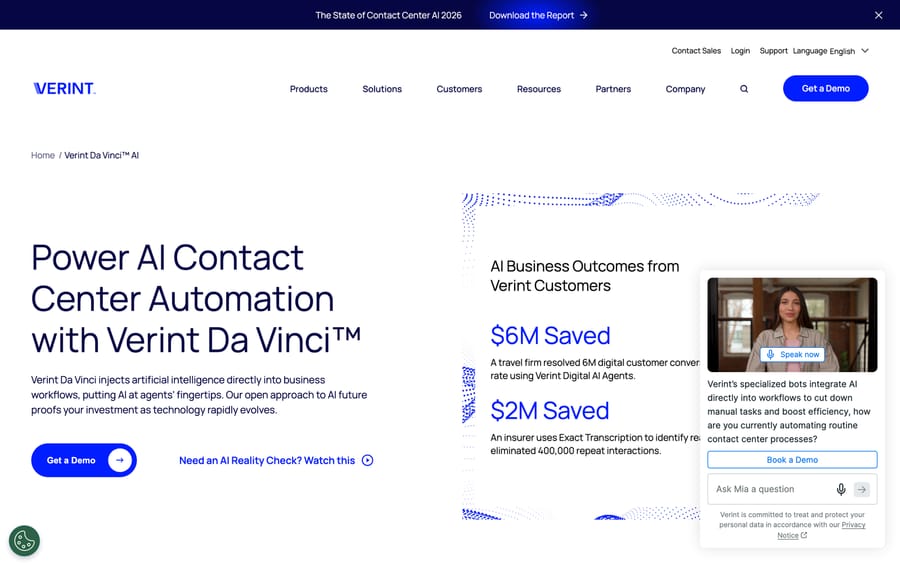
Verint's AI strategy is branded Da Vinci, and its design choice is deliberately to avoid betting on one model. Da Vinci plugs in commercial LLMs, open-source models and Verint's own proprietary models behind one service API, so Verint can swap the underlying model as better ones ship without asking a customer to reconfigure anything. That's a sensible hedge for a vendor selling multi-year enterprise contracts: a model chosen in 2024 looks dated by 2026, and nobody wants to re-sign a contract just because a newer model shipped.
Verint packages its AI as a set of narrow bots, each doing one job inside an existing contact center workflow, instead of one general-purpose chatbot:
- Coaching Bot: real-time, in-call guidance for agents (the Cogito-derived product). One telecom case cites 30 seconds off average handling time while agents are still on the call.
- Wrap-Up Bot: generates a call summary automatically after the interaction ends, cutting after-call work.
- Smart Transfer Bot: decides where a conversation should go next (a specific agent, a callback, a message) and hands the receiving side a summary so it isn't starting cold.
- Knowledge Automation Bot: turns a knowledge-base search into one synthesized answer instead of a list of articles to skim.
- Agent Virtual Assistant: acts on data from connected systems to complete transactional tasks without a human starting them.
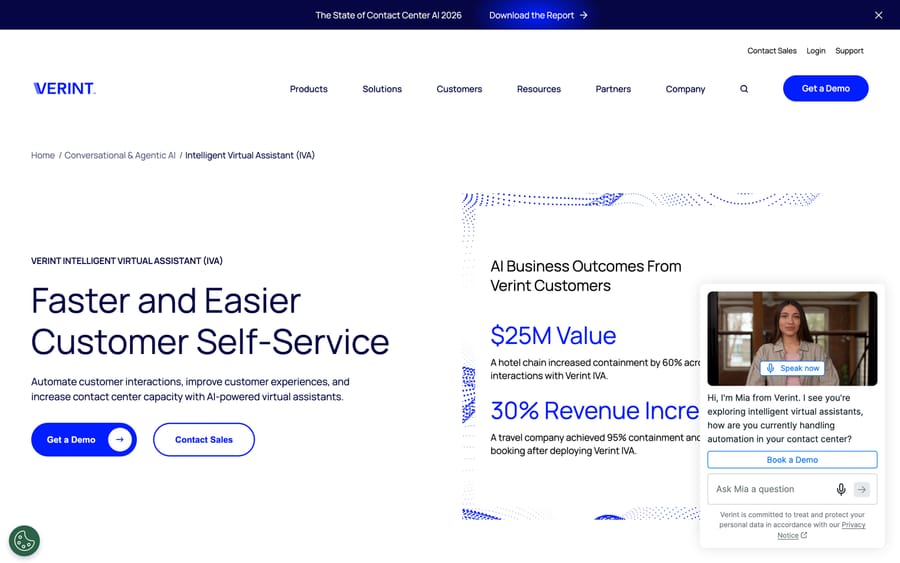
Above the bots sit Agent Factory, Verint's orchestration layer for building and managing a mixed human-and-AI workforce, and the Intelligent Virtual Assistant (IVA), the customer-facing half: a self-service layer across voice and digital channels that resolves what it can and hands off what it can't. Verint reports customer results like a hotel chain reaching 60% containment across 14 million voice and digital interactions, and a travel company hitting 95% containment with a 30% increase in revenue per completed booking. Both figures are vendor-reported and the customers aren't named in the public copy, so treat them as directional.
Key features
- Da Vinci AI orchestration: a model-agnostic AI layer behind every bot, swappable without customer-side reconfiguration.
- Named task bots: coaching, wrap-up, smart transfer, knowledge automation and agent-assist bots, each scoped to one job instead of one do-everything agent.
- IVA (voice and digital self-service): NLU-driven containment across phone and chat, with omnichannel handoff to a live agent.
- Workforce engagement management: forecasting, scheduling and adherence, now folded together with Calabrio's overlapping WEM suite after the merger.
- Quality and interaction analytics: automated scoring across a much larger share of interactions than manual QA sampling could reach. Verint's own marketing cites a Fiserv case going from 1% manual call coverage to 96% automated coverage.
- Open platform: Verint's positioning explicitly invites customers to keep their existing ACD, CRM and LLM instead of replacing them.
Where it plugs in
Verint markets itself as sitting on top of the contact center infrastructure a large enterprise already has, instead of replacing the ACD or the CRM. Its own AWS Marketplace listing says the platform is built to avoid "long, disruptive, and risky 'rip and replace' projects." In practice, most of what you're buying is the AI, analytics and WEM layer, deployed against systems like Genesys, Amazon Connect and Salesforce that stay in place. That is a heavier integration than a help-desk-native agent built inside the ticketing tool itself: you keep your infrastructure, but you wire a platform across it.
Verint pricing (researched)
Verint doesn't publish a price list, and its marketing pages route every "Get a Demo" click to a sales conversation. That's normal for a platform sold to enterprise contact centers, but the numbers below come from two third-party sources instead of a pricing page. Opaque, sales-led pricing also optimizes for Verint's average contract value: without a published number to anchor against, every negotiation starts from the buyer's stated budget rather than a fixed menu, and that's the incentive behind "contact us" on nearly every enterprise CX platform, not just this one.
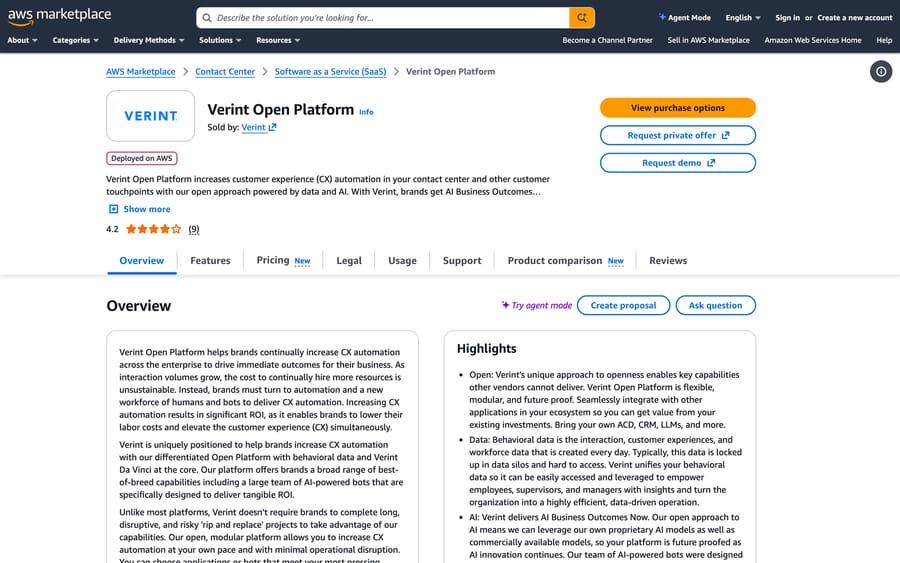
AWS Marketplace has real, published numbers. Verint sells "Verint Open Platform" through AWS Marketplace as three separately licensed modules, Workforce Engagement, Experience Management and Engagement Data Management, each listed at $200,000 for a 36-month term (roughly $66,700 a year per module before negotiation), plus a 25% surcharge on usage beyond the contracted amount. That's a genuine list price, not an estimate: it's the number AWS shows a signed-in buyer before they ever talk to Verint sales.
Vendr's aggregated buyer data puts the median Verint contract at $49,451 a year, with reported deals ranging from $18,858 to $231,780, a wide enough spread that the median tells you less than the range does. Vendr also records what buyers actually negotiated: one got a 26% discount by committing to a multi-year term and signing quickly at Verint's quarter end, and cut the annual price-uplift cap from 8% to 3% in the same deal. Another held the uplift to a 3% maximum at renewal and got Net 45 terms with it. The uplift cap is the number worth fighting over: compounded across two renewals, an 8% cap leaves you paying about 10% more in year three than a 3% cap would, on a line item most buyers skim past to argue about the headline discount.
Put the two numbers together and a shape emerges: a single-module deployment can land close to Vendr's median, while a multi-module Open Platform buy pushes toward $150,000-$200,000 a year at list price. Neither source tells you what a specific enterprise account will actually pay, because that number gets negotiated case by case.
Real-user reviews: what buyers say after they deploy
We checked three independent review sources on 2026-09-17, and they tell a consistent story: solid ratings, alongside a specific, repeated set of complaints once teams are running the software day to day.
- AWS Marketplace (verified purchasers only): 4.2/5 from 9 reviews for Verint Open Platform.
- Capterra: 4.2/5 from 19 reviews for Verint Workforce Management.
- G2 (company-wide, across all Verint products): 4.4/5 from 953 reviews, per G2's seller overview page. G2 and Capterra block automated fetches, so we're citing these by name and check date rather than linking the review page directly.
Direct quotes from Capterra reviewers of Verint Workforce Management:
"User friendly software that works well for you." (CEO, Marketing & Advertising)
"How easy to use, friendly GUI, lot of good features and improvements" (Workforce Analyst, Telecommunications)
"It's actually mind-blowing that someone could create something so insanely user-unfriendly" (Operations Supervisor, Package/Freight Delivery)
That last quote points at the recurring complaint pattern: a steep learning curve, documentation reviewers describe as thin, occasional lag and notification bugs, no native mobile app, and limited employee self-service (PTO requests and shift swaps often run through a separate system like ADP). None of this is unusual for enterprise WEM software, but the learning curve is a cost you pay in onboarding time regardless of what the license costs.
Pros and cons
Pros
- A genuinely broad platform: WEM, quality management, analytics and AI bots under one enterprise vendor, now consolidated further with Calabrio.
- Real-time coaching (via the Cogito acquisition) is a differentiated capability most AI-support vendors don't offer.
- Model-agnostic AI design (Da Vinci) reduces the risk of being locked to one LLM as the field moves.
- Deep integration options with existing ACD and CRM systems, avoiding a rip-and-replace migration.
Cons
- No public pricing. Every deal is a sales conversation, and AWS Marketplace list prices ($200K per 36 months per module) suggest a serious enterprise budget line.
- A steep learning curve and thin documentation are the most consistent complaints across review sites.
- The recent ownership change (Thoma Bravo/Calabrio) adds real uncertainty about roadmap and support continuity, most concretely because the merged company now owns two overlapping workforce management suites and hasn't said publicly which one survives.
- Built for large, high-volume contact centers: most of the platform's breadth (WEM, workforce scheduling, omnichannel voice) sits unused for a team running one help desk.
Who Verint is best for
Verint suits large enterprise contact centers that already run workforce management, need quality scoring across a high volume of interactions, and want an incumbent vendor over a newer point solution, especially where voice volume and agent headcount are big enough that a dedicated WEM platform earns its cost. If your organization already runs Calabrio or Verint WEM and is deciding whether to add AI bots on top, Da Vinci is a logical extension of a relationship you already have.
It's the wrong fit if your "contact center" is a help desk with a support inbox and a chat widget. Most of Verint's value, workforce scheduling across hundreds of agents, omnichannel voice analytics, a bot suite priced by module, is built for a scale and complexity a 20- or 200-person support team doesn't have yet. The enterprise sales cycle and contract size will slow that team down more than a lighter, help-desk-native option would.
Verint vs alternatives
| Verint | NICE (CXone) | Macha | |
|---|---|---|---|
| Model | Enterprise CX automation platform (Da Vinci AI bots + WEM + analytics) | Enterprise CX AI platform (agentic AI + CXone WEM) | AI agent layer on your existing help desk |
| Best for | Large contact centers already running WEM/QM at scale | Large contact centers, direct Verint competitor | Teams on Zendesk, Freshdesk, Gorgias or Front |
| Pricing | Opaque; AWS list about $66.7K/yr per module, Vendr median about $49.5K/yr | Opaque; enterprise sales-led, no public list price | From $299/month for 750 tickets (about $0.40 per ticket), published |
| Setup | Multi-quarter enterprise deployment, sales-led | Multi-quarter enterprise deployment, sales-led | setup and monitoring by the Macha team, included on every plan |
| Trial | None published | None published | $50 of free usage (about 125 tickets), no credit card, no time limit |
| Replaces your help desk? | No, sits alongside the ACD and CRM | No, sits alongside the ACD and CRM | No, it augments the help desk deliberately |
NICE is the most direct comparison: another long-standing enterprise CX vendor (itself the acquirer of Cognigy) selling a similar bundle of AI bots, workforce management and analytics to the same buyer, at the same opaque, sales-led pricing. Anyone shortlisting Verint has very likely already put NICE on that shortlist too.
Macha is a different shape of product, not a smaller Verint. It's for teams whose support operation already runs inside Zendesk, Freshdesk, Gorgias or Front and who want AI agents resolving tickets inside that tool, not a separate omnichannel platform sitting beside an ACD. See Macha on your help desk or pricing for the published numbers.
How we researched this: we read Verint's own site (homepage, the Da Vinci AI page, the Intelligent Virtual Assistant page, and the bot pages listed in its public sitemap), Verint's Wikipedia entry, and its SEC 8-K filing on the Cogito acquisition. Ownership-change reporting came from CX Today, MarketScreener and Crunchbase. Pricing came from Verint's live AWS Marketplace listing and Vendr's aggregated buyer data. Review data came from Capterra, the AWS Marketplace listing, and G2's seller page; we couldn't load G2's per-product review pages directly (they returned a 403 to automated requests), so the G2 figure cited is the company-wide seller rating rather than a per-product breakdown. Gartner Peer Insights also carries a Verint WEM listing, but it returned a 403 to automated access and is not cited here.
FAQ
Is Verint still a public company? No. Thoma Bravo took Verint private in a deal worth roughly $2 billion, which closed November 26, 2025. Verint merged with Thoma Bravo's existing portfolio company Calabrio, and the combined business kept operating under the Verint name from February 2026.
What is Verint Da Vinci? Da Vinci is Verint's AI engine and branding for its bot suite. It's model-agnostic, combining commercial, open-source and proprietary models behind one API, so Verint can change the underlying model without customers needing to reconfigure anything.
Does Verint own Cogito? Yes. Verint acquired Cogito, a real-time agent-coaching AI company, for about $61.4 million in October 2024. Cogito's technology became the basis for Verint's Coaching Bot.
How much does Verint cost? Verint doesn't publish list pricing. Its AWS Marketplace listing shows $200,000 per 36-month term per module (about $66,700/year), and Vendr's buyer data reports a median annual contract of $49,451, with a range from $18,858 to $231,780.
What's the difference between Verint and Calabrio now? They're the same company. Thoma Bravo owned Calabrio before buying Verint and merged the two; Verint's own site lists Calabrio One as part of its workforce engagement lineup. The two products' workforce management suites overlap heavily and neither company has published which one is the long-term platform, so get that in writing before signing a multi-year WEM contract.
Is Verint good for a small support team? Not really. Verint is built for large, high-volume contact centers with dedicated workforce management needs. A team running support inside one help desk pays for platform breadth (omnichannel voice, WEM at scale) it won't use.
What are the best Verint alternatives? NICE (CXone) is the closest direct competitor: a similar enterprise bundle of AI bots, WEM and analytics, also sold through an opaque, sales-led process. Teams that want AI agents inside an existing help desk instead of a separate contact center platform fit Macha better.
Does Verint integrate with Zendesk or Salesforce? Verint's public IVA page says the platform "works seamlessly with your existing CX ecosystem" without naming specific integrations. Verint's broader platform has historically connected to major CRMs and ACDs, Genesys, Amazon Connect and Salesforce among them, confirmed case by case during sales scoping rather than published as a fixed integration list.
Still resolving tickets by hand inside Zendesk or Freshdesk instead of a full contact-center rebuild? Start a Macha trial at dashboard.getmacha.com/signup or see pricing: $50 of free usage (about 125 tickets), no credit card, no time limit.
Sources: Verint homepage, Verint Intelligent Virtual Assistant, Verint Open Da Vinci AI, Verint on Wikipedia, Verint Open Platform, AWS Marketplace, Verint pricing, Vendr, Verint acquires Cogito, CX Today. Capterra ("Verint Workforce Management," capterra.com) and G2 ("Verint," g2.com/sellers/verint) reviews checked 2026-09-17; both block automated page fetches, so they're cited by name rather than linked.
Resolve tickets automatically with AI agents
Macha's AI agents work on top of the help desk you already use — no code.