Intercom
 Shopify
 Stripe
 Slack
Slack Notion
 Google Workspace
 Confluence

What Is GLPI? Free Open-Source ITSM and Asset Management, and What Teclib' Charges (2026)


GLPI is a free, open-source IT service management suite that keeps a help desk and an asset inventory in the same database, with no seat or asset cap when you host it yourself. Teclib', which publishes it, charges from €19 per user a month for managed cloud and from €100 a month for self-hosted support.
Key takeaways
- GLPI is a free, self-hosted, GPL-3.0 IT service management suite that combines a help desk with an asset inventory in the same MySQL database, with no seat cap or asset cap.
- Teclib's managed GLPI cloud costs €19 per user per month for Public Cloud with a 45-day free trial, and €21 for Private Cloud with a minimum of 25 users billed.
- GLPI self-hosted support subscriptions range from €100 a month for GLPI Network Basic, covering up to 10 technical staff or 500 assets, to €4,500 a month for GLPI Network Enterprise.
- GLPI holds 4.5 out of 5 on both G2, from 42 reviews, and Capterra, from 41 reviews, with maintenance effort and a dated interface as the recurring complaints.
- The current stable GLPI release is 11.0.9, published on 2026-09-16, and the GitHub repository carries 6,382 stars with a last commit on 2026-09-24.

GLPI is a free, GPL-3.0 open-source IT service management suite, published by the French company Teclib', that combines a help desk and an IT asset inventory in one MySQL database with no seat or asset cap when you host it yourself. Paying starts at €19 per user a month for Teclib's managed cloud or €100 a month for a self-hosted support subscription.
| GLPI route | Price (excl. VAT) | Who it suits |
|---|---|---|
| Self-hosted community edition | Free | IT teams that run their own Linux servers |
| GLPI Network Public Cloud | €19 / user / month, 45-day trial | Teams without a server to patch |
| GLPI Network Private Cloud | €21 / user / month, 25-user minimum | Larger teams needing a dedicated server |
| Self-hosted support (Network Basic to Enterprise) | €100 to €4,500 / month | Self-hosters who want vendor support |
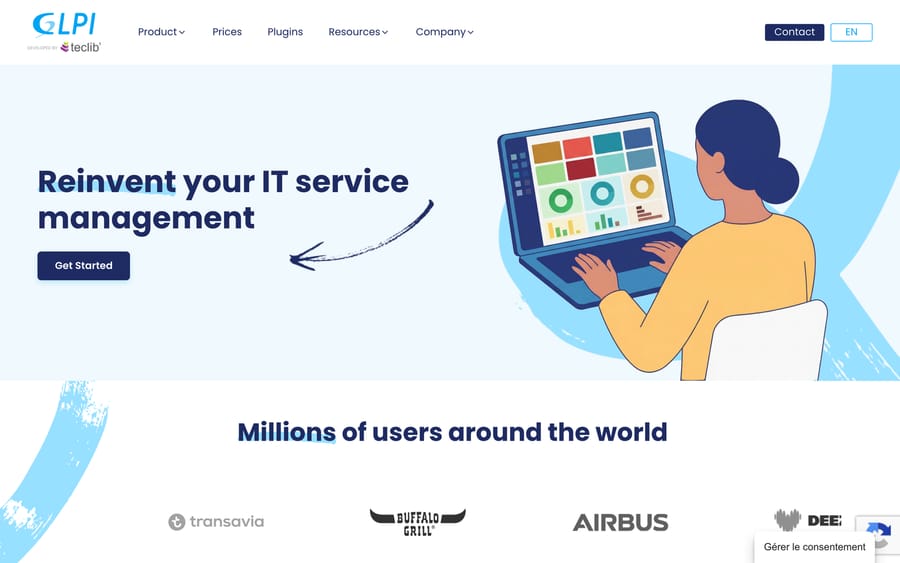
What is GLPI, and who publishes it?
GLPI started in 2003 as a French community project and is now developed and published by Teclib', a French company that sells hosting and support around it. The software is released under GPL-3.0, the source lives on GitHub, and the current stable release on the downloads page is 11.0.9. The repository carries 6,382 stars and 1,822 forks, 11.0.9 was published on 2026-09-16, and the last commit we saw was pushed on 2026-09-24, so this is an actively maintained project rather than a parked one.
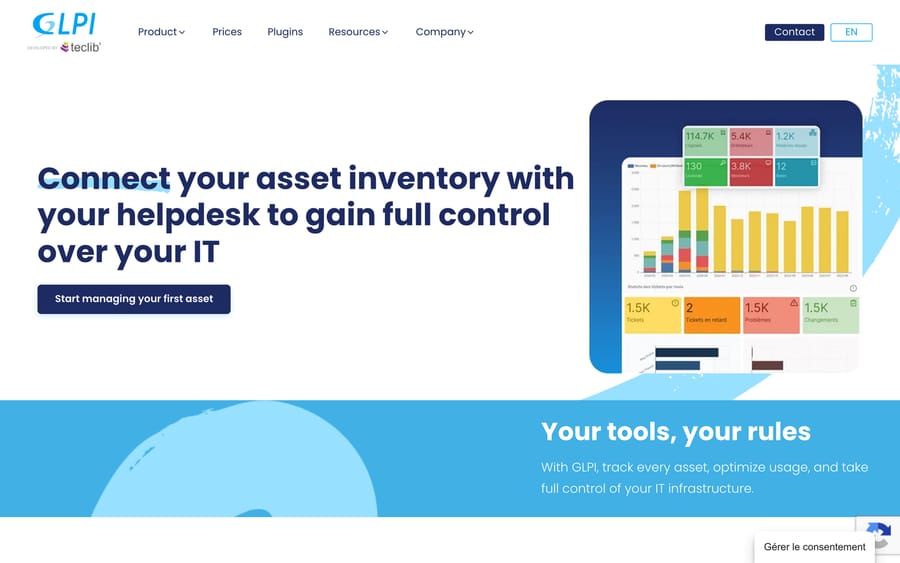
Two things sit inside one application. The first is a help desk: tickets, requests, a service catalog with forms, SLAs, problems, changes and a self-service portal. The second is an asset inventory: computers, software licenses, network gear, contracts, budgets and suppliers, with agentless network discovery and an optional agent. GLPI's own product page describes the pairing as connecting the inventory to the help desk, and that link is the reason people pick it.
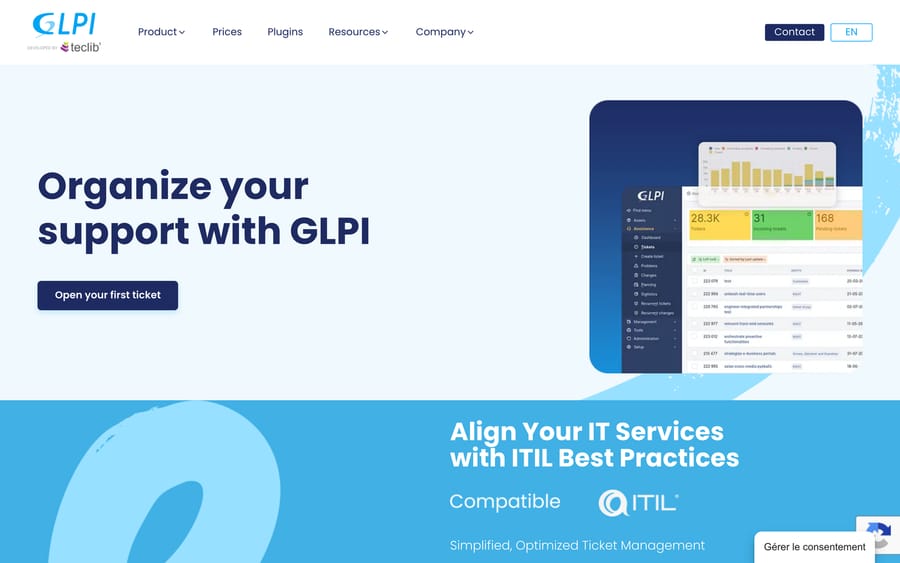
That matters because of what an IT ticket usually is. Someone's laptop is broken. The useful question is which laptop, bought when, under what warranty, running which software build. In a desk that only holds tickets you go and look that up somewhere else. In GLPI the asset record is one click from the ticket, because both rows live in the same MySQL database.
What is actually free in GLPI?
The free route is the self-hosted community edition, and it is genuinely free rather than a capped tier:
- No seat cap. Nothing in the download limits technicians, end users or tickets. Teclib' sells support subscriptions banded by staff count, but the software itself does not enforce those bands.
- No asset cap. Same story: the €100-a-month Network Basic subscription is described as covering up to 500 assets, and that is a support boundary, not a lock in the code.
- No time limit and no credit card. You download a tarball from glpi-project.org/en/downloads and install it.
- GPL-3.0 source, so you can modify it, and the community plugin catalog is open.
What you pay instead is hosting and hours. GLPI wants a Linux box with PHP and MySQL or MariaDB, a cron job, a mail account for ticket creation, TLS, and somebody to run the upgrades. On a small VPS the infrastructure cost is real but small, roughly the price of a coffee a week. The setup time is the part people underestimate: one r/sysadmin thread is literally about how long a GLPI rollout should take, with a contractor quoting a month and a half for 80 computers.
One honest caveat on the plugin side. The GLPI Network Marketplace lists community plugins and Network plugins separately, and the pricing page puts the Network set inside every paid tier. So "free" covers the application and the community plugin ecosystem, and a handful of publisher-maintained extras sit behind a subscription.
How much does GLPI cost when you outgrow free?
Teclib' publishes real numbers, which is more than most open-source vendors do. All of these were on the pricing page on 2026-09-20, were unchanged on 2026-09-24, and exclude VAT.
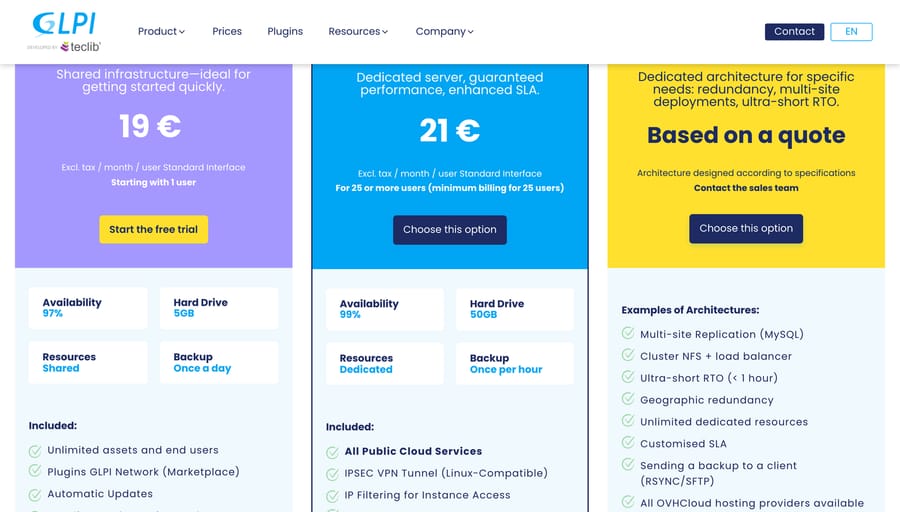
Managed cloud (Teclib' hosts it):
| Offer | Price | Minimum | What you get |
|---|---|---|---|
| GLPI Network Public Cloud | €19 / user / month | 1 user | Shared infrastructure, 5 GB files, 97% availability, daily backup, automatic updates, SSO |
| GLPI Network Private Cloud | €21 / user / month | 25 users (minimum billing) | Dedicated server, 50 GB files, 99% availability, hourly incremental backup, IPsec VPN, read-only MySQL access |
| GLPI Network Private Custom | Quote | By specification | Multi-site replication, geographic redundancy, sub-hour RTO |
Both cloud offers say unlimited assets and unlimited end users; the per-user price counts technical staff on the standard interface. There's a 45-day free trial, which is unusually long, and the fine print notes there are no backups during the trial period.
Self-hosted support subscriptions (you host it, Teclib' supports it):
| Tier | Price | Covers |
|---|---|---|
| GLPI Network Basic | €100 / month | Up to 10 technical staff or 500 assets, 1 production plus 1 test instance |
| GLPI Network Standard | €300 / month | Up to 50 staff or 5,000 assets, 2 production plus 2 test instances |
| GLPI Network Advanced | €1,000 / month | More than 50 staff or 5,000 assets, 4 production plus 4 test instances |
| GLPI Network Enterprise | €4,500 / month | Unlimited assets and instances, priority support, crisis response team, 3 training places |
Read those four rows carefully: the plugin list printed under each one is identical. The tiers sell scale and support response, not features. That's a healthier incentive than the usual open-core model, where the vendor earns more by holding a feature you need hostage, because here Teclib' only makes money when your estate genuinely grows.
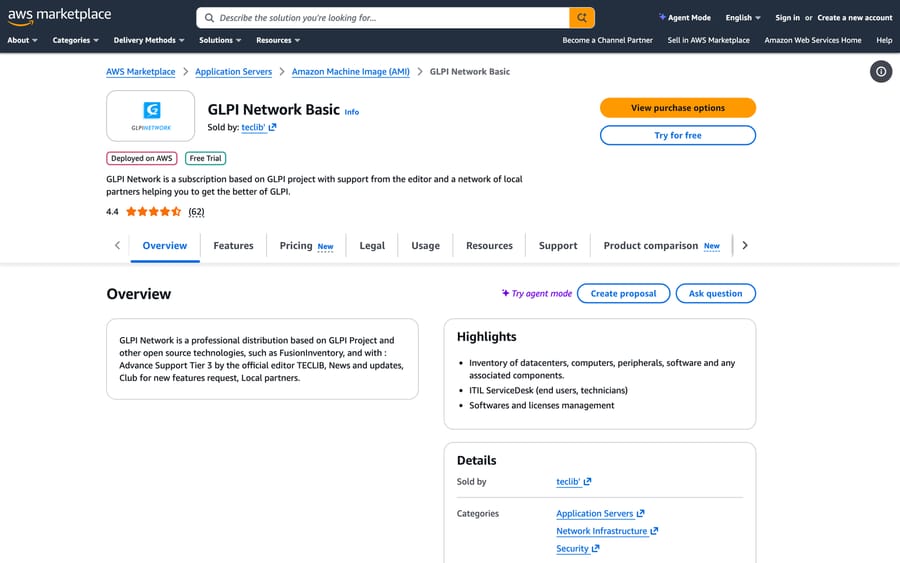
There is also an AWS Marketplace listing, which we checked before saying anything about published prices. GLPI Network Basic, sold by teclib', prices the software at $0.20 to $0.27 an hour depending on instance type, or $1,200 for a 12-month term, on top of AWS infrastructure. That annual figure lines up with the €100-a-month Basic tier, so the marketplace is a purchasing convenience rather than a discount.
What do GLPI users say about it?
GLPI holds 4.5 out of 5 from 42 reviews on G2 and 4.5 from 41 reviews on Capterra, both read on 2026-09-20; the Capterra page states it was last updated on 26 August 2026. The AWS listing carries 4.4 from 62 ratings. Those are small samples, so treat them as direction rather than proof.
The recurring praise is range and control. A CTO at a small business (G2, 17 March 2025) describes deciding exactly what each customer can access and wiring GLPI into an ERP and monitoring stack.
The recurring complaint is the price of that flexibility. Enzo P., a network specialist at a small business, gave GLPI 5 out of 5 on G2 on 10 December 2025 and still wrote that it's "easy to twist to your need, but then, maintenance is a little bit harder". On Capterra, a security analyst (4 November 2021) called it "an expensive tool", which is a striking thing to say about software that costs nothing and tells you where the money actually goes.
One older Capterra review complains that assets have to be entered by hand with no auto-discovery. That was written in August 2019; GLPI now ships agentless network discovery and a native inventory agent, so check the date on any review that describes missing inventory automation.
The community read is consistent. On r/sysadmin, GLPI vs Zammad and Ticketing System with Asset Management are live threads where GLPI is the answer people give when someone wants both halves in one tool. In GLPI Experience & Recommendations one commenter calls it the best you'll get in the free world before pointing at Jira Service Management as the paid step up. And an r/glpi thread asks whether a non-IT small business can run it at all, which is the right question, and the honest answer is below.
Who should use GLPI, and who shouldn't?
GLPI fits teams that have an IT person. Specifically it suits an internal IT or MSP team of roughly 2 to 50 technicians who already run their own Linux servers, who need asset and license tracking as much as ticketing, and who would rather spend a week configuring than €20 per agent per month forever. It's also a strong fit where data has to stay on your own hardware for procurement or regulatory reasons, and where you need the interface in a language most vendors skip.
It's the wrong choice if nobody on the team maintains servers. There is no free hosted tier to fall back on, so if you can't patch a PHP application you're one CVE away from a problem. It's also the wrong fit for a customer-facing support team: GLPI is built around IT requests, incidents and assets, so if you want live chat, a social inbox and a modern customer help center, you're fighting the product's shape. For that kind of queue, Chatwoot is the open-source tool built for the job.
And if you only want a ticket queue with no asset side at all, GLPI is more machine than you need. Our roundup of the best free IT ticketing systems covers the lighter options, and the best open-source ticketing systems piece puts GLPI next to its peers.
How does GLPI compare with Zammad, Snipe-IT and Jira Service Management?
| GLPI | Zammad | Snipe-IT | Jira Service Management | |
|---|---|---|---|---|
| What it is | Help desk plus asset management and CMDB | Help desk and shared inbox | IT asset management only | ITSM suite with assets |
| Free route | Self-host, GPL-3.0, no seat cap | Self-host the open-source edition | Self-host, no seat cap | Free plan, 3 agents, hosted |
| Cheapest paid | €100/mo self-hosted support, or €19/user/mo cloud | €7/agent/mo annually, max 5 agents (Starter v2) | Paid hosting from the vendor | $20/agent/mo (Standard) |
| Billing unit | Technical staff, or asset count | Per agent | Hosting tier | Per agent |
| Best at | One database for tickets and hardware | Email-first ticketing with a clean interface | Asset tracking with a sane interface | Enterprise process and integrations |
| Watch out for | Configuration effort, dated-looking interface | No asset management worth the name | It's not a help desk | Price climbs fast past 10 agents |
Prices read live on 2026-09-20, and the Zammad and Jira Service Management figures rechecked on 2026-09-24, from glpi-project.org, zammad.com, snipeitapp.com and atlassian.com.
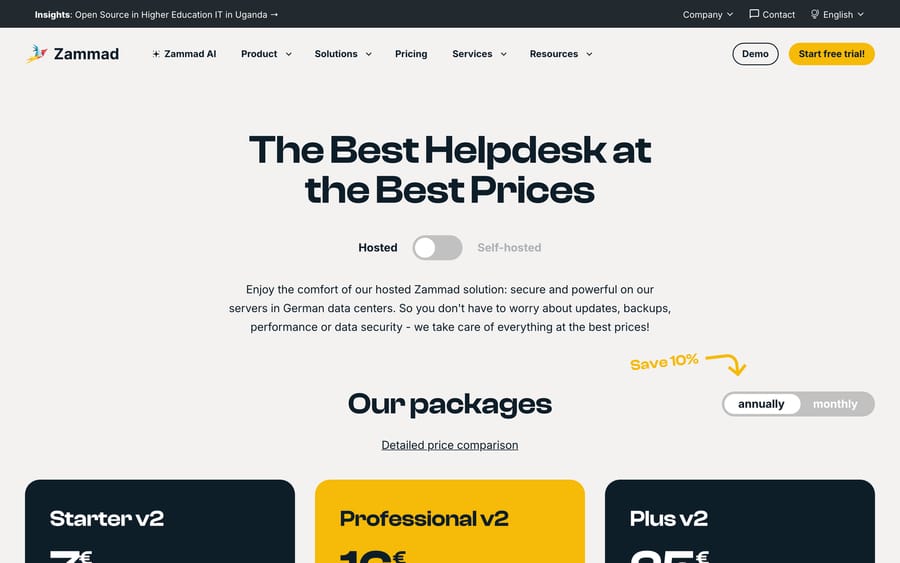
Zammad is the fair comparison on the ticketing half. It's also open source and also self-hostable for free, and most people find its interface friendlier. Its hosted Starter v2 plan is €7 per agent per month billed annually, €9 monthly, and caps at 5 agents; Professional v2 is €16 or €18 for up to 35 agents, and Plus v2 is €25 or €27 for unlimited agents. Zammad's AI features bill separately at €0.03 per AI call. Where Zammad loses to GLPI is assets: it doesn't do them.
Snipe-IT is the mirror image. Free and open source, excellent at asset and license tracking, and not a help desk. Teams often run Snipe-IT plus a separate desk, which is two systems to maintain and two places the laptop's serial number can drift out of sync. That trade is exactly what GLPI exists to avoid, and it's worth being honest that Snipe-IT's asset interface is nicer than GLPI's.
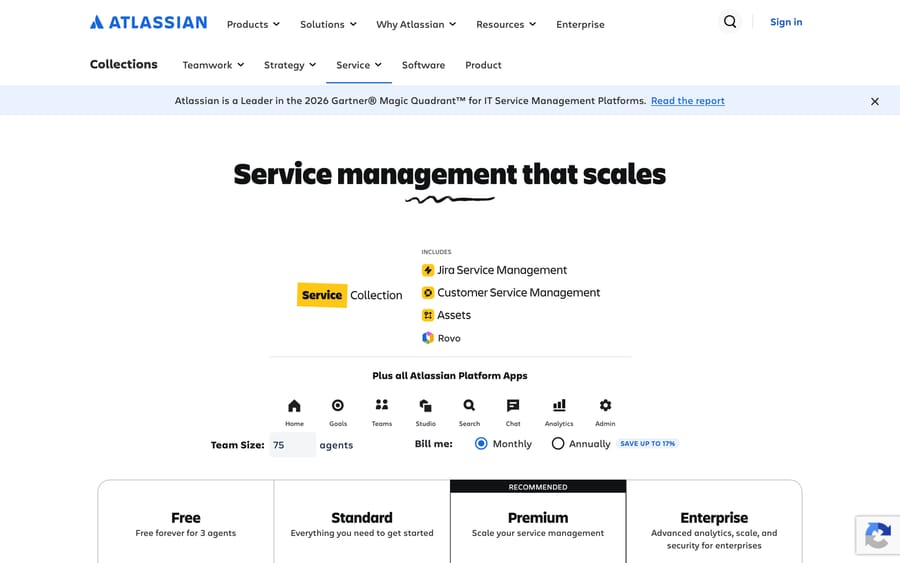
Jira Service Management is the paid answer, and it's the one r/sysadmin points at. Its free plan is genuinely free forever for 3 agents, Standard is $20 per agent per month and Premium is $51.42, with assets included and priced above 50,000 objects. At 3 agents it costs nothing and does less configuration work than GLPI. At 20 agents Standard runs $400 a month, against €300 a month for GLPI Network Standard covering up to 50 staff. The crossover is real, and it's the calculation to actually run before you commit to either.
Can an AI agent answer GLPI tickets?
We build Macha, an AI agent layer that sits on top of an existing help desk and answers tickets inside it. It connects to Zendesk, Freshdesk, Gorgias, Front, HubSpot or Intercom. It does not connect to GLPI, and we're not going to pretend otherwise. If GLPI is your desk, the automation worth your time is GLPI's own: business rules on ticket creation, a decent service catalog so requests arrive categorized, and the asset link doing the work a triage agent would otherwise do by hand.
If your customer-facing queue happens to live in one of those help desks while GLPI handles internal IT, that's the case where both make sense at once, and our pricing is published per ticket rather than per agent.
How we researched this
We read GLPI's own pages on 2026-09-20 and rechecked the pricing page, the latest release and the GitHub repository on 2026-09-24: the pricing page, the downloads page, and the help desk and asset management product pages, which is where the screenshots in this post come from. License and repository activity came from the GitHub API for glpi-project/glpi rather than from a search snippet. We checked AWS Marketplace for a listing before writing anything about published prices, and found one. We did not install GLPI for this guide, so every claim here is from a vendor page, the repository, a review listing or a public community thread, and none of it is from a test instance of ours.
Frequently asked questions
Is GLPI really free? Yes, for the self-hosted community edition. The software is GPL-3.0, there's no seat cap, no asset cap and no time limit, and you download it directly from glpi-project.org. You pay for your own server and your own time, and optionally for a Teclib' support subscription starting at €100 a month.
Does GLPI have a free cloud version? No. Teclib's cloud starts at €19 per user per month excluding VAT with a 45-day free trial, and the trial explicitly has no backups. If you want GLPI without a server, that trial is the only free path and it ends.
What's the difference between GLPI and GLPI Network? GLPI is the open-source application. GLPI Network is Teclib's commercial subscription around it: support, automatic updates, the publisher-maintained plugin set and the hosted cloud. The four self-hosted Network tiers list the same plugins and differ on how many technical staff, assets and instances they cover.
GLPI vs Zammad: which should I pick? Pick Zammad if you want a clean, email-first help desk and you don't care about hardware. Pick GLPI if the ticket and the laptop it's about need to live in the same system. Both are free to self-host, so the honest test is to install both on a spare box and see which one your technicians stop complaining about.
Can GLPI replace Snipe-IT? For most small estates, yes. GLPI covers asset records, software licenses, contracts and financials, plus network discovery. Teams who moved say the loss is interface polish. Teams who kept Snipe-IT usually did so because their asset workflow was already built around it.
How long does GLPI take to set up? Budget days, not hours, and weeks if you're importing an existing estate. Installing the application on a prepared LAMP server is a short job; configuring entities, profiles, categories, SLAs, the service catalog and the inventory agent is the real work. One r/sysadmin thread records a contractor quoting six weeks for 80 machines, which sounds high but tells you the shape of the task.
Is GLPI secure enough to expose to the internet? It can be, and it's on you. You're running a PHP application you patch yourself, so put it behind TLS, keep PHP current, subscribe to the project's security advisories and upgrade promptly. Teams without that discipline should buy the cloud version instead of self-hosting.
Does GLPI do AI? The paid Network tiers list a GLPI AI component. The free community edition does not ship an AI agent that answers tickets for you, and nothing on the pricing page suggests one is included below a subscription.
Sources: glpi-project.org, GLPI pricing, GLPI downloads, GLPI help desk, GLPI asset management, glpi-project/glpi on GitHub, GLPI Network Basic on AWS Marketplace, G2 GLPI reviews, Capterra GLPI reviews, Zammad pricing, Snipe-IT pricing, Jira Service Management pricing.
Resolve tickets automatically with AI agents
Macha's AI agents work on top of the help desk you already use — no code.