Intercom
 Shopify
 Stripe
 Slack
Slack Notion
 Google Workspace
 Confluence

Salesforce Einstein vs Agentforce (2026): What's the Difference and What Does Each Cost?


Einstein is Salesforce's brand for the predictive AI built into its clouds, priced inside editions or as per-user add-ons, while Agentforce is its agent product, billed at 10 cents an action in Flex Credits or per user for employees. Einstein Copilot became Agentforce in January 2025 with no change in what it did, which causes most of the confusion between the two names.
Key takeaways
- Salesforce Einstein is the brand for AI built into Salesforce editions, while Agentforce is a separate agent product billed at 10 cents an action in Flex Credits.
- Einstein Copilot became Agentforce in January 2025 with no change in functionality, according to Salesforce's Winter '25 release notes.
- For a 20-seat service team handling 5,000 chats a month, the Einstein Bots add-on on Service Cloud Core costs $1,500 a month, matching Agentforce at 3 actions a chat.
- Salesforce's Help Agent charges $2 per resolved session, so 5,000 chats at a 60% resolution rate would cost $6,000 a month.
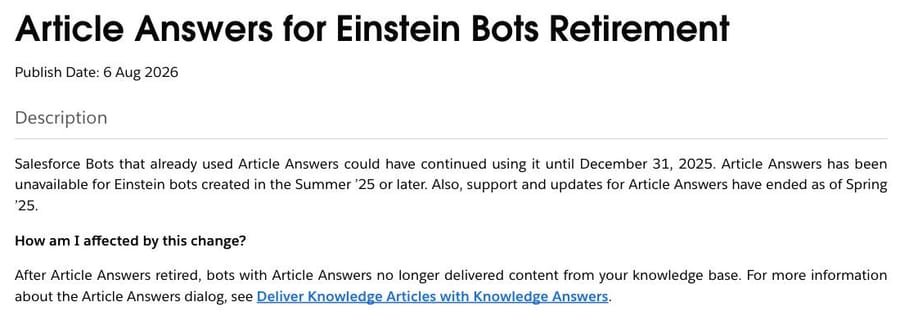
- Einstein Bots' Article Answers feature is being retired: existing bots could use it only until December 31, 2025, and bots created in Summer '25 or later never had it.

Einstein is Salesforce's umbrella brand for the predictive and assistive AI built into its clouds, priced inside editions and per-seat add-ons, while Agentforce is a separate agent product built on the Einstein platform and billed at 10 cents an action in Flex Credits ($500 per 100,000). The one true rename: Einstein Copilot became Agentforce in January 2025 with no change in functionality.
How do Einstein and Agentforce compare at a glance?
| Salesforce Einstein | Agentforce | |
|---|---|---|
| What it is | The brand for all AI and machine learning built into Salesforce; Salesforce says it isn't one product | A standalone agent product that "builds on top of the Einstein Platform" |
| Architecture | Predictive models trained per org (or global models, opt-out available), plus rules-based Einstein Bots | Agents with topics, instructions and actions that reason over a request and call Flows, Apex and APIs |
| Channels | Inside Salesforce apps; Einstein Bots on chat and messaging | Service chat, messaging, voice, Slack, and inside Salesforce for employees |
| Who builds | Admins switch features on and pick the data; bots built as dialogs | Admins and developers in Agentforce Builder; Salesforce also ships prebuilt agents |
| Billing unit | Included in editions, per-user add-ons, some usage caps | Flex Credits per action (20 credits), $2 per resolved Help Agent session, or per-user add-ons |
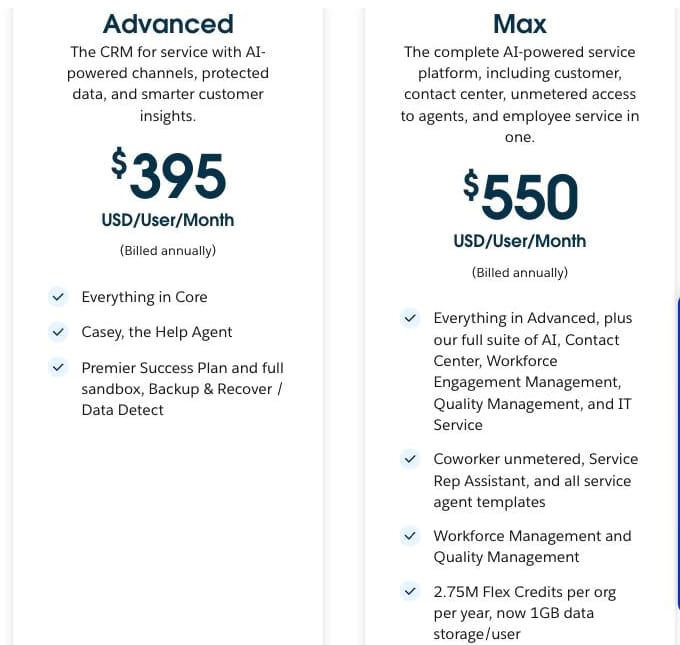
| Published price | Einstein Bots: $75 a user a month on Service Cloud Core, included in Advanced ($395) and Max ($550) | $500 per 100,000 Flex Credits; add-ons $125 a user a month; Foundations $0 |
| 5,000 chats a month, 20-seat team | $1,500 (Einstein Bots add-on on Core) | $1,500 (3 actions a chat) to $6,000 (Help Agent, 60% resolved) |
| Gartner Peer Insights | Einstein 4.2 from 52 ratings; Einstein Bots 4.3 from 5 | Salesforce Agentforce 4.3 from 72 ratings |
| Capterra | Salesforce Einstein 4.0 from 3 reviews | Agentforce 5.0 from 1 review |
| G2 | No standalone listing; redirects to Agentforce Service (formerly Salesforce Service Cloud), 4.4 from 8,412 | Salesforce Agentforce 4.3 from 1,695 |
| Customers Salesforce names | Einstein runs across the platform: "more than a trillion predictions every week" | OpenTable, SharkNinja, Indeed, Heathrow, Finnair, Fujitsu |
Prices checked September 19, 2026 and rechecked September 24 on Salesforce's Service Cloud pricing page and Agentforce pricing page; ratings read the same day on Gartner Peer Insights and Capterra. The cost row is worked out below.
What is Salesforce Einstein now?
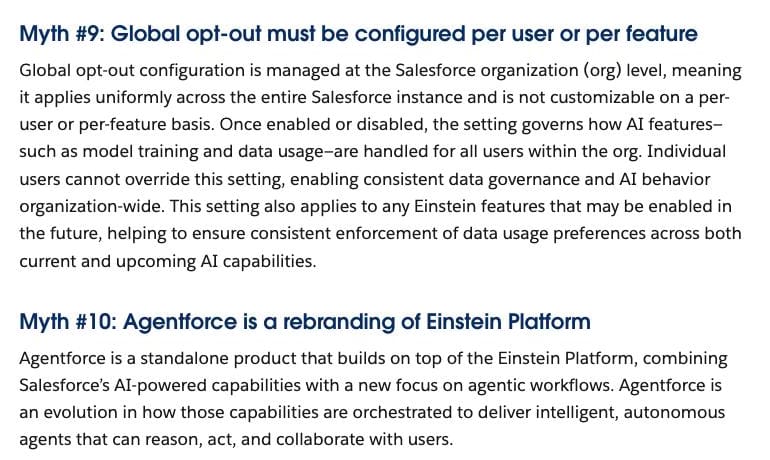
Salesforce's own myths post opens with the correction most buyers need: "Einstein is the umbrella brand for all AI and machine learning capabilities built into the Salesforce Platform." It lists a second myth that matters for budgeting. Einstein features aren't on by default: most "require setup, data preparation, and customization", and an admin has to switch each one on and choose the data it learns from.
In a service org, Einstein means a set of features that each do one job. From the Service Cloud pricing comparison, read on September 19, 2026:
| Einstein feature | Starter / Pro Suite | Core ($195) | Advanced ($395) | Max ($550) |
|---|---|---|---|---|
| Einstein Next Best Action | 5k requests per user per month | 5k | 5k | 5k |
| Einstein Case Classification | Not included | Not included | Single data segment | 5 data segments |
| Einstein Case Routing | Not included | Not included | Not included | 2,000 routing predictions per user per month |
| Einstein Article Recommendations | Not included | Not included | Unmetered for agent users | Unmetered for agent users |
| Einstein Bots | Not included | $75 a user a month extra | Included | Included |
These are classification and recommendation features for human reps: guess the case type, suggest the article, route to the right queue. Einstein Bots is the one customer-facing piece, and it's a dialog builder with rules and intents. The prices are per seat, and they're bundled, so a team rarely buys "Einstein" as a line item.
What is Agentforce?
Agentforce is Salesforce's agent product. An agent gets topics (what it handles), instructions and actions (Flows, Apex, prompt templates, API calls), and a reasoning engine picks which action to run for each request. The same agent can answer a customer on chat, update a case, or work for an employee inside Salesforce. Myth #10 in Salesforce's post puts the relationship plainly: "Agentforce is a standalone product that builds on top of the Einstein Platform", which is where the Trust Layer, the models and the grounding in CRM data come from.
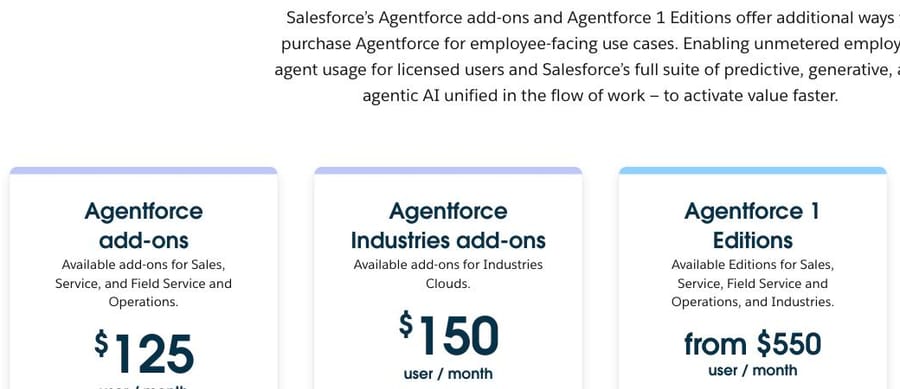
Agentforce is metered by what the agent does. Salesforce's rate card charges 20 Flex Credits for a standard action and 30 for a voice action, and Flex Credits cost $500 per 100,000, so an action is 10 cents. Salesforce's own customer-facing Help Agent is billed differently, at 400 credits ($2) per resolved session with unresolved sessions free. Employees can be covered per seat instead: Agentforce add-ons for Sales, Service and Field Service are $125 a user a month for unmetered employee use, and Agentforce 1 Editions start at $550 with 2.5 million Flex Credits a year. A cheaper route is the Agentforce User License at $5 a user a month, which draws on Flex Credits instead of being unmetered. Our Agentforce guide covers the product in depth.
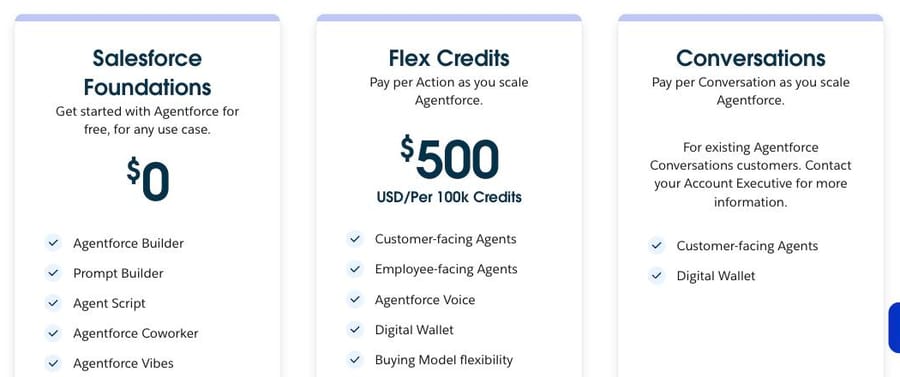
The per-user add-on is also where Einstein's predictive features now live in Salesforce's price list. The pricing page describes the add-ons and Agentforce 1 Editions as bringing "Salesforce's full suite of predictive, generative, and agentic AI" to licensed users. It doesn't list a separate Einstein add-on.
What happened to Einstein Copilot and Einstein Bots?
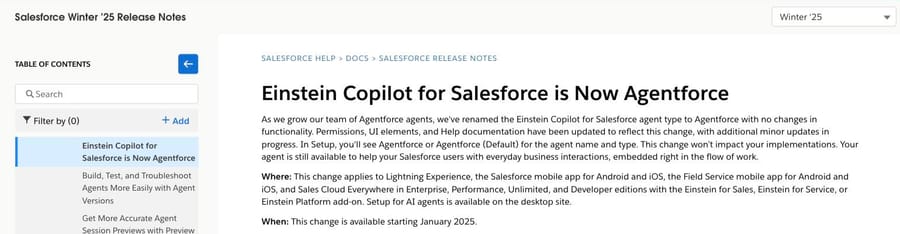
Einstein Copilot is now Agentforce. Salesforce's Winter '25 release note says it "renamed the Einstein Copilot for Salesforce agent type to Agentforce with no changes in functionality", that Setup now shows "Agentforce (Default)", and that the change was available from January 2025. Salesforce's old explainer is still live under the title "What Is Agentforce Assistant? (Formerly Einstein Copilot)", with an editor's note that Agentforce Assistant "has been upgraded to Agentforce". So the employee-facing assistant went through two names in about a year, and the org you set up as Einstein Copilot is the same one you now see as Agentforce.
Einstein Bots are still sold, but parts of them are being retired. Salesforce's Einstein Bots retirement notice, published August 6, 2026, says bots using Article Answers could keep it only until December 31, 2025, that bots created in Summer '25 or later never got it, and that support ended in Spring '25. The recommended replacement is Generative Knowledge Answers. A bot that stopped answering from the knowledge base this year is most likely running into that change.
What do Einstein and Agentforce cost for the same month?
Take a 20-seat service team on Service Cloud Core that gets 5,000 chat conversations a month and wants automation on the front line.
| Route | How it's billed | Monthly cost |
|---|---|---|
| Einstein Bots add-on on Core | $75 × 20 users | $1,500 |
| Einstein Bots on Advanced | Included; Advanced is $200 a user more than Core | $4,000 more in seats, which also buys case classification, article recommendations, the Help Agent and a Premier Success Plan |
| Agentforce, Flex Credits | 5,000 chats × 3 actions × 20 credits = 300,000 credits at $500 per 100,000 | $1,500 |
| Agentforce Help Agent | 60% resolved = 3,000 sessions × $2; the other 2,000 free | $6,000 |
The Einstein Bots and Flex Credit rows land on the same $1,500, and they pay for different things. The bot add-on is a flat seat fee, so it costs the same at 500 chats or 50,000; the pricing table lists no per-conversation charge. The Flex Credit row scales with the work: at 5 actions a chat it becomes $2,500, and at 1,000 chats it's $300. The Help Agent row charges only for success, and it's the most expensive of the four at a 60% resolution rate. At 30%, it would be $3,000.
None of these rows include the Service Cloud seats themselves, Data 360 usage, or voice. The action counts and resolution rate are our assumptions; the rates are Salesforce's. Salesforce's rate card is the place to check an action before you model it.
What does each billing unit reward?
Einstein's seat-based pricing gives Salesforce an incentive to sell editions. Case classification, routing and article recommendations sit in Advanced and Max, not in Core, so the features push a team up a tier rather than onto a meter. It's predictable, and it charges the same whether the features are used or not.
Flex Credits put Salesforce's incentive on activity. Every action is 10 cents, so an agent that makes five tool calls to answer a question earns Salesforce more than one that makes two, whether or not the customer got an answer. The upside for you is that the cost of a conversation is countable before launch.
The Help Agent's $2 per resolution is the one unit that pays Salesforce for outcomes. It's also the one where Salesforce decides what counted: its Help documentation defines a resolved session by the conversation's length, the final feedback and whether it escalated. Read that definition before signing, and ask for session-level reports.
What is the difference between Agentforce and Salesforce?
"Agentforce vs Salesforce" is mostly a naming question. Salesforce is the company and the CRM. Agentforce started as its agent product, and the name has since spread to the platform and some clouds. Salesforce's own Sales Cloud guide now refers to "The Salesforce Platform (now the Agentforce 360 platform)" and calls the sales product "Agentforce Sales". The Service Cloud pricing page still says Service Cloud, and sells "Agentforce for Service" as a line item inside it. Gartner Peer Insights lists Agentforce Service (4.3 from 416 ratings) separately from Salesforce Agentforce (4.3 from 72).
So "Agentforce" can mean three things on a Salesforce page: the agent product priced in Flex Credits, the renamed platform underneath every cloud, or a cloud's new name. When a quote says Agentforce, ask which one it's pricing.
What do reviewers say about Einstein and Agentforce?
Gartner Peer Insights rates Einstein 4.2 from 52 ratings and Salesforce Agentforce 4.3 from 72 (read September 19, 2026). The most specific Einstein complaint on Gartner's page is about cost visibility: one reviewer wrote "It's very difficult to estimate usage or even get reporting on it since it's all based on credits which is hard to measure", and another that "the lack of visibility into orchestration and usage makes the cost-benefit difficult to analyze." The credits that reviewer means are the Flex Credits Agentforce also bills on (prompt templates are metered per 2,000-token chunk on the same rate card), so in a modern org the two products share one meter.
Agentforce reviewers on Gartner's page like that it "lives natively inside the Salesforce ecosystem, so there's no need for external data syncs", and a highlighted review is titled "Fast automation within Salesforce, but advanced setup can be challenging." Another says complex customizations "may be overwhelming for AI agent to resolve. Hence the initial phase requires support from the vendor team."
What if your tickets don't live in Salesforce?
Both products assume your cases live in Salesforce. Many support teams use Salesforce as the CRM and run tickets in a separate help desk such as Zendesk, Freshdesk, Gorgias, Front, HubSpot or Intercom. For those teams, Agentforce means moving service work into Service Cloud first, which our Zendesk vs Service Cloud comparison prices out.
Macha fits teams in that second group: an AI agent layer on the help desk you already run that answers and acts inside the ticket, built, tested and monitored by the Macha team. It's priced per ticket, one charge however many replies it takes, from $299 a month for 750 tickets, with the 5,000-ticket tier at $1,999 (see pricing). It doesn't run on Service Cloud, so a team whose cases live in Salesforce should compare Einstein and Agentforce, or the options in our Agentforce alternatives list. For building on Salesforce, our guide to building an AI agent for Service Cloud walks through it, and AI agents for customer service compares the wider field.
Should you choose Einstein, Agentforce, or neither?
Choose Einstein features if you want help for human reps (case classification, routing, article suggestions) at a predictable per-seat price, and your edition already includes them. Keep Einstein Bots only for scripted flows, and plan the move to Generative Knowledge Answers if a bot answers from knowledge articles.
Choose Agentforce if you want an agent that answers customers and takes actions (refunds, order changes, case updates) across chat, messaging or voice, and you can model the cost per action. Start with a small Flex Credit block and count actions per conversation before committing to a larger one.
Consider neither if your tickets don't live in Salesforce, your volume is low enough that a macro library covers it, or you want a flat price per ticket instead of a meter per action. A help desk's own AI or an agent layer on that help desk will be cheaper to try.
How we researched this
On September 19, 2026 we checked Salesforce's Service Cloud and Agentforce pricing pages in a browser (reading the Service Cloud feature comparison from the page's accessibility tree, since the table was collapsed at our screen width), the Winter '25 release note on the Einstein Copilot rename, the Einstein Bots retirement notice, Salesforce's Einstein and Agentforce myths post and its Sales Cloud guide, and the Flex Credit rates in our shared Agentforce figures. Ratings came from Gartner Peer Insights, Capterra and G2 the same day. G2 no longer lists "Salesforce Einstein" as its own product; that URL now redirects to "Agentforce Service (formerly Salesforce Service Cloud)," rated 4.4 from 8,412 reviews. Salesforce Agentforce, the agent-builder product this page otherwise compares, holds 4.3 from 1,695. We did not build an agent: a Salesforce Developer Edition needs a work email and acceptance of Salesforce's developer agreements, and we don't create vendor accounts for these comparisons. The 5,000 chats, three actions a chat, 60% resolution rate and 20 seats are our assumptions.
Frequently asked questions
What's the difference between Salesforce Einstein and Agentforce? Einstein is Salesforce's brand for all the AI built into its products, mostly predictive and assistive features priced into editions. Agentforce is a separate agent product built on the Einstein platform that answers requests and takes actions, billed at 10 cents an action in Flex Credits or per user for employees.
Is Agentforce the same as Einstein? No. Salesforce's own myths post says Agentforce is "a standalone product that builds on top of the Einstein Platform", not a rebrand of it. One Einstein product was renamed, though: Einstein Copilot became Agentforce in January 2025.
What is Salesforce Einstein called now? Einstein is still the name for Salesforce's predictive AI features (Einstein Case Classification, Einstein Article Recommendations, Einstein Bots). Einstein Copilot, the conversational assistant, is now called Agentforce; its Setup label is "Agentforce (Default)".
Is Einstein Copilot the same as Agentforce? Yes. Salesforce's Winter '25 release note renamed the Einstein Copilot agent type to Agentforce "with no changes in functionality", starting January 2025. Salesforce's older explainer calls it Agentforce Assistant, formerly Einstein Copilot.
What is Salesforce Einstein used for? Classifying and routing cases, recommending knowledge articles and next best actions, scoring leads, and running rules-based Einstein Bots. Salesforce says Einstein makes "more than a trillion predictions every week" across its platform.
Is Agentforce more expensive than Einstein? It depends on volume. For 5,000 chats a month and a 20-seat team, the Einstein Bots add-on on Core is $1,500 a month and Agentforce at three actions a chat is also $1,500. Agentforce grows with every action; the bot add-on doesn't. Salesforce's Help Agent at $2 per resolution came to $6,000 at a 60% resolution rate.
Are Einstein Bots being retired? Not the bots themselves, but Article Answers for Einstein Bots is. Salesforce's notice says existing bots could use it until December 31, 2025, new bots from Summer '25 never had it, and teams should move to Generative Knowledge Answers.
What's the difference between Agentforce and Salesforce? Salesforce is the company and its CRM clouds. Agentforce is its agent product, and Salesforce now also uses the name for its platform ("the Agentforce 360 platform") and for products such as Agentforce Sales. Service Cloud still carries its old name on the pricing page.
Does Salesforce include Agentforce for free? Salesforce Foundations is $0 and includes Agentforce Builder, Prompt Builder and a starter grant of credits, for Enterprise, Performance, Unlimited and Developer editions. Running agents beyond that grant uses Flex Credits at $500 per 100,000, and Max edition includes 2.75 million a year.
Why is Einstein Setup not available in Salesforce? Usually because of the edition or a switch nobody turned on. Salesforce says most Einstein features "are not enabled by default" and an admin has to activate them, and the Einstein Copilot rename applied only to Enterprise, Performance, Unlimited and Developer editions with an Einstein or Agentforce add-on.
Who are Salesforce Einstein's main competitors? For CRM-embedded AI, Microsoft Copilot in Dynamics 365, HubSpot Breeze and Zendesk AI. For customer-facing agents, Agentforce competes with Decagon, Sierra and help desk agent layers; our Agentforce alternatives list compares them. Fin is no longer a rival: Salesforce completed its acquisition of Fin on 10 September 2026, and Fin still sells at $0.99 per outcome.
Is it worth switching from Einstein Bots to Agentforce? If your bot answers from knowledge articles, you have to change something anyway because Article Answers is retired. If it runs short scripted flows well, the $75 seat add-on is cheaper at high volume than paying 10 cents per action.
If your team's tickets sit in Zendesk, Freshdesk, Gorgias, Front, HubSpot or Intercom rather than Service Cloud, see how Macha prices per ticket on the pricing page or start with $50 of free usage.
Sources: Debunking Myths: Salesforce Einstein and Agentforce (Salesforce) · Einstein Copilot for Salesforce is Now Agentforce (Winter '25 release notes) · What Is Agentforce Assistant? (Formerly Einstein Copilot) · Article Answers for Einstein Bots Retirement · Service Cloud pricing · Agentforce pricing · Flex Credits rate card, Aug 31 2026 · Agentforce product page · Sales Cloud guide · Gartner: Einstein · Gartner: Einstein Bots · Gartner: Salesforce Agentforce · Gartner: Agentforce Service · Capterra: Salesforce Einstein · Capterra: Agentforce
Simple per-ticket AI pricing
One thread with one person is one charge, however many replies it takes.