Intercom
 Shopify
 Stripe
 Slack
Slack Notion
 Google Workspace
 Confluence

Assort Health: The Complete Guide (2026)


Assort Health sells an AI voice agent that answers the phone for medical practices: scheduling, triage, intake, referrals, refills. It has raised more than $222 million doing it, most recently a $120 million Series C at a $1.2 billion valuation. This guide covers what the product actually does, how its AI is built, what it costs (there is no price list, so we went and found real numbers), what reviewers say where they say anything at all, and how it compares to the alternatives, including where a help-desk AI agent layer like Macha fits a support team's tickets instead of a clinic's phone line.

We build AI agents for customer service ourselves, so this is written by people who have to evaluate platforms like this. We are not repeating its homepage.
What is Assort Health?
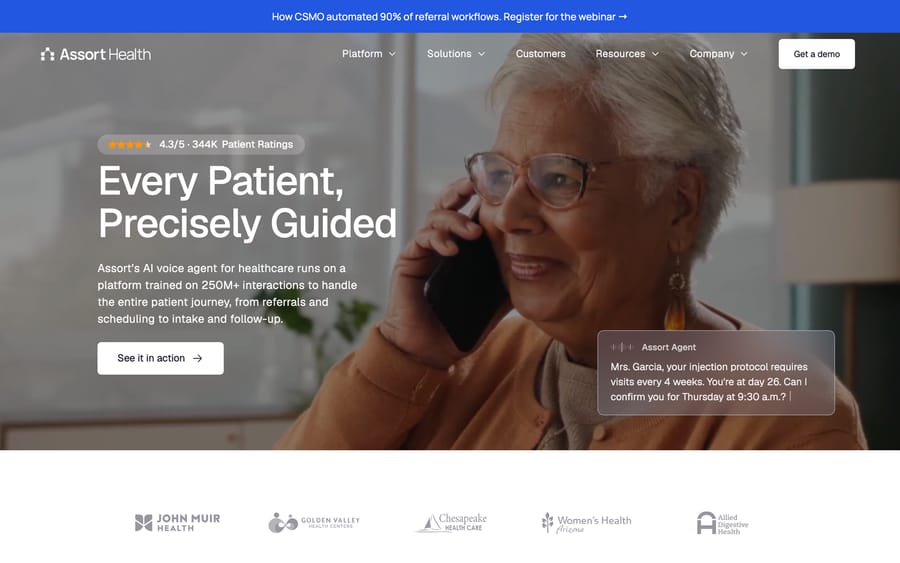
Assort Health is a healthcare-specific AI voice platform. Its core product answers inbound phone calls for medical practices and health systems, and it also places outbound calls for reminders, waitlist offers, and care-gap follow-ups. Co-CEOs Jon Wang and Jeffrey Liu describe the goal as building what they call the industry's first agentic AI platform for patient access.
The funding history matters here because it tells you what kind of buyer Assort is built to serve. It raised a $76 million Series B led by Lightspeed Venture Partners in 2025, four months after a Series A, taking it to $102 million. Then in June 2026 it raised a $120 million Series C led by Menlo Ventures at a $1.2 billion valuation, with Lightspeed, Felicis, First Round Capital, Chemistry, Tau Ventures, Quiet Capital and Joe Montana participating. Total disclosed funding is now over $222 million, and the company reports 20x revenue growth in the 15 months before that round. All of those figures come from Assort's own Series C announcement, checked 2026-09-17.
The specialty focus is the thing to understand before anything else. Assort has built separate calling logic for 23-plus medical specialties: orthopedics, dermatology, ophthalmology, women's health, pediatrics, cardiology, urology, neurology, gastroenterology, behavioral health, and more. A scheduling call for a dermatology biopsy follow-up and one for a new-patient orthopedic consult need different triage questions, and Assort has tuned its call flows separately for each. Named customers include John Muir Health, Golden Valley Health Centers, Women's Health Arizona, Allied Digestive Health, U.S. Urology Partners, Michigan Orthopaedic Surgeons, Peninsula Orthopaedic Associates, and SENTA: a mix of health systems, FQHCs, and multi-site specialty groups. Solo practices are absent from that list.
How Assort's AI works
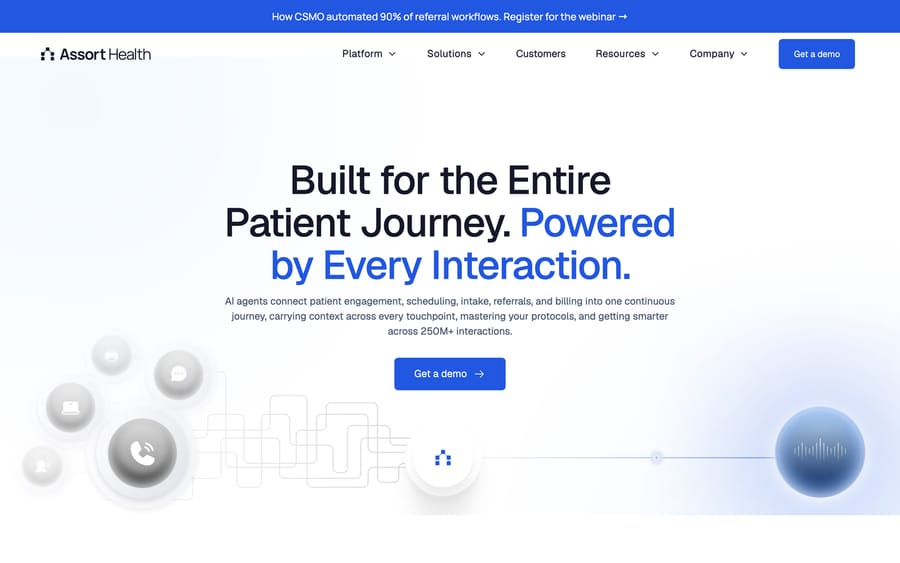
Assort splits its product into four named pieces instead of shipping one generic AI agent:
| Product | What it handles |
|---|---|
| Concierge | Always-on inbound line: answers calls, books and reschedules appointments, routes urgent cases, handles refill requests, covers after-hours |
| Activate | Proactive outbound: fills the schedule, works the waitlist, runs care-gap campaigns, chases overdue payments, texts patients back and forth |
| Orchestrate | Automation behind a visit: digital intake forms, referral workflows, insurance document processing, post-visit follow-up |
| Empower | Staff-facing tools: a scheduler co-pilot, call summarization, operational insights, and a warm handoff when the AI needs to pass a caller to a human |
Underneath those four products, Assort points to three things it says it built rather than bought: a training dataset drawn from more than 250 million patient interactions and 1.6 million logged decision pathways across 62,000-plus care protocols; a "Patient Journey Memory" layer that carries language preference, visit history, and open tasks across every channel a patient touches; and "Synapse," an onboarding engine that reads a practice's EHR data, standard operating procedures, and existing decision trees to generate specialty-specific call flows. Assort says this takes weeks. That claim comes only from Assort's own site, so treat it as a vendor timeline, not a benchmark.
The specialty-tuned decision trees are the real differentiator against a general-purpose voice AI. A generic scheduling bot can ask what the reason for a visit is. A specialty-tuned one asks the follow-up questions a scheduler at that specialty would actually ask, then books into the correct visit type and provider. That is a narrower, deeper build than a horizontal voice AI vendor selling the same script into every industry at once, and it is the reason Assort can charge health-system prices: the depth work is specific to each specialty and has to be redone for every new one it adds.
Key features
- Inbound and outbound voice AI covering scheduling, triage and routing, intake, referrals, medication refills, and payment collection.
- 23+ specialty-tuned call flows, each with its own triage logic and scheduling rules.
- EHR and practice-management integrations: Assort lists 15+ systems it connects to for real-time schedule and chart access.
- Patient Journey Memory that persists context (language, history, open tasks) across calls and channels.
- Synapse onboarding that ingests a practice's existing SOPs and decision trees to configure call flows.
- Staff-facing tools for call summarization and warm handoffs to a human.
- Vendor-reported outcome metrics, each attached to a different customer or cohort on Assort's own site: an 89% cut in hold times at Chesapeake Health Care (97% at SENTA, and 11 minutes down to 1 at Peninsula Orthopaedic), a 5% lift in appointment volume and a 115% increase in what Assort calls labor capacity across its base (+220% at Annapolis Internal Medicine). None are independently audited, and the headline percentages are single-customer results, not averages.
The reviews situation
This is worth stating plainly because it is unusual for a company at this funding stage: Assort Health has zero reviews on G2. A G2 search for Assort Health returns "Assort Health Products | Read 0 Reviews on G2." We could not find a Capterra listing or a TrustRadius page for Assort Health specifically either, checked 2026-09-17. That is not automatically a red flag. Assort sells to health-system procurement teams through a sales cycle. Individual buyers do not self-serve or leave reviews the way a G2 audience typically does, and the same pattern shows up at other high-touch enterprise healthcare vendors.
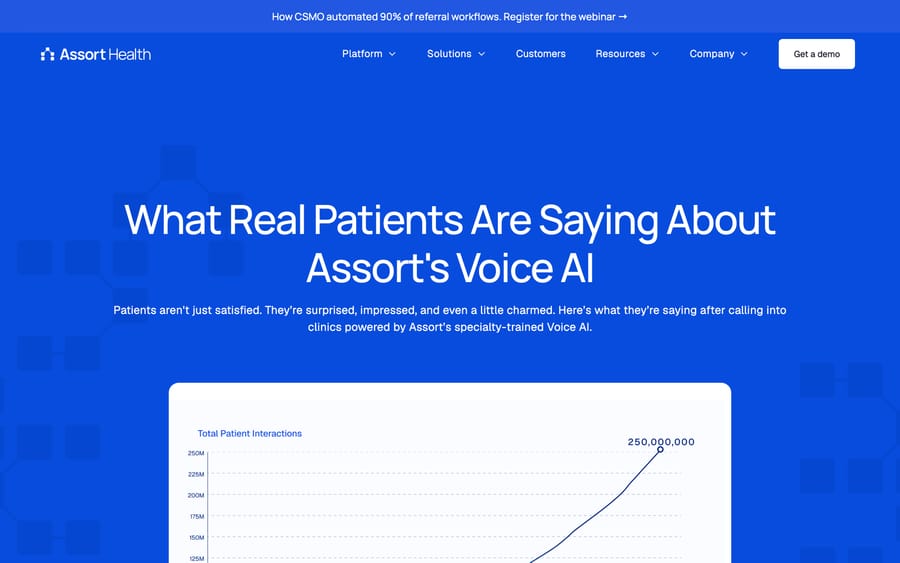
What Assort does publish is a patient-facing satisfaction number: 4.3 out of 5 across roughly 344,000 patient-reported ratings of calls handled by its voice AI, sourced from Assort's own patient feedback page. That number measures whether a patient was satisfied with the call. It says nothing about whether the office manager who bought the software would buy it again, which is the question a G2 or Capterra review would normally answer.
The page also carries dated patient testimonials. These are Assort's own published patient-satisfaction quotes, not independent buyer reviews; we read them on the live page on 2026-09-17 and they are reproduced here as written:
"I give it a 5 (out of 5). I'm 84 years old, and this technology is new for me, but it's excellent." Patient in Chicago, IL, June 2025.
"Five stars, this service does save a lot of time and it is very convenient for me." Patient in Silver Springs, MD, May 2025.
"This is a 5 out of 5. You've got this under control very well. I used to work in doctors' offices so I know." Patient in Chicago, IL, June 2025.
Take these for what they are: vendor-selected and patient-side. No third party verified them, and a page of testimonials a vendor chose is not a sample. If you are evaluating Assort, ask a reference customer directly how their front-desk staff and schedulers rate it. That is the review G2 would otherwise have surfaced.
What Assort doesn't publish about compliance
Worth checking yourself before a demo, because we went looking and came up short. An AI that answers a clinic's phone line handles PHI on every call, so the compliance posture is not a footnote. Assort publishes a blog post telling practices exactly which four documents to demand from an answering service: the most recent risk analysis, the workforce training log, the subprocessor list with flow-down BAAs, and the audit-log retention policy. Good advice. What we could not find anywhere on assorthealth.com, as of 2026-09-17, is Assort's own answer to any of it. There is no published SOC 2 Type II attestation, no HITRUST certification, no security or trust page, and no public statement that it signs a BAA.
That is not evidence of a problem. Enterprise healthcare vendors routinely hold all of this and release it only under NDA during procurement, and every named customer on the site is an organization that would have demanded it. But compare it to a voice vendor like Bland, which lists SOC 2 Type II, HIPAA and PCI DSS on its homepage: publishing costs nothing and shortens a buyer's evaluation. Put those four documents on your first-call agenda and treat "we'll send it after NDA" as a normal answer, not a dodge.
Assort Health pricing (researched)
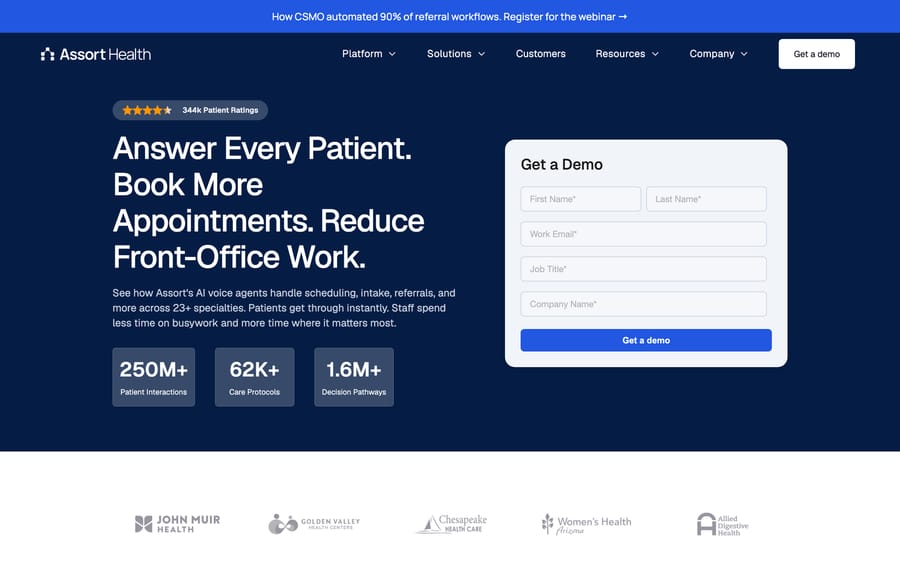
Assort Health does not publish pricing. There is no pricing page on assorthealth.com (the URL 404s), and the only path to a number is booking a call with sales.
We checked the places an opaque healthcare-AI vendor's pricing sometimes surfaces anyway: no AWS, Azure, or Google Cloud Marketplace listing; no G2 pricing tab, since there is no G2 profile with pricing data at all; no Vendr benchmark page for Assort Health specifically. Two independent buyer-comparison sites had already done the same legwork:
- OhMD's Assort Health pricing comparison reports plans starting around $1,500/month for smaller clinics, scaling into five figures a month for larger multi-site groups depending on call volume and configuration.
- Agentman's Assort Health alternatives post reports that a July 2026 sales inquiry came back requiring a $75,000 annual minimum commitment before a call would even be scheduled, a floor that works out to roughly $15,000 per provider per year at the minimum five-provider size implied.
Both of those are secondary sources. Agentman is explicit that the $75,000 figure is one quote it received for one practice profile, so treat both as directional. What we can say with confidence: this is not a self-serve, small-practice tool. A minimum commitment that size screens out solo and two-provider practices on its own, and the named customers (health systems, FQHCs, multi-site specialty groups) show the screening is deliberate. A vendor with no published rate and a sales-only quote process has an incentive to price close to what each account can bear, which is the usual trade a buyer makes for a custom-built, specialty-tuned deployment.
What drives the price
Reading across the vendor's own case-study language and the third-party estimates, the levers a sales conversation will pull are:
- Call volume. The core unit is inbound and outbound call handling, so a 40-provider health system pays a different number than a 5-provider group.
- Number of specialties and locations configured. Each specialty needs its own Synapse-built decision tree, and more locations means more configuration work up front.
- Which products you turn on. Concierge alone (inbound) is a narrower deployment than Concierge plus Activate plus Orchestrate plus the staff tools.
- EHR integration depth. Real-time schedule writes and chart lookups against any of 15+ possible EHR and practice-management systems is integration work that scales with how many systems and locations are in play.
Pros and cons
Pros
- Specialty-specific call flows are a real, defensible depth advantage over a horizontal voice AI vendor.
- Well-capitalized ($222M+ raised, most recently a $120M Series C at a $1.2B valuation) with a credible board (former Nuance CEO Paul Ricci advises) and named health-system customers.
- Covers the full patient-access loop: inbound, outbound, intake, referrals, not just the phone call.
- Vendor-reported outcome numbers are specific and attached to named customers (89% shorter hold times at Chesapeake Health Care, +220% labor capacity at Annapolis Internal Medicine), which is more checkable than an anonymous average, even though none are audited.
Cons
- No published pricing, and third-party reports put the entry commitment around $75,000/year: out of reach for small practices.
- Zero G2 reviews and no findable Capterra or TrustRadius listing, so there is no independent buyer-side evidence to check the vendor's own claims against.
- The 4.3/5 rating Assort leads with measures patient satisfaction with the call. It does not measure administrator or scheduler satisfaction with the software.
- Sales-led only, with no self-serve trial, so evaluating it costs a discovery call before you see a number.
- No publicly available SOC 2, HITRUST or BAA statement on its site, unusual for a vendor handling PHI on every call, so compliance diligence has to wait for procurement.
Who Assort Health is best for
Assort fits a health system, FQHC, or multi-site specialty group with real phone volume across several specialties and a budget that can absorb a five-figure-a-month commitment. If your organization runs orthopedics, women's health, or gastroenterology clinics across multiple sites and your front desk is drowning in scheduling calls that all need specialty-specific triage, the depth Assort has built for exactly that problem is hard to replicate with a generic voice bot.
It is the wrong choice if you run a solo or small-group practice, if your phone problem is really a handful of repetitive questions instead of full scheduling and triage, or if you want to see a number before a sales call. The tell is your provider count: below five providers, the reported minimum commitment alone likely prices you out before the specialty tuning even becomes relevant.
Assort Health vs alternatives
| Assort Health | Notable Health | Macha | |
|---|---|---|---|
| Model | Specialty-tuned inbound/outbound voice AI for medical practices | AI-powered patient intake, scheduling and revenue-cycle automation | AI agent layer on your existing help desk |
| Best for | Multi-site health systems, FQHCs, specialty groups with high call volume | Health systems automating intake, prior auth and billing workflows | Support teams on Zendesk, Freshdesk, Gorgias or Front |
| Channel | Phone (inbound and outbound), plus text | Patient intake forms, scheduling, some voice/chat | Chat and email tickets inside the help desk |
| Pricing | Not published; third-party reports ~$1,500-$10K+/mo, ~$75K/yr reported minimum | Not published; enterprise sales-led | From $299/mo for 750 tickets (~$0.40/ticket), published |
| Self-serve trial | No | No | Yes, $50 free usage, no credit card |
| Setup | Sales-led; Synapse onboarding builds specialty call flows | Sales-led implementation | Built, tested and monitored by the Macha team |
| Replaces your help desk or EHR? | No, it sits on the phone line and integrates with EHR/PM systems | No, it automates workflows around the EHR | No, it deliberately augments your help desk |
Assort Health and Notable Health both compete to automate the administrative load around a patient visit, and both are sales-led, opaque on price, and built for organizations with real scale. Both earn their revenue on multi-year enterprise contracts, so a health system's size and call volume, not a self-serve signup, is what gets either vendor on the phone.
Macha is a different shape of problem entirely. It does not answer phones or handle patient scheduling. It is an AI agent layer that sits on top of a help desk your support team already runs (Zendesk, Freshdesk, Gorgias, or Front) and drafts or resolves tickets inside it. Macha fits an organization whose actual pain is a support inbox, not a phone line: a billing team fielding email tickets, or an operations team answering the same shipping or account question on chat all day. It is priced transparently from $299/month for 750 tickets, about $0.40 a ticket at every tier, with $50 of free usage to start and no credit card required. See Macha's pricing for the full table.
For a genuinely comparable voice AI vendor outside healthcare, our Parloa guide covers a horizontal voice AI platform built for contact centers, useful context if you are weighing whether a specialty-tuned vendor like Assort is worth the premium over a general voice AI builder. Our Regal AI guide covers a similar voice and SMS AI agent aimed at revenue teams, which is another comparison point on price and setup.
How we researched this
We read Assort Health's homepage, /platform, and /patient-feedback pages directly on 2026-09-17, and confirmed the /pricing URL 404s. Funding, investors, and founder names came from Assort's own two PR Newswire releases (the $102M Series B and the $120M Series C), both of which fetch cleanly; FierceHealthcare's and MobiHealthNews' coverage of the same Series C returned a 403 to every attempt, so we cite the company's release rather than the trade press. G2's own page and a direct Capterra URL both blocked automated fetches; the zero-reviews figure comes from a G2 search-result snippet, and no Capterra or TrustRadius listing for Assort Health turned up in search. The pricing figures in this guide are attributed to OhMD's and Agentman's independent comparison posts, both of which we opened and checked, since we could not find a marketplace listing, Vendr page, or G2 pricing tab to verify them against directly.
FAQ
What is Assort Health? Assort Health is an AI voice platform for medical practices that answers and places phone calls: scheduling, triage, intake, referrals, refills, and payment follow-up, with call logic built separately for 23-plus medical specialties.
How much does Assort Health cost? Assort does not publish pricing; every deal goes through sales. Independent comparison sites report plans starting around $1,500/month for smaller clinics scaling into five figures for larger groups, and one report cites a $75,000 annual minimum commitment as of July 2026. Treat these as third-party estimates, not Assort's own numbers.
Does Assort Health have a free trial? No. There is no self-serve signup; every engagement starts with a demo call.
Is Assort Health any good? What do reviews say? There is no independent review-site evidence to check: G2 shows zero reviews, and we could not find a Capterra or TrustRadius listing. Assort publishes its own patient-satisfaction score (4.3/5 across roughly 344,000 calls), which reflects patient experience with the AI call. It says nothing about administrator satisfaction with the software.
Is Assort Health HIPAA compliant? Assort handles PHI on every call and sells to health systems that would require it, but as of 2026-09-17 we could not find a published SOC 2 attestation, HITRUST certification, trust page, or public BAA statement anywhere on assorthealth.com. Ask for the risk analysis, workforce training log, subprocessor list with flow-down BAAs, and audit-log retention policy in writing on your first call.
How long does Assort Health take to go live? Assort's own site says "weeks, not months," which is a vendor timeline. OhMD's independent comparison puts third-party-reported go-live at roughly three to five weeks, driven by how many specialties and locations need their own call flows.
What EHR systems does Assort Health integrate with? Assort lists 15-plus EHR and practice-management system integrations on its site, used for real-time scheduling and chart access during calls.
Who are Assort Health's customers? Publicly named customers include John Muir Health, Golden Valley Health Centers, Women's Health Arizona, Allied Digestive Health, U.S. Urology Partners, Michigan Orthopaedic Surgeons, Peninsula Orthopaedic Associates, and SENTA.
What are good alternatives to Assort Health? Notable Health is a comparable healthcare automation platform, though it leans more toward intake and revenue-cycle workflows than inbound calling. Neither replaces a general customer-support help desk. For that, an AI agent layer like Macha is a different category of tool.
How is Assort Health funded? Over $222 million disclosed. A Series A and a $76 million Series B led by Lightspeed Venture Partners took it to $102 million in 2025; a $120 million Series C led by Menlo Ventures in June 2026, at a $1.2 billion valuation, took it past $222 million. Both rounds are announced on Assort's own PR Newswire releases.
Does Assort Health work outside healthcare? No. Its entire product, from the specialty-tuned decision trees to the EHR integrations, is built for medical practices and health systems. It is not a general-purpose contact center or support-ticket tool.
Ready to automate the support inbox instead of the phone line? Start a Macha trial with $50 of free usage and no credit card, or see Macha's pricing.
Sources: assorthealth.com, assorthealth.com/platform, assorthealth.com/patient-feedback, PR Newswire: Assort Health Secures $102 Million, PR Newswire: Assort Health Raises $120 Million Series C, OhMD: Assort Health pricing, Agentman: Assort Health alternatives, Notable Health.
Resolve tickets automatically with AI agents
Macha's AI agents work on top of the help desk you already use — no code.