Intercom
 Shopify
 Stripe
 Slack
Slack Notion
 Google Workspace
 Confluence

Atlas AI: The Complete Guide (2026)


Atlas (atlas.so) is a YC-backed B2B customer support platform built around an AI layer branded Zeus, covering ticketing, chat, and AI-assisted replies in one tool. This guide covers what Atlas actually does, its real per-seat pricing, where its AI holds up and where it doesn't, and honest alternatives, all checked against the vendor's own site.

We build AI agents for customer service ourselves, so this is written by people who have to evaluate platforms like Atlas in practice. One disambiguation up front: "Atlas" is a genuinely generic name, in customer support software alone it collides with an Atlassian product, a research-coding tool (ATLAS.ti), and a recruitment CRM. Every claim in this guide is checked specifically against atlas.so, listed on G2 as "Atlas Support."
What is Atlas?
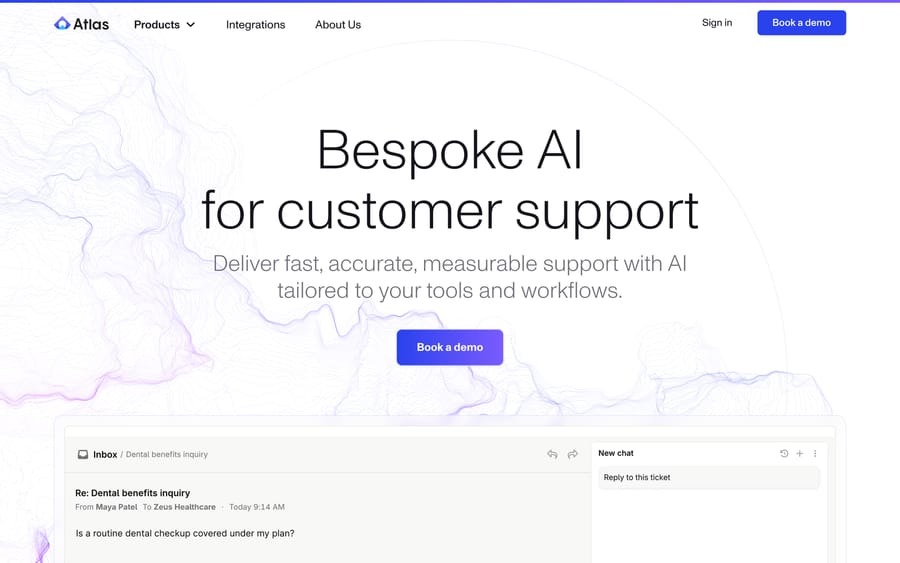
Atlas was founded by Jon O'Bryan and Rahul Asati, per the company's own about page, and is backed by Y Combinator, Soma Capital, and Palm Drive Capital, along with named individual investors including Parker Conrad (CEO, Rippling), Jack Altman (CEO, Lattice), and Arash Ferdowsi (CTO, Dropbox). The company is based in Pleasanton, California. Atlas's own site names Loops, Paage.io, Rootine, Genius Sheets, Nullstone, and First Delivery as customers, alongside logos for Loops, Mailmodo, and PadSplit shown on its AI product page, a customer mix that skews toward B2B SaaS companies over consumer ecommerce.
The product bundles ticketing, live chat, session recording, and AI features into one platform, positioned against Zendesk and Intercom directly (Atlas publishes its own comparison pages against both). Enterprise security claims include SOC 2, HIPAA, and GDPR compliance.
How Atlas's AI works
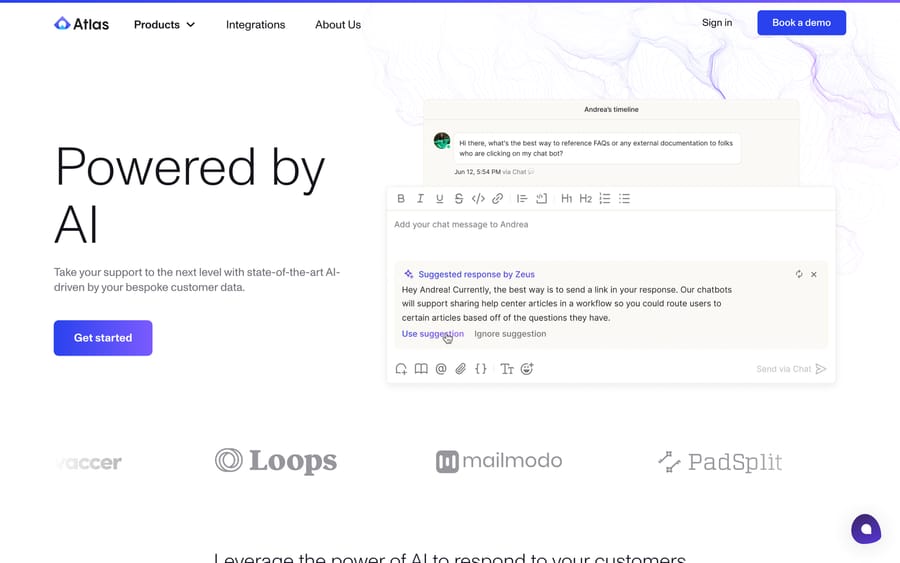
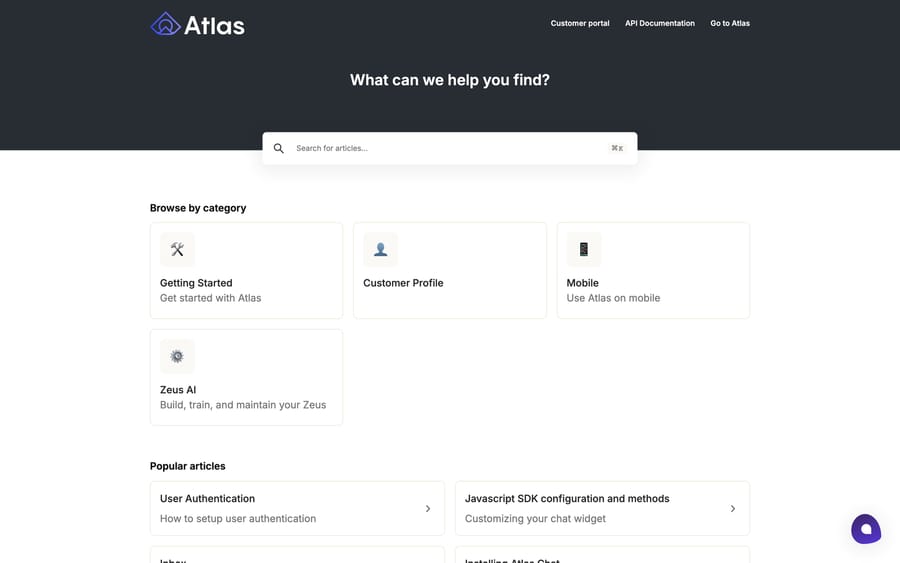
The detail worth understanding here is that Atlas's AI engine has its own internal name, Zeus, kept out of the top-line marketing copy but visible directly inside the product: a live screenshot on Atlas's own AI page labels a drafted reply "Suggested response by Zeus," and Atlas's help center has a dedicated "Zeus AI" category described as where a team can "build, train, and maintain your Zeus." That's closer to how a company names an internal system (like Slack's "Slackbot") than a headline product name, and a buyer comparing vendors by searching "Zeus AI" directly would likely miss Atlas entirely without knowing this.
Functionally, Zeus powers several distinct features rather than one chatbot: an AI chatbot that answers directly from support documentation and app data without agent involvement, suggested responses that draft replies inside the agent's inbox view, auto-generated and self-refreshing knowledge articles, AI-driven ticket routing and prioritization, and automatic translation. The chatbot and the agent-facing suggestions are architecturally separate paths, one replaces a human touch for well-covered questions, the other assists a human on everything else, which mirrors the autopilot-plus-copilot split most platforms in this category use, just under a code name Atlas hasn't put on a marketing page.
Key features
- AI chatbot answering directly from documentation and app data, per Atlas's own product page.
- Zeus-suggested replies drafted inline in the agent inbox, editable or sendable in one click.
- Auto-generated and self-refreshing knowledge articles built from tickets, chats, and SOPs.
- AI-driven auto-routing, auto-prioritization, and ticket summaries.
- Auto-translation for multilingual support.
- Unified inbox across chat, email, SMS, and WhatsApp (channel access varies by tier).
- Session recording with configurable retention (5k sessions/30 days on the entry tier, up to 75k/180 days on Pro).
Atlas pricing
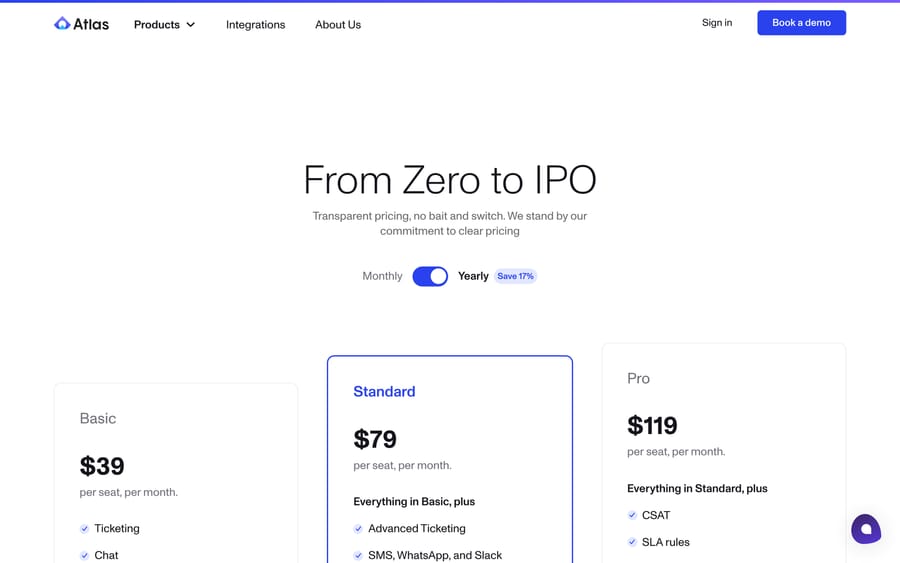
Atlas publishes real per-seat pricing on its own site, at the yearly-discount rate shown by default:
| Plan | Price/seat/month | Sessions/mo | Storage | Notable inclusions |
|---|---|---|---|---|
| Basic | $39 | 5,000 | 30 days | Ticketing, chat, email, session recording |
| Standard | $79 | 50,000 | 90 days | + Advanced ticketing, SMS, WhatsApp, Slack, custom data, API access |
| Pro | $119 | 75,000 | 180 days | + CSAT, SLA rules, routing rules, rule-based chatbots, customer portal, SSO/SAML |
| Enterprise | Custom | Custom | Custom | + Custom permissions, audit logs, enterprise-grade security |
Beyond seats and sessions, Atlas charges usage-based add-ons: SMS/MMS at $0.02–$0.04 per message, WhatsApp at $0.0075 per message, and extra sessions at $0.002 each once a tier's included volume runs out. Atlas's own pricing page leads with the line "transparent pricing, no bait and switch," and the tier table does back that up; the per-message and per-session add-ons are listed on the same page instead of buried in a separate sales conversation. A team should still model its expected SMS/WhatsApp volume before picking a tier, since those channels aren't included at all on Basic.
Pros and cons
Pros
- Real, itemized per-seat pricing with add-on costs shown on the same page, not gated behind a sales call.
- Named individual investors with real operating credibility (Rippling, Lattice, Dropbox leadership) alongside YC backing.
- AI features span the full ticket lifecycle: chatbot resolution, agent-assist drafting, knowledge generation, and routing, not just one chatbot widget.
- SOC 2, HIPAA, and GDPR claims support a regulated-industry buyer's checklist.
Cons
- The AI engine's actual name (Zeus) isn't used in top-line marketing, so a buyer researching "Zeus AI" as a term would likely never find Atlas.
- SMS and WhatsApp, two channels the homepage highlights, are excluded from the entry-level Basic tier entirely.
- G2 review access is limited (a direct fetch of Atlas's review page was blocked), so a buyer doing careful due diligence will need to check the platform directly rather than take a secondhand figure.
- The company doesn't publish a founding year or headcount, thinner public operating history than an established incumbent.
What actual users say
G2 lists this product as "Atlas Support." We couldn't fetch G2's review page directly, it returned a blocked response, so the following comes from search-result snippets citing G2's own page rather than a direct read, checked 2026-09-15: 4.9 out of 5 across 23 reviews, with 87% of reviewers from small businesses. Atlas reportedly scores a perfect 10.0 on both ease of setup and quality of support in that data, with reviewers citing responsive support and willingness to customize features. The one improvement area repeatedly mentioned is reporting depth, consistent with a young platform that hasn't built out analytics as far as its ticketing and AI features.
Capterra's own "Atlas AI" listing is a different, unrelated operational-management product with zero reviews, worth flagging so nobody confuses that listing with atlas.so.
How we researched this: we worked from atlas.so's homepage, pricing, about, and AI product pages, plus help.atlas.so's category listing (all fetched directly, 2026-09-15). G2's review page for "Atlas Support" blocked our automated fetch, so its rating is cited secondhand. We could not find individually attributed reviewer quotes, a founding year, or a customer count beyond the handful of named logos on Atlas's own site.
Who Atlas is best for
Atlas fits teams at a B2B SaaS company that want ticketing, chat, and AI-assisted support in one platform without a lengthy enterprise sales cycle, and that can plan their channel mix against the tier table above (SMS and WhatsApp specifically require Standard or above). A small support team that values responsive vendor support, per the reported G2 sentiment, over the deepest reporting suite gets a good match here.
Gating SMS and WhatsApp behind Standard and above optimizes for Atlas's own upgrade path: a team that starts on the cheapest tier and later wants the two channels its own homepage leads with has a built-in reason to move up a tier. We checked this directly against the pricing page itself, and it holds up as published: a buyer can see the gate before signing up, not discover it afterward.
It's a weaker fit for a team that needs SMS or WhatsApp on a tight budget (both require jumping past Basic), or one that wants a household-name AI brand it can point to internally, Zeus isn't marketed prominently enough to build that recognition today.
Atlas vs alternatives
| Atlas | Pylon | Macha | |
|---|---|---|---|
| Model | B2B support platform with Zeus AI (chatbot, copilot, routing) | Agentic B2B support platform | AI agent layer on your existing help desk |
| Best for | B2B SaaS teams wanting ticketing + AI in one tool | B2B teams wanting agents across investigation and resolution | Teams on Zendesk, Freshdesk, Gorgias, or Front |
| Pricing | $39-$119/seat/mo, published, plus per-message add-ons | Not independently verified here; see Zendesk vs. Pylon | From $299/mo for 750 tickets (~$0.40/ticket), published |
| Setup | Self-serve signup or demo | Sales-led | Built, tested, and monitored by the Macha team |
| Trial | "Try for free" self-serve option on site | Demo-gated | $50 free usage |
| Replaces your help desk? | Yes, it's a full ticketing platform | Yes, a full support platform | No, deliberately augments it |
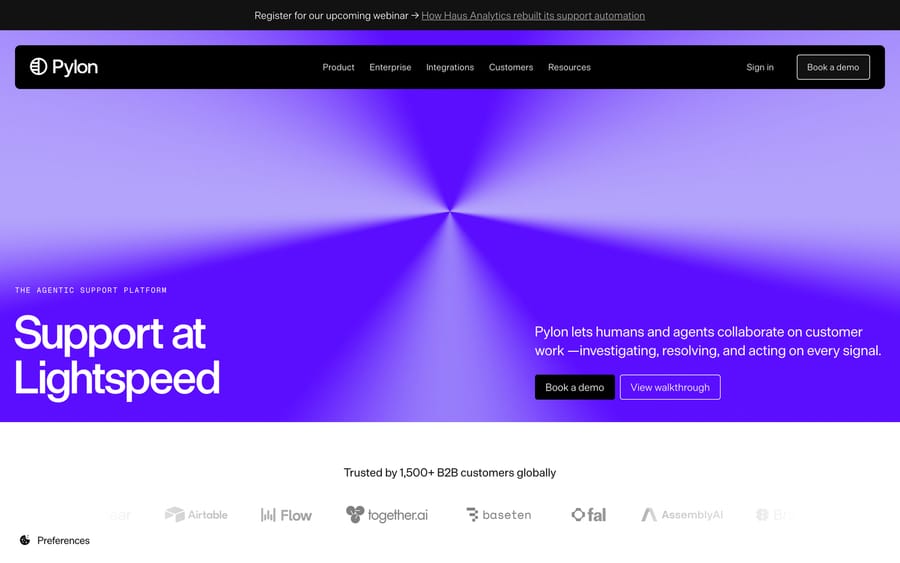
Atlas and Pylon both target B2B support specifically and both replace the help desk rather than sitting on top of one. Atlas leans on per-seat, self-serve pricing a small team can evaluate today; Pylon's own positioning ("Support at Lightspeed," 1,500+ B2B customers per its homepage) leans further into agentic investigation across a broader enterprise motion. Macha sits at a different layer than either: instead of replacing the ticketing system, it's an AI agent layer that runs on top of a help desk a team already uses (Zendesk, Freshdesk, Gorgias, or Front), which fits a team that's happy with its current ticketing tool and specifically wants AI agents acting inside it.
For a broader enterprise conversational-AI comparison beyond B2B ticketing specifically, the Decagon guide covers that different point on the market. If keeping the current help desk and adding an agent layer fits better than migrating to a new ticketing platform, see Macha's pricing or start a $50 free trial against real tickets.
FAQ
What is Atlas? Atlas (atlas.so) is a YC-backed B2B customer support platform combining ticketing, live chat, and an AI layer branded Zeus, which handles chatbot resolution, agent-assist drafting, knowledge generation, and ticket routing.
Is Atlas the same as Atlassian's Atlas, ATLAS.ti, or MongoDB Atlas? No. Those are unrelated products that happen to share the generic name "Atlas." This guide covers only atlas.so, listed on G2 as "Atlas Support."
What is Zeus? Zeus is Atlas's own internal name for its AI engine, visible directly in the product ("Suggested response by Zeus") and in a dedicated help-center category, though it isn't used prominently in Atlas's marketing.
How much does Atlas cost? Basic is $39/seat/month, Standard is $79/seat/month, and Pro is $119/seat/month, all shown at the yearly-billing rate on Atlas's own pricing page, plus custom Enterprise pricing. SMS, WhatsApp, and extra sessions beyond a tier's included volume are billed per-use on top.
Does Atlas have a free trial? Atlas's site offers a self-serve "try for free" option alongside a "Book a demo" path; it doesn't publish a specific trial length.
Who founded Atlas, and who backs it? Jon O'Bryan and Rahul Asati founded Atlas, which is backed by Y Combinator, Soma Capital, and Palm Drive Capital, plus individual investors including Rippling's Parker Conrad and Dropbox's Arash Ferdowsi.
What do real users say about Atlas? Search-result data citing G2 (Atlas's direct review page blocked our fetch) shows 4.9 out of 5 across 23 reviews, with reviewers praising responsive support and a perfect ease-of-setup score; the main improvement area cited is reporting depth.
Is Macha an alternative to Atlas? Not directly. Atlas replaces the ticketing platform itself; Macha is an AI agent layer that runs on top of a help desk a team keeps using (Zendesk, Freshdesk, Gorgias, or Front). A team open to migrating its ticketing system fits Atlas or Pylon; a team keeping its current help desk fits Macha.
Sources: Atlas homepage, Atlas pricing, Atlas about page, Atlas AI product page, Atlas help center.
Resolve tickets automatically with AI agents
Macha's AI agents work on top of the help desk you already use — no code.