Intercom
 Shopify
 Stripe
 Slack
Slack Notion
 Google Workspace
 Confluence

Best AI Chatbots for Freshdesk (2026): Freddy AI Agent vs Third-Party AI Agents


Freshdesk's native chatbot is Freddy AI Agent, which costs $49 per 100 sessions once the 500 free sessions are used. Third-party AI agents such as Macha, eesel AI, My AskAI and Intercom Fin run on top of Freshdesk with their own pricing.
Key takeaways
- The native Freshdesk chatbot is Freddy AI Agent, included on Growth, Pro and Enterprise with 500 free sessions once per account, then $49 per 100 sessions.
- Freddy Copilot is a separate per-seat add-on at $29 per agent per month billed annually, available only on Freshdesk's Pro and Enterprise plans.
- Intercom Fin now documents a Freshdesk tickets integration and a separate Freshchat setup, priced at $0.99 per outcome with a 50-outcome monthly minimum off Intercom.
- eesel AI bills $0.40 per regular task such as a support ticket, with no seat fee, while My AskAI starts at $199 a month after a 30-day free trial.
- Macha runs AI agents on top of Freshdesk on one plan priced by ticket volume, starting at $299 a month for 750 tickets with setup and monitoring included.

Freshdesk has one native AI chatbot, Freddy AI Agent, included on the Growth, Pro and Enterprise plans with 500 free sessions once per account and then $49 per 100 sessions. The alternative is a third-party AI agent that runs on top of Freshdesk: Macha from $299 a month for 750 tickets, eesel AI at $0.40 per regular task, My AskAI from $199 a month, or Intercom Fin at $0.99 per outcome, which now has its own documented Freshdesk integration. Ada, Decagon and Aisera sell quote-only platforms that sit in front of the desk. We make Macha and rank it by the same criteria as everyone else.
Which AI tools work with Freshdesk in 2026?
| Tool | Type | How it connects | Pricing model | G2 rating (June 2026) | Best for |
|---|---|---|---|---|---|
| Freddy AI Agent | Native (Freshworks) | Built in (Growth and up) | Per session, $49/100 after the first 500 | Freshdesk 4.4/5 (~3,700) | Teams staying all-in on Freshworks |
| Freddy Copilot | Native add-on | Built in (Pro/Enterprise) | $29/agent/month annual | Own G2 listing | Agent assist inside the ticket |
| Macha | AI agent layer on top | Freshdesk connector (read/write) | From $299/mo for 750 tickets | New entrant — few public reviews | Teams keeping Freshdesk, wanting custom agents |
| eesel AI | AI agent layer on top | One-click / Marketplace app | $0.40 per regular task, no seats | 4.6/5 (~15 — small sample) | Usage-priced deflection, many knowledge sources |
| My AskAI | AI agent in tickets | Freshdesk Ticket integration | $199/mo, tickets from ~$0.10 | 4.9/5 (~19 — small sample) | Lean teams wanting low-cost deflection |
| Intercom Fin | Cross-desk AI agent | Documented Freshdesk and Freshchat integration | $0.99 per outcome, 50/mo minimum | Not in our June 2026 check | Teams wanting a proven per-outcome agent |
| Ada | Standalone agent platform | Sits in front, hands off into the desk | Quote-only; Vendr median ~$70K/yr | Not in our June 2026 check | Large brands, voice + 50+ languages |
| Decagon | Standalone agent platform | Sits in front, hands off into the desk | Quote-only; ~$50K/yr+ estimated | Not in our June 2026 check | High-volume consumer brands and fintechs |
| Aisera | Enterprise agentic AI | Integration (CX + IT + HR) | Quote-only (enterprise) | 4.4/5 (~146) | Large enterprises, unified AI layer |
Freshworks, Fin, eesel and My AskAI prices checked 24 September 2026; Ada, Decagon and Aisera figures are third-party estimates read 20 September 2026; ratings from June 2026.
What is the difference between a chatbot, an AI agent and a copilot?
Two sets of words get used interchangeably here, and both cost teams money when they're confused.
The first set describes what the software is:
- Chatbot / bot: the older, scripted experience — menus, keyword matching, decision trees. Cheap, predictable, and lost the moment a customer phrases something off-script.
- AI agent: an LLM-powered agent that reads the question in natural language, pulls from your help center and connected data, and resolves the ticket — drafting the reply, tagging, routing — escalating to a human when it isn't confident. This is what most people now mean by "AI chatbot for Freshdesk."
- Copilot: assists the human agent inside the ticket — summarizing, drafting, rewriting tone — but a person still sends the reply. It improves handle time, not deflection.
The second set describes what it achieves, and it's the one that decides whether a tool is worth its price:
- Deflection means the bot answers from your knowledge base so the customer never files a ticket. Great for "how do I reset my password," useless for anything needing an account lookup.
- Resolution means the request is actually closed end to end, including reading the customer's specific order or account and taking or drafting the correct action. This is the hard part, and it's where a lot of "chatbots" quietly hand off.
- Automation means a workflow runs across tools — checking a subscription, applying a policy, updating a record — rather than replying with text.
Score every candidate on all three, not just the deflection number on the marketing page. And when you compare prices, make sure you're comparing the agent line, because that's the one that takes volume off the queue.
How did we rank these Freshdesk AI tools?
Disclosure: Macha publishes this blog. Macha is one of the eight tools below, scored on the same criteria as everything else on this page, placed where those criteria put it, and carrying the same watch-outs line as every other entry.
To make the list a tool had to be live and selling in September 2026, add AI resolution rather than scripted flows, and have a documented path to Freshdesk — verified on the vendor's own site or the Freshworks Marketplace. Anything that only works by replacing Freshdesk is in the closing note, not the list.
The order comes from four criteria, applied in this sequence:
- How directly it works your Freshdesk queue. Native beats a connector that reads and writes tickets, which beats a platform sitting in front of the desk and handing off into it.
- How much of the queue it takes off you — resolving and acting in your other systems, not only answering from articles.
- Whether you can model the cost before a sales call, against your own ticket volume.
- How long it takes to get to a first resolved ticket.
That sequence explains the shape below. Freddy leads because criterion 1 is its by definition — it is Freshdesk. Positions 2–4 all read and write Freshdesk tickets through a connector and all publish a rate you can model. Position 5 now has a documented Freshdesk connector too, but its primary home is Intercom and its defaults assume that desk. Positions 6–8 are standalone platforms that sit in front of Freshdesk and are quote-only, which is what criteria 3 and 4 do to them.
Where the facts come from: each vendor's own pricing and documentation pages, plus a real-user signal in the form of a G2 rating with its approximate review count. We flag small review samples, because a 4.9 from 19 reviews and a 4.4 from 3,000 are not the same kind of evidence. Freshworks' prices and plan gates, and the Fin, eesel and My AskAI prices, were re-checked on 24 September 2026; the enterprise estimates date from 20 September. What we could not check: G2 blocks automated reads, so the ratings below are from our June 2026 pass and are labeled with that date, and the quote-only platforms in positions 6–8 have no trial, so their entries describe how they sell and what buyers report paying rather than a hands-on test.
1. Freddy AI Agent: what does the native Freshworks option do?
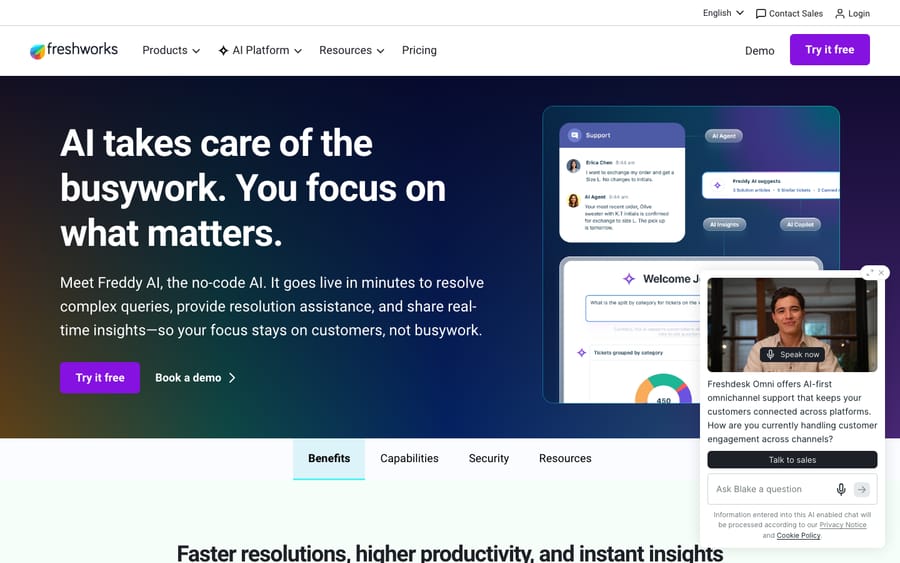
What it does: Freddy is Freshworks' built-in AI, and it comes in three surfaces worth keeping straight:
- Freddy AI Agent (sometimes called Freddy Self-Service) is the customer-facing bot. It answers chat and email questions autonomously from your connected knowledge sources.
- Freddy Copilot is the agent-assist layer inside the ticket: it drafts replies, summarizes long threads, adjusts tone, and translates, with a human approving before anything sends.
- Freddy Insights is the analytics layer for managers, surfacing alerts and root-cause patterns.
When people search for "the Freshdesk chatbot" today, they almost always mean the first one. Our Freshdesk Freddy AI explainer is the full reference on all three.
Which plans have it: this is where buyers get tripped up, because the two products are gated differently. AI Agent Studio — and so the customer-facing chatbot — is available on Growth, Pro and Enterprise, per Freshworks' AI Agent setup documentation, which states it is "not available in previous plans." Freddy Copilot is the one restricted to Pro and Enterprise, as a per-seat add-on. Since Freshworks withdrew its free tier — the current pricing page publishes Growth $19, Pro $55 and Enterprise $89 per agent a month billed annually, and nothing beneath them — every paid Freshdesk plan can run the native chatbot.
How to set up the native Freshdesk chatbot
Setup is genuinely approachable, which is one of Freddy's real strengths. Per the same setup documentation, the flow is:
- Open AI Agent Studio from the left navigation bar and click Create AI Agent. Give it a name, an avatar, and a primary language.
- In the Knowledge section's Build tab, add sources: solution articles from your knowledge base, files (.txt, .docx, .pdf), URLs (public pages only), and custom Q&As.
- Configure workflows, custom instructions, multilingual behavior, and — importantly — handover settings that decide when the bot passes a conversation to a human with context.
- Test and preview, then click Deploy and pick your channels: Web Chat, WhatsApp, Facebook, Instagram and others. For Web Chat you set a topic and enable "Start with AI Agent," then publish.
You can skip the blank canvas and start from a pre-built agent in the library instead — Freshworks ships templates for common domains, which is a fast on-ramp.
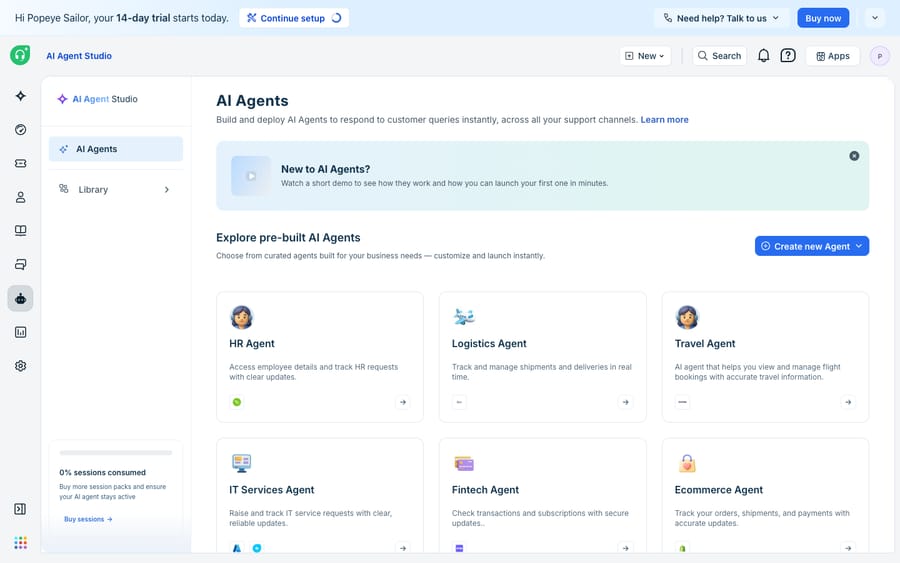
Know the knowledge caps before you design around them. The setup article publishes hard limits: files up to 35MB each, 200 files per agent and 200 per account, 10 URLs per agent and 25 per account, and a website crawl of up to 3,000 learnable pages. That's comfortable for a tidy help center and tight if your real answers are spread across a sprawling docs site, PDFs, internal wikis and past ticket history.
Pricing model: two separate lines. Freddy Copilot is a per-seat add-on at $29/agent/month billed annually, and you can assign it to only the agents who need it. The Freddy AI Agent is session-based: every paid plan includes 500 sessions, and Freshworks' pricing FAQ is explicit that this is "limited to once per account" — a one-time allocation, not 500 a month. After that it's $49 per 100 sessions, roughly $0.49 each, on both the Freshdesk and Freshdesk Omni price lists. A session is a unique user's interactions with the agent inside a rolling window: 24 hours for chat, 72 hours from the first email for the email agent. (Third-party breakdowns such as eesel's Freddy pricing analysis report a cheaper per-session rate for Omni web chat; we could not find that figure on either Freshworks pricing page, so treat it as unconfirmed.)
The catch buyers miss: you pay for the session whether or not the bot resolves anything. At a 25% resolution rate you're consuming roughly four sessions per genuinely resolved ticket, so the effective cost per resolution is several times the headline number. And unlike a per-seat line, session spend has no natural ceiling — an outage or a launch spike pushes it up fast.
Where it stops. Freddy is strong at retrieving from knowledge and phrasing a reply. It's weaker when the answer isn't in an article at all: when "where's my order?" needs a live call to your order system, or "cancel my subscription" needs a write to billing. Buyer guides including myAskAI's and gominimal's roundups make the same point about Freddy's third-party integrations being largely read-only — the bot can see order data but can't process the refund. That's the wall between deflection and resolution.
Who it's for: teams committed to Freshworks that want AI inside the product they already run, with one bill and no integration work. If your support is mostly FAQ deflection on one help desk and your knowledge base is in decent shape, native Freddy may be all you need. Be honest with yourself about that before you shop for anything heavier.
Real-user signal: Freshdesk overall held a G2 rating of 4.4/5 (~3,700 reviews) and Capterra 4.5/5 (~3,400) at our June 2026 check, and Freddy Copilot carries its own G2 listing. Sentiment on the AI specifically is mixed: reviewers praise the quick setup and the smooth handover to humans with full context, but recurring complaints are that Freddy needs manual training and isn't great out of the box, that it struggles with complex or multi-turn queries, that the email agent historically only replies to the first message in a thread, and that Copilot is locked to Freshworks products (myaskai, G2).
Watch-out: the costs stack. Copilot is per seat, the Agent is per session, and both sit on top of a base plan — so a mid-size team putting AI everywhere can pay several hundred dollars a month beyond ticketing.
Which third-party AI agents run on top of Freshdesk?
If Freddy's economics, accuracy ceiling, or Freshworks-only knowledge feel limiting, you can keep Freshdesk and add a dedicated AI agent on top. These tools connect via API or the Marketplace, read from broader knowledge sources, and often price more transparently.
One thing to settle first: some tools ask you to replace Freshdesk, others layer on top of it. For an established team, ripping out the help desk — re-training agents, moving history, rebuilding automations — is rarely worth it just to change your bot. Weigh that before a cheaper sticker price talks you into a migration.
2. Macha: build-your-own AI agents on top of Freshdesk
Here's the disclosure again: we make this one, so read it with that in mind. It sits at 2 rather than 1 because criterion 1 belongs to the native option and always will — Freddy is inside Freshdesk, and nothing bolted on can be more inside it than that. It sits above 3 and 4 on criterion 2: the connector writes to tickets and the agents can call your other systems, where the tools below are stronger at answering from knowledge than at acting on it.
What it does: Macha is an AI agent layer that runs on the help desk you already have: Zendesk, Freshdesk, Gorgias, Front, HubSpot or Intercom. It isn't a help desk and isn't a Freshdesk replacement. Instead of buying a fixed feature, you build agents: write instructions in plain English, give each agent the knowledge it can read and the tools it can use, pick its model, and choose where it runs. An agent can resolve routine tickets autonomously, assist a human in the sidebar, or answer on a website chatbot — drafting the reply, tagging, routing, and handing off to a person with full context when it isn't confident.
How it connects to Freshdesk: through a native Freshdesk connector configured with your subdomain and API key. It can search and update tickets, add public replies and private notes, and manage contacts, and agents can also pull from data outside the help center — Shopify, Stripe, Notion, Slack and the rest of the integrations list — so answers aren't limited to KB articles. The connector is for Freshdesk specifically, not Freshchat, Freshservice or Freshcaller.
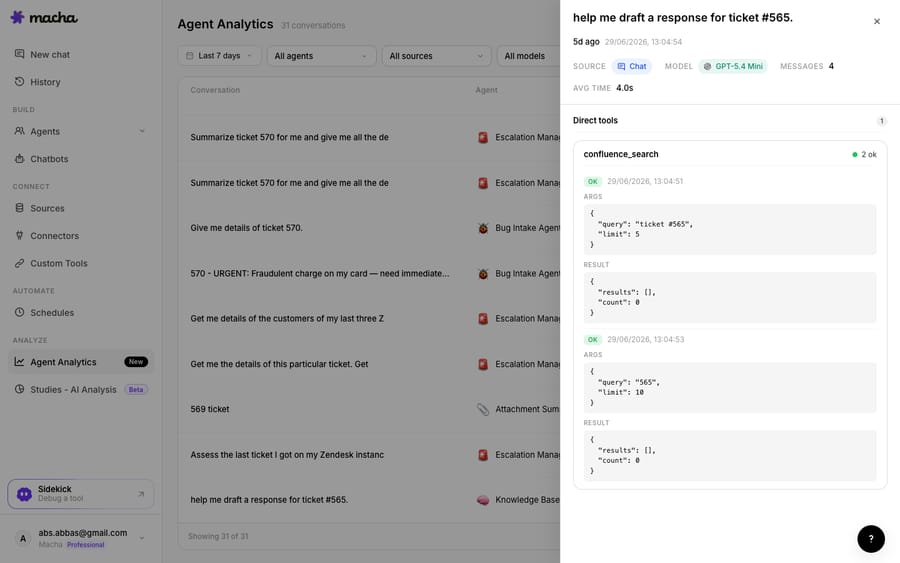
Where it differs from a knowledge-base bot. Two things. First, it acts rather than only answering: through a custom tool an agent can call one of your REST APIs to fetch an order status, check a subscription, or trigger a workflow, so "where's my order?" gets an answer from your system instead of a link to an article that doesn't contain it. Second, the grounding is inspectable — the screenshot below is a real request from our demo org, with the agent's tool call, its live arguments and its results visible on the ticket.
Because the layer sits above the help desk rather than inside it, the same agents and knowledge run across Zendesk, Freshdesk, Gorgias, Front, HubSpot and Intercom, so a multi-brand org isn't rebuilding its AI per platform, and a desk migration doesn't cost you the agents.
Pricing model: one plan, priced on monthly ticket volume, billed monthly: $299 for 750 tickets, $599 for 1,500, $1,199 for 3,000, $1,999 for 5,000, $2,999 for 7,500, $3,999 for 10,000, custom above that. That's about $0.40 a ticket at every tier. A ticket is one thread with one person, charged once however many replies it takes — an email ticket, a live chat and a Copilot session each count once. Every feature is on every tier, seats are unlimited, and there are no overages: agents pause at the tier limit rather than auto-billing you. Setup and monitoring by the Macha team is included on every plan, and the trial is $50 of free usage, about 125 tickets, with no credit card and no time limit. Full tiers are on the pricing page.

Who it's for: teams that want to keep Freshdesk but build agents tailored to their own workflows and data, rather than a one-size bot.
Real-user signal: Macha is a newer entrant with no G2 or Capterra profile to check us against, so we won't pretend to a 3,000-review track record — judge it on a trial, not a star rating.
Watch-outs: we're a much smaller company than Ada, Decagon or Aisera, and a procurement process that requires third-party review volume will fail us on that alone. Macha isn't a help desk, so it's a line item on top of Freshdesk rather than a replacement for it, and if your problem is Freshdesk's ticketing itself, a layer won't fix it. There's no voice channel — email, chat and the agent-facing Copilot only. An agent does what its instructions say, so a vague instruction produces a vague agent, and the answers are only as good as the knowledge and integrations you connect. Our deepest, most battle-tested connector is Zendesk; the Freshdesk one is capable but newer. See how to automate Freshdesk with AI for where a layer fits.
3. eesel AI: usage-priced AI agent
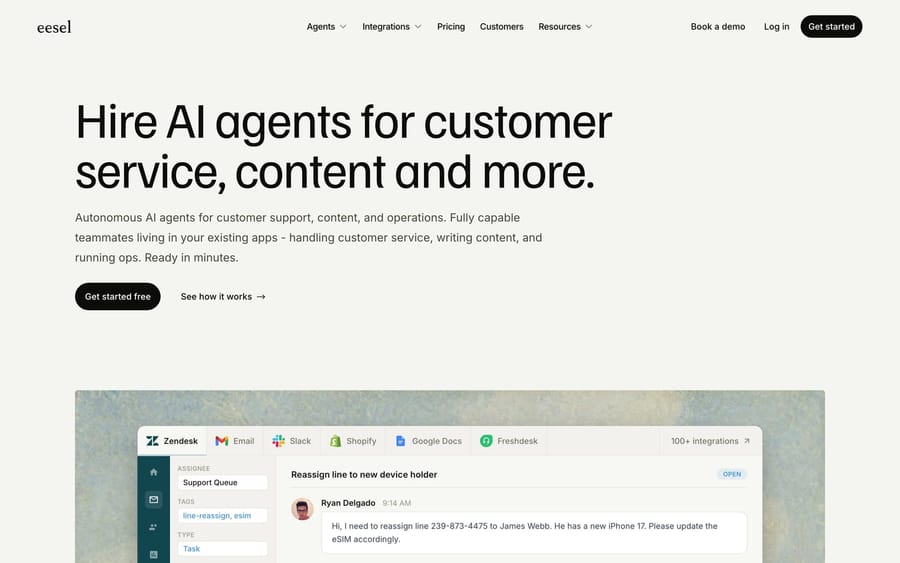
What it does: eesel offers an AI Agent (autonomous resolution), an AI Copilot (drafting and assist), and AI Triage, trained on your help center plus broader sources like Confluence, Google Docs, and Notion.
How it connects to Freshdesk: a one-click Freshdesk integration, also listed on the Freshworks Marketplace, set up in minutes.
Pricing model: eesel moved to usage pricing, and the old flat Team and Business plans are gone. Its live pricing page (checked 24 September 2026) bills per task: light tasks free, regular tasks (a support ticket or chat session) $0.40 each, and heavy generations $4.00, with no per-seat fee, no platform fee and no monthly minimum on the standard plans. An Enterprise tier adds a $1,000/month platform fee with a dedicated solutions engineer, higher knowledge limits and SSO/HIPAA. Annual commitment saves 25%. New accounts get $50 of free usage, and a default $250 monthly spending limit pauses the agent when it is reached.
Who it's for: teams that would rather pay for work done than for seats, and that need to connect knowledge sources beyond the Freshdesk KB.
Real-user signal: G2 4.6/5 at our June 2026 check, but from only ~15 reviews — a small sample, so weight it accordingly. Reviewers consistently praise fast setup and helpful support; the recurring criticism is that the price feels high for smaller teams (G2).
Watch-outs: a meter with no floor is excellent at 200 tickets and unremarkable at 20,000 — it climbs straight-line with volume where a tiered plan flattens. Action-taking is thinner than the platforms further down: eesel is strongest at answering from knowledge, less so at executing multi-step operations against your order or billing systems. And the two tiers are easy to conflate, so confirm whether a quoted figure includes the $1,000/month Enterprise platform fee.
4. My AskAI: low-cost deflection inside the ticket
What it does: My AskAI puts an AI agent directly inside Freshdesk tickets that answers using your knowledge base — it can reply directly to the customer, post an internal note for the agent, or generate a response on demand.
How it connects to Freshdesk: the Freshdesk Ticket integration is available on all paid plans; connect the app, no code required.
Pricing model: Pro $199/month and Scale $499/month, each after a 30-day free trial, with additional ticket credits from about $0.10 each, among the cheaper per-interaction rates in the category. (Read from the pricing page's own metadata on 24 September 2026.)
Who it's for: lean teams that want straightforward, affordable deflection without an enterprise contract.
Real-user signal: G2 4.9/5 at our June 2026 check — but from only ~19 reviews, so this is a strong-but-thin signal. Reviewers highlight excellent support and easy setup, with some self-reported high resolution rates; treat vendor-cited resolution figures as marketing until you test them (G2).
Watch-outs: it deflects from knowledge rather than acting in your systems, so the ceiling is your help center's quality, not the model's. The $199 floor is a real floor — at low volume you're paying it whether the agent works 50 tickets or 500 — and a ~19-review base is thin evidence on which to sign a year. It's also a narrower product than the layers above it: no custom API tools, no cross-desk portability.
5. Intercom Fin: the per-outcome agent, now with a Freshdesk integration
What it does: Fin is the most-cited per-resolution agent in the category, and the reason is the pricing page: a published rate with a definition of "resolution" you can argue with before you buy rather than after. It resolves across chat, email and messaging, and its Procedures let it take configured actions rather than only answer.
How it connects to Freshdesk: this changed in 2026. Fin's pricing page now lists Freshworks among its supported help desks, and its help center documents Fin for Freshdesk and Freshchat. On Freshdesk tickets, Fin answers email tickets assigned to a dedicated Fin agent through an automation rule, syncs your Solution Articles, and writes replies back to the ticket. On Freshchat, customers chat in the Intercom Messenger and Fin hands off to Freshchat agents. The two are separate products with separate credentials, so you configure each one on its own. It still sits at 5 because its home is Intercom: the setup starts in the Intercom workspace, and a human reply releases the ticket from Fin immediately.
Pricing model: $0.99 per outcome with a 50-outcome monthly minimum on non-Intercom help desks; Fin's Freshdesk article describes this as a $49 monthly base that includes 50 resolutions. There is a 14-day trial with no credit card. Fin's own outcome definition: "No further help is requested after Fin's last answer." Procedure handoffs, disqualifications and self-serve routings also bill at $0.99; qualifications bill at $9.99. A conversation simply passed to your team without an outcome is not charged. Salesforce completed its acquisition of Fin on 10 September 2026, in a deal worth about $3.6 billion.
Who it's for: teams that want a proven resolution agent with a clean published price, especially ones running Freshdesk alongside another desk Fin supports and wanting one agent across both.
Watch-outs: outside Intercom you're configuring a product whose defaults assume a different desk, you administer it from an Intercom workspace, and Freshdesk and Freshchat each need their own setup. The $9.99 qualification outcome surprises teams who model the bill on $0.99 alone, and the Salesforce transition adds roadmap risk to a multi-year decision.
6. Ada: enterprise automation in front of the desk
What it does: founded in Toronto in 2016, Ada helped define the idea of an AI agent that resolves rather than deflects. It spans voice, messaging and email in 50+ languages, with agentic playbooks for complex SOPs and the reporting, guardrails and QA tooling a large CX organization expects.
How it connects to Freshdesk: differently from everything above. Ada isn't a layer inside your tickets — it's a platform that handles the conversation first and hands off into your help desk with context when a human is needed. Your Freshdesk stays the system of record; the customer experience moves to Ada.
Pricing model: quote only — no public pricing, no self-serve trial. Third-party procurement data (Vendr) puts the median contract around $70,000/year, entry deals near $30,000 and enterprise contracts at $100,000–$300,000+. Billing is tied to conversation or resolution volume.
Who it's for: large brands with very high volume and genuine multilingual or voice requirements.
Watch-outs: you can't evaluate it without a sales cycle, and deployments typically run 8–16 weeks with professional services attached. Conversation-based billing charges for everything the agent touches, solved or not, so the bill peaks in your worst month. A mid-market Freshdesk team is a small account in a book of business built for much larger ones — and running Ada means two systems to administer and two places the conversation lives.
7. Decagon: enterprise agents that take real actions
What it does: Decagon builds AI concierge agents across chat, email and voice, with heavy emphasis on enterprise controls, QA and analytics. It's the name that comes up most often head-to-head with Ada, it's AI-native rather than retrofitted onto an older bot builder, and it's usually more flexible than Ada about which unit it bills you in.
How it connects to Freshdesk: the same shape as Ada — a platform in front of the desk that integrates back into it, rather than an agent working inside your ticket view.
Pricing model: quote only. Decagon offers per-conversation billing (its most common model) or per-resolution billing. Third-party sources estimate a platform fee around $50,000/year and up, plus roughly $0.99 per conversation at standard volumes.
Who it's for: high-volume consumer brands and fintechs that want a custom enterprise agent taking real actions and have the procurement bandwidth to buy one.
Watch-outs: the same procurement problem as Ada — no public price, no trial, weeks before you learn anything concrete. It's a newer company than Ada, so there's less longitudinal evidence of how deployments age. And at Freshdesk-sized budgets the platform fee alone can exceed a year of everything above it on this page.
8. Aisera: the enterprise agentic-AI layer
What it does: Aisera is an enterprise agentic-AI platform that spans customer service, IT, and HR on one conversational layer, automating resolutions across departments rather than just answering questions.
How it connects to Freshdesk: Aisera integrates with Freshdesk alongside other major help desks as part of a broader, orchestrated deployment.
Pricing model: quote-only and sales-led, with no public price list. Azure Marketplace data reported by eesel's Aisera pricing breakdown puts its AI Service Desk roughly between $200K and $1.2M a year depending on size — a third-party figure, not Aisera's own, but a useful order of magnitude: expect six-figure annual commitments.
Who it's for: large enterprises that want a single AI layer across support and internal IT/HR, and have procurement bandwidth for it.
Real-user signal: G2 4.4/5 (~146 reviews) at our June 2026 check. Reviewers praise accurate automation and broad integration, but consistently flag a long, heavy implementation, a real learning curve, and opaque pricing (G2).
Watch-outs: it is the heaviest thing on this page to deploy and the hardest to price. Six-figure commitments, months of implementation, and a scope that spans IT and HR as well as support — if all you want is a Freshdesk chatbot, most of what you're buying is aimed elsewhere.
The names that belong on a Zendesk shortlist, not this one
Three vendors dominate "best AI agent" results and are deliberately not ranked above, because putting them on a Freshdesk page would be padding:
- Zendesk AI agents resolve tickets well and cost $1.50–$2.00 per automated resolution, but they are Zendesk-only. There is no Freshdesk deployment.
- Forethought did triage and deflection better than most, and Zendesk's acquisition of it closed on 26 March 2026. It now ships as Forethought AI agents by Zendesk, folding into Zendesk's Resolution Platform, so buying it is a bet on Zendesk's roadmap rather than a Freshdesk purchase.
- Sierra sells the same in-front-of-the-desk shape as Ada and Decagon, but as a platform you build on, with third-party benchmarks around $150,000–$350,000+ a year. If you're shopping for a Freshdesk chatbot, it's outside the bracket — and you'd need engineers of your own to run it.
Also in the mix
Three more names come up in Freshdesk chatbot shortlists and are worth knowing about, even though they aren't layers built for Freshdesk:
- Tidio (Lyro) — a chat widget with its own AI, priced in per-conversation tiers. Sensible for SMB live chat on the website; it isn't a ticket-side agent for your Freshdesk queue.
- BunnyDesk — a bolt-on with a flat monthly fee, which suits teams that want predictable spend regardless of volume.
- Zoho Desk (Zia) — a full help-desk switch, with AI bundled into a per-agent price. Only relevant if you're leaving Freshdesk anyway.
How does native Freddy compare with a third-party AI agent layer?
| Dimension | Native Freddy AI Agent | Dedicated AI agent layer |
|---|---|---|
| Setup | No-code studio, minutes; zero integration | Connect via subdomain + API key |
| Lives where | Inside Freshdesk | On top of Freshdesk (native connector) |
| Plans | Growth, Pro, Enterprise (Copilot: Pro/Enterprise) | Independent of your Freshdesk plan |
| Knowledge | Articles, 200 files, 10 URLs per agent, 3,000 pages | Broad multi-source retrieval, incl. past tickets |
| Acts in other systems | Largely read-only integrations | Yes — custom tools call your APIs |
| Pricing shape | Per session ($49 / 100 after the first 500) | Varies: per task, per ticket, per month |
| Best at | Fast FAQ deflection on native channels | Resolution and automation across the long tail |
None of this is an argument to rip Freddy out. Plenty of teams run both: Copilot assisting human agents inside the ticket, and an agent layer handling the resolve-and-act workload on top.
How do you choose the right AI for Freshdesk?
Score your shortlist against your real support mix, not the demo:
- Deflection depth. Can it answer your top 20 questions from your knowledge base, not a canned one?
- True resolution. Can it read a specific order or account and take — or draft — the correct action, or does it hand off?
- Automation reach. Can it call your systems through tools, or are its integrations read-only?
- Pricing sanity at your volume. Session-based (Freddy), per-task (eesel), per-ticket credits (My AskAI), per-outcome (Fin) and monthly-volume (Macha) bill very differently at scale, and Ada, Decagon and Aisera won't quote you at all until you've spent weeks in procurement. Model your real monthly ticket volume against each before signing — the sticker number rarely equals the bill.
- Knowledge sources. If your answers live only in the Freshdesk KB, Freddy is fine. If they're scattered across Confluence, Notion, Shopify or internal tools, pick something that reads them — and check the caps.
- Help-desk coverage and switching cost. One platform today, but what about next year's second brand? And does the "cheap" option secretly require ripping out Freshdesk?
- Review evidence, weighted honestly. A 4.4 from ~3,000 reviews and a 4.9 from ~19 are different confidence levels.
- Pilot on a real slice of your queue. Whatever you shortlist, run it on live tickets and measure resolution rate, accuracy, CSAT and escalation quality against your current baseline before committing.
What do users say about Freddy and the alternatives?
Across G2, Capterra and community threads at our June 2026 read, a few themes repeat. Freddy AI earns credit for quick setup, a smooth handover to humans, and decent deflection on simple, KB-answerable questions, but reviewers say it needs manual training, stumbles on complex or multi-turn tickets, and that its costs stack across the per-seat Copilot and per-session Agent. eesel AI (4.6/5, ~15 reviews) is praised for fast setup and good support, with price the main gripe. My AskAI (4.9/5, ~19 reviews) draws strong praise for support and affordability, though the review base is small. Aisera (4.4/5, ~146 reviews) is seen as powerful and genuinely enterprise-grade, but operationally heavy with opaque pricing. We have no June 2026 G2 read on Fin, Ada or Decagon, so their entries above rest on published pricing and documentation rather than review evidence, and we've marked them that way. The honest read: native Freddy is the safe default if your tickets are simple and you want one vendor; the third-party layers win on transparency, broader knowledge and reach into other systems, at the price of running a second tool.
Frequently asked questions
What's the best AI chatbot for Freshdesk? It depends on your tickets and budget. Freddy AI Agent is the native default and the simplest path if you're staying all-in on Freshworks and your questions are answerable from articles. Among third-party AI agents that connect on top of Freshdesk, eesel AI suits teams that prefer usage pricing, My AskAI is the low-cost deflection pick, Aisera fits large enterprises wanting one AI layer across CX, IT and HR, and Macha suits teams that want to build custom agents on top of Freshdesk while keeping it. Ada and Decagon are the enterprise options if you're willing to move the conversation in front of the desk, and Intercom Fin is the per-outcome option now that it documents a Freshdesk integration.
Do Ada, Decagon or Intercom Fin work with Freshdesk? Yes, but in different ways. Ada and Decagon are standalone platforms: they handle the conversation first and hand off into your help desk with context, so Freshdesk stays your system of record but the customer experience moves. Fin does work inside Freshdesk: it now documents a Freshdesk tickets integration and a separate Freshchat setup, though you run it from an Intercom workspace. Zendesk AI agents and Forethought have no Freshdesk deployment at all — Zendesk owns both.
Does Freshdesk have a built-in AI chatbot? Yes. Freddy AI Agent, built in AI Agent Studio, is the LLM-powered customer-facing bot, and Freddy Copilot is the agent-assist layer inside the ticket. Freddy Insights adds manager analytics on top of both.
Is the Freshdesk chatbot free? No, and Freshdesk itself no longer has a free plan. AI Agent Studio is included on Growth, Pro and Enterprise; every paid plan gets the first 500 Freddy AI Agent sessions once per account, and additional usage is billed at $49 per 100 sessions. Freddy Copilot is a separate per-seat add-on on Pro and Enterprise.
Which Freshdesk plans include Freddy? The customer-facing AI Agent is on Growth, Pro and Enterprise — Freshworks' setup documentation says it is "not available in previous plans." Freddy Copilot is Pro and Enterprise only, at about $29 per agent a month billed annually. The two are gated differently, which is the single most common misreading of Freshdesk's AI packaging.
How much does Freshdesk's Freddy AI Agent cost? After the one-time 500 included sessions, $49 per 100 sessions — about $0.49 each — on both the Freshdesk and Freshdesk Omni price lists. You pay per session regardless of whether the bot resolved anything, so at a 25% resolution rate the effective cost per resolved ticket is roughly four times that.
What is a Freddy session? A session is any interaction a unique user has with an AI Agent within a rolling window: 24 hours for chat, and 72 hours from the customer's first email for the email agent. Multiple messages from the same person inside that window count as one session; the same person returning the next day is a new one.
What's the difference between Freddy Copilot and Freddy AI Agent? Freddy AI Agent is the customer-facing chatbot that answers on web chat and messaging channels. Freddy Copilot is an agent-assist tool inside the ticket that suggests replies and summaries for your human agents. One serves customers; the other assists staff — and they are billed separately.
What knowledge can the native Freshdesk chatbot learn from? Solution articles, custom Q&As, uploaded .txt/.docx/.pdf files up to 35MB each, and public URLs. The published caps are 200 files per agent and per account, 10 URLs per agent and 25 per account, and up to 3,000 learnable pages from a crawled site — worth checking against how scattered your real answers are before you design around it.
How much does an AI agent for Freshdesk cost? Models vary widely: Freddy is session-based plus a per-seat Copilot; My AskAI is $199 or $499 a month with ticket credits from ~$0.10; eesel bills $0.40 per regular task with no seats; Intercom Fin is $0.99 per outcome with a 50-outcome monthly minimum off Intercom; Ada, Decagon and Aisera are enterprise quote-only, with third-party medians of roughly $70K, $50K+ and $200K+ a year; and Macha is one plan on monthly ticket volume from $299 for 750 tickets, about $0.40 a ticket. Model your actual volume — the cheapest sticker isn't always the cheapest bill.
Can I add an AI agent without replacing Freshdesk? Yes — that's the whole point of the layer approach. Tools like eesel, My AskAI, Intercom Fin and Macha connect on top of Freshdesk via API or the Marketplace and work the same tickets inside your existing workflow, no migration. See how to automate Freshdesk with AI and our best Freshdesk integrations roundup.
Deflection, resolution, automation — what's the difference? Deflection is answering a question so a ticket never reaches a human. Resolution is closing the actual request, which often needs data or an action from another system. Automation is a workflow running end to end without a person. A knowledge-base chatbot mostly deflects; an agent with tools can resolve and automate the harder cases.
Is Freddy AI good enough, or do I need a third-party tool? If your tickets are mostly simple, KB-answerable questions and you want one vendor, Freddy is often good enough. Reviewers hit its limits on complex and multi-turn tickets, knowledge beyond the Freshdesk KB, read-only integrations, and stacking costs — that's when a third-party AI agent layer earns its keep.
Which Freshdesk AI option should you pick?
The best Freshdesk chatbot in 2026 is an AI agent, not a scripted bot — and the real choice is native versus layer. Freddy AI Agent is the lowest-friction option if you're staying on Freshworks and your tickets are straightforward, and it's now on every paid plan, but watch the stacked session-plus-seat costs, the knowledge caps and the read-only integrations. If you've outgrown that, a layer on top of Freshdesk gives you broader knowledge, the ability to act in other systems, and clearer pricing: eesel for per-task billing, My AskAI for cheap deflection, Fin for a published per-outcome rate, Ada, Decagon and Aisera for enterprise scale if you'll accept a platform in front of the desk, and Macha if you want to build custom agents while keeping the help desk your team already knows. Model the cost at your real volume, weigh the review evidence honestly, and pilot on live tickets before you commit. If you want to see an agent resolve a real ticket rather than deflect one, start a trial and connect it to your Freshdesk. The wider category, and how these tools differ from a bot builder, is covered in AI agents for customer service.
Freshworks plan gates, session mechanics and prices verified on freshworks.com and support.freshdesk.com, 24 September 2026. Fin, eesel and My AskAI prices read from their own pricing pages the same day. G2 and Capterra ratings are from our June 2026 check and were not re-read. AI pricing in this category changes fast — confirm current terms on each vendor's site before buying.
Sources: Set up AI Agent, Freshdesk pricing, Freshdesk Omni pricing, eesel AI pricing, eesel on Freddy pricing, My AskAI Freshdesk integration, eesel AI on the Freshworks Marketplace, Fin pricing, Fin for Freshdesk and Freshchat.
Add AI agents to your Freshdesk
Macha reads the ticket, drafts the reply and takes the action, inside the Freshdesk you already run.