Shopify
 Stripe
 Slack
Slack Notion
 Google Workspace
 Confluence

The Best AI Automations to Set Up in Front (with AI)


Front is a shared inbox, so the automations that pay off there are the ones that move a conversation through a team, not just a single agent's queue. A message lands, and before anyone reads it, it should already be in the right inbox, wearing the right tag, with a grounded draft waiting and the right teammate mentioned if it's urgent. That's the promise of AI in Front — and between native features and an AI agent layer on top, most of it is now buildable. This playbook maps the highest-value AI automations to the conversation types that actually flow through a collaborative inbox: support questions, sales requests, and ops work. It stays honest about what Front's own AI does well and where a dedicated agent layer earns its keep.

The five automations worth building first
You don't need thirty automations. You need five that cover the conversation types your shared inbox sees every day. Here's the shortlist, mapped to what shows up in a real Front workspace.
- Auto-route by intent — get the conversation to the right inbox or teammate the moment it arrives.
- KB-grounded draft — when a message matches a known question, write the answer from your help center instead of a canned template.
- Triage and tag — classify by topic, urgency, and sentiment so reporting and routing both have something to work with.
- VIP escalation — spot the high-value or at-risk conversation and mention the right person immediately.
- Follow-up and close-the-loop — nudge unreplied threads and chase the customer reply that never came.
Each of these has a native Front path and a place where an AI agent goes further. Let's walk them.
1. Auto-route by intent
What Front does natively. Front rules route on patterns: subject contains "invoice" → move to Billing, from a VIP domain → assign round-robin to the account team. It's fast and deterministic, and for a lot of routing it's exactly right. If you want the mechanics of rule-based routing, smart routing in Front — tagging, teammate assignment, and @mention breaks it down.
Where AI goes further. A keyword rule can't tell that "I was charged twice and nobody's replied" is both a billing issue and an escalation. An AI agent reads the actual message, infers intent, and routes on meaning — so "my payout is late" reaches the ops team even when the word "payout" never appears in your rule list. This is the difference between matching text and understanding a request.
2. KB-grounded draft
What Front does natively. Front's AI Compose (part of Copilot) polishes drafts, adjusts tone — professional, friendly, empathetic — and fixes grammar before you send, per Front's AI features. And Autopilot can automatically reply to conversations tagged with selected Topics (Front's Autopilot docs). That's real, useful automation for FAQ-shaped traffic.
Where AI goes further. The honest gap is grounding. A polished draft is only as good as what it's grounded in, and native auto-reply is scoped to Topic-tagged FAQ traffic. A dedicated agent layer grounds every draft in your knowledge base and can pull live data — a real order status, an account balance — through a custom tool that turns your REST API into something the agent can call. The result isn't a tidied-up template; it's an answer built from this customer's actual situation. For the full picture of native Front AI, see Front AI explained.
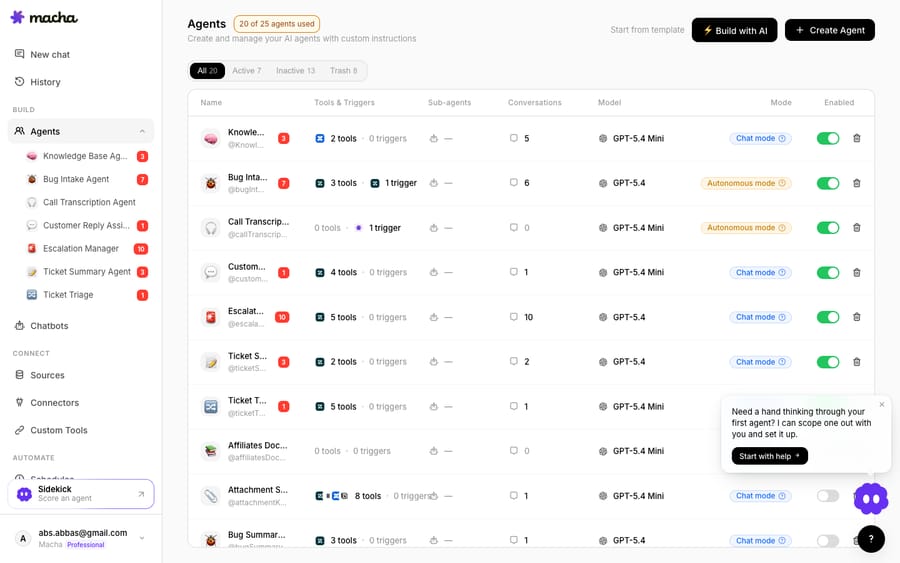
The agents above are Macha demo-org agents demonstrating these shared-inbox capabilities — a Knowledge Base agent for grounded drafts, a Ticket Triage agent, an Escalation Manager — each with its own tools, triggers, model, and mode. They illustrate the playbook, not a live Front conversation.
3. Triage and tag
What Front does natively. Front automatically analyzes conversations to create Topics and organize them, and Copilot can summarize long threads — both genuinely handy for a busy shared inbox. Rules then tag on keyword matches for reporting.
Where AI goes further. Topic-based tagging is broad; an agent can tag on the dimensions that actually drive workflow — intent, urgency, and sentiment together — and do it consistently across every channel feeding the inbox. Instead of "this thread mentions 'refund,'" you get "billing dispute, high urgency, frustrated tone" applied the same way every time, which is what makes downstream routing and reporting trustworthy.
4. VIP escalation
What Front does natively. A rule can watch for a domain or a tag and @mention a manager. Deterministic, reliable, and a fine safety net for known accounts.
Where AI goes further. The escalations that hurt are the ones a rule can't see coming — a normally-calm customer whose tone just turned, a sales lead asking about enterprise pricing, a churn-risk signal buried in paragraph three. An agent reads for those signals and escalates on judgment, mentioning the right person before the conversation goes cold. For teams building this end to end, how to build an AI agent for Front covers the setup.
5. Follow-up and close-the-loop
What Front does natively. Delayed rules — Unreplied after, Unassigned after — are Front's built-in nudges, and they're great at catching threads that stall on your side.
Where AI goes further. A time-based nudge is blind to content. An agent can decide whether a follow-up is even warranted, draft a context-aware nudge ("still waiting on that screenshot to finish your refund"), and close conversations that are clearly resolved — so your open count reflects real work, not stale threads.
The honest part: native Front AI, credited fairly
Front's AI is good, and it's fair to say so. Autopilot is a capable agent for end-to-end workflows — quote requests, scheduling, intake — with escalation controls built in. Copilot / AI Compose genuinely speeds up drafting, tone, summarizing, and translation. Smart QA reviews all your tickets rather than a manual sample, which is a real quality-assurance upgrade. If native features cover your needs, use them.
Two things to go in with your eyes open on. First, AI Answers is discontinued — Front's own help center states plainly that "AI Answers is no longer available for purchase" and points you to Autopilot Resolve instead (AI Answers legacy notice). If you built on AI Answers, that's a migration. Second, the billing model. Most of Front's AI is priced as per-seat add-ons on top of your plan, and the agent piece is metered:
| Front AI capability | How it's billed (annual) |
|---|---|
| Plan (Professional) | ~$65 / seat / mo, up to 20 rules |
| Plan (Enterprise) | ~$105 / seat / mo, unlimited rules, advanced AI included |
| Autopilot (AI agent) | Starting at ~$0.05 / conversation |
| Copilot / AI Compose | ~$20 / seat / mo add-on (included in Enterprise) |
| Smart QA | ~$20 / seat / mo add-on (included in Enterprise) |
| Smart CSAT | ~$10 / seat / mo add-on |
Source: Front's pricing page. The nuance worth naming: a per-conversation or per-resolution meter charges you a flat unit whether the AI did one small thing or ran a five-step workflow — and it's easy to under-model at volume. It's also worth reading Front's tiers closely, because the rule caps (10 on Starter, 20 on Professional) mean a rules-heavy automation strategy runs into a ceiling; Front pricing explained lays out where each capability unlocks.
Where Macha fits — the AI agent layer on top of Front
Macha is the AI agent layer that runs on top of the Front you already use through the Macha–Front connector — it is not a replacement for Front, your shared inboxes, your rules, or your teammates. You keep Front as your collaborative hub; Macha adds agents that read conversations, understand intent, ground answers in your knowledge base, pull live data through custom tools, and act with the same guardrails you'd expect. The broader category of AI agents for customer service exists precisely for the reasoning work a keyword rule structurally can't do.
The pricing difference is deliberate and honest: Macha's credits are consumed per AI action — per drafted reply, per lookup, per classification — never per resolution. Macha does automation and orchestration; outcomes vary by conversation, so it prices the work the agent does, not a claimed outcome. If you want to wire it up, connecting Front to Macha to route conversations to AI walks through the setup step by step.
The clean division of labour: let Front rules and native AI be the fast, deterministic layer, and layer Macha's agents on top for the reasoning-heavy automations — grounded drafts, intent-based routing, judgment-based escalation — that turn a routed conversation into a resolved one.
FAQ
What are the best AI automations to set up in Front first? Start with five that map to real shared-inbox traffic: auto-route by intent, KB-grounded drafts, triage-and-tag by intent/urgency/sentiment, VIP escalation, and follow-up/close-the-loop. Each has a native Front path (rules, Autopilot, Copilot) and a place where an AI agent layer adds reasoning.
Does Front have a native AI agent? Yes — Autopilot is Front's AI agent for end-to-end workflows, and Copilot / AI Compose assists with drafting, tone, summarizing, and translation. Note that the older AI Answers feature is discontinued and no longer available for purchase; Front points you to Autopilot Resolve instead.
How is Front's AI billed? Mostly as per-seat add-ons on top of your plan — Copilot and Smart QA at roughly $20/seat/mo (included in Enterprise), Smart CSAT at ~$10/seat/mo — while Autopilot is metered, "starting at $0.05/conversation." Check Front's pricing page for current figures.
Can I add an AI agent to Front without replacing it? Yes. Macha is an AI agent layer that connects to Front as a live connector and runs on top of your existing inboxes and rules — it doesn't replace them. Your rules keep routing and tagging; Macha's agents read the conversation, ground a reply in your knowledge base, and act.
How does Macha's pricing differ from per-resolution AI? Macha's credits are consumed per AI action — each draft, lookup, or classification — not per resolution. Because automation and orchestration produce varying outcomes, Macha prices the work the agent performs rather than a claimed result.
Ready to turn "routed and tagged" into "actually answered" in your Front inbox? Start a free trial of Macha and connect it to Front in minutes.
Add AI agents to your Front
Macha reads the conversation, drafts the reply and takes the action, inside the Front you already run.